The Mist of Avalon Myth Meaning & Symbolism
A sacred isle shrouded in mist, accessible only to the worthy, where the wounded king seeks healing from the goddess of the land.
The Tale of The Mist of Avalon
Listen, and let the fire’s glow dim. Let [the world](/myths/the-world “Myth from Tarot culture.”/) of stone and field fall away. We travel now to the time between times, to the edges of the map where the land bleeds into [water](/myths/water “Myth from Chinese culture.”/) and water into sky.
There was a king, a great and wounded king. His name was Arthur, but his title was a hollow crown. A grievous blow had been struck, a wound that festered not just in his side but in the soul of the land itself. The Sovereignty was bleeding. The seasons stuttered. The once-bright court of Camelot grew silent, its colors leaching into grey.
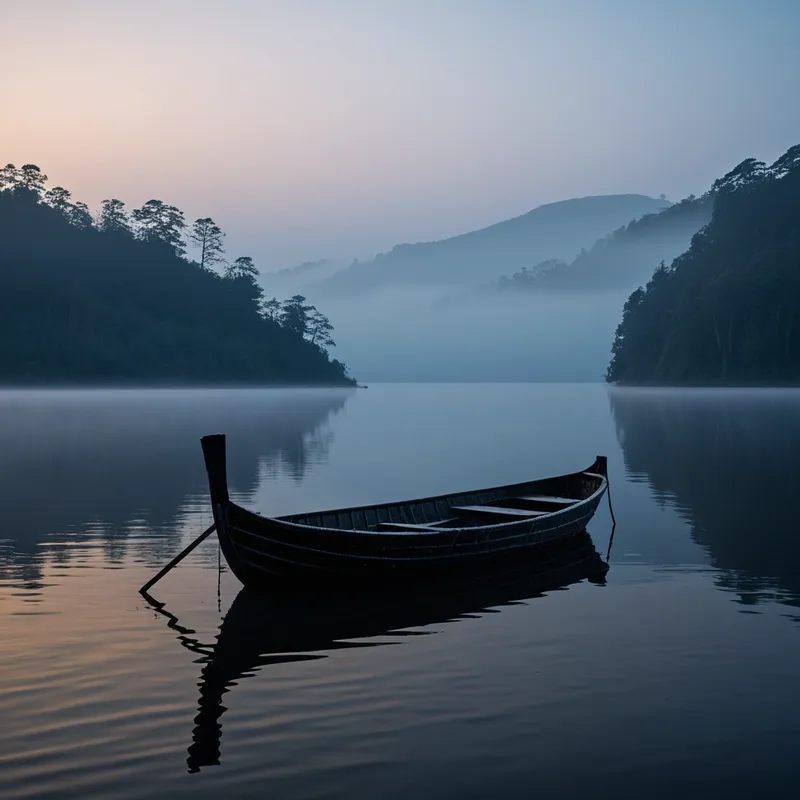
In this twilight, the king’s few remaining loyal ones—the sorrowful [Morgan le Fay](/myths/morgan-le-fay “Myth from Celtic culture.”/) and the steadfast Sir Bedivere—prepared a boat of wicker and hide. No grand vessel this, but a coracle, a shell upon the water. They laid the king upon a litter of cloaks, his breath shallow as a winter stream. “Where do we go?” whispered Bedivere. Morgan, her eyes holding the depth of still pools, pointed westward, where the sun drowned each night. “To the place that is not a place. To the Isle of Avalon.”
And so they pushed into the water, into the embrace of [the mist](/myths/the-mist “Myth from Celtic culture.”/). It rose from the lake not as weather, but as a living veil—thick, cool, and tasting of peat and apple blossom. Sounds died. The world contracted to the lap of water against hide and the king’s ragged breath. Time unspooled. Was it an hour? A night? A year? In the mist, all measures are lost.
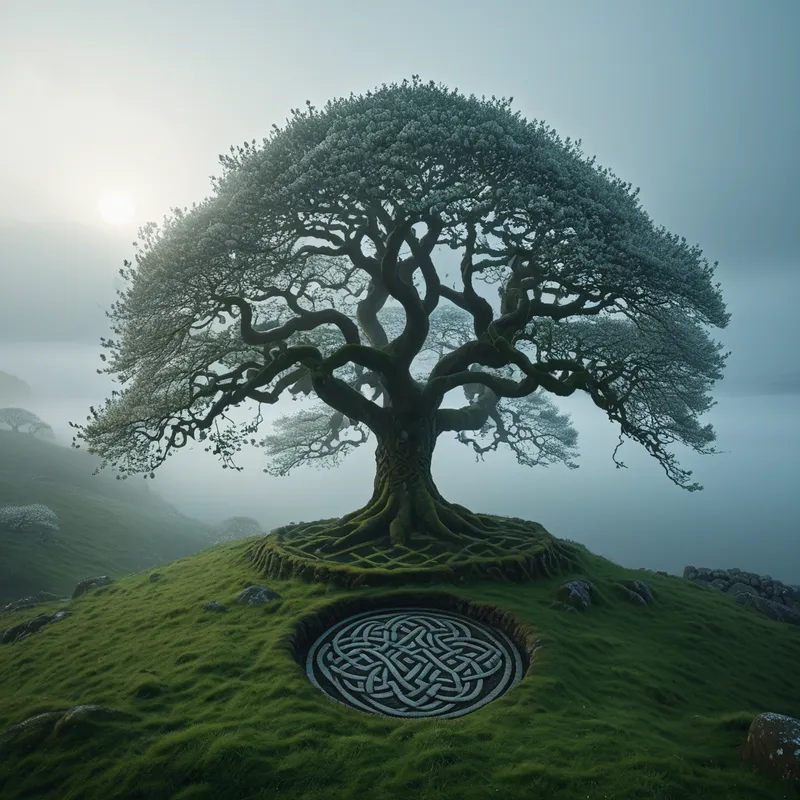
Then, a shift. The air grew sweeter, warmer. The mist, as if by a conscious will, began to thin and part like a curtain. And there it was: an island of impossible green, rising from the silver water. Ancient apple trees, heavy with white blossom and golden fruit, lined its shores. A gentle, sourceless light glowed from its heart. No fortress stood there, no towers of stone. Only low, rounded hills and sacred springs that whispered as they flowed.
Figures emerged from the orchards—women in robes the color of dawn and twilight. Their faces were serene, ageless. They were the Nine Sisters. Without a word, they took the litter from the boat. Their hands, cool as river stones, touched the king’s fevered brow. They bore him away, into the heart of the isle, into a bower where the air itself seemed to hum with a song of healing.
And the mist, having granted passage, closed once more behind them. To Bedivere, left standing on the shore of the world, the Isle was gone. Only the vast, mist-covered lake remained, holding its secret. The king was gone from the world of men. He rested now in the land of eternal apple blossom, where time is a circle and wounds are undone, waiting for the hour when the land might call him forth again.
Cultural Origins & Context
The tale of Avalon is not a single, codified myth from a singular “Celtic” source, but a powerful confluence of strands from the Celtic [otherworld](/myths/otherworld “Myth from Celtic culture.”/) tradition, later refined in the medieval Arthurian romances. The core concept—an island of healing and eternal youth shrouded in mist and accessible only to the chosen or the pure—is profoundly Celtic. It echoes the [Tír na nÓg](/myths/tr-na-ng “Myth from Celtic culture.”/), the Annwn, and the many [sídhe](/myths/sdhe “Myth from Celtic / Irish culture.”/) mounds that dot the landscape.
Originally, these stories were the province of the fili and bards, told in chieftains’ halls to explain the mysterious relationship between the sovereign and the land. The wounded king and the blighted land are classic Celtic motifs, emphasizing the sacred contract between ruler and realm. Avalon, as the place where this contract is restored, functions as a deep cultural “immune system”—a mythological space where societal and spiritual decay can be halted and reversed. It was passed down not as history, but as a resonant truth about the nature of sovereignty, sacrifice, and the thin veil between the human world and the world of spirit.
Symbolic Architecture
At its [heart](/symbols/heart “Symbol: The heart symbolizes love, emotion, and the core of one’s existence, representing deep connections with others and self.”/), the Mist of [Avalon](/symbols/avalon “Symbol: A mythical island from Arthurian legend, often representing a spiritual paradise, eternal rest, or a place of healing and transformation.”/) is a supreme [symbol](/symbols/symbol “Symbol: A symbol can represent an idea, concept, or belief, serving as a powerful tool for communication and understanding.”/) of the liminal. It is not a [wall](/symbols/wall “Symbol: Walls in dreams often symbolize boundaries, protection, or obstacles in one’s life, reflecting the dreamer’s feelings of confinement or security.”/), but a [veil](/symbols/veil “Symbol: A veil typically symbolizes concealment, protection, and transformation, representing both mystery and femininity across cultures.”/); not a [barrier](/symbols/barrier “Symbol: A barrier symbolizes obstacles, limitations, and boundaries that prevent progression in various aspects of life.”/) of denial, but a threshold of qualification.
The mist does not hide the island from the world; it hides the world from the island. It is the psyche’s filter, allowing only that which is ripe for transformation to pass.
The wounded [king](/symbols/king “Symbol: A symbol of ultimate authority, leadership, and societal order, often representing the dreamer’s inner power or external control figures.”/) represents the conscious ego, the ruling principle that has been shattered by [life](/symbols/life “Symbol: The symbol of ‘Life’ represents a journey of growth, interconnectedness, and existential meaning, encompassing both the joys and challenges that define human experience.”/)’s battles. His incurable wound is the complex, the neurosis, the core [trauma](/symbols/trauma “Symbol: A deeply distressing or disturbing experience that overwhelms the psyche, often manifesting in dreams as unresolved emotional wounds or psychological injury.”/) that the ordinary world cannot heal. The [journey](/symbols/journey “Symbol: A journey in dreams typically signifies adventure, growth, or a significant life transition.”/) across the [water](/symbols/water “Symbol: Water symbolizes the subconscious mind, emotions, and the flow of life, representing both cleansing and creation.”/) is the descent into the unconscious. The coracle is the fragile [vessel](/symbols/vessel “Symbol: A container or structure that holds, transports, or protects something essential, representing the self, emotions, or life journey.”/) of [intention](/symbols/intention “Symbol: Intention represents the clarity of purpose and direction in one’s life and can symbolize motivation and commitment within a dream context.”/) that carries us into that unknown.
Avalon itself is the archetypal symbol of [the Self](/myths/the-self “Myth from Jungian culture.”/)—the wholeness and healing center of the [psyche](/myths/psyche “Myth from Greek culture.”/), often imagined as a [temenos](/myths/temenos “Myth from Greek culture.”/) or sacred precinct. It is the inner sanctuary where the conflicts of the outer world are resolved. The Nine Sisters are the integrative, nurturing, and wise aspects of the [psyche](/myths/psyche “Myth from Greek culture.”/) (the [anima](/symbols/anima “Symbol: The feminine archetype within the male unconscious, representing soul, creativity, and connection to the inner world.”/), in Jungian terms, or the functions of [consciousness](/symbols/consciousness “Symbol: Consciousness represents the state of awareness and perception, encompassing thoughts, feelings, and experiences.”/) in [harmony](/symbols/harmony “Symbol: A state of balance, agreement, and pleasing combination of elements, often associated with musical consonance and visual or social unity.”/)) that perform the healing. The ever-blooming [apple](/symbols/apple “Symbol: An apple symbolizes knowledge, temptation, and the duality of good and evil, often representing the pursuit of wisdom with potential consequences.”/) [tree](/symbols/tree “Symbol: In dreams, the tree often symbolizes growth, stability, and the interconnectedness of life.”/) is the symbol of eternal life, wisdom, and the sacred [fruit](/symbols/fruit “Symbol: Fruit symbolizes abundance, nourishment, and the fruits of one’s labor in dreams.”/) of introspection that heals the wounds of time.
The Dreamer’s Resonance
When this myth stirs in the modern dreamer, it signals a profound somatic and psychological crossroads. To dream of a dense, impenetrable mist often accompanies feelings of confusion, depression, or a life transition where the path forward is utterly obscured. The body may feel heavy, directionless.
Dreaming of finding a boat or being in a boat on still water suggests the unconscious mobilization of resources for a journey inward. The appearance of a guiding, often feminine, figure (a healer, an unknown woman, Morgan) points to the awakening of the nurturing, intuitive function needed for this passage.
Most critically, dreaming of glimpsing or arriving at a beautiful, peaceful island amidst the mist signifies that the psyche is ready for—and is actively initiating—a deep process of healing. It is the unconscious affirming, “The sanctuary exists. You are approaching it.” The somatic feeling upon this dream-image is often one of immense relief, a release of held breath, a warmth in the chest. It is the body recognizing the possibility of wholeness before the mind can articulate it.

Alchemical Translation
The myth of Avalon is a perfect map for the alchemical process of individuation, the psychic transmutation of leaden suffering into golden consciousness.
[The first stage](/myths/the-first-stage “Myth from Alchemical culture.”/), [nigredo](/myths/nigredo “Myth from Alchemical culture.”/) (the blackening), is the wounding of the king and [the wasteland](/myths/the-wasteland “Myth from Arthurian culture.”/). It is the necessary crisis, the acknowledgment that one’s current mode of being is terminally ill. The journey into the mist is the albedo (the whitening), the purification. It is the surrender of ego control, the allowing of oneself to be lost, to be guided by something other than the will. The mist dissolves old certainties.
The healing in Avalon is not a cure, but a transmutation. The wound is not removed; it is alchemized into a vessel for wisdom.
Arrival at Avalon and the tender care of the Sisters represents the citrinitas (the yellowing), the dawning of a new, illuminating understanding of one’s own nature. The king does not simply recover; he is remade in the context of the sacred. He integrates his wound into his story.
Finally, the mist closing, leaving the king within, symbolizes the [rubedo](/myths/rubedo “Myth from Alchemical culture.”/) (the reddening), the completion. The healed Self does not necessarily return to the old world in its old form. A part of the psyche must remain in that sacred, timeless space—integrated but distinct—to sustain the wholeness. For the modern individual, this translates to carrying the wisdom and peace of Avalon within while engaging with the world. One becomes the island in the mist, a centered Self from which to act, no longer a wounded king reacting to a blighted land. The quest is not to find Avalon once, but to learn its song, so you may summon its mist whenever the world grows too solid, and your soul requires the healing of the apple blossom.
Associated Symbols
Explore related symbols from the CaleaDream lexicon: