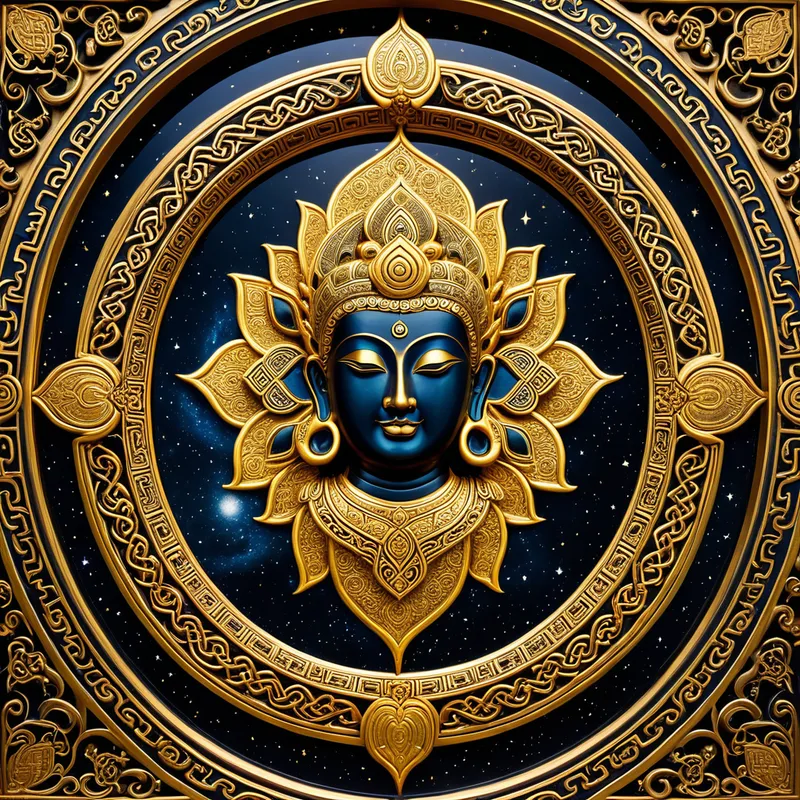
The Mirror of Wisdom Myth Meaning & Symbolism
A myth of a celestial mirror that reveals not the world, but the true nature of the mind that perceives it, challenging all who gaze within.
The Tale of The Mirror of Wisdom
In a time when the mountains were young and the rivers sang with the voices of forgotten gods, there existed a realm known as the Sukhāvatī. It was a place of tranquil light, where the air hummed with the silent mantra of existence. At its heart, in a pavilion woven from moonlight and [lotus](/myths/lotus “Myth from Hindu culture.”/) stems, rested the [Mirror of Wisdom](/myths/mirror-of-wisdom “Myth from Buddhist culture.”/).
It was not a mirror of silver or glass, but of a substance like solidified sky, framed by the Śrīvatsa and tongues of golden flame. It did not show the face of the one who stood before it. It showed nothing they expected.
A great king, mighty and proud, heard of this mirror. He journeyed for lifetimes, crossing deserts of doubt and oceans of desire, seeking [the mirror](/myths/the-mirror “Myth from Various culture.”/) that promised ultimate truth. He stood before it, clad in jewels, expecting to see the visage of a universal monarch. The mirror’s surface swirled like milk in tea, and showed him instead a beggar, frail and clinging to a crust of bread. The king cried out in rage, “This is a lie!” But as he stared, he felt the gnawing hunger in his own belly, the profound poverty of a soul that knows only taking.
A renowned scholar, whose mind contained ten thousand scriptures, approached next. He sought the reflection of his impeccable understanding. The mirror clouded, then cleared to reveal a child’s wooden top, spinning wildly on a stone floor—a mind forever chasing its own tail, active but going nowhere. The scholar’s certainty turned to ash in his mouth.
Then came a young woman, a weaver from a humble village, who had come with no quest for glory or knowledge, but with a simple, aching heart. She had lost her child to a fever, and her grief was a vast, silent ocean. She stood before the mirror, tears tracing paths through the dust on her cheeks. She did not ask for anything.
The mirror did not swirl or cloud. It grew still, deep as a midnight pool. It did not show her the face of her lost child. It showed her the village well at dawn, the spiderweb jeweled with dew in her own doorway, the patient ox in its stall. It showed the endless, interconnected tapestry of life and death, not as a philosophy, but as a felt truth. In that reflection, she saw her grief not as a separate, private agony, but as one thread in the vast, compassionate weave of [the world](/myths/the-world “Myth from Tarot culture.”/). She did not see her face, but she saw her place. And in that seeing, the ocean of grief did not vanish, but became [water](/myths/water “Myth from Chinese culture.”/) she could drink. She bowed, her heart a broken-open lotus, and the mirror’s surface shimmered with a light that seemed to bow in return.

Cultural Origins & Context
The motif of the Mirror of Wisdom is not a single, codified myth from a specific [sutra](/myths/sutra “Myth from Hindu culture.”/), but a pervasive archetype woven through Dharma literature and avadāna. It finds one of its most potent expressions in the metaphor of the Dzogchen tradition, where the nature of mind is described as a “mirror-like wisdom” (Ādarśa-jñāna). This mirror does not judge, distort, or hold onto images; it simply reflects with perfect, empty clarity.
The tale was passed down by monks and wandering yogis, not merely as entertainment, but as a upāya, a skillful means. It was told around evening fires to pilgrims, used in meditation instruction, and depicted in temple murals. Its societal function was subversive and therapeutic: to deconstruct the viewer’s most cherished identities—the ruler, the scholar, the griever—and point toward the unconditioned ground of being that lies beneath all roles and stories. It served as a narrative gateway to the profound teaching of anātman.
Symbolic Architecture
The Mirror is the ultimate [symbol](/symbols/symbol “Symbol: A symbol can represent an idea, concept, or belief, serving as a powerful tool for communication and understanding.”/) of pure, non-dual [awareness](/symbols/awareness “Symbol: Conscious perception of self, surroundings, or internal states. Often signifies awakening, insight, or heightened sensitivity.”/). It is not an object within [consciousness](/symbols/consciousness “Symbol: Consciousness represents the state of awareness and perception, encompassing thoughts, feelings, and experiences.”/), but a [metaphor](/symbols/metaphor “Symbol: A figure of speech where one thing represents another, often revealing hidden connections and deeper truths through symbolic comparison.”/) for consciousness itself in its primordial state.
The Mirror does not show you what you are. It shows you what you think you are, so that you may see the thinker.
The proud [king](/symbols/king “Symbol: A symbol of ultimate authority, leadership, and societal order, often representing the dreamer’s inner power or external control figures.”/) sees a [beggar](/symbols/beggar “Symbol: A symbol representing vulnerability, need, and social inequality, often reflecting the dreamer’s feelings of lack, dependence, or neglected aspects of self.”/)—the [reflection](/symbols/reflection “Symbol: Reflection signifies self-examination, awareness, and the search for truth within oneself.”/) of his own inner [poverty](/symbols/poverty “Symbol: A state of lacking material resources or essential needs, often symbolizing feelings of inadequacy, vulnerability, or spiritual emptiness in dreams.”/), his spiritual [hunger](/symbols/hunger “Symbol: A primal bodily sensation symbolizing unmet needs, desires, or emotional voids. It represents craving for fulfillment beyond physical nourishment.”/) masked by [material](/symbols/material “Symbol: Material signifies the tangible aspects of life, often representing physical resources, desires, and the physical world’s influence on our existence.”/) [wealth](/symbols/wealth “Symbol: Wealth in dreams often represents abundance, security, or inner resources, but can also symbolize burdens, anxieties, or moral/spiritual values.”/). The scholar sees a spinning top—the [image](/symbols/image “Symbol: An image represents perception, memories, and the visual narratives we create in our minds.”/) of his intellectual saṃsāra, [perpetual motion](/symbols/perpetual-motion “Symbol: Perpetual motion symbolizes the endless pursuit of goals, embodying a sense of continuous activity and effort towards fulfillment.”/) without liberation. Their projections are thrown back at them, not as insults, but as precise diagnoses. The mirror reveals the [shadow](/symbols/shadow “Symbol: The ‘shadow’ embodies the unconscious, repressed aspects of the self and often represents fears or hidden emotions.”/) cast by the light of their constructed selves.
The grieving [mother](/symbols/mother “Symbol: The symbol of ‘Mother’ represents nurturing, protection, and the foundational aspect of one’s emotional being, often associated with comfort and unconditional love.”/)’s experience is different because she approaches not from a place of egoic fortification, but of egoic [dissolution](/symbols/dissolution “Symbol: The process of breaking down, dispersing, or losing form, often representing transformation, release, or the end of a state of being.”/) (her [grief](/symbols/grief “Symbol: A profound emotional response to loss, often manifesting as deep sorrow, yearning, and a sense of emptiness.”/) has already shattered her smaller self). The mirror meets her at that level of openness, reflecting not a fragmented [identity](/symbols/identity “Symbol: Identity represents the sense of self, encompassing personal beliefs, cultural background, and social roles.”/), but the interconnected whole. She sees the [pratītyasamutpāda](/myths/prattyasamutpda “Myth from Buddhist culture.”/)—dependent origination—in the intimate details of her world. The mirror’s wisdom here is the wisdom of [compassion](/symbols/compassion “Symbol: A deep feeling of empathy and concern for others’ suffering, often involving a desire to help or alleviate their pain.”/) (maitrī), showing her that her personal sorrow is part of the universal fabric of feeling.
The Dreamer’s Resonance
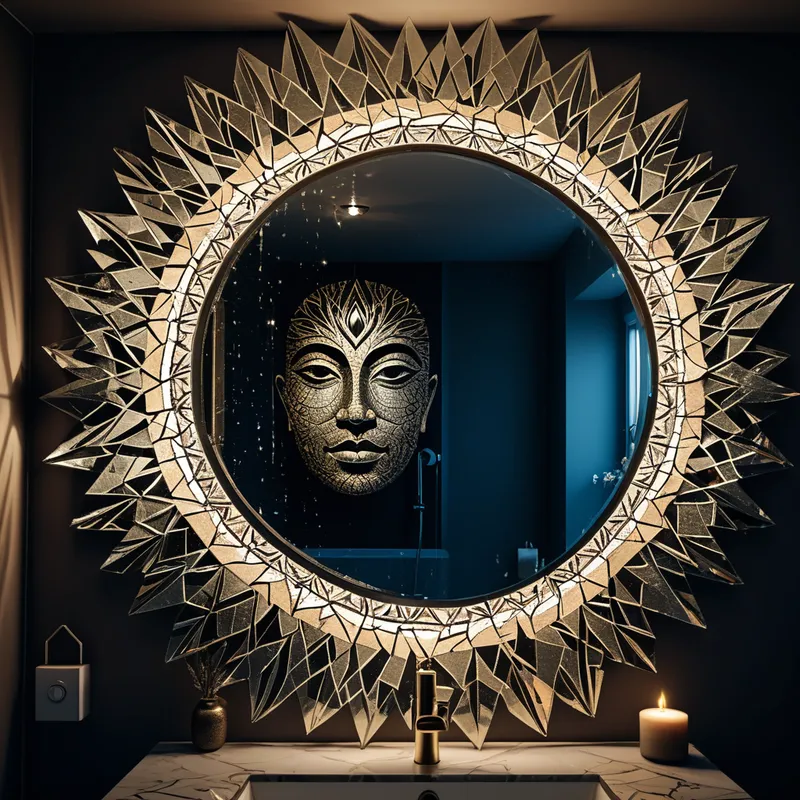
When this myth stirs in the modern [psyche](/myths/psyche “Myth from Greek culture.”/), it often manifests in dreams of mirrors. But these are never ordinary mirrors. They are mirrors that change what they reflect based on the dreamer’s inner state. One might dream of a mirror that reflects a childhood version of themselves, or a monstrous shadow, or a being of radiant light. The critical somatic experience is the feeling in the gut upon seeing the reflection—the shock of the king, the confusion of the scholar, the poignant release of the weaver.
This dream signals a moment of profound self-confrontation. The psyche is offering up a reflection of a complex, an ignored aspect of [the Self](/myths/the-self “Myth from Jungian culture.”/), or a core identification that is ready to be examined. The dreamer is standing before their own internal Mirror of Wisdom. The conflict is between [the ego](/myths/the-ego “Myth from Jungian culture.”/)’s narrative (“I am this”) and the soul’s truth (“You are also that”). The psychological process is one of dis-identification, where the dreamer is invited to step back from the content of the reflection (the beggar, [the child](/myths/the-child “Myth from Alchemy culture.”/), the monster) and recognize themselves as the space in which the reflection appears.
Alchemical Translation
The myth models the alchemical opus of individuation—the journey from a leaden, identified state to a golden, conscious wholeness. The first step, embodied by the king and scholar, is the [nigredo](/myths/nigredo “Myth from Alchemical culture.”/), the blackening. It is the confrontation with [the shadow](/myths/the-shadow “Myth from Jungian culture.”/), the humbling of the [persona](/myths/persona “Myth from Greek culture.”/). The mirror forces the “I” to see what it has rejected or ignored. This is a necessary death of illusion.
The weaver’s journey represents the albedo, the whitening, and the subsequent stages. Her willingness to feel her grief fully, without defense, is the dissolution of the ego in the waters of emotion. The mirror then reflects not a fragment, but a pattern of relationship. This is the integration of the shadow into a larger context.
The ultimate alchemy is not changing what you see in the mirror, but realizing you are the mirror itself—the luminous, empty capacity that holds all images without being defined by any of them.
For the modern individual, the “Mirror of Wisdom” is any life situation, relationship, or inner crisis that ruthlessly reflects back our unconscious patterns. A failed project mirrors our hidden fears of inadequacy. A conflict mirrors our unhealed wounds. The alchemical work is to cease blaming the mirror (the outer circumstance) and to have the courage to gaze deeply into what it reveals. The [triumph](/myths/triumph “Myth from Roman culture.”/) is not in achieving a perfect reflection, but in attaining sampajañña—the wisdom that knows the seeing, the seen, and the seer as a seamless, luminous event. In that realization, the seeker, the mirror, and the reflection are understood to have never been separate.
Associated Symbols
Explore related symbols from the CaleaDream lexicon: