The Mirror of the Heart Myth Meaning & Symbolism
A celestial mirror reveals the true, unadorned self, challenging a soul to accept its own pure essence beyond all worldly masks and desires.
The Tale of The Mirror of the Heart
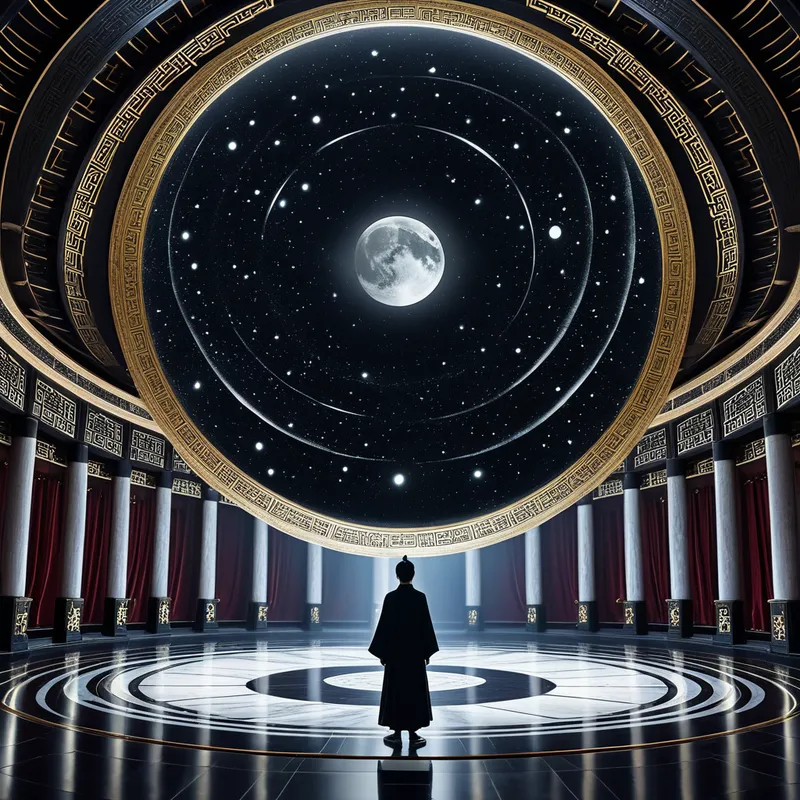
In the age when the mountains were still young and the rivers sang with the voices of dragons, there existed a hall not of earth, nor of heaven, but in the liminal space between breaths. This was the Kunlun, and within its deepest chamber, veiled by the sigh of creation and the silence before thought, hung the Mirror of the Heart.
It was said the mirror was forged from the first tear of compassion shed by the Mother of the West, Xi Wangmu, when she witnessed the suffering of sentient beings lost in their own illusions. Its frame was the unbreakable void, and its surface was the stillest water at the universe’s dawn.
To this hall came a seeker named Lin, whose soul was a tapestry of achievements and regrets. He had mastered the arts of the inner elixir, commanded respect, and accumulated wisdom, yet a hollow wind whistled through the chambers of his spirit. He had heard the whisper: to look into the Mirror was to know the truth of oneself, beyond the stories told to the world and the lies whispered in the dark.
The journey to the chamber was an unraveling. The path was not stone, but the thinning of his own certainties. The air grew cold with the absence of pretense. When he finally stood before it, the Mirror did not show the proud sage he believed himself to be. It showed no image at all at first—only a depth like a well leading to the core of a star.
Then, the reflection began.
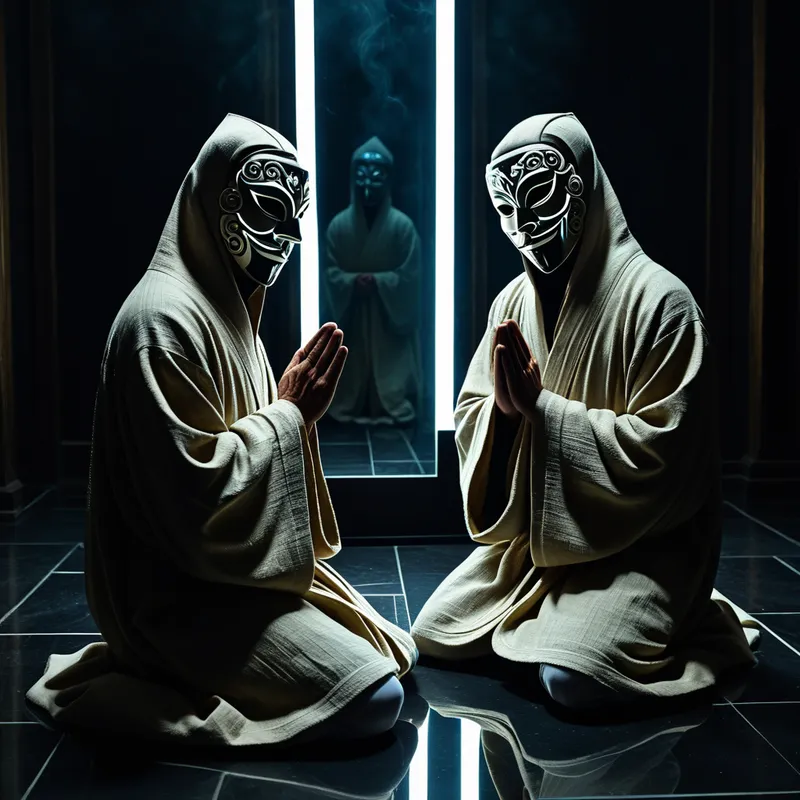
It was not his face, but a procession of faces. He saw the dutiful son, the mask worn to please a stern father. It melted like wax. He saw the fierce scholar, the armor of knowledge forged in rivalry. It cracked and fell away. He saw the benevolent teacher, the role played for admiration. It dissolved into mist. Layer after layer, persona after persona, each constructed with care and fear, was stripped bare before that silent, merciless silver.
What remained was not a hero, nor a monster. It was a essence, fragile as a new leaf yet ancient as stone—a being of pure, undecorated awareness. It was him, the Lin before the world had written upon him. In that raw presence, he felt a terror more profound than any demon, for it was the terror of his own insignificance and his own absolute divinity, intertwined. He wanted to flee, to rebuild the familiar masks, but the Mirror held him in its gaze.
The conflict was not with a beast, but with the scream of his own ego dissolving. The resolution came not with a battle cry, but with a sigh—the last exhalation of resistance. As he accepted the naked reflection, the Mirror did not change. He did. The hollow wind in his spirit ceased. The reflection and the reflector became one. The chamber, the Mirror, and Lin were no longer separate. They were simply what is, and in that, he found the peace that the world of forms could never give or take away.
Cultural Origins & Context
The motif of the Mirror of the Heart, while not a singular, codified myth from a specific text, is a profound archetype woven through Taoist mystical thought, Chán Buddhism, and later Chinese folk religion. Its roots tap into the ancient Chinese concept of xin and the Taoist pursuit of ziran.
It was transmitted not as a epic tale with a fixed plot, but as a parable told by masters to disciples in meditation halls and alchemical laboratories. A Daoshi might speak of it when a student became attached to their progress in meditation, mistaking spiritual vanity for enlightenment. Its societal function was deeply subversive to Confucian hierarchies of role and status; it served as a direct, internalizing tool to deconstruct the social self—the self defined by family duty, profession, and reputation—and point toward the unconditioned, authentic self aligned with the Tao.
Symbolic Architecture
The myth’s power lies in its stark, uncompromising symbolism. The Mirror itself is the ultimate symbol of consciousness devoid of judgment.
The Mirror does not judge; it only reveals. It is the Wuji of perception.
The hall in Kunlun represents the inner sanctum of the psyche, the sacred space one must courageously enter to engage in true self-work. The peeling away of masks is the process of withdrawing projections and confronting the personal shadow. The final, essential reflection is the Self, what Taoists might call the yuanshen, or original spirit.
The terror Lin experiences is the death of the ego-identity, a necessary “small death” for psychic rebirth. The myth teaches that authenticity is not about building a better, shinier persona, but about the courageous dissolution of all personas to stand in the naked, unadorned truth of one’s being.
The Dreamer’s Resonance
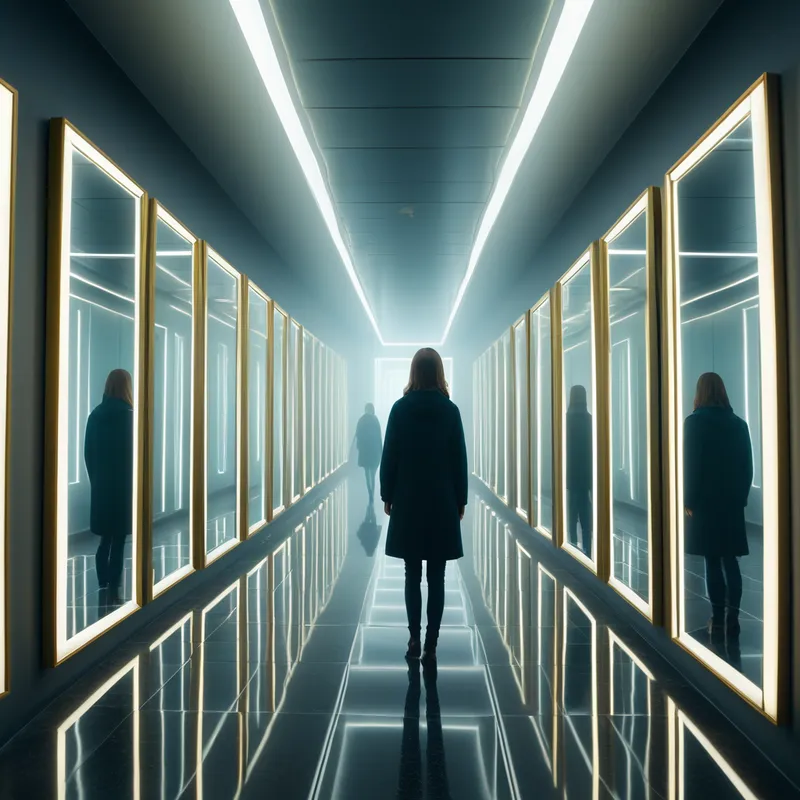
When this myth activates in the modern dreamscape, it often manifests as dreams of mirrors that show distorted, frightening, or confusing reflections. One might dream of a mirror that shows them as a child, a stranger, or a monstrous form. These are not prophecies, but somatic revelations.
The psyche is signaling a critical moment of self-reckoning. The dreamer is likely at a life threshold—a career change, the end of a relationship, a midlife passage—where old identities are crumbling. The body may feel it as anxiety, a tightness in the chest (the heart center), or a profound sense of disorientation. The dream is the psyche’s attempt to conduct its own alchemy, using the symbol of the mirror to force a confrontation between the curated self presented to the world and the more complex, perhaps neglected, totality within. The discomfort is the friction of transformation.
Alchemical Translation
For the modern individual, the myth models the core of the individuation process: the nigredo or dark night of the soul, where all that was once certain is dissolved in the solvent of self-awareness.
The alchemical vessel is not a crucible of fire, but the silent, observing space of consciousness itself.
The journey is inward. The “master” one seeks is not an external guru, but one’s own capacity for honest self-reflection. The “art of the inner elixir” becomes the daily practice of noticing when we are speaking from a role (the parent, the professional, the victim) and gently inquiring what lies beneath.
The triumph is not an achievement to be displayed, but a state of being to be inhabited. It is the integration symbolized by the end of the myth, where seeker, mirror, and setting become one. Psychically, this is the realization that you are not the thoughts, emotions, or social identities that pass through you. You are the awareness in which they all arise and fall—the mirror itself. This is the ultimate transmutation: from identifying with the reflection to abiding as the clear, boundless space that holds it. In that space, action arises from ziran, not calculation, and one moves through the world not as a fragmented persona, but as a whole being in alignment with the unseen flow of the Tao.
Associated Symbols
Explore related symbols from the CaleaDream lexicon: