
The Mirror of Galadriel Myth Meaning & Symbolism
A goddess's enchanted basin reveals not the future, but the soul's hidden truths, demanding courage to face the reflection within.
The Tale of The Mirror of Galadriel
Listen, and let [the mist](/myths/the-mist “Myth from Celtic culture.”/) of [the Otherworld](/myths/the-otherworld “Myth from Celtic culture.”/) settle upon your mind. This is not a tale of swords clashing, but of the quiet, terrible clash within the soul. In the heart of the great forest of [Tír na nÓg](/myths/tr-na-ng “Myth from Celtic culture.”/), where time flows like honey, there dwelt the goddess Galadriel. Her dwelling was not a hall of stone, but a living bower woven from the silver branches of birch and the deep green sigh of ancient yew.
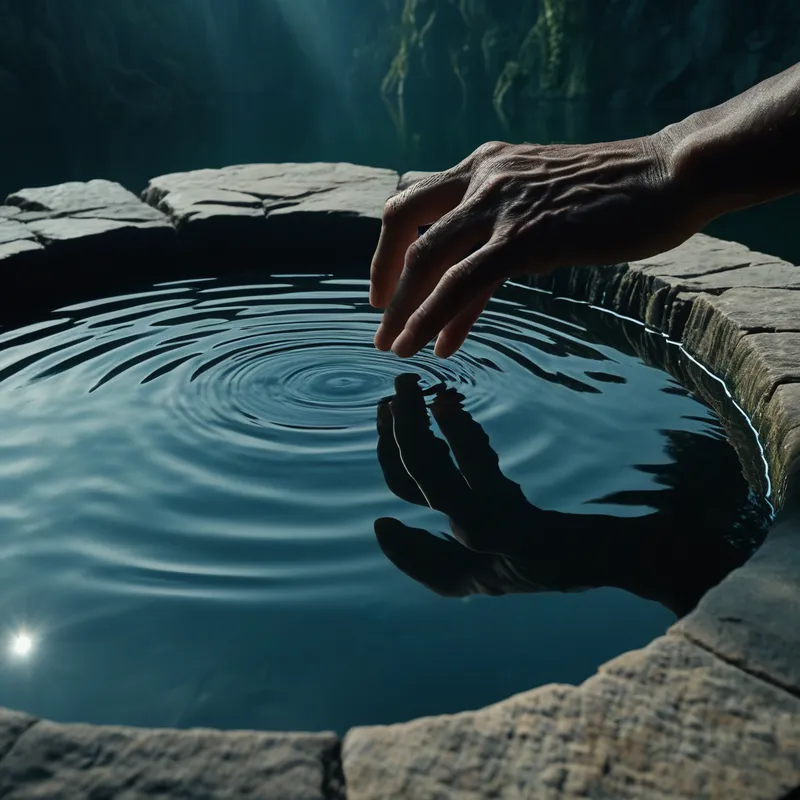
She was the keeper of a secret well, a basin carved from a single moon-pale stone, fed by a spring that bubbled up from the roots of [the world](/myths/the-world “Myth from Tarot culture.”/). This was no mere pool for thirst. Its waters were still as a held breath, deep as a starless night. They called it [the Mirror](/myths/the-mirror “Myth from Various culture.”/), but it showed no simple vanity. It showed what was, what might be, and what must be confronted.
One evening, as [the veil between worlds](/myths/the-veil-between-worlds “Myth from Celtic culture.”/) grew thin, a mortal hero, weary from a quest not yet complete, stumbled into her grove. He was a man of action, his hands calloused from the hilt of his sword, his mind clouded with the dust of roads and the shouts of battle. He sought a prophecy, a clear path to victory, a map of the future drawn in the stars.
Galadriel, her eyes holding the patience of deep [water](/myths/water “Myth from Chinese culture.”/), led him to the basin. “Many things I can command,” she whispered, her voice like wind through reeds, “but not this. The Mirror shows what it wills. Gaze, if your heart has the courage. It shows things that were, and things that are, and things that yet may come to pass.”
The hero knelt, his own tired face a pale ghost on the water’s skin. Then the image rippled and dissolved. He did not see armies arrayed for his [triumph](/myths/triumph “Myth from Roman culture.”/). He saw his own homeland, not in glory, but in flames, set by a treachery he had never suspected. He saw the face of his most trusted friend, twisted by a jealousy he had been blind to. He saw himself, not as a hero returning with spoils, but as an old, lonely man, haunted by the choices he was making now. The visions were not loud prophecies; they were silent, terrible truths, whispered from the depths of his own soul into the water.
He cried out and recoiled, wanting to shatter the stone, to flee the grove and its awful clarity. But Galadriel’s hand rested on his shoulder, a weight both gentle and immovable. “The Mirror does not lie,” she said. “But it does not command. To see is to be given a choice. The future it shows is but a branch on the tree of possibility, grown from the seed of your present heart.”
The hero left the grove not with a battle plan, but with a burden. The path before him was darker, for he now knew the shadows that walked beside him. Yet, in that darkness, a new kind of sight was born. He carried the Mirror within him.
Cultural Origins & Context
The motif of the prophetic, truth-revealing vessel is deeply woven into the Celtic mythological tapestry, though the specific name “Galadriel” is a later, literary conflation (most famously by J.R.R. Tolkien, who drew heavily on Celtic and Norse motifs). The archetype finds its purest Celtic expression in the Cauldron of [the Dagda](/myths/the-dagda “Myth from Celtic culture.”/), which never ran empty and could restore the dead, and in the countless [sacred wells](/myths/sacred-wells “Myth from Celtic culture.”/) and springs dedicated to goddesses of sovereignty and wisdom like Ériu or Brigid.
These waters were liminal spaces, portals to the [Otherworld](/myths/otherworld “Myth from Celtic culture.”/). The myth would have been transmitted by the Druids and filid, not as a simple story for entertainment, but as a teaching narrative. Its societal function was initiatory. It prepared the individual, especially those in leadership roles, for the burden of foresight and the necessity of ruthless self-honesty. In a culture that valued fate (geis) and the interconnected web of cause and effect, the myth taught that the most important battle is not against an external foe, but against one’s own ignorance and illusion.
Symbolic Architecture
The Mirror is the ultimate [symbol](/symbols/symbol “Symbol: A symbol can represent an idea, concept, or belief, serving as a powerful tool for communication and understanding.”/) of the [psyche](/myths/psyche “Myth from Greek culture.”/) itself. It is not a [window](/symbols/window “Symbol: Windows in dreams symbolize opportunities for insight, clarity, and a desire to connect with the outside world or one’s inner self.”/) to a predetermined future, but a reflective surface that reveals the contents and consequences of the unconscious.
The future you fear in the water is the shadow of the choice you are avoiding in the present.
The [water](/symbols/water “Symbol: Water symbolizes the subconscious mind, emotions, and the flow of life, representing both cleansing and creation.”/) represents the fluid, often murky [depths](/symbols/depths “Symbol: Represents the subconscious, hidden emotions, or foundational aspects of the self, often linked to primal fears or profound truths.”/) of the unconscious mind. The [stone](/symbols/stone “Symbol: In dreams, a stone often symbolizes strength, stability, and permanence, but it may also represent emotional burdens or obstacles that need to be acknowledged and processed.”/) [basin](/symbols/basin “Symbol: A vessel for holding water, symbolizing containment, cleansing, and the subconscious. It represents receptivity and emotional depth.”/) is the container of [consciousness](/symbols/consciousness “Symbol: Consciousness represents the state of awareness and perception, encompassing thoughts, feelings, and experiences.”/), [the ego](/myths/the-ego “Myth from Jungian culture.”/), which attempts to hold and give shape to these [depths](/symbols/depths “Symbol: Represents the subconscious, hidden emotions, or foundational aspects of the self, often linked to primal fears or profound truths.”/). Galadriel is the [archetype](/symbols/archetype “Symbol: A universal, primordial pattern or prototype in the collective unconscious that shapes human experience, behavior, and creative expression.”/) of the [Sophia](/myths/sophia “Myth from Gnostic culture.”/) or Wise Woman, the personification of [the Self](/myths/the-self “Myth from Jungian culture.”/) that guides [the ego](/myths/the-ego “Myth from Jungian culture.”/) toward [integration](/symbols/integration “Symbol: The process of unifying disparate parts of the self or experience into a cohesive whole, often representing psychological wholeness or resolution of internal conflict.”/). She does not interpret; she facilitates the confrontation.
The [hero](/symbols/hero “Symbol: A hero embodies strength, courage, and the ability to overcome significant challenges.”/)’s desire for a simple [prophecy](/symbols/prophecy “Symbol: A foretelling of future events, often through divine or supernatural means, representing destiny, fate, and hidden knowledge.”/) represents the ego’s craving for certainty and control. The terrifying, personal visions he receives are the [eruption](/symbols/eruption “Symbol: A sudden, violent release of pent-up energy or emotion from beneath the surface, often representing transformation or crisis.”/) of the [shadow](/symbols/shadow “Symbol: The ‘shadow’ embodies the unconscious, repressed aspects of the self and often represents fears or hidden emotions.”/) and the archetypal complexes that govern his [life](/symbols/life “Symbol: The symbol of ‘Life’ represents a journey of growth, interconnectedness, and existential meaning, encompassing both the joys and challenges that define human experience.”/) unbeknownst to him. The flame, the [betrayal](/symbols/betrayal “Symbol: A profound violation of trust in artistic or musical contexts, often representing broken creative partnerships or artistic integrity compromised.”/), the lonely old man—these are not fates, but symbolic expressions of the trajectory his current [psychology](/symbols/psychology “Symbol: Psychology in dreams often represents the exploration of the self, the subconscious mind, and emotional conflicts.”/) is creating.
The Dreamer’s Resonance
When this mythic pattern stirs in the modern dreamer, it signals a critical moment of psychic readiness. Dreaming of a mirror that shows a distorted, frightening, or prophetic image—be it a bathroom mirror, a pool of water, or a darkened window—is the soul’s equivalent of being led to Galadriel’s basin.
The somatic experience is often one of frozen awe, a chilling paralysis mixed with irresistible fascination. Psychologically, this is the process of assimilation breaking through denial. The dream-ego is being forced to “see” what it has refused to acknowledge: a hidden resentment festering in a relationship (the friend’s betrayal), a self-destructive pattern leading to a barren future (the lonely old man), or a repressed aspect of the personality that threatens to erupt (the burning homeland). The dream does not solve the problem; it presents the diagnosis with stark, symbolic clarity. The anxiety upon waking is the birth pang of a new consciousness struggling to integrate a painful but essential truth.

Alchemical Translation
The journey of the hero at the Mirror is a perfect model for the alchemical stage of [nigredo](/myths/nigredo “Myth from Alchemical culture.”/), the blackening, which precedes all true psychic transmutation.
The first step is Invitation: A life crisis, a persistent dream, or a deep dissatisfaction (the weary quest) leads the ego to [the threshold](/myths/the-threshold “Myth from Folklore culture.”/) of the unconscious ([the sacred grove](/myths/the-sacred-grove “Myth from Celtic culture.”/)). The second is Reflection: The ego gazes into the unconscious and sees not what it wants (a solution, a validation), but the unvarnished truth of its own condition—its shadow, its complexes, its probable future if left unchanged. This is the dissolution of illusion, the nigredo.
The Mirror’s gift is not knowledge of fate, but the searing freedom of responsibility. To see the shadow is to be given the chance to turn and face it, thereby altering the very light that casts it.
The third step is The Choice, which is the beginning of albedo. The hero can shatter the mirror (repression, psychosis, a return to ignorant action) or he can, as the myth implies, carry its reflection within him. To carry it is to accept the burden of consciousness. It is to make daily choices informed by that deeper sight, to integrate [the shadow](/myths/the-shadow “Myth from Jungian culture.”/), to mourn the betrayed trust, and to plant new seeds for a different future.
Thus, the myth of Galadriel’s Mirror is not about predicting destiny, but about forging it. The alchemical gold it promises is not victory in the world’s terms, but individuation—the state of being a whole, self-aware individual who acts not from blind impulse or fearful prophecy, but from the integrated wisdom of having faced what the mirror showed, and chosen to change.
Associated Symbols
Explore related symbols from the CaleaDream lexicon: