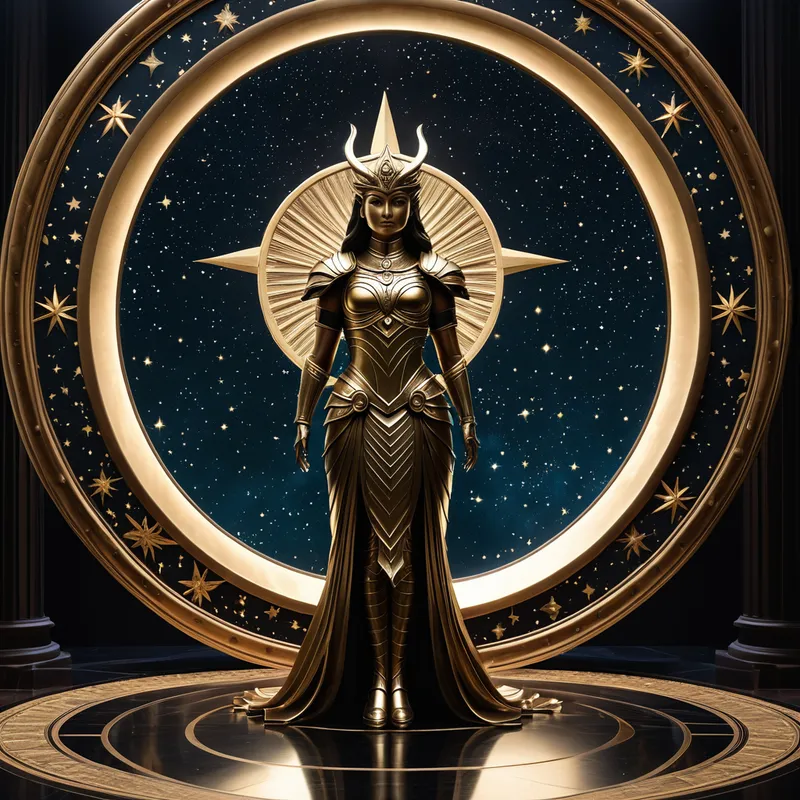
The Mirror of Athena Myth Meaning & Symbolism
A goddess confronts her own shadow in a divine mirror, forging wisdom not from victory, but from the terrifying grace of self-recognition.
The Tale of The Mirror of Athena
Listen, and hear a truth woven not in thread, but in the silver light of a moon that watches over all seekers. In the time before time was measured, when [the world](/myths/the-world “Myth from Tarot culture.”/) was raw clay in the hands of the first gods, there stood Athena, born not of womb but of thought, sprung fully formed from the mind of the sovereign sky. She was clarity embodied, strategy personified, the cool intellect that plans the just war and weaves the orderly tapestry of civilization. Her shield was polished to a blinding sheen, deflecting the chaos of monsters and the fog of ignorance.
Yet, a whisper began, a rustle in [the sacred grove](/myths/the-sacred-grove “Myth from Celtic culture.”/) of her own being. It spoke of a flaw in her perfect wisdom, a blind spot in her omniscient gaze. The whisper said that to know all things, one must first know [the thing](/myths/the-thing “Myth from Norse culture.”/) that is closest, and most terrifying: oneself. It spoke of a mirror, not of silver or glass, but forged in the first smithy of consciousness, quenched in the waters of the collective unconscious. This was [the Mirror](/myths/the-mirror “Myth from Various culture.”/) of Athena, said to hang in a chamber at the very axis of the world, where no light from sun or torch could reach. It did not show the face one presented to the world, but the face one presented to the soul.
Driven by the very intellect that sought to master this final mystery, Athena descended. She left her shining citadel and walked [the spiral](/myths/the-spiral “Myth from Celtic culture.”/) path into [the earth](/myths/the-earth “Myth from Hindu culture.”/), past the sleeping dragons of forgotten instincts, through forests of memory where the trees bore fruit of regret and [triumph](/myths/triumph “Myth from Roman culture.”/). The air grew thick and silent, until she stood in a cavern where the only sound was the slow drip of [water](/myths/water “Myth from Chinese culture.”/) and the thunder of her own heartbeat. And there it hung: a vast disc of darkest bronze, its surface holding the stillness of a midnight lake.
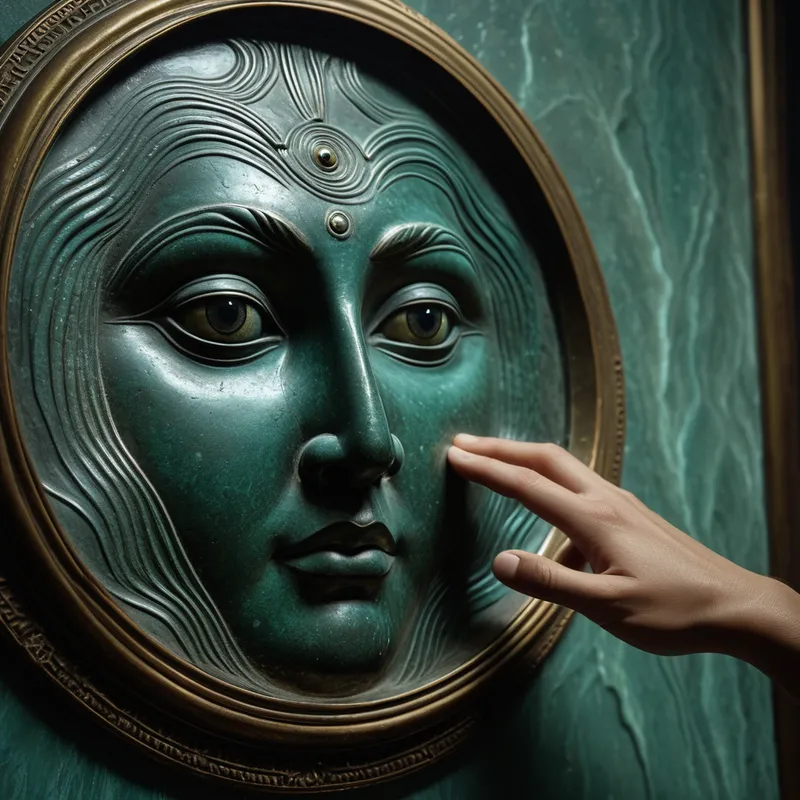
She approached, her armor clinking in the profound quiet. She expected to see her own stern, gray-eyed visage, the helm, the unassailable countenance of the strategist. But the mirror remained dark. Then, as her breath fogged the metal, an image swam into being. It was her, yet not her. This reflection wore no armor. Its eyes held not cool calculation, but raw, untamed potential—the furious creativity she had disciplined into craft, the protective rage she had channeled into just war, the intuitive knowing she had subordinated to logic. It was her shadow, the totality of what she was, but had never fully acknowledged.
The reflection reached out. Athena, for the first time, knew fear. To touch it was to admit this wild twin was part of her divine substance. Conflict raged—the impulse to shatter the mirror, to deny this vision with her spear, against the deeper pull of the wisdom she professed to own. With a will that shook the foundations of the cavern, she did not raise her weapon. She lifted her hand and placed her palm against the cold bronze. The surface yielded like water. In that moment of contact, no lightning flashed, no thunder roared. There was only a profound and silent exchange. The armored goddess and her unarmored reflection flowed into one another. When she stepped back, the mirror showed a single figure, her eyes now holding both the clarity of [the owl](/myths/the-owl “Myth from Celtic culture.”/) and the depth of [the abyss](/myths/the-abyss “Myth from Kabbalistic culture.”/). She had not conquered a foe. She had greeted a forgotten self. And in that greeting, her wisdom was no longer just a shield against the world, but a bridge to the entirety of her own being.
Cultural Origins & Context
The myth of the Mirror of Athena does not belong to a single scroll or oral tradition, but emerges as a psychoid archetype that has surfaced in countless guises across the universal human story. We find its echoes in the Gnostic quest for gnosis (self-knowledge), in the Zen koan that turns the mind back upon itself, and in the alchemical dictum Visita Interiora Terrae Rectificando Invenies Occultum Lapidem (“Visit the interior of the earth, and by rectifying, you will find [the hidden stone](/myths/the-hidden-stone “Myth from Alchemical culture.”/)”). It is a myth told by mystics, depth psychologists, and poets—those who navigate the interior landscapes. Its societal function was never to enforce social order, but to subvert the tyranny of a one-sided consciousness. It was a story whispered in the margins, a corrective to cultures (and individuals) that worship only the light, reminding them that sovereignty is born from the integration of the whole self.
Symbolic Architecture
The myth’s power lies in its stark, symbolic [architecture](/symbols/architecture “Symbol: Architecture in dreams often signifies structure, stability, and the framing of personal identity or life’s journey.”/). Athena herself represents the luminous, conscious intellect—the part of the [psyche](/myths/psyche “Myth from Greek culture.”/) that values order, [strategy](/symbols/strategy “Symbol: A plan of action designed to achieve a long-term or overall aim, often involving competition, resource management, and foresight.”/), and conscious control. Her descent is [the ego](/myths/the-ego “Myth from Jungian culture.”/)’s necessary [journey](/symbols/journey “Symbol: A journey in dreams typically signifies adventure, growth, or a significant life transition.”/) into the personal unconscious and beyond.
The Mirror is the ultimate [symbol](/symbols/symbol “Symbol: A symbol can represent an idea, concept, or belief, serving as a powerful tool for communication and understanding.”/) of self-[reflection](/symbols/reflection “Symbol: Reflection signifies self-examination, awareness, and the search for truth within oneself.”/), but of a kind that transcends vanity. It is the objective psyche, the Self, presenting the ego with an undistorted [image](/symbols/image “Symbol: An image represents perception, memories, and the visual narratives we create in our minds.”/) of its own complete [reality](/symbols/reality “Symbol: Reality signifies the state of existence and perception, often reflecting one’s understanding of truth and life experiences.”/). It does not judge; it simply shows what is.
The mirror does not create the shadow; it reveals the light-bearer’s necessary counterpart. Wholeness is not the annihilation of darkness, but the recognition that it holds the shape of our un-lived life.
The shadowy reflection is not evil, but the “other half”—the instinctual, emotional, creative, and vulnerable aspects that the [persona](/symbols/persona “Symbol: The social mask or outward identity one presents to the world, often concealing the true self.”/) of “wisdom” or “perfection” has excluded to maintain its [identity](/symbols/identity “Symbol: Identity represents the sense of self, encompassing personal beliefs, cultural background, and social roles.”/). The [climax](/symbols/climax “Symbol: The peak moment in a narrative or musical composition, representing resolution, transformation, or ultimate expression.”/)—the touch—is the act of Anerkennung (recognition), the fundamental move of [consciousness](/symbols/consciousness “Symbol: Consciousness represents the state of awareness and perception, encompassing thoughts, feelings, and experiences.”/) that transforms a feared “it” into a relatable “thou.”
The Dreamer’s Resonance
When this myth stirs in the modern dreamer, it often manifests as dreams of mirrors: mirrors that crack, mirrors that show a different age or face, mirrors in endless hallways, or a familiar room where one wall is suddenly a mirror. The somatic experience is one of profound unease, a chill at the base of the spine, a tightening in the chest—the body’s intelligence registering a psychic confrontation.
Psychologically, this dream pattern signals a critical moment in the process of individuation. The conscious attitude, perhaps one of hyper-rationality, relentless optimism, or rigid control (our personal “Athena”), is being challenged by the unconscious. The dream is the psyche’s attempt to present the mirror. The figure in the glass—whether monstrous, childlike, or fiercely passionate—represents those qualities the dreamer has disowned. The dream invites not analysis, but a courageous, feeling-based recognition of that inner other.

Alchemical Translation
The alchemical journey is precisely this: descend, confront, integrate, and be transformed. Athena’s myth is a perfect map of this psychic transmutation.
- Descent ([Nigredo](/myths/nigredo “Myth from Alchemical culture.”/)): The conscious ego, proud of its achievements (the shining citadel), must willingly descend into the unknown, dark, and chaotic aspects of [the self](/myths/the-self “Myth from Jungian culture.”/). This is the dark night of the soul, the initial dissolution of certainty.
- Confrontation (Mortificatio): Facing the mirror is the ego’s symbolic death. The identity one clung to (“I am only my intellect”) is shown to be partial. This is a painful mortification of the [persona](/myths/persona “Myth from Greek culture.”/).
- The Touch (Coniunctio): This is [the sacred marriage](/myths/the-sacred-marriage “Myth from Various culture.”/), the mysterium coniunctionis. The conscious mind (Athena) does not destroy the unconscious content ([the shadow](/myths/the-shadow “Myth from Jungian culture.”/)), nor is it overwhelmed by it. They meet as equals and merge. This is rectification.
- Return ([Rubedo](/myths/rubedo “Myth from Alchemical culture.”/)): The goddess returns, not to her old citadel, but to a new mode of being. Her wisdom is now embodied, tempered by self-knowledge. The gold of [the alchemist](/myths/the-alchemist “Myth from Various culture.”/), the [Lapis Philosophorum](/myths/lapis-philosophorum “Myth from Alchemical culture.”/), is this integrated state where consciousness is informed by the full spectrum of the psyche.
The alchemical fire is not lit to destroy the base metal, but to reveal the gold hidden within its alloy. So too, the mirror’s gaze does not shatter the self, but reveals the Self waiting within.
For the modern individual, the myth teaches that our greatest quest is not outward conquest, but inward hospitality. Our wounds, our irrational passions, our “unacceptable” traits—these are not errors to be erased, but the very substance awaiting recognition at the mirror’s surface. True wisdom, the myth concludes, is not knowing more than others, but knowing all of oneself. It is the courage to greet [the stranger](/myths/the-stranger “Myth from Biblical culture.”/) in the glass and discover, in that moment of terrifying grace, that you have finally come home.
Associated Symbols
Explore related symbols from the CaleaDream lexicon: