The Mirror in 'Snow White' Myth Meaning & Symbolism
A queen's magical mirror reveals a truth that shatters her world, igniting a dark quest for beauty and a deeper journey of innocence, shadow, and self.
The Tale of The Mirror in ‘Snow White’
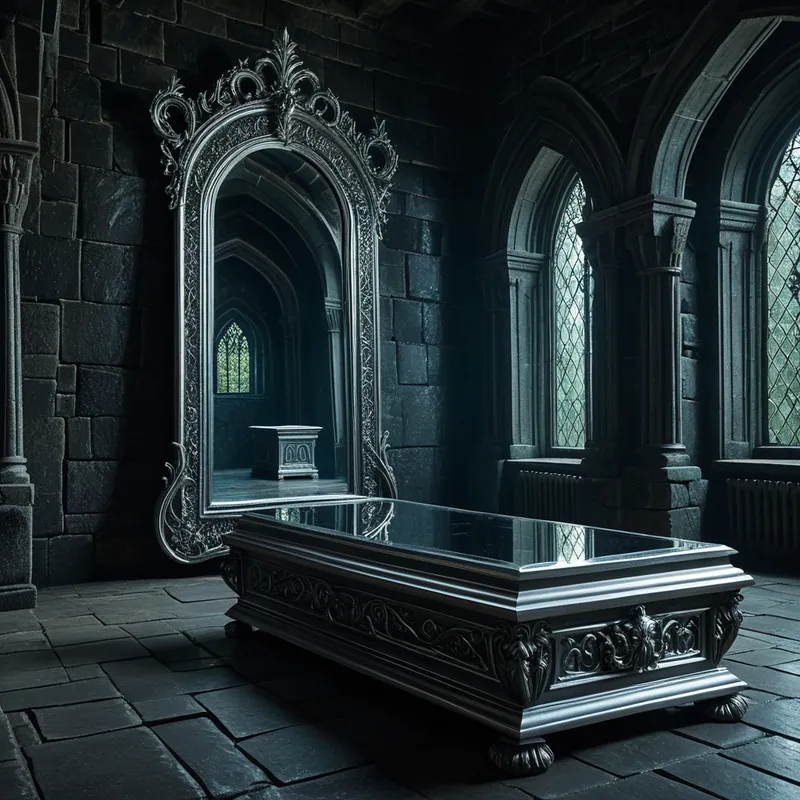
In a kingdom of high towers and deep, whispering woods, there lived a queen whose beauty was as renowned as the winter’s first frost. But beauty is a crown that weighs heavy, and hers was a throne built upon it. In her most secret chamber, she kept not a treasure of gold, but a Mirror of polished silver and obsidian, framed by serpents and lilies.
Each day, as the pale dawn light crept through the narrow window, she would stand before it, her breath held in the silent cold. “Mirror, Mirror, on the wall,” she would whisper, her voice the only sound in the stone room. “Who is the fairest one of all?”
For years, the voice that emerged from the glassy depths was a low, resonant hum that soothed her soul. “You, my Queen, are the fairest in the land.” And the kingdom’s peace was held in that fragile, reflected truth.
But deep in the forest, a different kind of beauty was growing. A child of snow-white skin, lips red as blood, and hair black as ebony—Snow White. She grew not in the sterile light of the court, but in the dappled shade of the woods, her laughter mingling with the birdsong, her heart as open as the wildflowers.
The day the Mirror’s voice changed, the very stones of the castle seemed to grow colder. “You, my Queen, are fair, ’tis true,” it intoned, its tone now holding a strange, distant echo. “But Snow White is a thousand times fairer than you.”
The words were not merely spoken; they were etched into the queen’s heart with a blade of ice. The reflection she saw was no longer of a sovereign, but of a woman being erased, her fairest title stolen by a girl of the forest. The Wrath of the Displaced Queen was born in that instant, a dark fire that demanded a dark remedy.
She commanded a huntsman to take the girl’s heart. But the huntsman, seeing the innocent terror in Snow White’s eyes, let her flee into the embrace of the ancient trees. There, she found a cottage of seven small beds, and with seven dwarfs, she found a semblance of home.
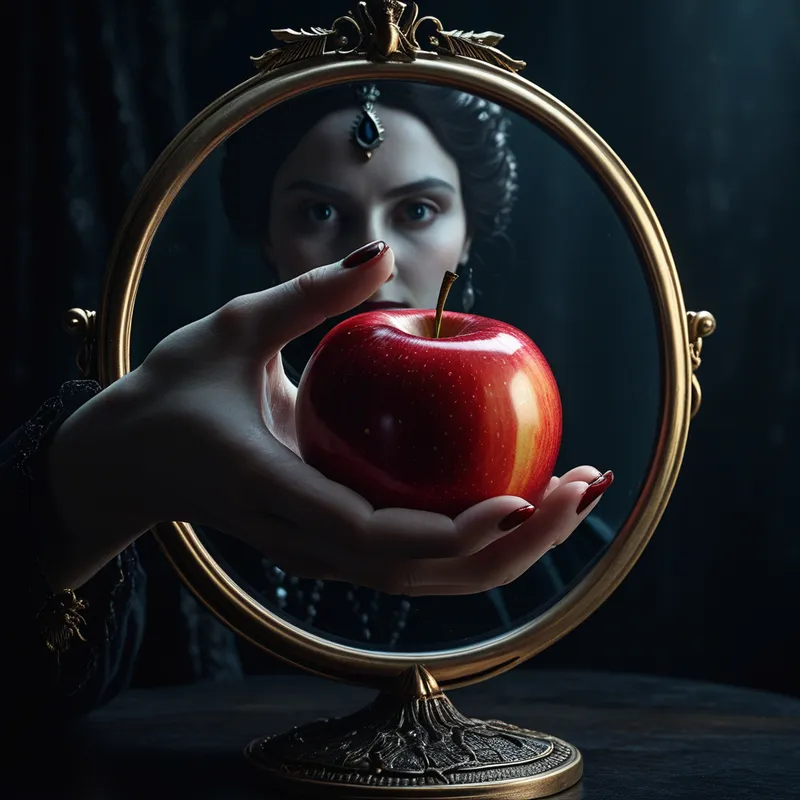
Thrice the queen, now a mistress of poisons and disguises, came for her. A lace bodice to still her breath, a comb to pierce her mind, and finally, an apple, red and perfect, its flesh sweet with a sleep like death. It was this last gift that succeeded. Snow White bit, and fell into a stillness so profound she seemed carved from alabaster and rosewood.
The dwarfs, hearts breaking, could not bear to bury her. They placed her in a casket of clear glass in the forest glade, where she became a legend—a [sleeping beauty](/myths/sleeping-beauty “Myth from Greek culture.”/) mourned by the creatures of the wood.
Years passed. A prince, riding through that part of the forest, saw the glass casket gleaming like a forgotten jewel. He saw her, and his heart was stricken. In his grief, he ordered his servants to carry her with him. As they lifted the casket, the jolt dislodged the poisoned bite from her throat.
Her eyes opened, the color of a sky after a long storm. The Prince’s Gaze had broken the spell. At their wedding, the queen was forced to attend. There, before the assembly, the truth-speaking Mirror finally showed her not Snow White, but her own reflection—a woman ravaged by envy, her beauty now a hollow, terrifying mask. Her own truth consumed her, and she was cast out into the endless night from which she came.
Cultural Origins & Context
The tale, as we know it, was crystallized in the 19th century by the Brothers Grimm, but its roots wind deep into the loam of European folklore. It is a story told by [the hearth](/myths/the-hearth “Myth from Norse culture.”/), a warning and a lesson passed from mother to daughter, from spinner to listener in the long winter nights. Its societal function was multifaceted: a cautionary tale about the perils of vanity and unchecked envy, a narrative about the vulnerable transition from childhood innocence to adulthood, and a reinforcement of the perceived natural order where purity and passivity are ultimately rewarded by royal rescue.
The figures of the active, scheming stepmother and the passive, beautiful maiden are archetypes found across countless cultures, speaking to universal tensions around power, aging, and female rivalry within patriarchal structures. The dwarfs represent [the world](/myths/the-world “Myth from Tarot culture.”/) of humble, productive labor—a safe, pre-sexual haven separate from both the decadent court and the princely rescue. The story was a tool for socialization, but like all true myths, it contained a symbolic depth that far exceeded its moralistic surface.
Symbolic Architecture
At its core, this is a myth of the [Shadow](/symbols/shadow “Symbol: The ‘shadow’ embodies the unconscious, repressed aspects of the self and often represents fears or hidden emotions.”/) and the Self. The [Queen](/symbols/queen “Symbol: A queen represents authority, power, nurturing, and femininity, often embodying leadership and responsibility.”/) and Snow White are not two women, but two aspects of a single psychic [reality](/symbols/reality “Symbol: Reality signifies the state of existence and perception, often reflecting one’s understanding of truth and life experiences.”/).
The Mirror does not lie; it shows the soul its next necessary truth, however devastating.
The Queen is the ruling Ego, whose [identity](/symbols/identity “Symbol: Identity represents the sense of self, encompassing personal beliefs, cultural background, and social roles.”/) is built entirely on a single, superlative value: being “the fairest.” She is [consciousness](/symbols/consciousness “Symbol: Consciousness represents the state of awareness and perception, encompassing thoughts, feelings, and experiences.”/) fixated on a [persona](/symbols/persona “Symbol: The social mask or outward identity one presents to the world, often concealing the true self.”/) of perfection and control. The Mirror is the voice of the Objective [Psyche](/myths/psyche “Myth from Greek culture.”/) or [the Self](/myths/the-self “Myth from Jungian culture.”/). It is the function of truthful self-[reflection](/symbols/reflection “Symbol: Reflection signifies self-examination, awareness, and the search for truth within oneself.”/), the inner critic that ultimately serves wholeness, not comfort. Its shift in allegiance from the Queen to Snow White marks a critical [moment](/symbols/moment “Symbol: The symbol of a ‘moment’ embodies the significance of transient experiences that encapsulate emotional depth or pivotal transformations in life.”/) in psychic [life](/symbols/life “Symbol: The symbol of ‘Life’ represents a journey of growth, interconnectedness, and existential meaning, encompassing both the joys and challenges that define human experience.”/): [the ego](/myths/the-ego “Myth from Jungian culture.”/)’s favored [status](/symbols/status “Symbol: Represents one’s social position, rank, or standing within a group, often tied to achievement, power, or recognition.”/) is revoked by the [soul](/symbols/soul “Symbol: The soul represents the essence of a person, encompassing their spirit, identity, and connection to the universe.”/) itself, which now recognizes a deeper, more authentic potential for [life](/symbols/life “Symbol: The symbol of ‘Life’ represents a journey of growth, interconnectedness, and existential meaning, encompassing both the joys and challenges that define human experience.”/).
Snow White is the nascent Self, the promise of future [integration](/symbols/integration “Symbol: The process of unifying disparate parts of the self or experience into a cohesive whole, often representing psychological wholeness or resolution of internal conflict.”/). She is natural, instinctual, connected to animals and the earthy dwarfs. Her “[death](/symbols/death “Symbol: Symbolizes transformation, endings, and new beginnings; often associated with fear of the unknown.”/)” by the [apple](/symbols/apple “Symbol: An apple symbolizes knowledge, temptation, and the duality of good and evil, often representing the pursuit of wisdom with potential consequences.”/) (an ancient [symbol](/symbols/symbol “Symbol: A symbol can represent an idea, concept, or belief, serving as a powerful tool for communication and understanding.”/) of [knowledge](/symbols/knowledge “Symbol: Knowledge symbolizes learning, understanding, and wisdom, embodying the acquisition of information and enlightenment.”/) and temptation) is not an end, but a necessary [incubation](/symbols/incubation “Symbol: A period of internal development, rest, or hidden growth before emergence, often associated with healing, creativity, or transformation.”/). The [glass](/symbols/glass “Symbol: Glass in dreams often symbolizes clarity, transparency, fragility, and the need for introspection.”/) [casket](/symbols/casket “Symbol: A casket symbolizes the containment of something precious, often relating to emotions, memories, or aspects of self that need to be preserved or buried.”/) is this state of [suspended animation](/symbols/suspended-animation “Symbol: A state where biological processes are halted or slowed dramatically, often used in science fiction for space travel or medical preservation.”/), where the potential self is preserved, visible but untouchable, awaiting the right [condition](/symbols/condition “Symbol: Condition reflects the state of being, often focusing on physical, emotional, or situational aspects of life.”/) for awakening.
The Dreamer’s Resonance
When this mythic pattern stirs in modern dreams, it signals a profound confrontation with the Shadow. To dream of a talking mirror is to encounter the uncompromising voice of one’s own conscience or deepest truth, often revealing an aspect of the self we have denied or a talent (our “Snow White”) we have neglected.
Dreaming of a poisonous gift (an apple, a drink, a piece of jewelry) points to an introjection—something from the outside world (a belief, a relationship, a career path) that looks appealing but is putting the authentic self to sleep. The somatic experience is often one of paralysis or choking in the dream, reflecting a felt sense of being stifled in waking life.
Conversely, dreaming of being in or seeing a glass coffin speaks to a feeling of being trapped in a role, a relationship, or a self-image that is pristine but lifeless. You are on display but not alive. The arrival of the prince in the dream is not necessarily a literal romantic rescue, but the emergence of an active, conscious, valuing principle in the psyche that is finally ready to engage with and “lift” this dormant potential.
Alchemical Translation
The myth models the alchemical process of Individuation: the transformation of the base metal of a fractured psyche into the gold of wholeness. The Queen’s initial question to [the Mirror](/myths/the-mirror “Myth from Various culture.”/) is the ego’s routine check-in, seeking validation. The Mirror’s shocking reply is the [nigredo](/myths/nigredo “Myth from Alchemical culture.”/)—the blackening, the despair and chaos that initiates all true transformation. The ego’s beautiful, controlled world is shattered.
The poison is also the medicine; the Queen’s envy, though destructive, is the fierce energy that ultimately forces the system to evolve.
The Queen’s subsequent disguises and attacks represent the Shadow’s relentless attempts to re-assimilate or destroy the emerging Self, a painful but necessary stage of conflict. Snow White’s flight to the forest and life with the dwarfs is the albedo—the whitening, a retreat into a simpler, more instinctual state for purification and grounding.
Her poisoned sleep in the glass casket is the citrinitas—the yellowing, a long, passive incubation where the work happens unseen. The potential self is preserved in a state of perfect latency. Finally, the Prince’s arrival and the dislodging of the poison is the [rubedo](/myths/rubedo “Myth from Alchemical culture.”/)—the reddening, the awakening. This is not an act performed by the dormant Self, but a completion brought about by a new, connecting principle (the animus in a woman’s psyche, the capacity for directed consciousness and relatedness).
For the modern individual, the myth instructs: Your deepest truth (the Mirror) will eventually dismantle the identity (the Queen) you have built on a single, comparative value. The new life that threatens that identity (your Snow White) must be protected, even if it means a period of humble retreat and apparent death. Wholeness is achieved not by the old queen ruling forever, nor by the young princess simply replacing her, but by the transformative crisis that the Mirror instigates, forcing a death of the old attitude so a more complete life can be awakened.
Associated Symbols
Explore related symbols from the CaleaDream lexicon: