The Miracle of the Oil Myth Meaning & Symbolism
A small, pure cruse of oil, enough for one day, burns for eight nights, rekindling a desecrated temple and a people's spirit.
The Tale of The Miracle of the Oil
Listen. Listen to the silence that follows the roar of battle. The air in Jerusalem is thick with the scent of cold ashes and spilled blood. The great Temple, once a beacon of the divine, lies violated. Its golden vessels are looted, its altars defiled with the profane idols of a conquering empire. The spirit of the people is a guttering wick, nearly extinguished by the long night of oppression.
But from the hills, a band of brothers, the Maccabees, have returned. They have fought with the ferocity of lions to reclaim this sacred ground. As they push open the heavy, scarred doors, they are met not with glory, but with desolation. The task before them is not merely one of cleaning stone, but of cleansing soul. They sweep away the debris of idolatry, they scrub the stains of sacrilege, their work a silent prayer.
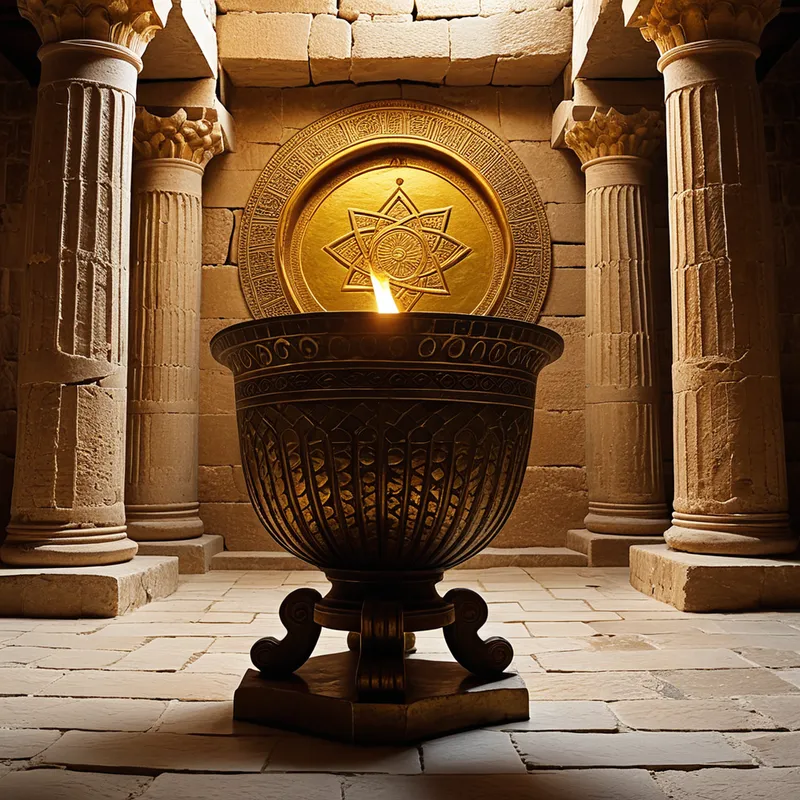
Then comes the moment. The great Menorah, the symbol of divine wisdom and the light of the world, must be rekindled. But to kindle it requires pure, consecrated olive oil, sealed with the stamp of the High Priest. They search frantically through the shattered remnants of the sanctuary. Hope, like their lamp oil, is nearly spent.
Then, a cry—not of triumph, but of poignant discovery. One small, intact clay cruse is found, hidden in the rubble. It is brought into the dim light. The seal of the High Priest is unbroken. It is pure. But as they hold it, their hearts sink anew. The vessel is small. It contains only enough oil to feed the Menorah’s seven branches for a single day. To produce new, ritually pure oil would require eight days.
A profound stillness settles over them. Do they wait, leaving the Temple dark for a week? Or do they light it now, knowing the light will die, a symbol of extinguished hope?
With a faith that moves against the logic of the material world, they choose to light it. The priest pours the precious oil. He touches a flame to the wicks. One by one, the seven tongues of fire awaken, casting a warm, fragile light onto the cleansed walls. It is a beautiful, heartbreaking sight: a light destined to fade.
They tend it, they watch it. The first day passes, and the flame does not diminish. The second day arrives, and the oil still burns, clear and bright. A whisper of awe moves through the people. On the third day, and the fourth, the impossible continues. The single day’s portion of oil burns on, defying every law of nature. For eight full nights, through the completion of the eighth day, the Menorah burns with the oil from that one small cruse. By the time the new, pure oil is ready, the miracle has woven itself into the very stones of the Temple. The light was not sustained; it was multiplied. The darkness was not held back; it was transformed into a testament. The fragile flame became an everlasting symbol: the light of spirit is not subject to the arithmetic of the world.
Cultural Origins & Context
The story of the Miracle of the Oil is the narrative heart of the holiday of Hanukkah. While the historical accounts of the Maccabean Revolt (2nd century BCE) in books like 1 Maccabees detail the military victory and the Temple’s rededication, they make no mention of the supernatural oil. This specific miracle emerges later, in the Talmud (Tractate Shabbat 21b), compiled centuries after the events.
This is profoundly telling. The rabbis of the Talmud were less focused on celebrating military might—a potentially dangerous precedent for a dispersed people—and more on articulating a spiritual truth. They shaped the memory into a story of divine grace (Shekhinah) intervening in the realm of the mundane. The myth was passed down not by generals, but by scholars and families. Its societal function was dual: it provided a theological reason for the eight-day festival, and more importantly, it encoded a core tenet of resilience for a people facing endless exile and persecution. The message was clear: your spirit, like that cruse of oil, may seem insufficient for the long night ahead, but when dedicated purely, it can be met with a grace that makes it enough.
Symbolic Architecture
At its core, this is a myth about the relationship between the finite and the infinite, the human effort and the divine response. The cruse of oil represents the intact, pure essence of the individual or the community—the soul, tradition, or faith—that survives even the most devastating catastrophe. It is the irreducible core of identity.
The miracle does not begin with the endless oil, but with the decision to light the lamp despite knowing it should go out. Faith is the act of investing one’s last resource in a future one cannot see.
The Menorah symbolizes the structured world, the vessel of civilization and spiritual order that must be illuminated. The eight days transcend the natural cycle (represented by the seven days of creation), pointing to the supernatural, the realm of grace and transcendence. The myth asserts that when pure human intention (the sealed cruse) is applied to sacred purpose (lighting the Menorah), it creates a vessel capable of receiving and manifesting the infinite. The “miracle” is not a suspension of natural law, but the revelation of a deeper law: the law of spiritual sustenance.
The Dreamer’s Resonance
When this myth stirs in the modern psyche, it often manifests in dreams of finding a hidden, precious resource at the moment of utter depletion. You may dream of discovering a tiny, still-functional tool in a ruined workshop; a single, clean water source in a vast desert; or a forgotten, fully charged phone in a blackout.
Somatically, this accompanies a state of nervous system exhaustion—the “freeze” or “collapse” state—giving way to a faint but persistent inner warmth. Psychologically, the dreamer is navigating the tension between measurable reality (“there is only enough for one day”) and an intuitive, defiant hope (“but I must light it anyway”). The dream is a testament from the unconscious that one’s essential integrity—one’s “sealed cruse”—has survived the internal or external devastation. The eight-day burn in the dream-world validates the choice to act from that pure, albeit limited, core self, promising that this action will attract or unlock unforeseen sustenance. It is the psyche’s ritual of rededication.
Alchemical Translation
The alchemical process mirrored here is the multiplicatio—the miraculous multiplication of a substance, representing the stage where the philosopher’s stone, once attained, can transform limitless base material. For the individual on the path of individuation, the “desecrated temple” is the psyche colonized by the complexes, societal expectations, and shadow material that obscure the true self.
The work of the Maccabees is the arduous labor of shadow-work—confronting and clearing these inner defilements. Finding the sealed cruse is the moment of connecting with the Self, the indestructible core of one’s being that remains pure amidst the chaos. The critical, alchemical fire is the act of living from that core, even when all rational evidence suggests your resources (time, energy, confidence) are insufficient.
The miracle occurs in the commitment, not the outcome. By investing our last, pure measure of courage into the work of becoming whole, we create the vessel—the illuminated psyche—into which a transformative, sustaining energy can flow. The single day’s oil is our conscious effort; the eight-day light is the unconscious, the numinous, the supporting matrix of life itself, responding to our faithful act. We do not become limitless, but our finite effort becomes the conduit for the limitless.
Associated Symbols
Explore related symbols from the CaleaDream lexicon: