The Minotaur's Labyrinth Myth Meaning & Symbolism
A monstrous half-bull, half-man is imprisoned in a vast, inescapable maze, demanding a tribute of youths until a hero armed with a thread confronts the beast within.
The Tale of The Minotaur’s Labyrinth
Hear now a tale of a king’s shame, a queen’s desire, and a monster born of both. It begins not in darkness, but in the blinding light of the sea, where Minos, lord of Crete, prayed to Poseidon. He asked for a sign, a bull from the foam, to affirm his right to rule. The god answered. From the azure waves surged a bull, but not of common stock. It was a creature of pure white, magnificent, its hide gleaming like polished marble, its muscles rolling like the sea itself—a sacred offering.
But the heart of a king can be a fickle thing. Greed, that sly serpent, coiled around Minos’s throne. The bull was too beautiful, too valuable to sacrifice. He kept it, and in its place slew another. The salt air grew heavy with divine offense. Poseidon’s wrath did not come as a storm, but as a twisted passion. He made Pasiphaë, the queen, burn with an unnatural love for the white bull. From her desperation and the cunning of the artisan Daedalus, a hollow wooden cow was born. Within its deceptive frame, the queen hid. And from that cursed union was born a child who was no child—Asterion, the Minotaur. A being with the powerful, shaggy neck and great horned head of a bull, and the body of a man. His breath was hot and ragged, his voice a low, guttural roar that spoke of a soul trapped between worlds.
The king’s shame now had a face, a form that paced and bellowed in the palace depths. To hide his disgrace, Minos again summoned Daedalus. “Build a prison,” he commanded, “from which nothing that enters may leave.” And so the Labyrinth was wrought. Not a simple maze, but a living, breathing puzzle of stone. Its corridors turned back upon themselves, its identical passages mocked memory, its very walls seemed to shift in the torchlight. At its heart, in a sunless chamber, the Minotaur was placed. His world became the endless turn, the damp stone, the echo of his own footsteps. But a monster confined is not a monster appeased.
Blood-tribute was the price. For the slain son of Minos in Athens, a retribution was demanded: every nine years, seven youths and seven maidens were sent across the wine-dark sea, forced into the Labyrinth’s maw to be lost, and then found by the creature within. The very earth of Crete seemed to drink their terror.
Until a hero with grief in his heart and destiny in his lineage arrived. Theseus, prince of Athens, stepped onto the Cretan shore not as a victim, but as a volunteer. His eyes met those of Ariadne, the princess. In her, he saw not just pity, but a fierce rebellion. She saw in him a way to break the cycle of her father’s monstrous legacy. In the dead of night, she came to him. Into his hands she pressed a ball of gleaming thread and a sword. “Tie this to the entrance,” she whispered, her voice a thread itself in the darkness. “Unwind it as you go. It will remember the path your mind cannot.”
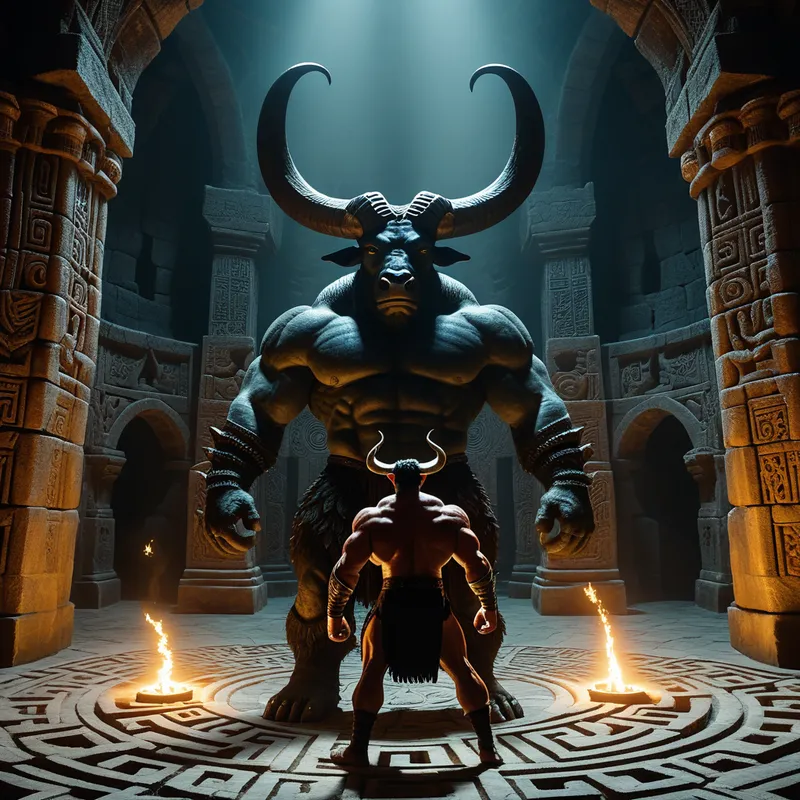
The great bronze doors groaned open. The dank, earthy breath of the Labyrinth poured out. Theseus stepped in, the thread whispering from his hand. The world collapsed into stone and shadow. Left, right, straight, back—the path was a delirium. The only truth was the slender red line behind him, a lifeline spun from love and cunning. He heard it first: a heavy snort, the scrape of a hoof on stone. Then he smelled it—blood, old straw, and wild beast. In the central chamber, the Minotaur stood, a mountain of muscle and rage, its human eyes in its bovine face filled with a pain as old as its birth.
No words were exchanged. Only the roar, the rush, the flash of bronze in the gloom. Theseus danced aside from the deadly lunge of horns, using the beast’s own blind fury, the confined space, against it. With a final, mighty heave, he drove the blade home. The great body shuddered, collapsed. The labored breathing ceased. Silence, deeper than before, flooded the chamber. Then, with the red thread as his guide, Theseus retraced his steps, leading the trembling Athenian youths and maidens from the tomb of stone back into the shock of sunlight and the waiting arms of Ariadne, leaving the Labyrinth and its dead king to the echoes.
Cultural Origins & Context
This myth, as we have it, is primarily woven from the threads of Athenian propaganda, crystallized in the works of later writers like Plutarch. For Athens, a rising power, the story of Theseus was a foundational epic. It transformed a likely historical reality—a burdensome tribute paid to the earlier, superior naval power of Minoan Crete—into a triumphant moral drama. The monstrous Minotaur became the symbolic vessel for Athenian fears and resentments of their Cretan overlords, while Theseus’s victory symbolized Athenian ingenuity and courage overcoming brute, archaic force.
The myth was not static literature but living ritual. It was performed, recited, and depicted on pottery. The Labyrinth itself was not just a story element; it was a ritual pattern, a “Geranos” or crane dance, performed on Delos to commemorate Theseus’s victory. This blurring of myth and ritual practice shows how the story functioned as a societal binding agent. It explained the origins of Athenian festivals, justified political relationships, and most importantly, provided a narrative template for the transition from adolescent vulnerability to civic heroism. The tribute youths represented the city’s fragile future; Theseus represented that future secured through heroic action.
Symbolic Architecture
At its core, the Labyrinth is not a prison for a monster, but the architectural blueprint of a fractured psyche. The Minotaur is the original inhabitant, the denied and hidden child of a corrupted union. It is the shadow made flesh—the product of a king’s broken oath (spiritual betrayal) and a queen’s unnatural desire (instinct perverted). It is not evil, but unintegrated; a raw, powerful instinctual force born from shame and locked away in the deepest, most convoluted part of the self.
The Labyrinth is the mind that has forgotten its own design. The Minotaur is the truth it was built to contain.
Theseus represents the conscious ego, the part of the self that must voluntarily descend into the chaos of the unconscious. He does not go blindly; he is armed with two gifts from the feminine principle: Ariadne’s thread (intuition, connection, the subtle guiding intelligence) and her sword (discernment, the ability to cut through confusion). The thread is the critical element—it is not brute force that conquers the maze, but a sustained, fragile connection to consciousness. The victory is not the slaying of the instinct, but the confrontation with it. By facing the shadow-beast, the hero acknowledges its existence and reclaims the energy trapped within the maze of repression.
The Dreamer’s Resonance
When this myth stirs in the modern dreamer, it announces a state of psychic imprisonment. To dream of endless, identical corridors, of being lost in a basement, a vast building, or a twisting hedge-maze, is to feel the somatic truth of the Labyrinth. There is a claustrophobic pressure, a rising panic that the rational mind cannot map a way out. This is the psyche signaling that a core complex—a tangled knot of emotion, memory, and belief—has been activated.
The Minotaur in the dream may not appear as a literal bull-man. It may be a looming shadow, a pursuing figure, a terrifying animal, or even a overwhelming emotion like rage or shame that feels “monstrous” and alien. The dream is staging the confrontation the waking self avoids. The body often records this as a heavy chest, restricted breathing, or a pounding heart—the somatic signature of facing the repressed. The process is one of orientation within disorientation. The dreamer is not yet Theseus with a thread; they are the tribute, feeling their way through the dark, sensing the presence of something that must ultimately be met, not escaped.
Alchemical Translation
The myth models the alchemical process of individuation, where the base material of the fragmented self is transmuted into a more complete, authentic being. The initial state is one of nigredo—blackness, confusion, and the hidden shadow (the Minotaur in its dark labyrinth). King Minos’s act of hiding the bull and the monster represents the ego’s initial refusal to deal with its own difficult contents.
The heroic journey is the albedo—the whitening. Theseus’s descent is a purposeful introversion, a turning inward. Ariadne’s thread is the coniunctio, the sacred marriage of masculine resolve and feminine wisdom that makes the journey possible. It is the linking of conscious intention to unconscious guidance.
The slaying is not destruction, but a radical integration. The beast is not killed; its monstrous, trapped form is dissolved so its essential power can be reclaimed.
The final act is the return, the rubedo—the reddening, the embodiment of the gained wisdom. Theseus emerges with the saved youths and maidens, symbolizing the liberation of vital life energy (potential, creativity, vitality) that was previously sacrificed to the maintenance of the labyrinthine defense. He leaves with Ariadne, integrating the guiding principle. The myth, however, in its cruelty, often continues—Theseus abandons Ariadne, and Daedalus is imprisoned for his knowledge. This reminds us that the process is cyclical, not linear. One integration reveals the next layer of the maze. The work of confronting what we have walled away is the perpetual, profound task of becoming whole. The Labyrinth, ultimately, is not a place we escape, but a structure we learn to navigate, discovering that at its center, and in ourselves, lies not just a beast to be slain, but a truth to be embraced.
Associated Symbols
Explore related symbols from the CaleaDream lexicon: