
The Minaret Myth Meaning & Symbolism
A myth of a celestial architect descending to build a tower of pure sound, offering humanity a path from worldly noise to sacred silence.
The Tale of The Minaret
In the First Age, the world was a cacophony. The earth groaned with formless stone, the winds shrieked without melody, and the hearts of men beat to a rhythm of pure want. There was no up or down, only the great, swirling Miasma of Becoming. From this din, no prayer could rise, no thought could complete itself. It was a world of pure potential, and thus, of pure torment.
Then came the silence. Not an absence, but a presence. From the place beyond the seven veils of the sky, where shapes are born from intention alone, descended Al-Mu’allim, the First Builder. He did not walk, for the ground could not hold him. He did not speak, for his language was form. His body was the blueprint of harmony, his gaze the compass of true north.
He stood in the heart of the Miasma and raised a hand. The shrieking winds stilled. With a gesture, he drew from the chaos a single, resonant tone—a deep hum that vibrated in the bones of the world. This tone was the First Word, the Asl. Around this sound, dust began to dance, not randomly, but in perfect, concentric rings.
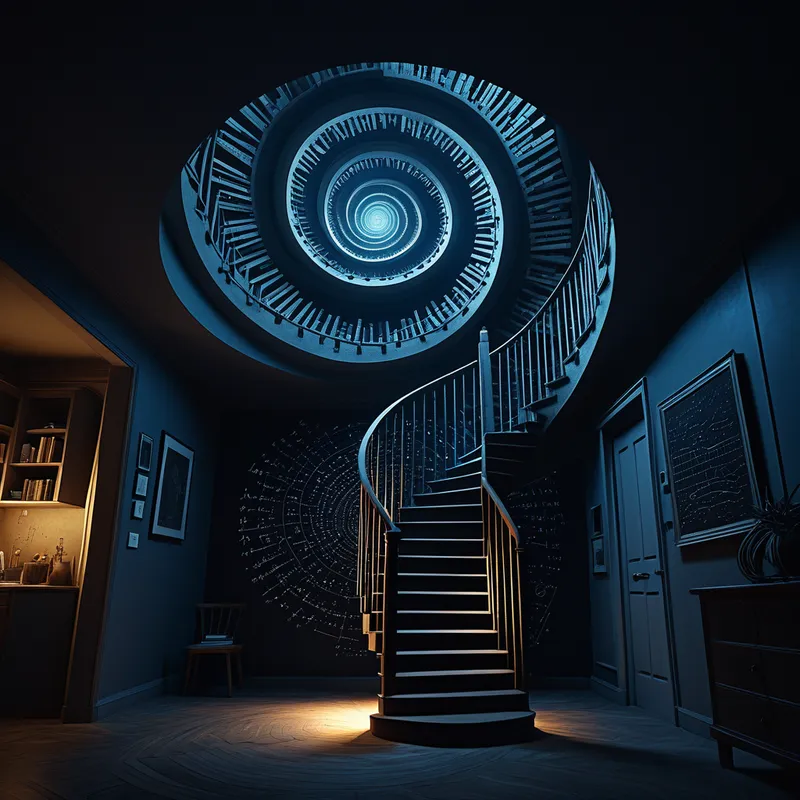
Al-Mu’allim began to build. He did not quarry stone; he invited it. With each placement of a block, carved not by tool but by the sustained frequency of the Asl, the surrounding chaos receded a step. The tower grew, slender and impossibly tall, a needle of silent intention stitching the raucous earth to the serene sky. It was not a fortress, but a filament. Its stairs were not for climbing with feet, but with breath. Its windows were not for looking out, but for listening in.
As the Minaret pierced the lowest veil of heaven, a final miracle occurred. The Asl within it did not shout into the void. Instead, it became a receiver. From the infinite silence above poured down a wave of quietude—a cool, clear resonance that washed over the land. The grinding rocks found their stable beds. The wailing winds learned the art of the breeze. And the people, their hearts hushed for the first time, heard not a command, but an invitation: a path was now open. The way was not to the top, but through the center. The conflict of chaos was not defeated; it was given a axis around which to gracefully, meaningfully turn.

Cultural Origins & Context
The myth of The Minaret is the cornerstone narrative of the Global Architecture tradition. It is not merely a story of a building, but the foundational etiology for the culture’s entire worldview—that the universe is fundamentally architectural, and consciousness is its primary material. The myth was transmitted not in books, but in the Rites of the Plumb Line, performed by master builders at the groundbreaking of any significant structure.
These builders, known as Al-Haddathun, were the myth-keepers. They recited the tale while tracing the building’s first lines on the earth, believing the story’s structure would imbue the physical structure with ontological stability. The myth served a critical societal function: it sacralized the act of creation itself, framing the architect as a mediator between human disorder and cosmic order. It provided a psychic map for a civilization obsessed with navigating the space between the earthly Miasma and the heavenly silence, suggesting that civilization itself was the ongoing construction of this mediating tower.
Symbolic Architecture
At its core, the myth presents the Minaret not as a thing, but as a process. It is the symbolic axis mundi, the world-pillar, but with a distinct psychological twist.
The Minaret is not climbed; it is resonated with. Its height is not a measure of distance, but of attunement.
Al-Mu’allim represents the archetypal principle of consciousness itself—the ordering, pattern-making faculty that emerges from the chaos of the unconscious (Miasma). He does not conquer the chaos; he structures it by introducing a central, organizing frequency (Asl). This is the birth of the individual ego, not as a tyrannical ruler, but as a necessary, centering function that allows complexity to coalesce into meaningful form.
The tower’s incredible slenderness symbolizes the precariousness of this conscious structure. It is a single, vertical thread of awareness in the vast horizontal sprawl of the unconscious and the external world. The “silence” it connects to is the symbolic representation of the Self in Jungian terms—the transcendent, unifying center of the total psyche, which is experienced not as more noise (more thoughts, more desires), but as a profound, integrative quiet.

The Dreamer’s Resonance
When the symbol of the Minaret arises in modern dreams, it often signals a critical phase of psychic re-ordering. The dreamer may be lost in life’s “cacophony”—overwhelming choices, conflicting responsibilities, or internal emotional noise.
To dream of seeing a minaret in the distance, shining through urban clutter or a dense forest, points to a nascent awareness of a possible center, a potential axis around which to reorganize a chaotic life situation. The somatic feeling is often one of relief, a deep inhalation.
To dream of climbing its interior, however, is to engage in the active process of individuation. The narrow, spiraling staircase is the constricting but necessary path of self-confrontation.
Dreams of the staircase collapsing, or of being unable to find the entrance, speak to fears of ego-dissolution or the difficulty of finding one’s core principle (Asl). The ultimate dream—standing at the summit not to look down upon the world, but to experience a wash of silent clarity—indicates a momentary, transcendent connection with the Self, a taste of the inner order achieved when the personal psyche aligns with its own deepest architecture.
Alchemical Translation
The myth of The Minaret is a precise allegory for the alchemical process of psychic transmutation, or individuation. The Miasma is the massa confusa, the primal, undifferentiated matter of the soul. The descent of Al-Mu’allim is the influx of a guiding archetype (the Wise Old Man/Sage) that initiates the work.
The Asl, the foundational tone, is the discovery of one’s own intrinsic value or guiding principle—the “philosopher’s stone” in audible form. Building the tower is the long, arduous work of coagulatio: giving solid, enduring form to one’s personality around this central truth, stone by conscious stone.
The alchemical goal is not to escape the base material (chaos), but to transform it by providing a structure through which it can express itself in harmony.
The final reception of “silence from above” represents the stage of unio mentalis, the union of the mind with the spirit. It is the moment when the ego, having built itself up diligently, realizes its role is not to rule, but to serve as a conduit for a greater, transpersonal reality. The individual becomes like the Minaret itself: a stable, slender vessel through which the noise of the personal is transmuted into the music of the cosmic. The triumph is not in reaching heaven, but in becoming the means by which heaven touches earth within one’s own being.
Associated Symbols
Explore related symbols from the CaleaDream lexicon: