The Miller and the Wind Myth Meaning & Symbolism
A miller makes a pact with the wind to save his livelihood, learning that true power lies not in command, but in humble partnership with nature.
The Tale of The Miller and the Wind
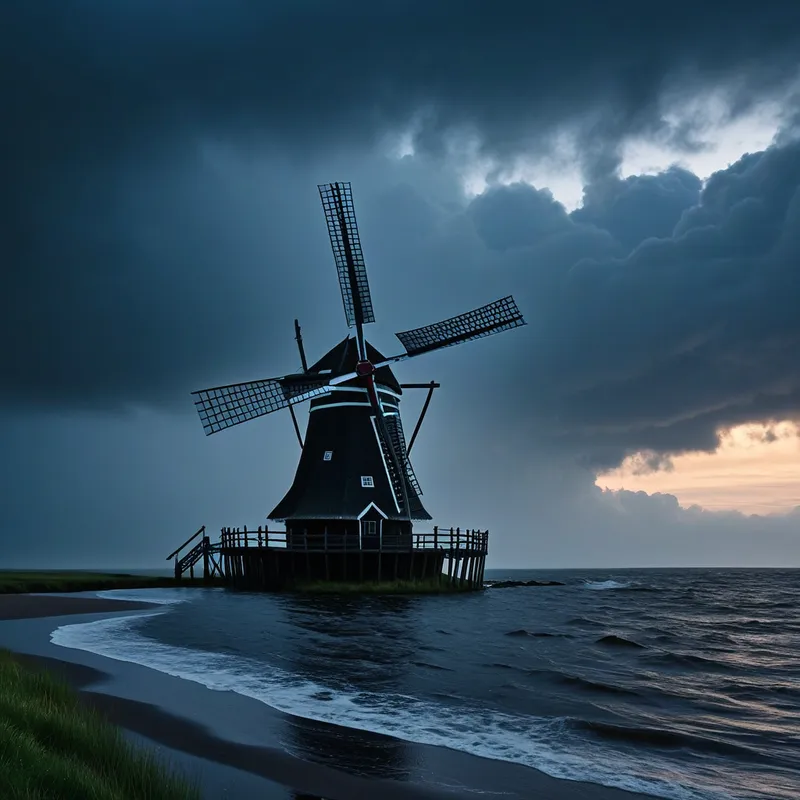
Listen, and hear the tale whispered by the reeds along the polders. In a time when [the sky](/myths/the-sky “Myth from Persian culture.”/) spoke directly to [the earth](/myths/the-earth “Myth from Hindu culture.”/), there lived a miller on the flat, open lands. His mill was his world, its great arms his prayers, grinding the community’s grain into the flour of life. But for a season, the winds grew capricious. They slept when they should have roared, and the great sails hung still and silent as a tombstone. The miller’s heart grew heavy as his empty sacks. His family’s hope dwindled like the last grains in the bin.
One evening, as a bitter calm choked the land, the miller climbed to the highest platform. He did not shake his fist at the heavens—a Dutchman knows the futility of that. Instead, he spoke into the stillness, his voice raw with a weariness that was also a plea. “Great Wind,” he said, “I am but a servant of the grain and the stone. Without your breath, my work is dead, and my people will hunger. I have nothing to offer but my labor. What pact can we make?”
The air did not stir. But a voice, like the sound of a distant gale through a thousand pine needles, spoke not to his ears, but into his very bones. “You speak of pacts, little grinder of earth. I am the North Wind. I answer to no bellows but my own. Yet… your humility is a curious [thing](/myths/thing “Myth from Norse culture.”/). You wish my service? Then you must serve me in turn.”
“Name your price,” the miller whispered, the blood cold in his veins.
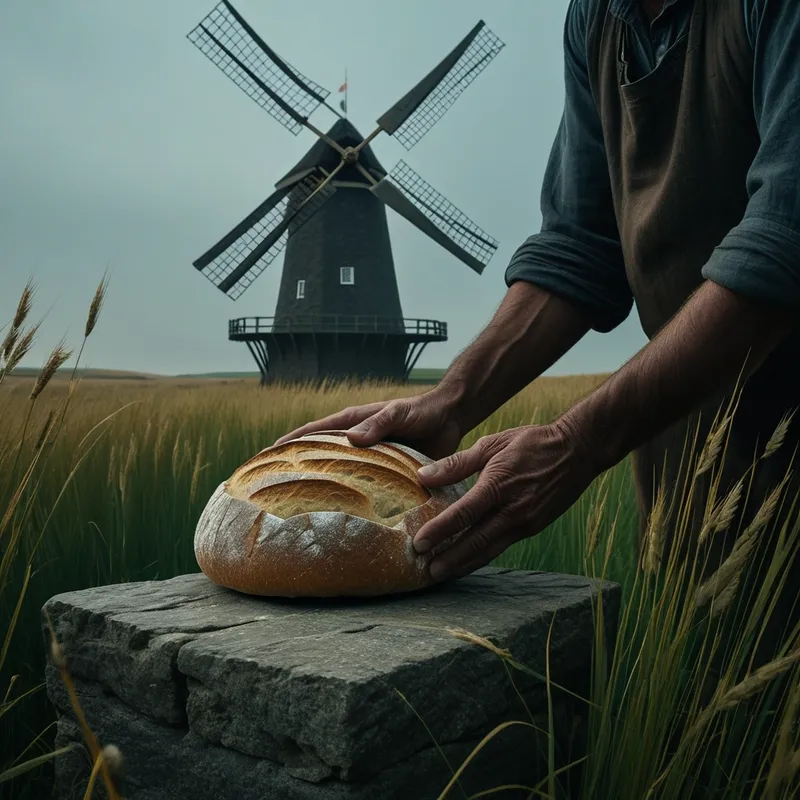
“Every seventh sack of flour you grind with my breath,” [the Wind](/myths/the-wind “Myth from Various culture.”/) intoned, “you will set aside. From it, you will bake a single loaf. Not for your family, not for your market. This loaf you will leave for me, upon the stone at the base of your tower, under [the moon](/myths/the-moon “Myth from Tarot culture.”/)’s eye. Do this, and my breath shall be steady for you. Fail, or cheat me of my share, and I shall not only leave you in stillness… I shall take back what I have given, and more.”
The miller agreed. The next morning, a fierce and steady wind awoke, turning the sails with a mighty groan. The millstones sang again. True to his word, the miller meticulously set aside the portion. Each seventh moon, he would bake a loaf of exquisite simplicity—[water](/myths/water “Myth from Chinese culture.”/), salt, the gifted flour—and place it on the offering stone. In return, his mill knew reliable winds. He prospered.
Years passed. The miller’s son, a modern lad with a head for accounts, saw the weekly loaf as wasteful superstition. “Father,” he argued, “the wind blows for all. It is a force of nature, not a merchant to be bribed! That flour is pure profit lost.” Wearied by success and his son’s logic, the miller’s vigilance wavered. One cycle, he kept the flour. He baked no loaf.
That very night, a tempest of unnatural fury descended. It was not a storm that watered crops, but a focused, vengeful gale. It tore at the mill’s sails, not to destroy them utterly, but to wrench them from their rhythm. Then, with a final, sucking breath, the Wind did not blow away—it reversed. It drew the very flour-dust from every crack of the mill, every sack in the storeroom, creating a ghostly blizzard of the miller’s livelihood that was whipped out into the black fields and lost. The wind then fell dead still, leaving a silence more terrible than the noise.
Humbled to his core, the miller, with his chastened son, baked two loaves that dawn. He placed them on the stone with a prayer of true contrition. The wind returned, not with a fanfare, but with the reliable, whispering consistency of a partner once wronged but willing to forgive. The miller had learned: the pact was not commerce, but covenant.
Cultural Origins & Context
This tale hails from the oral traditions of the Netherlands, a nation literally forged in a ceaseless conversation—and conflict—with wind and water. It is a beast fable of the elements, told not in grand halls but in gezellig kitchens and smoky taverns. Millers were pivotal yet liminal figures in rural society; they held the community’s sustenance in their hands, yet were often viewed with suspicion, accused of taking more than their share. The myth served multiple functions: it explained the capriciousness of the weather, enforced an ethic of fairness and honoring agreements (afspraak is afspraak), and encoded a profound ecological truth. It taught that prosperity is not a right wrested from nature, but a gift maintained through respectful reciprocity. The wind is not a slave in the sails, but a volatile, sentient force of the landscape that must be acknowledged, not commanded.
Symbolic Architecture
At its [heart](/symbols/heart “Symbol: The heart symbolizes love, emotion, and the core of one’s existence, representing deep connections with others and self.”/), the myth is a [blueprint](/symbols/blueprint “Symbol: A blueprint represents the foundational plan or design for something, often symbolizing potential, structure, and the mapping of one’s inner self or future.”/) for negotiating with the autonomous, animating forces of our own [psyche](/myths/psyche “Myth from Greek culture.”/) and world. The Miller represents the conscious ego, the part of us that tends the machinery of daily [life](/symbols/life “Symbol: The symbol of ‘Life’ represents a journey of growth, interconnectedness, and existential meaning, encompassing both the joys and challenges that define human experience.”/) and seeks order and provision. The Wind is the archetypal libido itself—the raw, unpredictable, and vital power of the unconscious and of [nature](/symbols/nature “Symbol: Nature symbolizes growth, connectivity, and the primal forces of existence.”/). It is pure potential [energy](/symbols/energy “Symbol: Energy symbolizes vitality, motivation, and the drive that fuels actions and ambitions.”/); it can create or devastate.
The pact is not with a devil, but with the divine breath of the world. It formalizes the ego’s necessary, terrifying, and humble surrender to a power greater than its will.
The “seventh sack” is the critical [symbol](/symbols/symbol “Symbol: A symbol can represent an idea, concept, or belief, serving as a powerful tool for communication and understanding.”/). Seven is the [number](/symbols/number “Symbol: Numbers in dreams often symbolize meaning, balance, and the quest for understanding in the dreamer’s life, reflecting their mental state or concerns.”/) of completion and cycles. The offering is not a bribe, but a sacrifice—a conscious setting aside of a portion of one’s productivity back to the [source](/symbols/source “Symbol: The origin point of something, often representing beginnings, nourishment, or the fundamental cause behind phenomena.”/) of that productivity. It represents the acknowledgement that our personal power is always, in part, borrowed. The miller’s son embodies the modern, rationalist fallacy: the belief that natural law negates sacred [relationship](/symbols/relationship “Symbol: A representation of connections we have with others in our lives, often reflecting our emotional state.”/), that [efficiency](/symbols/efficiency “Symbol: A tool or object representing optimization, streamlined processes, and maximum output with minimal waste. It symbolizes the pursuit of perfection in function.”/) trumps [ritual](/symbols/ritual “Symbol: Rituals signify structured, meaningful actions carried out regularly, reflecting cultural beliefs and emotional needs.”/). The Wind’s [punishment](/symbols/punishment “Symbol: A dream symbol representing consequences for actions, often tied to guilt, societal rules, or internal moral conflicts.”/)—reclaiming the flour—is a perfect symbolic [justice](/myths/justice “Myth from Tarot culture.”/). It demonstrates that what is taken without honoring the [source](/symbols/source “Symbol: The origin point of something, often representing beginnings, nourishment, or the fundamental cause behind phenomena.”/) will be dissolved back into [chaos](/symbols/chaos “Symbol: In Arts & Music, chaos represents raw creative potential, uncontrolled expression, and the breakdown of order to forge new artistic forms.”/).
The Dreamer’s Resonance
When this myth stirs in modern dreams, it often surfaces during periods of creative drought, burnout, or a feeling of being “stuck” despite frantic effort. One might dream of a stalled machine, a silent instrument, or trying to shout into a void with no echo. These are dreams of the “still sails.” The somatic feeling is one of impotent frustration, a tightness in the chest as if one cannot draw breath.
Conversely, the dream may feature a terrifying but awe-inspiring storm that targets the dreamer’s home or workplace specifically. This is the psyche’s Shadow, in the form of the North Wind, delivering its corrective justice. The dream process here is one of forced humility. The psyche is dismantling [the ego](/myths/the-ego “Myth from Jungian culture.”/)’s illusion of total control and demanding a re-negotiation of terms. The dream asks: What have you ceased to honor? What vital force are you trying to use without offering thanks?
Alchemical Translation
The journey of the Miller is a precise model of psychic alchemy, the individuation process. The initial state is one of [separatio](/myths/separatio “Myth from Alchemical culture.”/): the ego (miller) is cut off from its energizing source (wind), leading to stagnation.
The courageous act of speaking into [the void](/myths/the-void “Myth from Buddhist culture.”/) begins the coniunctio—[the sacred marriage](/myths/the-sacred-marriage “Myth from Various culture.”/). The pact is the crucial stage of negotium, the difficult, ongoing work of relationship between consciousness and the unconscious. The regular offering of the loaf is the alchemical [solutio](/myths/solutio “Myth from Alchemical culture.”/)—a voluntary dissolution of a hard-earned product (flour/ego achievement) back into a spirit (wind/unconscious) to keep the cycle fluid.
Individuation is not about harnessing the unconscious, but about learning its language and agreeing to its terms. The sacrifice is the fuel for the transformation.
The son’s doubt and the subsequent catastrophe represent the inevitable [nigredo](/myths/nigredo “Myth from Alchemical culture.”/), the blackening, [the dark night of the soul](/myths/the-dark-night-of-the-soul “Myth from Christian Mysticism culture.”/) where the old attitude dies. The ego’s arrogance is purged. The final, penitent offering and the return of the steady wind signify the albedo and [rubedo](/myths/rubedo “Myth from Alchemical culture.”/)—the whitening and reddening—resulting in a new, more resilient and humble consciousness. The Miller is no longer a mere technician, but a custodian in a living partnership. He has learned that true power is not dominance, but a sustained, respectful dialogue with the invisible forces that turn [the world](/myths/the-world “Myth from Tarot culture.”/).
Associated Symbols
Explore related symbols from the CaleaDream lexicon: