The Migration Voyages Myth Meaning & Symbolism
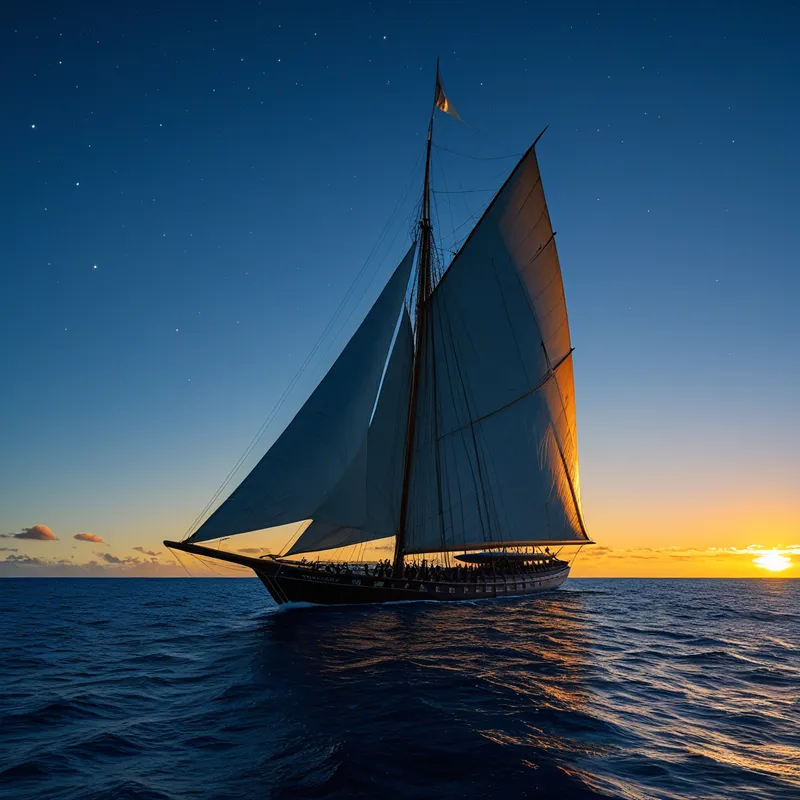
Ancestral voyagers, guided by stars and gods, cross an endless ocean to find new lands, carrying the future in their double-hulled canoes.
The Tale of The Migration Voyages
Listen. The ocean is not empty. It is a vast, breathing memory, a road paved by the ancestors. Before the great canoes, there was only the known world, a cradle of green islands. But the cradle grew tight. The whispers of the far horizon, carried on the east wind, grew into a song that could not be ignored.
The great navigator, Kupe, heard it clearest. He stood on the shore, feeling the pulse of the tide in his feet, watching the flight of the koekoeā. The sea called, a siren song of danger and destiny. He did not go alone. With him went his family, his crew—the brave and the willing. They built not a simple boat, but a waka hourua, a vessel of two souls bound together for balance, a floating island. They stocked it with precious shoots of kūmara, with coconuts, with dogs and rats, with the very seeds of life.
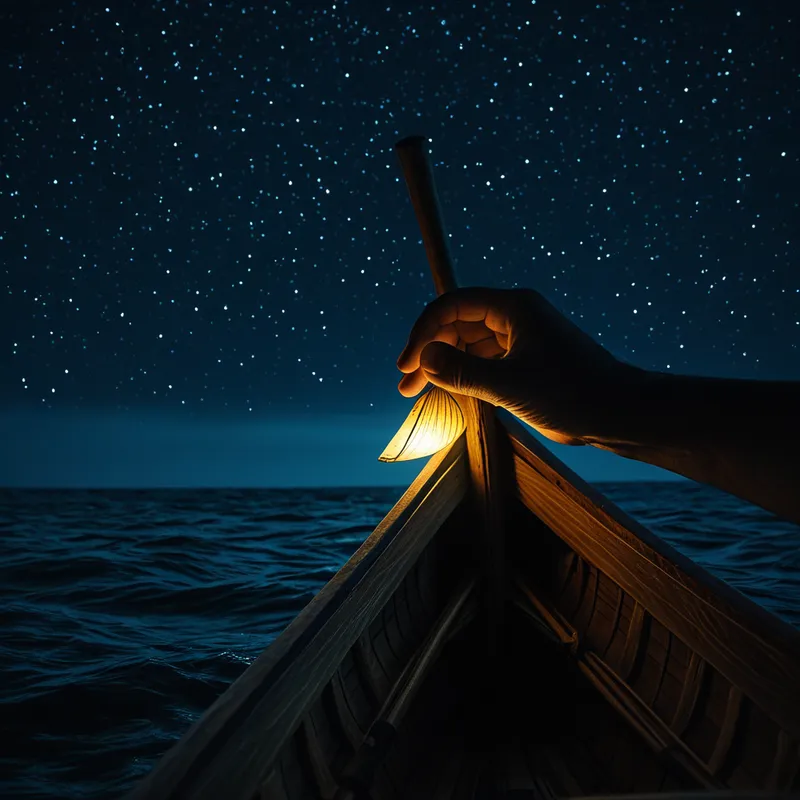
They launched into the moana, and the known world vanished behind a curtain of waves. Now there was only the dome of the sky and the endless, heaving plain of the sea. They sailed by the sun by day, a blazing guide. But the true map was written at night. Māui had fished up islands from the deep; now his star brethren would guide them. The navigator lay in the hull, feeling the swell’s direction, tasting the spray for the scent of land, reading the ocean’s rhythm like a heartbeat. He looked up. There was Hōkūle’a, the star of joy. There, the Maui’s Fishhook, glinting. The stars were not just lights; they were the eyes of the ancestors, the fixed points in the turning world.
Weeks passed. The water gourds grew light. Doubt, a colder current, began to seep into the crew. Where was the land? Had the stars lied? The navigator’s faith was tested in the marrow of his bones. Then, a sign: a flock of birds, flying with purpose. A change in the swell, rebounding from an unseen shore. A cloud on the horizon that did not move like other clouds—the cloud that sits above an island. A cry went up. From the void, a shape emerged: a dark green line, then the white lace of surf on a reef, then the smell of earth and flowers carried across the water. Whenua. They had not found an empty rock, but a new home. They stepped onto the sand, planted their shoots, and gave thanks to the ocean, the sky, and the courage that brought them. The voyage was complete, but the story was just beginning, for they would become the ancestors for those who would come after.
Cultural Origins & Context
This is not a single myth, but a living constellation of stories, chants, and genealogies (whakapapa) that form the bedrock of Polynesian identity. Passed down orally through generations by trained experts—navigators, priests (tohunga), and storytellers—these accounts of the great migrations (such as those from Hawaiki) served as historical record, navigational science, and social charter. They were recited at births, deaths, and land disputes, rooting a people in a specific journey and a specific canoe. The myth functioned as a cosmic map and a moral compass: it explained how a people came to be in their land, codified the sacred knowledge needed to survive the ocean, and instilled the values of preparation, observation, communal effort, and unwavering trust in ancestral wisdom. It was the ultimate story of purposeful becoming.
Symbolic Architecture
At its core, the Migration Voyage is a master symbol of the conscious journey into the unknown depths of the Self. The waka hourua represents the psyche itself—dual-natured, requiring balance between conscious and unconscious, intellect and instinct, to stay upright on the deep waters of transformation. The vast moana is the primordial unconscious, teeming with life and danger, the realm of all potential and all fear.
The navigator does not conquer the ocean; he learns its language, becoming a conscious part of its great, unconscious pattern.
The stars and signs are not external tools, but internalized knowledge—the guiding lights of intuition, inherited wisdom (whakapapa), and synchronicity. The moment of despair, when land is not seen, is the crucial dark night of the soul, where faith in one’s inner guidance is tested to its limit. The arrival at the new island (whenua) symbolizes the achievement of a new state of being, a new level of consciousness that was only a potential when the journey began. The voyage is never for the individual alone; the canoe carries the entire “seed” of a future world.
The Dreamer’s Resonance
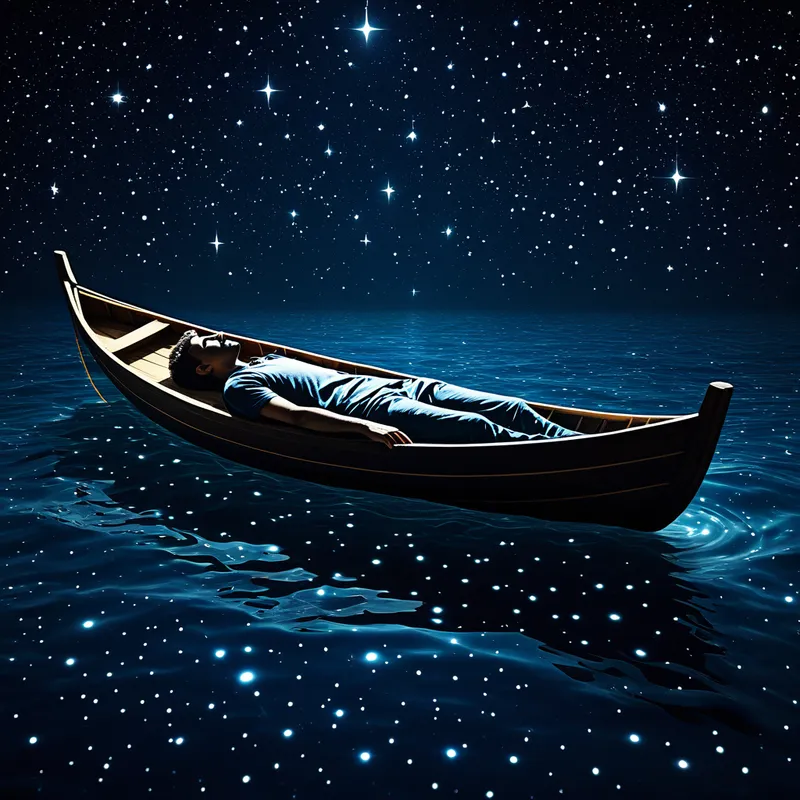
When this myth stirs in the modern dreamer, it often manifests as dreams of vast oceans, of being on a small boat, or of searching for a specific, faraway point. There is a somatic quality of rocking, of being carried by a great force. One might dream of reading a strange map, of following birds or stars, or of a looming, beautiful horizon. Psychologically, this indicates the psyche is engaged in a process of major re-orientation. The dreamer is in the “moana”—the unstructured, overwhelming space between life phases, identities, or understandings. The dream is not about literal travel, but about the internal voyage of leaving a known psychological “island” (a job, a relationship, a self-concept) and committing to the search for a new one. The anxiety in the dream is the weight of the unknown; the hope is the latent trust in inner navigation.
Alchemical Translation
For individuation—the process of psychic integration and wholeness—the Migration Voyage provides a flawless blueprint. The first alchemical step is the nigredo, the conscious recognition of confinement in the “old land,” prompting the call to voyage. Building the waka hourua is the labor of constructing a competent ego-structure, balanced enough to contain the journey.
The long crossing is the albedo, the whitening, where one must sustain oneself on scant resources (faith, memory, discipline) while navigating by the cold, clear light of inner stars (insights, values, dreams). The crisis of doubt is the crucial dissolution of the old ego’s certainty.
The new land does not appear until the voyager has fully internalized the map, until the external quest becomes an embodied knowing.
The arrival is the rubedo, the reddening or realization: the discovery of “land” within oneself—a new attitude, a creative insight, a solidified purpose. Finally, the act of planting the kūmara is the final stage: giving this new psychic reality life in the world, making it fruitful for the community of one’s soul and for others. The voyage transforms the wanderer into an ancestor, one who can now guide others.
Associated Symbols
Explore related symbols from the CaleaDream lexicon: