The Midas Touch Myth Meaning & Symbolism
A king's wish to turn all he touches to gold becomes a curse, revealing the barrenness of greed and the life-giving power of true connection.
The Tale of The Midas Touch
Hear now the tale of Midas, a king whose name became a whisper of warning for all who would listen. His kingdom was rich, his storerooms heavy with grain and wine, yet a hunger gnawed at him—a hunger not of the belly, but of the soul, a thirst for a splendor that outshone the sun itself.
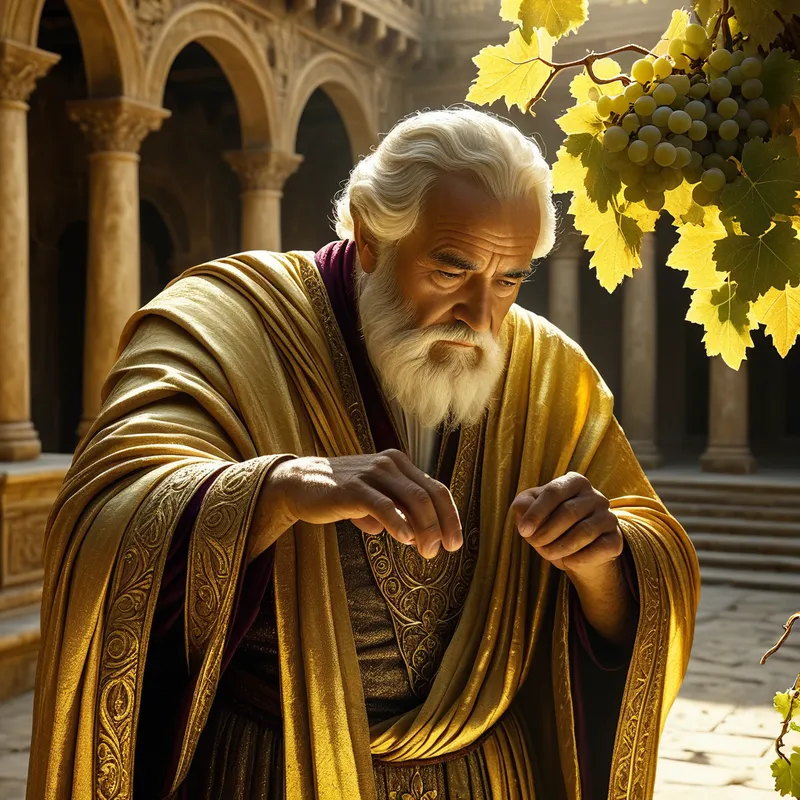
It began in a forest of whispering pines, where the old satyr Silenus, tutor to the god Dionysus, had stumbled, lost and wine-heavy. Midas found him, showed him kindness for ten days and nights, leading him back to his divine pupil. In gratitude, Dionysus offered the king a single wish, any boon his heart desired. The air grew thick with possibility. Midas did not pause to think of wisdom or long life. The words burst from him: “Grant that all I touch be turned to gold!”
The god’s smile was tinged with pity, but he nodded. “So be it.”
The king returned to his palace, his heart a drum of triumph. He reached for an oak branch; it stiffened in his hand, a rigid, gleaming artifact. He plucked a stone from the earth; it became a weighty nugget of pure sun-metal. He laughed, running through his halls, transforming a table, a spear, a tapestry—all into cold, perfect, immutable gold. Servants gaped in awe. Midas was a living alchemist, a god among men.
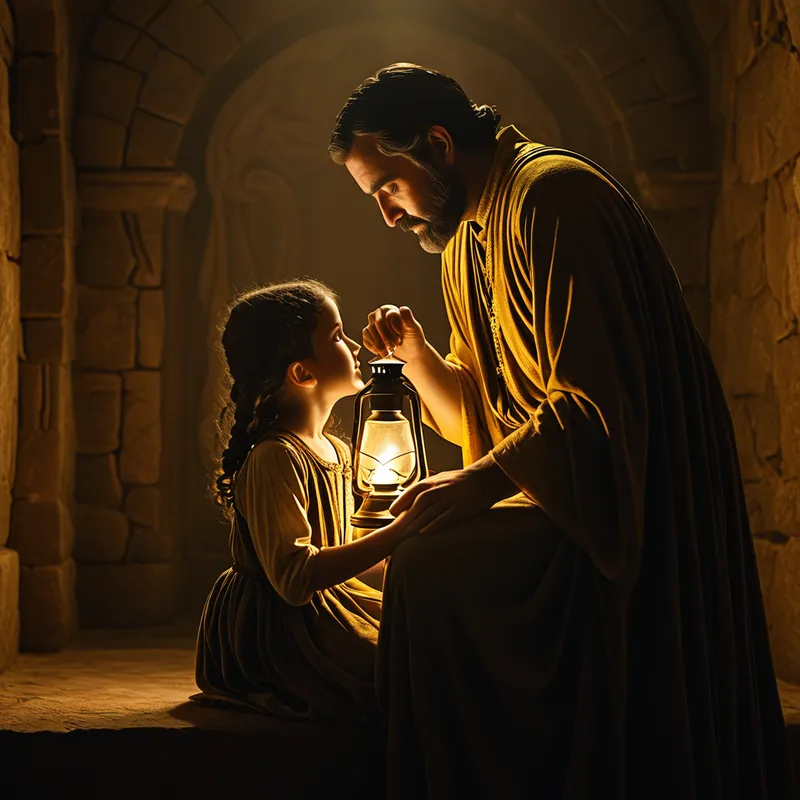
But then came the feast. He raised a cup of wine to his lips; the liquid hardened against them, a metallic seal. He tore a piece of bread from a loaf; it became a dense, inedible lump in his palm. Hunger and thirst, once simple complaints, became terrifying specters. The dread reached its zenith when his young daughter, seeing her father’s distress, ran to embrace him. Her small arms wrapped around his neck, and in that instant of love, she froze—a statue of breathtaking, heartbreaking gold, her face forever caught in an expression of concern.
The king’s cry shattered the silent grandeur of his golden court. He clutched his metallic child, and for the first time, he felt the true weight of gold: the weight of absolute loss, of life extinguished. His gift was a prison. His touch, death.
He crawled back to Dionysus, his robes stained with dust and tears, his golden crown a mockery. “Undo this curse! I was a fool! Take it back, I beg you!” The god, moved by this raw human anguish, instructed him to wash in the source of the river Pactolus. Midas plunged into the icy waters, and as he scrubbed his skin, the power flowed from him into the riverbed, legend says, leaving sands that glitter with gold to this day. He rushed back to his palace, and with trembling, human hands, he touched the golden statue of his daughter. The cold metal warmed, color flushed her cheeks, and she drew a gasping breath, alive once more. The king wept, holding not treasure, but his child.
Cultural Origins & Context
This myth springs from the rich soil of Anatolian and Greek tradition, most famously recorded in Ovid’s Metamorphoses. It is a Phrygian tale, from a kingdom famed for its wealth and its connection to the earthy, ecstatic cult of Cybele and Dionysus. Passed down by bards and poets, it functioned not as a historical account but as a profound moral and psychological fable for a society navigating the tensions between burgeoning material wealth (from trade, coinage) and the older, vitalistic values of community, harvest, and the sacred.
It was a story told to kings about the limits of kingship, to merchants about the nature of value, and to every person about the dangers of a wish made without foresight. It belongs to a universal class of “monkey’s paw” or “fool’s wish” narratives, where a literal granting of desire reveals its hidden, catastrophic shadow. It served as a societal check, a reminder that the gods’ gifts are complex and that true prosperity is rooted in the fertile, messy, and transient stuff of life, not in its static, metallic preservation.
Symbolic Architecture
At its heart, the myth of Midas is an anatomy of a psychic inflation. The “golden touch” symbolizes a singular, totalizing psychic attitude—in this case, the greed of the Ruler archetype run amok, seeking to convert the entire dynamic, living world into the one currency it understands: control, permanence, and quantified value.
The wish for the golden touch is the ego’s fantasy of omnipotence, the desire to make the unpredictable world perfectly predictable, to transform the flowing into the fixed.
Gold itself is ambivalent. Alchemically, it represents the highest goal, the Philosopher’s Stone, a symbol of the integrated Self. But in Midas’s hands, it is gold untempered by spirit; it is literalization, the concretization of a spiritual symbol into a dead object. He attempts to possess the symbol’s power without undergoing its required inner transformation. The result is not enlightenment, but a living death—an isolation where connection (the shared meal, the daughter’s embrace) is impossible.
The river Pactolus represents the necessary dissolution. The king must descend into the cleansing, fluid unconscious (the river) to wash away the rigid, conscious complex that has possessed him. This is an act of humility and surrender, the only antidote to inflationary pride.
The Dreamer’s Resonance
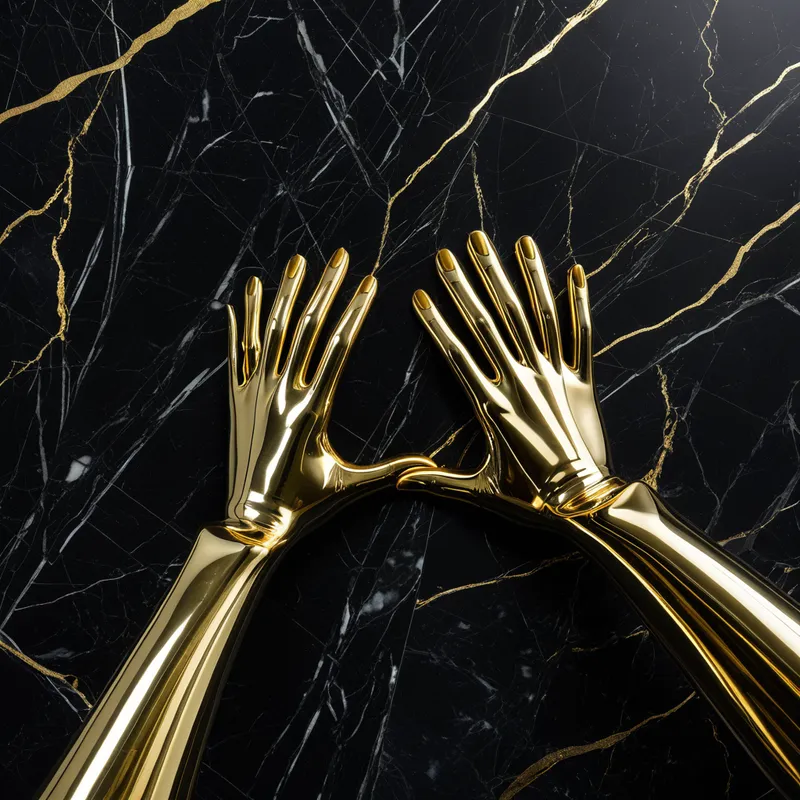
When this myth stirs in the modern dreamer, it often manifests as a somatic experience of a “curse of efficiency” or a “gift that isolates.” You may dream of your hands emitting a strange light or power that inadvertently destroys what you love. You might touch a pet, and it turns to glass or stone. You may find yourself in a house of beautiful, empty rooms where all furniture is plastic-wrapped or metallic, and you are starving.
These dreams signal a psychological process where an aspect of the personality—perhaps ambition, a drive for perfection, or a need for total control—has become so dominant it is severing your connection to the instinctual, nourishing, and vulnerable parts of life. The “Midas complex” is active. The dream is showing you the cost of your own “golden touch”: the emotional nourishment that has turned inedible, the relationships that have become frozen transactions, the inner child (the daughter) that you have sacrificed to your goal. The anxiety and hunger in the dream are the psyche’s urgent call for rehydration, for a return to the river.
Alchemical Translation
The myth models the full arc of psychic transmutation, or individuation. It begins in the nigredo, the blackening: Midas’s initial, unconscious greed. The granting of the wish is the albedo, the whitening—a false dawn, an inflation where the ego mistakes a partial truth (the power to transform) for the whole. The confrontation with the golden daughter is the crucial rubedo, the reddening or suffering, the emotional crisis that forces consciousness.
The curse is not the golden touch itself, but the unconsciousness with which it is wielded. The redemption is not its removal, but the conscious integration of its lesson.
The journey to the river Pactolus is the conscious engagement with the unconscious (the water) to dissolve the inflated complex. This is the solutio stage of alchemy. The final act—transforming the statue back into a living girl—is the true gold, the citrinitas or golden dawn of the integrated Self. The power to transform is not gone; it is redeemed. It is no longer used to turn life into metal, but to appreciate the metal in life—the enduring value of love, connection, and humility.
For the modern individual, the alchemy lies in recognizing our own “Midas wishes.” Where do we seek to turn the fluid processes of life (relationships, creativity, personal growth) into fixed, controllable assets? The myth invites us to wash that compulsive touch in the waters of reflection, to redeem our power by reconnecting with what is soft, perishable, and truly nourishing. The goal is not to renounce the “gold”—our talents, ambitions, or resources—but to learn to touch the world with hands that can both hold value and feel warmth, that can build and yet still embrace.
Associated Symbols
Explore related symbols from the CaleaDream lexicon: