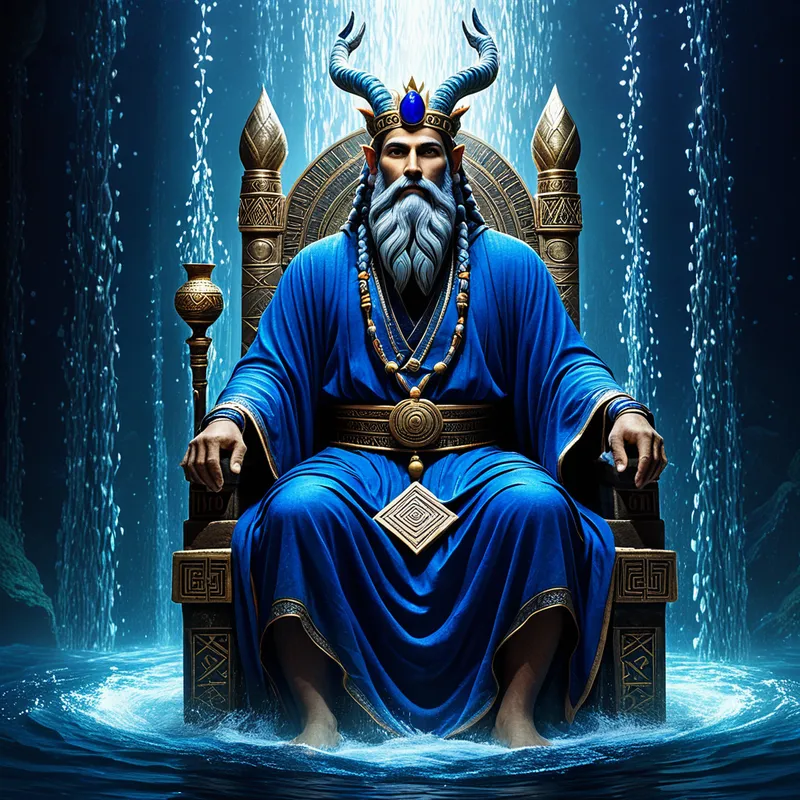
The Mesopotamian god Enki/Ea Myth Meaning & Symbolism
The story of the cunning god of sweet waters, who shaped humanity, outwitted divine wrath, and held the cosmic balance between order and chaos.
The Tale of The Mesopotamian god Enki/Ea
Before kings, before cities, when [the world](/myths/the-world “Myth from Tarot culture.”/) was young and raw, the cosmos was a clamor of gods. They labored, they toiled, digging the beds of the Two Rivers, piling up [the earth](/myths/the-earth “Myth from Hindu culture.”/) to make the land. Their divine backs ached, their spirits grew weary with a complaint that echoed through the Abzu, the sweet-[water](/myths/water “Myth from Chinese culture.”/) deep.
And in that deep, where silence was a presence and wisdom pooled in dark currents, dwelt Enki. He was the Lord of the Sweet Waters, the one who knew the Me, the sacred patterns of all things—from kingship to basket-weaving. He heard the gods’ cries, a dissonant music that troubled his realm.
He rose from his watery abode, his form shimmering like light on a deep well. “Enough,” his voice was the sound of a spring bubbling from stone. “The toil is too great. Let us create a being to bear the burden.” He summoned the mother goddess, Nintur. Together, in the chamber of fate, they took clay from the primordial silt of the Abzu. But clay alone makes only a vessel. It needs a spark, a destiny.
The great gods convened. A decree was passed: a god must be chosen, one who had fomented rebellion. That god was slain. And from his blood, mingled with the Abzu’s clay, Enki and Nintur kneaded the first substance of humanity. The divine midwives pinched and shaped the figures. Enki breathed upon them not life, but purpose: “You shall serve the gods. You shall bear their baskets.”
And so humanity was born from divine rebellion and divine cunning, a hybrid of earth, blood, and water. They multiplied, their noise rising to the heavens. And the gods, fickle and powerful, grew restless once more. The warrior god Enlil, lord of the air, could bear the clamor no longer. In a council shrouded in storm clouds, he decreed a flood—a return to the watery chaos, a washing clean of all he had made.
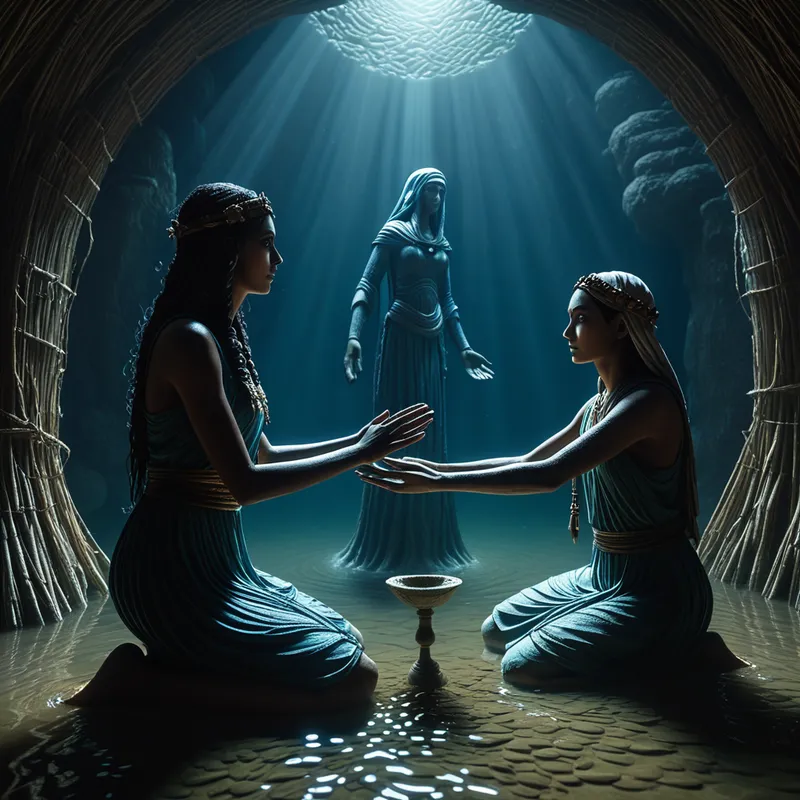
But Enki, the wise, the contriver, could not abide this unraveling of his craft. He did not defy Enlil openly, for order must be preserved. Instead, he went to the reed wall of a pious man, [Utnapishtim](/myths/utnapishtim “Myth from Mesopotamian culture.”/). Speaking through the wall, so as not to break his oath, his voice was the whisper of reeds in [the wind](/myths/the-wind “Myth from Various culture.”/). He revealed the secret decree. “Tear down your house,” he murmured, “and build a boat. A cube, sealed with bitumen. Bring the seed of all living things into it.”
The rains came. The Sebitti rode the winds. The world was drowned. But the cube-boat bobbed upon the furious waters, a tiny, sealed world of life upon the Abzu’s raging surface. When the waters receded, and Utnapishtim made an offering, the sweet smell of sacrifice reached the hungry gods. Enlil was enraged to see survivors—until Enki, the sage, spoke. “Should sin be on the sinner alone? To destroy all for the fault of some is to unravel the very order we uphold. Let there be limits. Let there be stillbirths and barrenness to curb humanity’s numbers, but let the line continue.”
And so it was. Balance was restored, not by sheer force, but by the cunning wisdom that flows beneath all things.
Cultural Origins & Context
This tapestry of tales is woven from threads of Sumerian and Akkadian tradition, spanning millennia in ancient Mesopotamia, the land between [the Tigris and Euphrates](/myths/the-tigris-and-euphrates “Myth from Mesopotamian culture.”/). Enki (Sumerian) or Ea (Akkadian) was not a god of distant Olympus, but of the vital, tangible source of life: the freshwater springs, the irrigation canals, the subterranean aquifers that made civilization possible in a harsh land. His myths were recited by temple priests and scribes in cities like Eridu, his primary cult center, considered the first city. These stories were not mere entertainment; they were cosmological maps and social contracts. They explained humanity’s fraught relationship with the divine (servitude tempered by protection), justified the necessity of hard labor, and offered a model of intelligence and diplomacy over brute force. [The flood](/myths/the-flood “Myth from Biblical culture.”/) story, most famously preserved in the Epic of [Gilgamesh](/myths/gilgamesh “Myth from Mesopotamian culture.”/), served as a foundational theodicy, explaining divine caprice and the precarious, gifted nature of human existence.
Symbolic Architecture
Enki/Ea is the [archetype](/symbols/archetype “Symbol: A universal, primordial pattern or prototype in the collective unconscious that shapes human experience, behavior, and creative expression.”/) of the Me—the inherent, hidden [logic](/symbols/logic “Symbol: The principle of reasoning and rational thought, often representing order, structure, and intellectual clarity in dreams.”/) within [chaos](/symbols/chaos “Symbol: In Arts & Music, chaos represents raw creative potential, uncontrolled expression, and the breakdown of order to forge new artistic forms.”/). He is not the [king](/symbols/king “Symbol: A symbol of ultimate authority, leadership, and societal order, often representing the dreamer’s inner power or external control figures.”/), but the advisor; not the [warrior](/symbols/warrior “Symbol: A spiritual archetype representing inner strength, discipline, and the struggle for higher purpose or self-mastery.”/), but the engineer; not the stern [father](/symbols/father “Symbol: The father figure in dreams often symbolizes authority, protection, guidance, and the quest for approval or validation.”/), but the clever, sometimes mischievous, [uncle](/symbols/uncle “Symbol: An uncle in a dream often symbolizes masculine guidance, family dynamics, and the influence of male role models in one’s life.”/) who knows how the [system](/symbols/system “Symbol: A system represents structure, organization, and interrelated components functioning together, often reflecting personal or social order.”/) works and how to work the system.
He represents the intelligence of the deep, unconscious psyche—the subterranean waters of instinct and pattern-recognition that nourish the ego’s arid surface.
His element, [water](/symbols/water “Symbol: Water symbolizes the subconscious mind, emotions, and the flow of life, representing both cleansing and creation.”/), is profoundly symbolic: it is the medium of [life](/symbols/life “Symbol: The symbol of ‘Life’ represents a journey of growth, interconnectedness, and existential meaning, encompassing both the joys and challenges that define human experience.”/), the solvent that mixes disparate elements ([clay](/symbols/clay “Symbol: Clay symbolizes malleability, creativity, and the potential for transformation, representing the foundational aspect of life and the ability to shape one’s destiny.”/) and [blood](/symbols/blood “Symbol: Blood often symbolizes life force, vitality, and deep emotional connections, but it can also evoke themes of sacrifice, trauma, and mortality.”/)), the [realm](/symbols/realm “Symbol: The symbol of ‘Realm’ often signifies the boundaries of one’s consciousness, experiences, or emotional states, suggesting aspects of reality that are either explored or ignored.”/) of the unseen, and the agent of both cleansing and destruction. His cunning in saving humanity via the [reed](/symbols/reed “Symbol: A flexible plant symbolizing resilience, adaptability, and vulnerability. It bends without breaking, representing survival through yielding.”/) [wall](/symbols/wall “Symbol: Walls in dreams often symbolize boundaries, protection, or obstacles in one’s life, reflecting the dreamer’s feelings of confinement or security.”/) illustrates a core psychological [truth](/symbols/truth “Symbol: Truth represents authenticity, honesty, and the quest for knowledge beyond mere appearances.”/): wisdom often operates indirectly, through [intuition](/symbols/intuition “Symbol: The immediate, non-rational understanding of truth or insight, often described as a ‘gut feeling’ or inner knowing that bypasses conscious reasoning.”/) and symbolic communication (the whisper), navigating the constraints of conscious oaths and superego demands (Enlil’s decree). He is [the principle](/symbols/the-principle “Symbol: A fundamental truth, law, or doctrine that serves as a foundation for a system of belief, behavior, or reasoning, often representing moral or ethical standards.”/) of [adaptation](/symbols/adaptation “Symbol: The process of adjusting to new conditions, often involving psychological or physical change to survive or thrive.”/) and preservation, ensuring the survival of [consciousness](/symbols/consciousness “Symbol: Consciousness represents the state of awareness and perception, encompassing thoughts, feelings, and experiences.”/) (humanity) through the great floods of psychic overwhelm.
The Dreamer’s Resonance
To dream in the pattern of Enki is to dream of subterranean solutions and ethical cunning. One might dream of discovering a hidden spring in a barren landscape, of receiving crucial advice through an indirect or coded message (a note, a symbol in a wall), or of successfully navigating a [great flood](/myths/great-flood “Myth from Mesopotamian culture.”/) by being inside a sealed, protective structure of one’s own making.
Somatically, this can feel like a release of pressure, a finding of fluidity in a situation perceived as rigid or desiccated. Psychologically, the dreamer is likely grappling with a seemingly absolute decree from their inner “Enlil”—a rigid moral code, a towering rage, or an annihilating depression that threatens to wipe out their sense of self. The Enki process is the emergence of a deeper, more nuanced intelligence from the psychic depths, offering a contrarian path to survival that honors [the law](/myths/the-law “Myth from Biblical culture.”/) while subverting its destructive intent. It is the dream of the savvy survivor, not the conquering hero.

Alchemical Translation
The individuation process modeled by Enki is not one of heroic conquest, but of intelligent integration and diplomatic mediation. The “Abzu” is [the personal unconscious](/myths/the-personal-unconscious “Myth from Jungian Psychology culture.”/), a deep, often dark reservoir of forgotten knowledge, instincts, and creative potential. The conscious ego, like the laboring gods, often exhausts itself trying to manage reality through sheer effort.
The alchemical work is to descend, like Enki to his abode, to consult this inner wisdom. It involves mixing the “clay” of one’s earthly nature with the “blood” of a sacrificed inner content—perhaps a naive ideal or a rebellious impulse—to create a servant, a functioning personality that can bear the burdens of life.
[The great flood](/myths/the-great-flood “Myth from Biblical culture.”/) is the inevitable psychic crisis, when the accumulated tensions and ignored contents of the unconscious threaten to overwhelm [the ego](/myths/the-ego “Myth from Jungian culture.”/)-complex. The Enki-oriented [psyche](/myths/psyche “Myth from Greek culture.”/) does not try to stop the flood (which is impossible), nor does it abandon its responsibility. It builds an ark—a contained, sealed vessel of consciousness (a practice, a creative work, a therapeutic container) designed by inner wisdom. This vessel preserves the “seed of all living things”—the core potentials of [the Self](/myths/the-self “Myth from Jungian culture.”/)—through the dissolution.
The ultimate [triumph](/myths/triumph “Myth from Roman culture.”/) is not victory, but the establishment of a new, more conscious covenant. It is the recognition that life requires limits (barrenness, mortality) to have meaning, and that true order is not the static rule of a single principle (Enlil’s storm), but the dynamic, fluid balance negotiated by the wise, mediating consciousness. To integrate Enki is to become a craftsperson of one’s own destiny, using the deep, flowing wisdom from within to navigate the divine and chaotic demands of existence.
Associated Symbols
Explore related symbols from the CaleaDream lexicon: