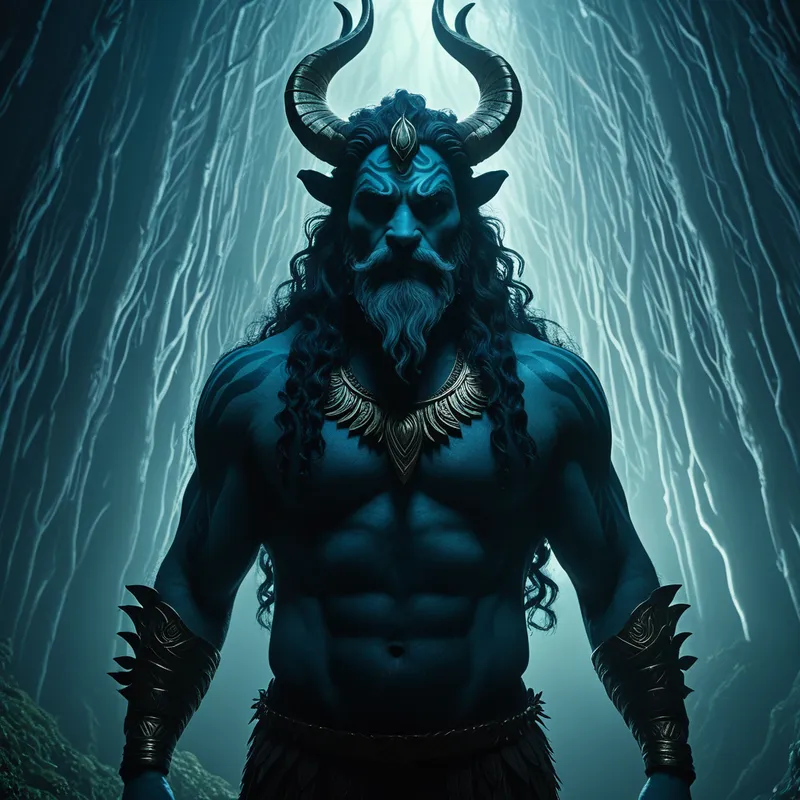
The Merkabah Chariot Vision
A profound mystical vision from Hebrew tradition where Ezekiel witnesses a divine chariot, symbolizing spiritual ascent and cosmic order.
The Tale of The Merkabah Chariot Vision
The tale begins not in a temple, but in exile. By the waters of Babylon, the priest Ezekiel sat among the displaced, his soul a vessel of collective grief and dislocation. It was there, in the thirtieth year, as the heavens opened, that the hand of the Lord came upon him. He did not seek the vision; it sought him, a tempest of spirit breaking upon the shores of his perception.
He looked, and behold, a stormy wind came out of the north, a great cloud with flashing fire, and brightness all around it. From within the midst of the fire came something like gleaming amber. And within it, [the forms](/myths/the-forms “Myth from Platonic culture.”/) of [four living creatures](/myths/four-living-creatures “Myth from Abrahamic culture.”/) emerged. This was no gentle [epiphany](/myths/epiphany “Myth from Greek culture.”/), but a cataclysm of sight and sound that shattered ordinary reality. Each creature had four faces—that of a human, a lion, an ox, and an eagle—and four wings. Their legs were straight, and the soles of their feet were like the sole of a calf’s foot, sparkling like burnished bronze. Under their wings were human hands. Their wings touched one another as they moved; they did not turn as they went, each moving straight forward wherever the spirit would go.
The sight was one of overwhelming, coordinated motion, a symphony of eyes covering their bodies, seeing all things at once. And beside each living creature was a wheel, a wheel within a wheel. Their rims were tall and awesome, full of eyes all around. Wherever the spirit would go, the wheels went, for the spirit of the living creatures was in the wheels. Above the heads of the living creatures was the likeness of an expanse, shining like awe-inspiring crystal, spread out above their heads.
And above the expanse, there was the likeness of a throne, in appearance like sapphire. Seated upon the likeness of the throne was a likeness with a human form. From what appeared as his waist upward, it was like gleaming metal, full of fire; and downward it was like fire, with brightness all around. Like the appearance of the bow in a cloud on a rainy day, so was the appearance of the brightness all around. Such was the appearance of the likeness of the glory of the Lord.
When Ezekiel saw it, he fell on his face. A voice spoke. It did not offer comfort for his exile, but a commission. “Son of man, stand on your feet, and I will speak with you.” The spirit entered him and set him on his feet, and the voice charged him to speak to a rebellious house, whether they listened or not. The vision was not an end, but a terrifying beginning. The divine mobile throne, the [Merkabah](/myths/merkabah “Myth from Hebrew culture.”/), was revealed not as a static icon of power, but as the dynamic, unsettling presence of a God who moves, who sees all, and whose purposes unfold in the very midst of [chaos](/myths/chaos “Myth from Greek culture.”/) and displacement.
Cultural Origins & Context
Ezekiel’s vision is rooted in the profound trauma of the Babylonian Exile (c. 597–538 BCE). The destruction of [the Temple](/myths/the-temple “Myth from Jewish culture.”/) in [Jerusalem](/myths/jerusalem “Myth from Biblical culture.”/) and the forced migration of Judah’s elite represented not just a political catastrophe, but a theological and cosmological crisis. The central pillars of reality—[the promised land](/myths/the-promised-land “Myth from Biblical culture.”/), the Davidic dynasty, and, most critically, the dwelling place of God in [the Temple](/myths/the-temple “Myth from Jewish culture.”/)—had been violently upended. Where was God’s glory now? Could divinity be confined to a ruined city, or had it abandoned its people entirely?
The vision by the Chebar canal is a direct response to this existential rupture. It performs a radical relocation of the sacred. The [Shekhinah](/myths/shekhinah “Myth from Jewish Mysticism culture.”/) is no longer fixed behind [the Temple veil](/myths/the-temple-veil “Myth from Christian culture.”/); it is mobile, transcendent yet immanent, revealed to a single individual in a foreign land. This re-mapping of the divine onto a personal, visionary experience became the bedrock of later Jewish mysticism. The vision’s dense, almost architectural symbolism draws from ancient Near Eastern motifs—the four-faced [cherubim](/myths/cherubim “Myth from Judeo-Christian culture.”/) guarding thrones, the wheeled platforms of Mesopotamian deities—but it rigorously subsumes them into a fiercely monotheistic framework. It is a vision born of cultural [death](/myths/death “Myth from Tarot culture.”/), asserting that the structure of the cosmos and the throne of the Holy One remain intact, even when every earthly institution has fallen to dust.
Symbolic Architecture
The Merkabah is not merely a [vehicle](/symbols/vehicle “Symbol: Vehicles in dreams often symbolize the direction in life and the control one has over their journey, reflecting personal agency and decision-making.”/); it is a symbolic [blueprint](/symbols/blueprint “Symbol: A blueprint represents the foundational plan or design for something, often symbolizing potential, structure, and the mapping of one’s inner self or future.”/) of a living, conscious [cosmos](/symbols/cosmos “Symbol: The entire universe as an ordered, harmonious system, often representing the totality of existence, spiritual connection, and the unknown.”/). Every element is a [cipher](/symbols/cipher “Symbol: A secret code or hidden message requiring decoding, often representing concealed truths, intellectual challenge, or artistic expression through patterns.”/) for a divine attribute and a [layer](/symbols/layer “Symbol: Layers often symbolize complexity, depth, and protection in dreams, representing the various aspects of the self or situations.”/) of psychic [reality](/symbols/reality “Symbol: Reality signifies the state of existence and perception, often reflecting one’s understanding of truth and life experiences.”/).
The Four Living Creatures (Chayot) represent the totality of creation—the [human](/symbols/human “Symbol: The symbol of a human represents individuality, complexity of emotions, and social relationships.”/) (reason), the [lion](/symbols/lion “Symbol: The lion symbolizes strength, courage, and authority, often representing one’s inner power or identity.”/) (wild [strength](/symbols/strength “Symbol: ‘Strength’ symbolizes resilience, courage, and the ability to overcome challenges.”/)), the ox (patient service), and the [eagle](/symbols/eagle “Symbol: The eagle is a symbol of power, freedom, and transcendence, often representing a person’s aspirations and higher self.”/) (soaring [spirit](/symbols/spirit “Symbol: Spirit symbolizes the essence of life, vitality, and the spiritual journey of the individual.”/)). They are the archetypal powers of the natural and spiritual worlds, unified in service to the One above. Their multiple faces and eyes signify omniscience and the [capacity](/symbols/capacity “Symbol: A measure of one’s potential, limits, or ability to contain, process, or achieve something, often reflecting self-assessment or external demands.”/) to perceive reality from all dimensions simultaneously. Their [movement](/symbols/movement “Symbol: Movement symbolizes change, progress, and the dynamics of personal growth, reflecting an individual’s desire or need to transform their circumstances.”/), “straight forward,” speaks of a divine will that is singular and unwavering.
The Wheels Within Wheels (Ophanim) signify the complex, interlocking mechanisms of providence and cosmic law. Their eyes denote the all-seeing [nature](/symbols/nature “Symbol: Nature symbolizes growth, connectivity, and the primal forces of existence.”/) of this order; nothing is hidden from its gaze. That their spirit is one with the living creatures illustrates the profound [integration](/symbols/integration “Symbol: The process of unifying disparate parts of the self or experience into a cohesive whole, often representing psychological wholeness or resolution of internal conflict.”/) of animate [life](/symbols/life “Symbol: The symbol of ‘Life’ represents a journey of growth, interconnectedness, and existential meaning, encompassing both the joys and challenges that define human experience.”/) and the mechanistic structures of the [universe](/symbols/universe “Symbol: The universe symbolizes vastness, interconnectedness, and the mysteries of existence beyond the individual self.”/)—a [harmony](/symbols/harmony “Symbol: A state of balance, agreement, and pleasing combination of elements, often associated with musical consonance and visual or social unity.”/) of [soul](/symbols/soul “Symbol: The soul represents the essence of a person, encompassing their spirit, identity, and connection to the universe.”/) and law.
The throne above the expanse signifies the ultimate separation and otherness of the divine essence, the Ein Sof, while the human-like form upon it (demut ke-mar’eh adam) represents the knowable aspect of God, the bridge between absolute transcendence and human comprehension.
The storm wind from the north, the [direction](/symbols/direction “Symbol: Direction in dreams often relates to life choices, guidance, and the path one is following, emphasizing the importance of navigation in personal journeys.”/) of [mystery](/symbols/mystery “Symbol: An enigmatic, unresolved element that invites curiosity and exploration, often representing the unknown or hidden aspects of existence.”/) and hiddenness in Hebrew thought, signals that this [revelation](/symbols/revelation “Symbol: A sudden, profound disclosure of truth or insight, often through artistic or musical means, that transforms understanding.”/) emerges from the unknown [depths](/symbols/depths “Symbol: Represents the subconscious, hidden emotions, or foundational aspects of the self, often linked to primal fears or profound truths.”/) of the divine. The overall [impression](/symbols/impression “Symbol: An impression symbolizes the impact of experiences and the perceptions formed in waking life.”/) is of a reality that is intensely ordered, dynamically alive, and terrifyingly intelligent—a cosmos that is a [body](/symbols/body “Symbol: The body in dreams often symbolizes the dreamer’s self-identity, personal health, and the relationship they have with their physical existence.”/) for the divine will.
The Dreamer’s Resonance
For the modern [psyche](/myths/psyche “Myth from Greek culture.”/), Ezekiel’s vision resonates not as a theological artifact but as a profound archetypal event. It is the ultimate “[vision quest](/myths/vision-quest “Myth from Native American culture.”/),” erupting during a life crisis of total disorientation—exile. The vision provides a map when all external maps have been destroyed. It speaks to the [psyche](/myths/psyche “Myth from Greek culture.”/)’s capacity, in its deepest despair, to generate or receive an image of wholeness and supreme order.
The overwhelming, even frightening, sensory overload of the vision mirrors the psyche’s initial resistance to profound transformation. The command “Stand on your feet!” is the call to integrate this numinous experience, to let it empower rather than annihilate [the ego](/myths/the-ego “Myth from Jungian culture.”/). The Merkabah becomes an internal symbol of [the Self](/myths/the-self “Myth from Jungian culture.”/)—the central, organizing principle of the psyche that contains and coordinates all opposing forces (the four faces), perceives with uncanny clarity (the eyes), and moves with purposeful direction (the wheels and the spirit). To encounter it is to confront the awesome, impersonal machinery of one’s own destiny and the sacred center of one’s being.
Alchemical Translation
Psychologically, the Merkabah vision is an alchemical opus depicted in visionary form. The exile by [the river](/myths/the-river “Myth from Buddhist culture.”/) is the [nigredo](/myths/nigredo “Myth from Alchemical culture.”/), the blackening—the dissolution of all former identities and securities. The fiery cloud and gleaming metal are the [albedo](/myths/albedo “Myth from Alchemical culture.”/), the whitening—the searing, purifying revelation that burns away illusion.
The process described is one of exaltatio—a spiritual ascension through the layered heavens (the expanse, the throne) to witness the lapis philosophorum, the divine Anthropos, the perfected image of the human at the heart of reality.
The integration of the four disparate creatures into a single, coordinated movement symbolizes the [coniunctio oppositorum](/myths/coniunctio-oppositorum “Myth from Alchemical culture.”/), [the sacred marriage](/myths/the-sacred-marriage “Myth from Various culture.”/) of psychic opposites within the individual. The human integrates the strength of the lion, the endurance of the ox, and the perspective of the eagle. The wheels turning in unison with the spirit reflect the alignment of one’s personal will and life’s circumstances (the wheels of fate) with the transpersonal spirit. The vision does not promise a return to the old Jerusalem, but the revelation of a new inner Jerusalem—a psychic structure of sublime order born from the ashes of the old.
Associated Symbols
Explore related symbols from the CaleaDream lexicon:
- Vision — The primary mode of revelation, a transcendent seeing that restructures reality and grants knowledge of hidden cosmic orders.
- Chariot — A vehicle for divine movement and power, representing the means of spiritual ascent and the dynamic structure of the cosmos.
- Throne — The seat of ultimate authority and the stable center around which all cosmic activity revolves, symbolizing divine sovereignty and the Self.
- Wheel — The cyclical and interlocking mechanisms of fate, law, and providence, denoting the complex, eye-like awareness of cosmic order.
- Fire — The purifying and revealing element of divine presence, both terrifying and illuminating, that consumes impurity and manifests glory.
- Spirit — The animating wind or breath that directs all movement, the invisible force of will and life that unites creature and wheel.
- Eye — The symbol of omniscient perception, seeing from all directions and dimensions, representing divine knowledge and the illuminated consciousness.
- Storm — The chaotic, overwhelming force from the hidden north that precedes revelation, symbolizing the disruptive power that breaks open ordinary awareness.
- Expanse — The crystalline firmament separating the earthly from the heavenly, representing [the threshold](/myths/the-threshold “Myth from Folklore culture.”/) or veil between levels of reality.
- Human Form — The anthropomorphic image of the divine, serving as the bridge between absolute transcendence and human understanding, the knowable face of the unknowable.
- Merkaba — The specific, geometrically complex vehicle of light and spirit, representing the integration of body, heart, and mind for the purpose of ascension and mystical union.
- Journey — The fundamental narrative of displacement and spiritual seeking that provides the context for the vision, representing the soul’s passage through exile toward revelation.