The Memory Palace Myth Meaning & Symbolism
A myth of a divine architect who builds a palace of memory to contain all knowledge, only to have it shattered and scattered, awaiting a hero's quest for reintegration.
The Tale of The Memory Palace
In the time before time was measured, when the breath of the All was still warm upon the face of the deep, there lived a being known as the Mnemosynarch. He was not a god of thunder or love, but of memory—the silent, shimmering substance from which all things are recalled into being. He dwelt in the liminal space between the fixed stars and the swirling chaos, a realm of pure potential.
His heart ached with a divine loneliness, for he contained within himself the echo of every event, the blueprint of every form, the name of every star, yet they were formless, a brilliant, churning fog. So, from the substance of his own being—from the silver of recollection and the gold of understanding—he began to build. Not a fortress, not a temple, but a Palace of Mneme.
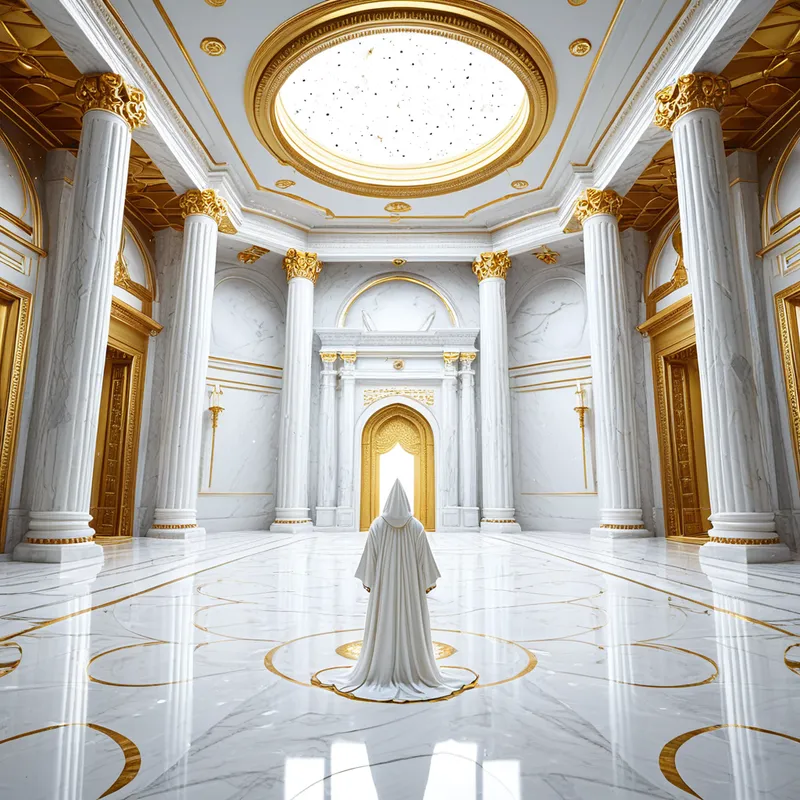
Walls rose not of stone, but of solidified moments, each brick a perfectly preserved sensation. Hallways stretched into infinity, lined with mirrors that reflected not faces, but truths. In one wing, [the music of the spheres](/myths/the-music-of-the-spheres “Myth from Greek culture.”/) played eternally in vaulted chambers of crystal. In another, gardens of metaphor bloomed with flowers whose petals were pages of unwritten books. At its heart lay the Thalamos of the Anamnesis, a room with a single, pulsing orb that was the perfect, unified memory of the All. It was a perfect system, a cosmos in miniature, where every fact, every feeling, every forgotten dream had its sacred place.
But perfection is a provocation to chaos. From the outer dark, a whispering entropy, called the Skotadinos, beheld the palace. It could not bear the radiant order, the terrible clarity. It did not attack with claw or flame, but with a single, corrosive question, breathed against the palace’s foundations: “What if you forget?”
The question was a seed of doubt. The Mnemosynarch, for the first time, felt a tremor—not in his palace, but in his certainty. The shimmering walls flickered. In that instant of divine hesitation, the Skotadinos struck. A silent, shattering wave passed through the Palace of Mneme. It did not crumble to dust, but exploded into a billion glittering shards. Each fragment—a piece of knowledge, a slice of beauty, a fragment of law—was scattered across the lower worlds, falling through the realms of gods, heroes, and humans, burying itself in matter, in myth, in the blind soil of instinct.
The Mnemosynarch did not die. He dissolved into a sigh that became [the wind](/myths/the-wind “Myth from Various culture.”/), his voice the instinct to seek, his tears the salt in the human sea of longing. And the myth whispers that the palace was not destroyed, but sleeping, its blueprint latent in the soul of every living [thing](/myths/thing “Myth from Norse culture.”/). It awaits the one who can endure the longing, gather the scattered light, and in remembering, rebuild.

Cultural Origins & Context
This myth finds its roots not in a single scripture, but in the fragmented corpus of Hermetica, blending Egyptian cosmological thought with Hellenistic philosophy. It was an oral teaching, a “whispered tradition,” passed from teacher to initiate in the mystery schools of late antiquity. The storyteller was not a bard for the masses, but a guide for the philosophically inclined, often framing it as an allegory for the soul’s descent into matter and its potential ascent.
Its societal function was deeply psychological and pedagogical. In a pre-printing press world, memory was the primary library. The myth served as a metaphysical justification for the classical memory technique of the method of loci (the “memory palace” technique), framing it not as a mere mental trick, but as a microcosmic participation in a divine, cosmological process. To train one’s memory was to perform a sacred act of recollection (anamnesis), gathering the scattered fragments of divine knowledge within oneself. It taught that ignorance is not a void, but a fragmentation, and that wisdom is the arduous labor of psychic reintegration.
Symbolic Architecture
The myth is a profound map of the [psyche](/myths/psyche “Myth from Greek culture.”/). The Mnemosynarch represents the Nous, the divine mind or true self, which seeks to give order to the raw [material](/symbols/material “Symbol: Material signifies the tangible aspects of life, often representing physical resources, desires, and the physical world’s influence on our existence.”/) of experience. The [Palace](/symbols/palace “Symbol: A palace symbolizes grandeur, authority, and the pursuit of one’s ambitions or dreams, often embodying a desire for stability and wealth.”/) is the ideal, integrated [psyche](/myths/psyche “Myth from Greek culture.”/)—a Self where every [memory](/symbols/memory “Symbol: Memory symbolizes the past, lessons learned, and the narratives we construct about our identities.”/), [trauma](/symbols/trauma “Symbol: A deeply distressing or disturbing experience that overwhelms the psyche, often manifesting in dreams as unresolved emotional wounds or psychological injury.”/), talent, and [insight](/symbols/insight “Symbol: A sudden, deep understanding of a complex situation or truth, often arriving unexpectedly and illuminating hidden connections.”/) has its rightful, harmonious place.
The shattered palace is not a tragedy, but the necessary condition for experience. Wholeness must be forgotten so that it may be earned.
The Skotadinos is not merely an external [villain](/symbols/villain “Symbol: A character representing opposition, moral corruption, or suppressed aspects of self, often embodying fears, conflicts, or societal threats.”/), but the inherent principle of [entropy](/symbols/entropy “Symbol: In arts and music, entropy represents the inevitable decay of order into chaos, often symbolizing creative destruction, impermanence, and the natural progression toward disorder.”/) within existence itself—the tendency toward [dissociation](/symbols/dissociation “Symbol: A psychological separation from one’s thoughts, feelings, or identity, often experienced as a journey away from the self during trauma or stress.”/), forgetfulness, and decay. Its corrosive question, “What if you forget?”, mirrors the primal [anxiety](/symbols/anxiety “Symbol: Anxiety in dreams reflects internal conflicts, fears of the unknown, or stress from waking life, often demonstrating the subconscious mind’s struggle for peace.”/) at the root of [the ego](/myths/the-ego “Myth from Jungian culture.”/), the fear of [dissolution](/symbols/dissolution “Symbol: The process of breaking down, dispersing, or losing form, often representing transformation, release, or the end of a state of being.”/) that paradoxically causes us to fragment our own experience. The scattering of the [shards](/symbols/shards “Symbol: Fragments of a broken whole, representing destruction, potential reconstruction, or irreparable loss.”/) symbolizes the descent of pure [consciousness](/symbols/consciousness “Symbol: Consciousness represents the state of awareness and perception, encompassing thoughts, feelings, and experiences.”/) into the [fragmentation](/symbols/fragmentation “Symbol: The experience of breaking apart, losing cohesion, or being separated into pieces. Often represents disintegration of self, relationships, or reality.”/) of embodied [life](/symbols/life “Symbol: The symbol of ‘Life’ represents a journey of growth, interconnectedness, and existential meaning, encompassing both the joys and challenges that define human experience.”/), where unity is lost and [knowledge](/symbols/knowledge “Symbol: Knowledge symbolizes learning, understanding, and wisdom, embodying the acquisition of information and enlightenment.”/) is partial, hidden in the “matter” of our daily lives and unconscious complexes.
The Dreamer’s Resonance
When this myth stirs in the modern unconscious, it manifests in dreams of searching and assembling. You may dream of wandering through a vast, labyrinthine building—a library, museum, or abandoned mansion—searching for a specific room or object you cannot name. You might find drawers full of disconnected objects (keys, photographs, stones) that feel urgently significant. The somatic sensation is often one of anxious focus, a “tip-of-the-tongue” feeling magnified into a full-body quest.
This dream pattern signals a profound psychological process: the ego’s recognition that a vital piece of [the Self](/myths/the-self “Myth from Jungian culture.”/) is missing. It is the psyche initiating its own process of individuation. The dream is not about finding a literal memory, but about retrieving a lost aspect of your potential—a repressed talent, an unlived life, a buried trauma that holds energy. The fragmented palace in the dream is your own unintegrated psyche, and the search is the call to make the unconscious conscious.

Alchemical Translation
The myth models the entire alchemical opus of the soul. The initial, perfect Palace is the [prima materia](/myths/prima-materia “Myth from Alchemical culture.”/)—the original, divine state we unconsciously long to return to. The shattering is the [nigredo](/myths/nigredo “Myth from Alchemical culture.”/), the necessary “dark night of the soul,” where our illusions of wholeness are broken apart. The hero’s quest to gather the shards is the long and meticulous albedo—the whitening, the work of conscious recollection and purification, where we sift through the contents of our lives.
To remember in the Hermetic sense is not to recall a fact, but to re-member the Self—to put the scattered parts of the soul back into a living, conscious relationship.
Each reclaimed shard is a moment of insight, a healed complex, an integrated shadow aspect. The final act of rebuilding the palace within is the [rubedo](/myths/rubedo “Myth from Alchemical culture.”/)—the reddening, the creation of [the Philosopher’s Stone](/myths/the-philosophers-stone “Myth from Alchemical culture.”/). This is not a return to the old, naive perfection, but the creation of a new, conscious wholeness that has incorporated and transcended the experience of fragmentation. The modern individual undergoing this process moves from a state of being lived by unconscious fragments (complexes, triggers, compulsions) to living from a consciously assembled center. The Memory Palace, once an external myth, becomes the internal architecture of a sovereign soul.
Associated Symbols
Explore related symbols from the CaleaDream lexicon: