The Medicine Tree Myth Meaning & Symbolism
A sacred tree offers its life to heal a dying world, becoming the source of all medicine and the root of humanity's covenant with nature.
The Tale of The Medicine Tree
In the time before time, when the world was young and the people were new, a great shadow fell upon the land. It was not a shadow of night, but of sickness—a creeping silence that stilled the songs of the birds, a withering breath that browned the grasses, a cold fever that shook the bones of the people. The rivers ran slow and thick. The game grew thin and fearful. The laughter of children turned to a weak crying, and the elders’ stories were interrupted by coughs that rattled like stones in a dry gourd. The world was dying, and with it, the heart of the people.
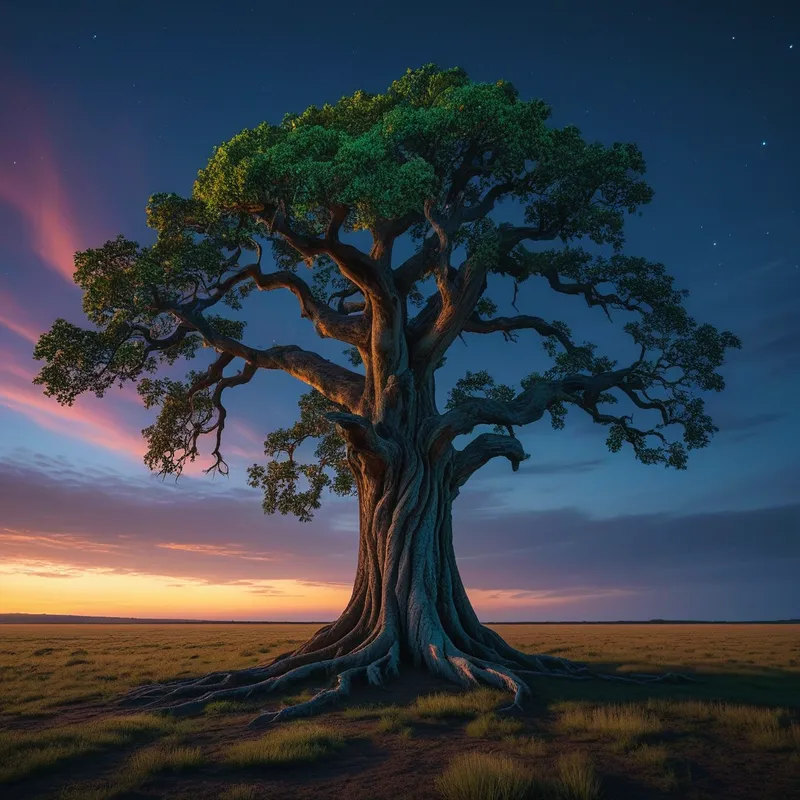
In the center of all lands, where the four winds met, stood a single, magnificent tree. It was the First Tree, The One Who Watches. Its branches held up the sky, its roots drank from the deepest waters of the earth. Its leaves were every shade of green, and its bark shone with the colors of dawn and dusk. All life knew this tree, and the tree knew all life. It felt the shivering of the rabbit in its burrow, the labored breath of the bison, the fading pulse of the human heart.
As the sickness spread, the spirits of the land—the keepers of the stone, the water, the fire, and the air—gathered at the tree’s base. Their forms flickered like heat haze. “We are being unmade,” whispered the Spirit of the Stream. “Our children forget their names,” groaned the Spirit of the Bison. They turned their faces, which were like landscapes of concern, to the great tree.
The tree did not speak with a voice of air, but with a voice of presence. A deep, resonant feeling settled over the gathering, a question that grew in the heart: What is given must be returned. What is broken must be made whole. But what can heal a wound that touches all?
Then, a knowing came, not from the spirits, but from the tree itself. It was a decision that rang through its rings, from the newest growth to the ancient heartwood. The tree would give itself. Not a branch, not a leaf, but its very essence—its life as a singular being—to become medicine for all. It was the ultimate act of reciprocity, a turning inside-out of its own existence.
A great stillness fell. Then, a single leaf, glowing with a soft, internal gold, detached and spiraled down. Where it touched the earth, a small, vibrant plant sprouted instantly—a plant none had ever seen, with leaves shaped like hearts. Another leaf fell, becoming a vine with bright berries. Another, a thorny stem with fragrant flowers. The tree began to shed its magnificence. Its shining bark cracked, weeping a fragrant resin. Its roots pushed upward, breaking the soil to offer bitter tubers and tangles of useful fiber. It was not a death, but a great dispersal. Its body was translating itself into a thousand forms of remedy—for fever, for wound, for sorrow, for poison.
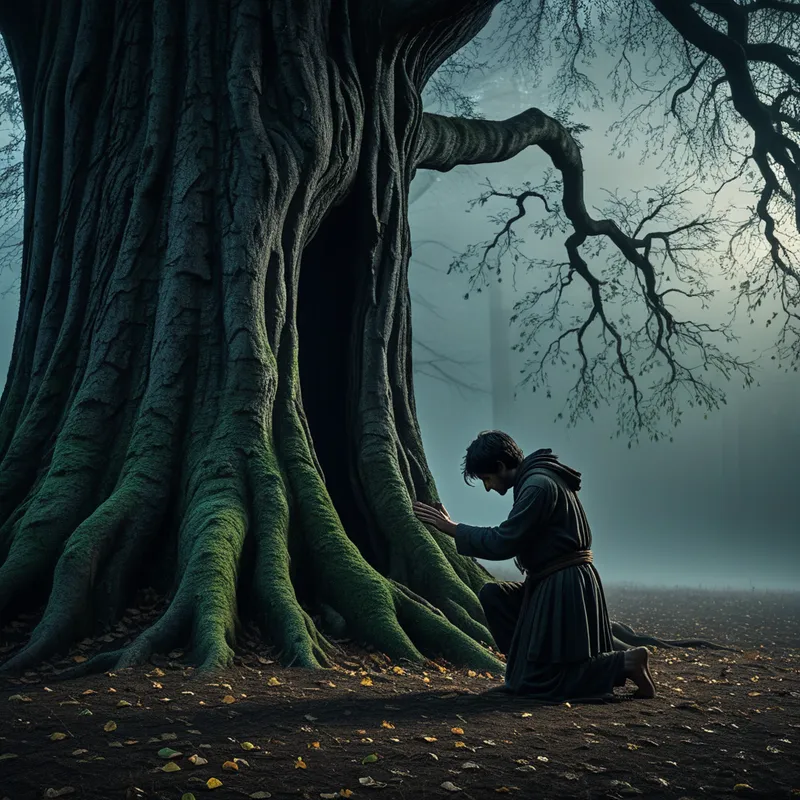
The people, drawn by the light and the scent of life, came from their sickbeds. They watched in awe and grief as the tree diminished, its form dissolving into the bounty at its feet. A child, burning with fever, crawled to a low-hanging leaf and put it to its lips. The fever broke. A hunter with a festering wound packed it with the fragrant resin, and the flesh knit clean. The tree was giving them the language of healing, teaching them to see the pharmacy in the forest, the clinic in the meadow. Finally, as the last of its leaves became a canopy of low, healing herbs, the great trunk sighed and became still, not dead wood, but a silent, watchful teacher—the remembered spine of the world’s health.
Cultural Origins & Context
The motif of the Medicine Tree, or the Tree of Life that becomes the source of healing, is not the property of a single nation but a profound archetype that emerges across numerous Indigenous traditions in North America. Versions of this narrative are held by various Anishinaabe, Cree, Lakota, Cherokee, and other nations, each woven into their specific ecological and cosmological understandings. It is a foundational myth, often told by elders and medicine people (Midewiwin in Anishinaabe contexts, Pejuta Wicasa in Lakota) during times of teaching, during healing ceremonies, or at the gathering of medicinal plants.
Its societal function is multifaceted. Primarily, it is a charter myth for ethnobotany—it explains the origin of medicinal plants and, more importantly, establishes the sacred protocol for their use. The story encodes the principles of respect, gratitude, and reciprocal relationship. One does not take medicine; one accepts a gift from the transformed body of a sacred being, with a promise to use it wisely and to give back through care, offerings, and sustainable practice. It frames healing not as a technological extraction, but as a participatory covenant with a living, conscious world. The myth also serves as a narrative anchor during times of collective sickness or despair, reminding the people that healing is woven into the very fabric of creation, born from a primordial act of sacrifice and love.
Symbolic Architecture
At its core, the myth presents the tree as the ultimate symbol of the animate world. It is not an object, but a subject; a conscious, sovereign person who engages in a moral act. Its sacrifice dismantles the dichotomy between the human and the natural, the healer and the healed. The tree’s transformation from a singular, towering entity into a diverse, scattered pharmacy is a master symbol of life’s fundamental unity expressing itself through multiplicity.
The greatest healing is not the application of a remedy, but the remembrance of a relationship. The Medicine Tree does not cure by its substance alone, but by re-membering the sick one back into the body of the world.
Psychologically, the tree represents the Self—the central, organizing principle of the psyche in Jungian terms. The “sickness” is a state of psychic dissociation, where the ego feels separate from its nourishing roots in the unconscious and the instinctual world. The tree’s deliberate dispersal is a symbolic map of the individuation process: the integrated Self must often “dissolve” its compact, iconic form to distribute its healing power throughout the entire personality. The singular “I” of the tree becomes the myriad healing potentials—the insights, strengths, and compensatory energies—that can address the specific, fragmented ailments of the psyche.
The Dreamer’s Resonance
When this myth pattern activates in the modern dreamer, it often surfaces during periods of profound crisis, burnout, or a feeling of being spiritually and emotionally poisoned. To dream of a dying or withering world reflects a psyche whose connections to vitality, meaning, and instinct have atrophied. The appearance of a singular, potent tree—often glowing, speaking, or demanding attention—is the unconscious presenting the archetypal image of the core Self, the central source of life within.
The somatic experience in such dreams can be one of deep grief mixed with awe. The dreamer may feel the tree’s “decision” in their own body as a release or a surrender. To witness the transformation of the tree into many plants is to witness the psyche’s own alchemy: a monolithic problem (the dying world) is met not by a single, heroic effort from the ego, but by a systemic, self-organizing response from the deeper Self. The dream signals that healing will not come from clinging to an old, rigid form of identity (the towering, isolated tree), but from allowing that identity to transform and distribute its essence into new, adaptable, and specific forms of self-care and understanding.
Alchemical Translation
For the individual on the path of individuation, the myth of the Medicine Tree models the crucial stage of psychic transmutation: the sacrifice of the superior position. The tree, in its perfection and centrality, occupies the ultimate “superior position.” To heal the world, it must relinquish this form. Similarly, for a person to heal their own inner fragmentation, they must often sacrifice a cherished self-image—the competent healer, the invulnerable tower of strength, the perfectly integrated person.
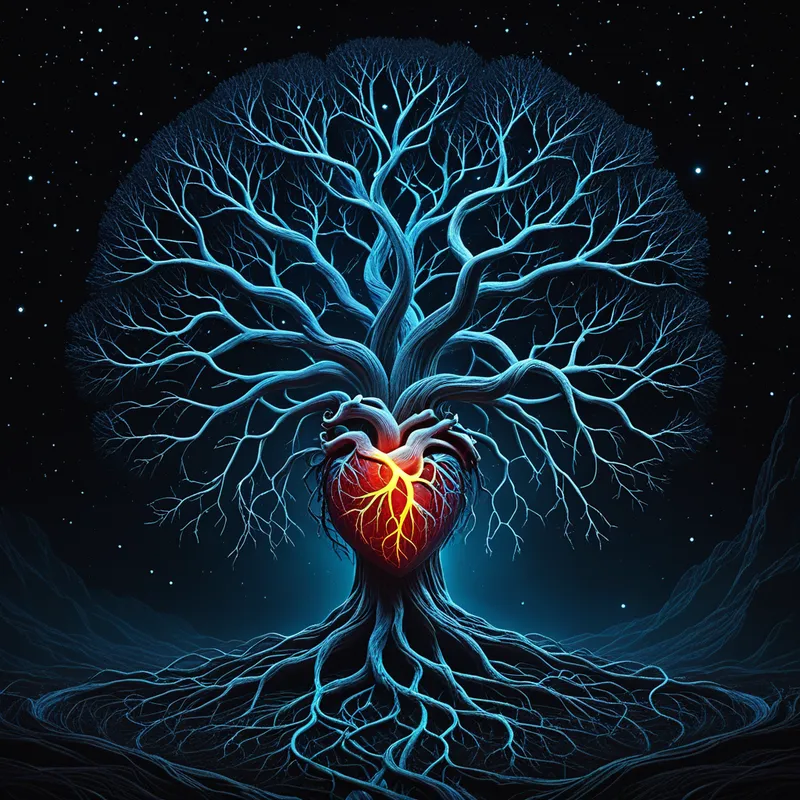
The alchemical operation here is solutio (dissolution) followed by multiplicatio (multiplication). The compact, precious “gold” of one’s hard-won inner unity (the solid tree) must dissolve into the prima materia (the primal matter) of lived experience and vulnerability. This feels like a loss, a disintegration. Yet, from this dissolution comes the multiplicatio—the proliferation of countless small, practical “medicines”: a new capacity for setting boundaries (a thorn), a sudden insight that cools a feverish anxiety (a cooling leaf), the resilience to digest a bitter truth (a tonic root).
The ego’s task is not to become the tree, but to become the humble, grateful gatherer at its roots, learning the language of the thousand cures now scattered throughout the landscape of its own soul.
The final, stilled trunk is the enduring core of the personality, no longer identified with its glorious display, but serving as the silent, unwavering witness and the anchor point. The modern individual’s “covenant” is then an internal one: a promise to honor these scattered gifts of the Self, to use them with respect for their source, and to understand that personal wholeness is not a static state of being, but a dynamic, living ecosystem of healing potentials, born from a willing sacrifice of isolation.
Associated Symbols
Explore related symbols from the CaleaDream lexicon: