
The Measuring Line of Zechariah Myth Meaning & Symbolism
A prophet's vision of a man with a measuring line, sent to map a restored Jerusalem, symbolizing divine order imposed upon psychic and societal chaos.
The Tale of The Measuring Line of Zechariah
Hear now, a vision granted in the deep of night, when the boundary between earth and heaven grows thin as a veil. The air was heavy with the memory of smoke and exile. The prophet Zechariah walked not on solid ground, but in the landscape of a soul—his own, and that of his shattered people.
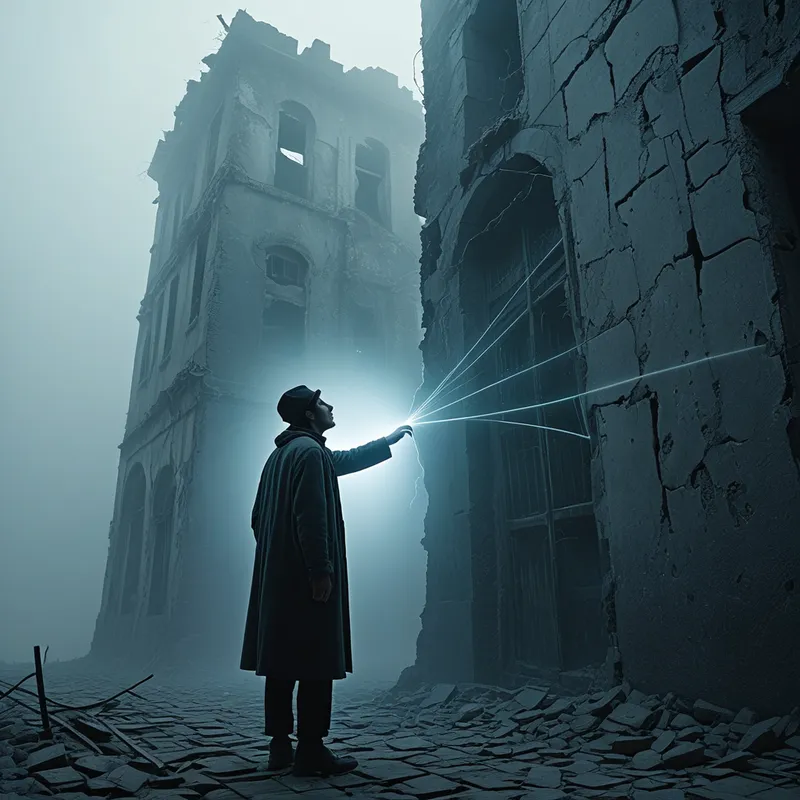
He lifted his eyes, and behold! A man stood before him, and in his hand was a measuring line. Not a tool of conquest, but of reclamation. The line was simple, knotted cord, yet it hummed with a silent, potent promise. The man did not speak with a mortal tongue, but his intent was clear as mountain spring water: Come, see what is to be measured.
And they went, the prophet and the silent surveyor, through the ghost of a city. Jerusalem lay around them not in her glory, but in her wound. Stones wept dust where temples once sang. Gates hung broken on their hinges, mouths agape in a silent cry. The wind did not whisper; it mourned through the hollows.
But the man with the line saw not ruin. He saw foundation. He saw potential. With movements both tender and supremely confident, he stretched the cord. He measured the breadth of the city-to-be, the length of the walls-not-yet-built. He paced out the spaces for gates that would one day swing open not in fear, but in welcome. Each stretch of the line was a stitch, sewing the torn fabric of sacred space back together.
Then, from the place of seeing, a voice that was not of the man, nor of the wind, nor of the prophet’s own heart, thrummed through the vision. It was the voice of the Holy One. “Run,” it said to a second, younger messenger. “Speak to that young man there. Say this: Jerusalem shall be inhabited as villages without walls… For I will be to her a wall of fire all around, declares the YHWH, and I will be the glory in her midst.”
And as the words echoed, the measuring line in the first man’s hand seemed to catch an inner fire. It was no longer measuring lack, but abundance. Not defining a limit, but declaring a sanctuary so vast, so secure in its divine protection, that stone walls would be superfluous. The vision faded, leaving Zechariah not with a blueprint, but with a heartbeat—the rhythm of a future being pulled into the present, one measured length at a time.

Cultural Origins & Context
This vision is recorded in the Book of Zechariah, a text emerging from the crucible of the Post-Exilic period. The Jewish people had returned from Babylon to a homeland that was a ghost of its former self. Jerusalem was a skeletal city, its physical ruin mirroring a profound psychological and spiritual dislocation. The grand narratives of Saul, David, and Solomon felt like myths of a golden age lost forever.
Zechariah’s prophecies, likely shared in communal gatherings amid the rubble, were not escapist fantasies. They were acts of radical cognitive and spiritual architecture. The measuring line was a powerful, tangible symbol in an agrarian and building-oriented society. To measure is to begin. It is the first, definitive act of construction, of imposing human (or divinely-guided) order upon chaotic space. This myth functioned as a societal psyche-therapy, countering the internalized “measuring line” of despair that saw only the present ruins. It redirected the communal gaze from what was lost to what was possible, asserting that their reality was not defined by the broken stones they touched, but by the sacred dimensions revealed in vision.
Symbolic Architecture
At its core, the myth presents the measuring line as an archetypal instrument of distinction and creation. It is the logos—the ordering principle—applied to the chaos of ruin.
The measuring line does not create the city; it reveals the city that is already present in the mind of the Divine, waiting to be acknowledged and built.
The man with the line represents the angelic or transpersonal function of consciousness—the part of the Self that operates from a perspective beyond egoic limitation. He is not the builder, but the divine surveyor. The prophet Zechariah is the human ego-complex, the witness who must receive and integrate this transcendent blueprint into conscious understanding.
The act of measuring the ruined Jerusalem is profoundly alchemical. It is not a denial of the ruin, but a sacred engagement with it. The line touches the broken stones, acknowledging their reality, yet in that very touch, it transmutes them from symbols of an ending into foundations for a beginning. The shift from a vision of walls to a declaration of a “wall of fire” signifies the ultimate goal: a psychic structure so secure in its authentic, inner authority (the divine presence) that rigid, defensive ego-boundaries (“walls”) are no longer needed. Protection becomes a quality of being, not a fortification.

The Dreamer’s Resonance
When this myth stirs in the modern unconscious, it often manifests in dreams of measurement, architecture, or returning to a foundational, yet damaged, place. A dreamer may find themselves holding a tape measure in their childhood home, trying to size a room that keeps changing dimensions. They may walk through a familiar city that is both theirs and utterly alien, tasked with mapping its new, confusing layout.
Somatically, this can correlate with a feeling of internal “re-calibration”—a subtle, often anxious sense of things being rearranged at the core. Psychologically, it signals a process where the conscious ego (the dreamer) is being confronted by the Self (the internal “man with the line”). The psyche is attempting to survey the damage—past trauma, outgrown identities, collapsed beliefs—not to dwell in it, but to take its precise measure as the necessary first step in reconstruction. The anxiety arises from the tension between the comfortable, familiar ruin and the daunting, unknown responsibility of the new blueprint.
Alchemical Translation
The individuation process modeled here is the movement from identification with the ruin to participation in the restoration. We all have our inner Jerusalems—aspects of our psyche that feel sacked, exiled, and lying in waste. This could be a damaged sense of self-worth, a creative capacity long abandoned, or a relational template built on rubble.
The first alchemical stage is the Nigredo: the honest confrontation with the ruin, the “dark night.” This is Zechariah standing in the desolate city. The second, critical stage is the Albedo: the bringing of the illuminating, measuring consciousness. This is not positive thinking; it is precise seeing. The ego must consent to be led by the transpersonal Self (“the man with the line”) to measure the exact breadth and depth of the damage.
The measuring line is the axis mundi of the personal psyche; it connects the ruined earth of current circumstance to the heavenly blueprint of potential wholeness.
The final transmutation is the Rubedo, symbolized by the “wall of fire.” As the ego consistently aligns itself with the measured, divine blueprint—building new habits, integrating shadow material, honoring the sacred dimensions of the Self—a transformation occurs. The rigid, defensive walls of the ego, born of fear, begin to dissolve. They are replaced by the vibrant, living boundary of authentic being. One is protected not by what one keeps out, but by the radiant, purifying integrity of what one has become. The psyche becomes “inhabited as villages without walls,” open, expansive, and yet utterly secure because its center—the divine glory—is held within. The tool of measurement is eventually outgrown, leaving only the lived reality of the sanctuary it helped to define.
Associated Symbols
Explore related symbols from the CaleaDream lexicon: