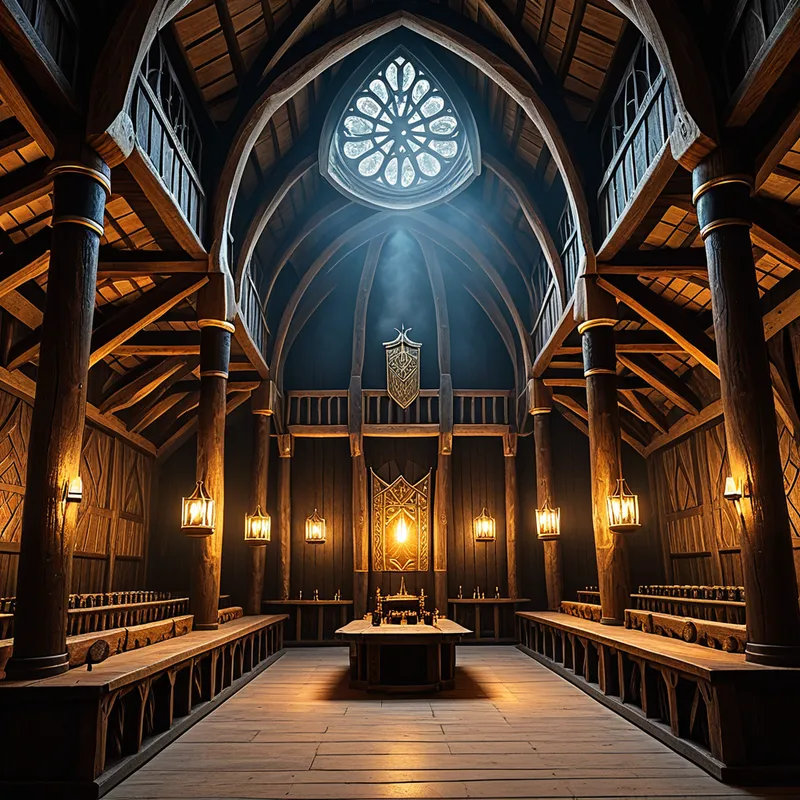
The Mead Hall Myth Meaning & Symbolism
A myth of stolen divine mead, won through trickery and sacrifice, becoming the source of poetic inspiration for gods and mortals alike.
The Tale of The Mead Hall
Hear now of the theft that gave breath to song, the cunning that stole fire for the mind. It begins not in gold-lit [Valhalla](/myths/valhalla “Myth from Germanic culture.”/), but in the aftermath of a war long cooled. When the gods of the Æsir and the rival Vanir made peace, they spat into a great vat. From that mingled spittle, a being was formed: [Kvasir](/myths/kvasir “Myth from Norse culture.”/), the wisest of all. His wisdom flowed like a river, answering every question posed.
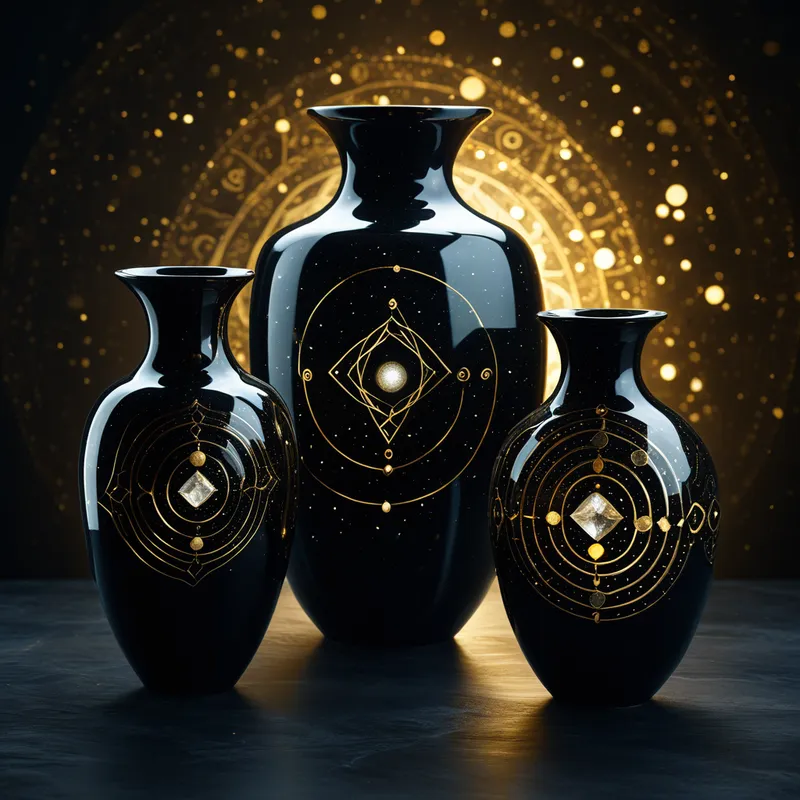
But darkness craves light to extinguish. Two dwarven brothers, Fjalar and Gjalar, invited Kvasir to their deep-delved halls. With treachery in their hearts, they slew him. They drained his blood into three wondrous vessels—Óðrerir, and the pots Son and Bodn. They mixed it with honey, and a mead was brewed. Whoever drank of it would become a skald or a scholar, gifted with the intoxicating power of poetry and profound speech. This was the [Mead of Poetry](/myths/mead-of-poetry “Myth from Norse culture.”/).
[The dwarves](/myths/the-dwarves “Myth from Norse culture.”/)’ malice did not end. They drowned a giant, Gilling, and his wife in sorrow, and to buy silence from the giant’s son, Suttungr, they gave him the precious mead. Suttungr bore it deep into the heart of the mountain Hnitbjorg, and set his daughter, Gunnlod, to watch over the three vessels in a sealed cavern. There it sat, a hoarded light in a stone womb, far from [the world](/myths/the-world “Myth from Tarot culture.”/).
But the whisper of such a treasure reaches even the high seat of Odin. The one-eyed god, ever hungry for wisdom, set his purpose. He journeyed to the world of men, and with him came his whetstone. He found nine thralls scything hay and offered to sharpen their sickles. His stone worked so wondrously that the men, in their greed, fought over it and slew each other. Odin, taking the name Bölverk, the Worker of Evil, claimed lodging from their master, the giant Baugi, Suttungr’s brother.
He bargained: for a summer’s labor, he would ask only a sip of Suttungr’s mead. Baugi agreed, but when the work was done, Suttungr refused the price. Undeterred, Odin had Baugi drill into [the mountain Hnitbjorg](/myths/the-mountain-hnitbjorg “Myth from Norse culture.”/). When the auger broke through, Odin changed his shape. He became a serpent, a slick, dark whisper of scale and will, and slithered into the hole. Baugi, betraying him even then, stabbed at the serpent’s tail with the auger, but missed.
Inside the stone heart of the world, Odin found Gunnlod. For three nights, he stayed with her, a stranger in the dark. He wooed her not with love, but with the promise of an end to her lonely vigil. Moved, or perhaps weary, she granted him one drink from each vessel. In one draught from Óðrerir, one from Son, and one from Bodn, Odin drank the mead all. The stolen wisdom of Kvasir, fermented by murder and hoarded by giants, flooded into him.
Transformed once more, now into a great eagle, he burst from the mountain, the mead within him. Suttungr, seeing the theft, took his own eagle-form and gave chase. [The sky](/myths/the-sky “Myth from Persian culture.”/) itself tore with the fury of their flight. As Odin neared the walls of Asgard, the Æsir saw him coming and set out great vats. In his desperation, Odin regurgitated the mead into the vessels. But in his violent haste, some drops fell backwards, out of Asgard and into the world below. This is the bad poets’ portion, the inspiration that is flawed and scattered.
The rest, the true Mead of Poetry, was secured. From then, Odin would gift it to those he favored—the skalds, the poets, the seers. The mead hall’s true treasure was not the ale that warmed the belly, but this stolen fire that ignited the tongue and illuminated the mind.

Cultural Origins & Context
This myth, primarily found in the Prose Edda of Snorri Sturluson, was not mere entertainment. It was a foundational etiological story for the Norse poetic tradition. Skalds, the court poets, saw themselves as vessels for this divine inspiration, their craft a sacred technology passed down from Odin himself. The myth explained the source of their talent (óðr, a word for poetic fury closely linked to Odin’s name) and justified the often-ambiguous morality of the creative process. It was told in halls to aspiring poets, a map of the perilous journey inspiration must take from the chaotic depths to conscious articulation. The story validated poetry as a force of immense cultural power—a power born from conflict, sacrifice, and cunning, not given freely.
Symbolic Architecture
The myth is a profound [allegory](/symbols/allegory “Symbol: A narrative device where characters, events, or settings represent abstract ideas or moral qualities, conveying deeper meanings through symbolic storytelling.”/) for the [birth](/symbols/birth “Symbol: Birth symbolizes new beginnings, transformation, and the potential for growth and development.”/) of conscious culture from the raw, often violent, materials of the unconscious. Kvasir represents pure, undifferentiated potential wisdom—the latent [knowledge](/symbols/knowledge “Symbol: Knowledge symbolizes learning, understanding, and wisdom, embodying the acquisition of information and enlightenment.”/) born from the reconciliation of opposites (Æsir and Vanir). His murder by the dwarves symbolizes how this raw potential must be “killed” or broken down (fermented) to become a usable, potent form. The dwarves, masters of subterranean craft, are the primal, amoral forces of the unconscious that initiate this transformative process.
The mead is not created; it is distilled. Inspiration is the alchemy of trauma, memory, and time.
The giant Suttungr and his [daughter](/symbols/daughter “Symbol: In dreams, a daughter symbolizes innocence, potential, and the nurturing aspects of oneself or one’s relationships.”/) Gunnlod represent the [psyche](/myths/psyche “Myth from Greek culture.”/)’s tendency to hoard its deepest resources. The [mountain](/symbols/mountain “Symbol: Mountains often symbolize challenges, aspirations, and the journey toward self-discovery and enlightenment.”/) Hnitbjorg is the [fortress](/symbols/fortress “Symbol: A fortress symbolizes security and protection, representing both physical and psychological safety from external threats.”/) of the personal complex, guarding a precious but isolated content. Odin’s [journey](/symbols/journey “Symbol: A journey in dreams typically signifies adventure, growth, or a significant life transition.”/)—involving deception, serpentine penetration, seduction, and frantic [flight](/symbols/flight “Symbol: Flight symbolizes freedom, escape, and the pursuit of one’s aspirations, reflecting a desire to transcend limitations.”/)—models [the ego](/myths/the-ego “Myth from Jungian culture.”/)’s heroic, if morally ambiguous, [quest](/symbols/quest “Symbol: A quest symbolizes a journey or search for purpose, fulfillment, or knowledge, often representing life’s challenges and adventures.”/) to retrieve this [buried treasure](/symbols/buried-treasure “Symbol: The ‘Buried Treasure’ symbolizes undiscovered potential, hidden emotions, or valuable insights that lie beneath the surface of consciousness.”/) for the benefit of the larger Self (Asgard). The final act, where some mead is lost, acknowledges that not all creative [output](/symbols/output “Symbol: The result or product of a process, often representing achievement, validation, or the tangible manifestation of effort in leisure and games.”/) is pure; much is spilled, flawed, or profane.
The Dreamer’s Resonance
When this myth stirs in modern dreams, it often signals a profound engagement with the process of inspiration retrieval. Dreaming of a hidden, guarded cavern or vault points to an unconscious content—a memory, a talent, a trauma, a burst of creative potential—that is felt to be sequestered and protected. The figure of the guardian (a stern parent, a monstrous animal, a locked door) embodies the resistance, often fear or old pain, that keeps this resource locked away.
The dreamer may find themselves in the role of Odin, employing cunning or adopting disguises to bypass the guardian. This can feel unsettling, as it involves shadow-work—using parts of [the self](/myths/the-self “Myth from Jungian culture.”/) we might disown (trickery, determination, ruthlessness) for a higher purpose. The somatic sensation is often one of constriction (the serpent’s journey) followed by a frantic, exhilarating flight (the eagle’s escape), mirroring the physical release of tension when a creative insight or psychological breakthrough finally erupts into consciousness.
Alchemical Translation
Psychologically, the myth perfectly models the individuation process, where the ego must venture into the unconscious to retrieve and integrate vital aspects of the Self. The initial state is one of potential (Kvasir) that has been lost to the depths. The ego (Odin) must descend, engaging with [the shadow](/myths/the-shadow “Myth from Jungian culture.”/) (the dwarves, the giants) and the anima (Gunnlod)—the inner feminine that holds the key to the treasure. This engagement is rarely polite or purely heroic; it involves bargaining, shape-shifting, and necessary deception of one’s own defensive structures.
The goal is not to defeat the guardian, but to undergo the transformation required to pass it.
The retrieval is violent and messy. The mead is not calmly carried out; it is consumed, carried within, and violently expelled into the waiting vessels of the conscious mind (the vats of Asgard). This is the act of giving form to inspiration—writing the poem, painting the image, articulating the insight. It is a regurgitation, a rebirth. The final, integrated state is not purity, but a synthesis: the conscious mind now holds the intoxicating, life-giving mead, but acknowledges the scattered, imperfect parts (the bad poets’ share) as part of the whole creative act. The individual becomes their own mead hall, a space where the divine draft of self-knowledge and expression can be both stored and shared.
Associated Symbols
Explore related symbols from the CaleaDream lexicon: