The Mayan World Tree Myth Meaning & Symbolism
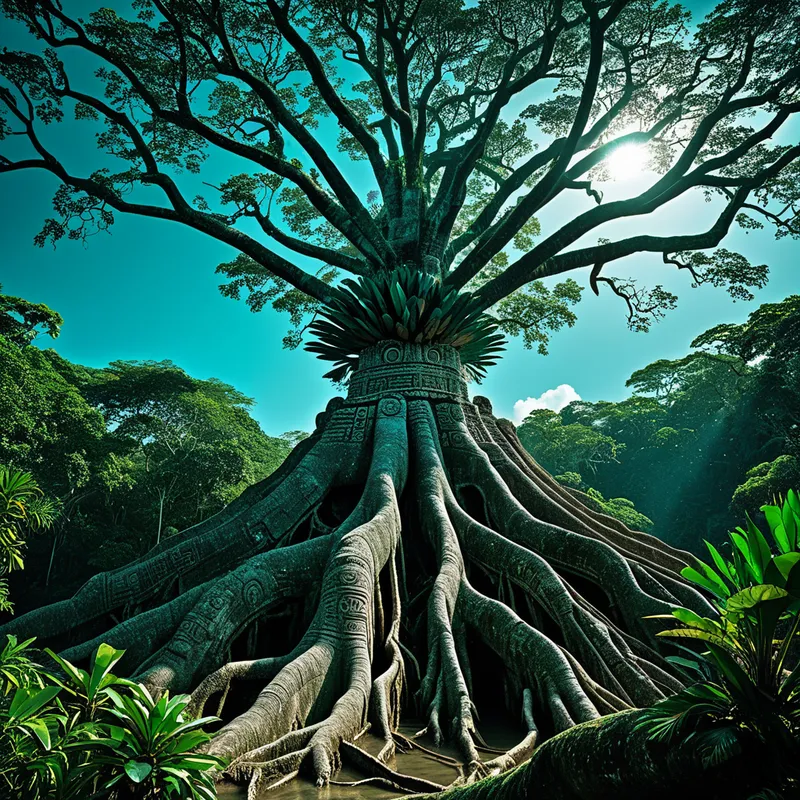
The sacred ceiba tree, planted by the gods, stands as the cosmic axis, uniting all realms and channeling divine energy through its roots, trunk, and branches.
The Tale of The Mayan World Tree
In the time before time, when the world was dark and formless, the gods gathered in the primordial sea. They spoke the Word of Creation, and from the silent waters, a great mountain of earth and stone heaved itself upwards. But the world was unstable, adrift. It needed a spine, a central pillar to hold the layers of reality apart and bind them together.
From the heart of this First True Mountain, a seed stirred. It was no ordinary seed, but the condensed essence of <abbr title=“A supreme creator deity, often depicted as an aged being."">Itzamna’s breath and <abbr title=“The goddess of the moon, childbirth, and weaving."">Ix Chel’s tears. It drank the black waters of the underworld, <abbr title=“The Mayan underworld, a place of fear and testing."">Xibalba, and pushed through the stone flesh of the mountain. It grew with a sound like thunder cracking stone, its roots plunging deep, seeking the nine layers of darkness below. They anchored in the realm of the <abbr title=“The Lords of the Underworld, gods of death and disease."">Lords of Death, drawing up the bitter waters of sacrifice and memory.
The trunk burst forth into the Middleworld, the world of humans and jaguars and corn. It was massive, a pillar of grey-green bark, studded with formidable thorns. Upon its bark, the patterns of the cosmos were inscribed by the wind—glyphs of stars, the faces of ancestors, the coils of the celestial <abbr title=“A giant, cosmic serpent, often associated with the sky and divinity."">Vision Serpent. It was the first <abbr title=“The sacred ceiba tree, revered as the axis of the world."">Ceiba, the Tree of Life.
Its growth did not stop. It pierced the canopy of the green world and soared into the heavens, the <abbr title=“The thirteen-layered upper world, the domain of celestial deities."">Upperworld. Its branches spread like vast arteries against the turquoise sky, becoming the pathways for the sun, <abbr title=“The sun god, often associated with the Hero Twins and warfare."">Kinich Ahau, and the moon. In its highest branches, the stars were hung like luminous fruit, and the <abbr title=“A resplendent bird, symbol of freedom, divinity, and the sky."">Quetzal made its nest, its feathers catching the first and last light of day.
Thus stood the <abbr title=“The World Tree, or ‘Wakah Chan’, the axis mundi of Mayan cosmology."">Wakah Chan, the Raised-Up-Sky. Its roots drank from the waters of death, its trunk was the road of human life, and its branches cradled the gods. It was the first center, the navel of the world, the conduit through which the sacred breath of the cosmos flowed. All things were in relation to it. The four cardinal directions were born from its base, each guarded by a <abbr title=“A divine being who supports the sky at the four corners of the world."">Bacab, a sky-bearer, each associated with a color, a wind, and a fate. The tree did not merely exist; it happened. It was the ongoing act of creation, a silent, eternal chant holding the layers of reality in a sacred, trembling balance.
Cultural Origins & Context
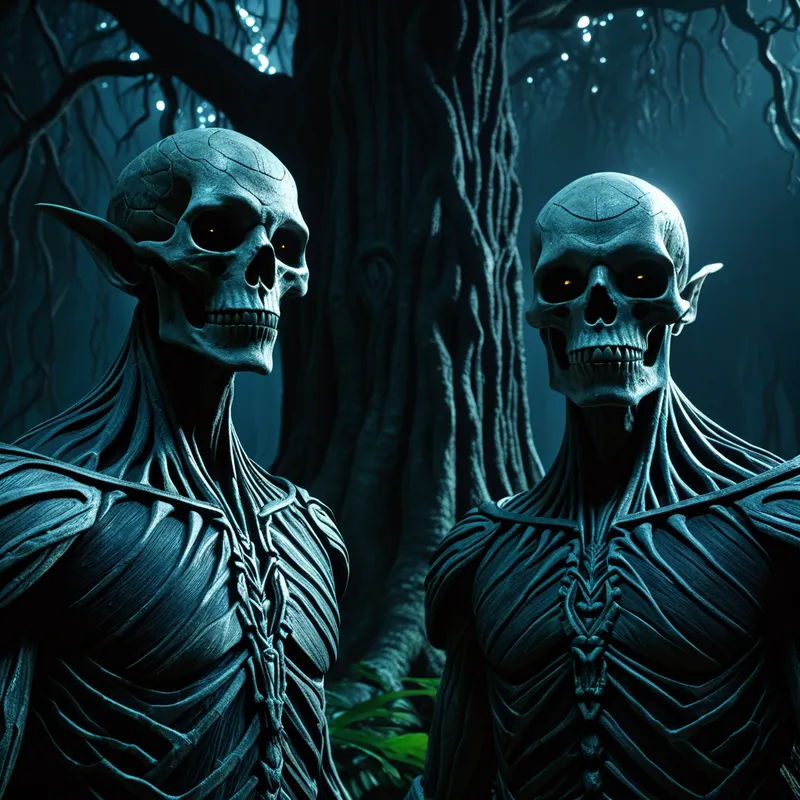
The myth of the World Tree is not a single story from one book, but a foundational pillar of the Mesoamerican worldview, intricately woven into the cosmology of the Maya, and shared with neighboring cultures like the Aztecs (who revered it as the <abbr title=“The Aztec world tree, conceptually similar to the Mayan Wakah Chan."">Tamoanchan). Our understanding comes from a confluence of sources: the breathtaking iconography on carved stelae and temple friezes at sites like Palenque and Copán; the few surviving pre-Columbian screenfold books, such as the <abbr title=“A Mayan codex from the Postclassic period, containing almanacs and cosmological information."">Dresden Codex; and the rich, post-conquest narratives like the <abbr title=“A foundational K’iche’ Maya text containing myths of creation and the Hero Twins."">Popol Vuh.
This was not a myth told merely for entertainment. It was a living map of cosmic and social order. Kings (<abbr title=“Holy Lords, the divine rulers of Mayan city-states."">K’uhul Ajaw) were intimately associated with the World Tree. During accession rituals, a ruler would literally embody the Wakah Chan, becoming the human axis mundi, the conduit through which divine power flowed to nourish the kingdom. The tree’s structure mirrored the architecture of the temple-pyramid, which was itself a stone-and-mortar representation of the sacred mountain and the tree it held. Every community had its central ceiba, a physical anchor for this cosmic principle. The myth explained the nature of reality—vertical, layered, and interconnected—and prescribed humanity’s place within it: as beings living on the trunk, capable of communicating with the realms above and below through ritual, dream, and sacrifice.
Symbolic Architecture
The World [Tree](/symbols/tree “Symbol: In dreams, the tree often symbolizes growth, stability, and the interconnectedness of life.”/) is the ultimate [symbol](/symbols/symbol “Symbol: A symbol can represent an idea, concept, or belief, serving as a powerful tool for communication and understanding.”/) of the [axis](/symbols/axis “Symbol: A central line or principle around which things revolve, representing stability, orientation, and the fundamental structure of reality or consciousness.”/) mundi, the central axis of the world present in countless cosmologies. Its genius lies in its tripartite [structure](/symbols/structure “Symbol: Structure in dreams often symbolizes stability, organization, and the framework of one’s life, reflecting how one perceives their environment and personal life.”/), which models a complete psychic and cosmic ecology.
The tree does not seek to escape its roots in the dark earth; its majesty depends upon them. The highest aspiration is fed by the deepest source.
The roots in watery Xibalba represent the unconscious, the [underworld](/symbols/underworld “Symbol: A symbolic journey into the unconscious, representing exploration of hidden aspects of self, transformation, or confronting repressed material.”/) of the psyche. This is the [realm](/symbols/realm “Symbol: The symbol of ‘Realm’ often signifies the boundaries of one’s consciousness, experiences, or emotional states, suggesting aspects of reality that are either explored or ignored.”/) of ancestors, forgotten memories, instincts, and the raw, often terrifying, [material](/symbols/material “Symbol: Material signifies the tangible aspects of life, often representing physical resources, desires, and the physical world’s influence on our existence.”/) of [life](/symbols/life “Symbol: The symbol of ‘Life’ represents a journey of growth, interconnectedness, and existential meaning, encompassing both the joys and challenges that define human experience.”/) (suffering, decay, [death](/symbols/death “Symbol: Symbolizes transformation, endings, and new beginnings; often associated with fear of the unknown.”/)). It is not “evil,” but necessary—the [source](/symbols/source “Symbol: The origin point of something, often representing beginnings, nourishment, or the fundamental cause behind phenomena.”/) of all [fertility](/symbols/fertility “Symbol: Symbolizes creation, growth, and abundance, often representing new beginnings, potential, and life force.”/) and the ground of being. The [trunk](/symbols/trunk “Symbol: The trunk in dreams typically denotes the core structure or foundation of one’s identity, values, or beliefs.”/) in the Middleworld is the [realm](/symbols/realm “Symbol: The symbol of ‘Realm’ often signifies the boundaries of one’s consciousness, experiences, or emotional states, suggesting aspects of reality that are either explored or ignored.”/) of conscious ego and daily [life](/symbols/life “Symbol: The symbol of ‘Life’ represents a journey of growth, interconnectedness, and existential meaning, encompassing both the joys and challenges that define human experience.”/). It is the field of [action](/symbols/action “Symbol: Action in dreams represents the drive for agency, motivation, and the ability to take control of situations in waking life.”/), culture, and the [human](/symbols/human “Symbol: The symbol of a human represents individuality, complexity of emotions, and social relationships.”/) [journey](/symbols/journey “Symbol: A journey in dreams typically signifies adventure, growth, or a significant life transition.”/). The branches in the Upperworld symbolize the super-conscious, the [realm](/symbols/realm “Symbol: The symbol of ‘Realm’ often signifies the boundaries of one’s consciousness, experiences, or emotional states, suggesting aspects of reality that are either explored or ignored.”/) of [spirit](/symbols/spirit “Symbol: Spirit symbolizes the essence of life, vitality, and the spiritual journey of the individual.”/), ideals, archetypes, and celestial order. The tree teaches that these three are not separate territories but a continuous, flowing [system](/symbols/system “Symbol: A system represents structure, organization, and interrelated components functioning together, often reflecting personal or social order.”/). The sap—the [life](/symbols/life “Symbol: The symbol of ‘Life’ represents a journey of growth, interconnectedness, and existential meaning, encompassing both the joys and challenges that define human experience.”/) force—must circulate between them all.
The four directions emanating from its base introduce the quaternary, the symbol of wholeness and manifestation in the world. This creates the sacred cross, a map of totality. The tree is also a [conduit](/symbols/conduit “Symbol: A passage or channel that transfers energy, information, or substance from one place to another, often hidden or structural.”/) for [vision](/symbols/vision “Symbol: Vision reflects perception, insight, and clarity — often signifying the ability to foresee or understand deeper truths.”/). The <abbr title=“The Vision Serpent, a conduit for communication with ancestors and gods."">Vision Serpent, often depicted rising from the roots or alongside the tree, is the manifestation of this channel. It is the shape taken by the numinous when it erupts into consciousness, whether in shamanic trance, royal ritual, or profound dream.
The Dreamer’s Resonance
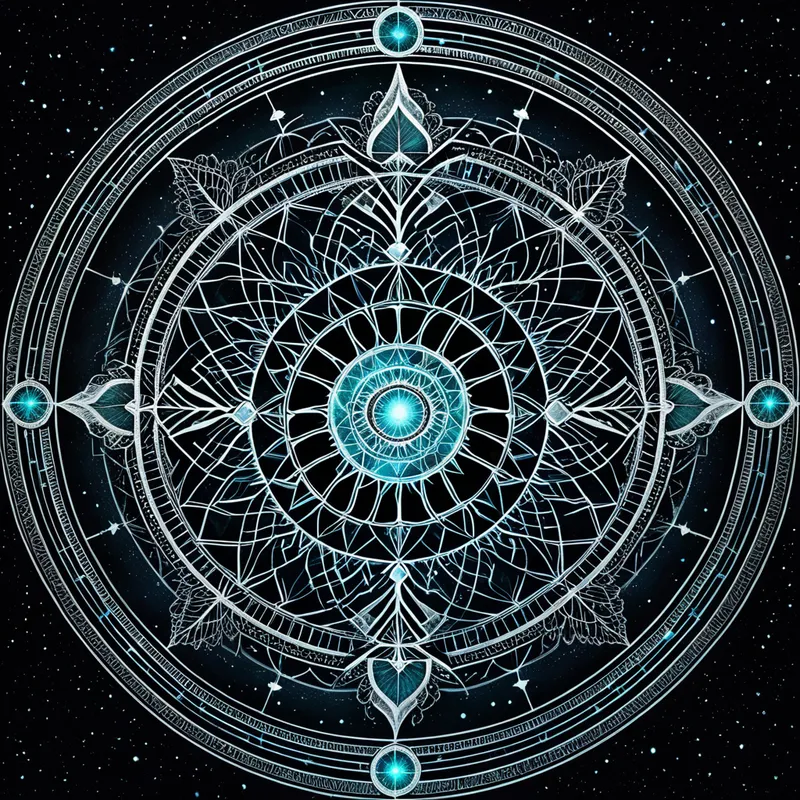
When the pattern of the World Tree emerges in modern dreams, it signals a profound reorientation of the psyche. The dreamer is not merely seeing a tree; they are experiencing the architecture of their own soul being reconfigured.
To dream of climbing the tree suggests a conscious effort toward spiritual or psychological growth, seeking perspective or a connection to higher guidance. However, the myth warns that the ascent is perilous without an equal connection to the roots. Dreaming of the roots themselves—especially if they are exposed, tangled, or delving into dark water—points to a necessary, if uncomfortable, engagement with the personal or collective unconscious. This is the work of <abbr title=“In Jungian psychology, the process of integrating the unknown or rejected parts of the psyche."">shadow-integration, of facing buried memories, grief, or primal fears (the Lords of Xibalba).
A dream where the tree is damaged, withered, or felled is a critical alarm. It indicates a severe disconnection in the dreamer’s life—perhaps a repression of the instinctual (roots), an inflation by spiritual fantasies (branches), or a collapse of the central ego-structure (trunk) that holds one’s world together. The somatic sensation is often one of profound vertigo, groundlessness, or existential panic. Conversely, dreaming of a vibrant, luminous tree connecting distinct realms can accompany a phase of profound integration, where insights from the unconscious (roots) successfully inform one’s life direction (trunk) and inspire new creativity or understanding (branches).
Alchemical Translation
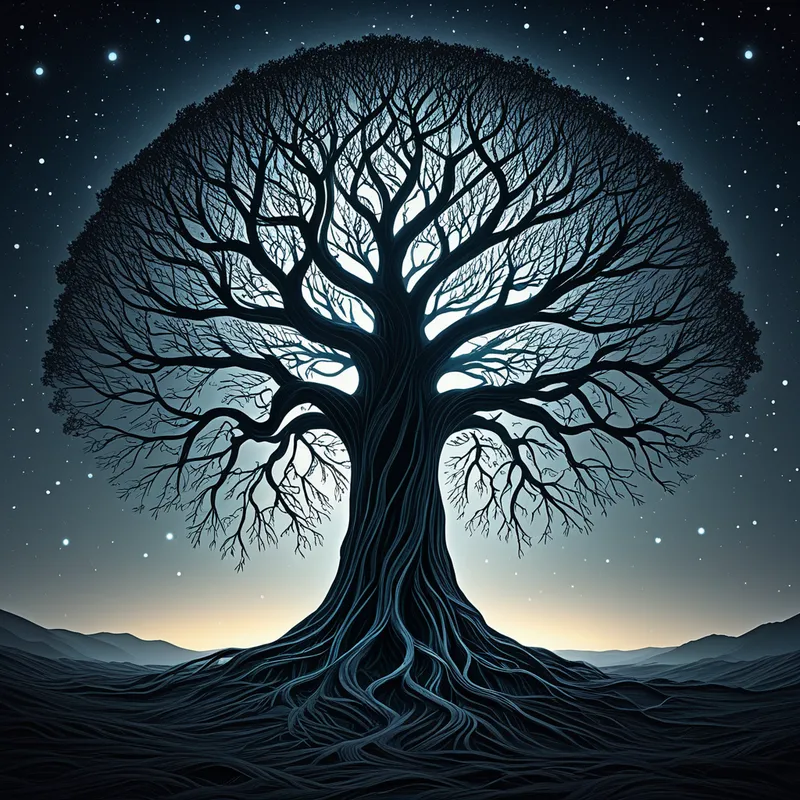
The myth of the World Tree is a blueprint for the alchemical process of individuation—the journey toward psychological wholeness. It models the creation of a stable, vertical axis within the personal psyche, around which the chaos of internal and external experience can organize itself into meaningful order.
The first, and often most resisted, step is the descent to the roots. This is the nigredo, the blackening. One must voluntarily confront their own Xibalba—the shame, grief, rage, and trauma stored in the personal and ancestral unconscious. This is not intellectual analysis, but a felt, often painful, immersion. From this dark soil, however, the true sap of life is drawn.
The individuated self is not a peak to be conquered, but a living axis to be inhabited—a conduit between the depths of one’s own history and the heights of one’s potential.
The strengthening of the trunk is the albedo, the whitening. It is the consolidation of the conscious ego, not as an isolated tyrant, but as a sturdy, grounded vessel capable of containing and translating the energies from above and below. This is the development of a resilient identity, ethical stance, and conscious purpose in the world—the “Middleworld” of one’s daily life and relationships.
Finally, the ascent to the branches is the rubedo, the reddening, and the connection to the gold of the spirit. This is not an escape from humanity but the infusion of conscious life with transpersonal meaning, archetypal wisdom, and creative inspiration. It is what Jung called the connection to the <abbr title=“A central Jungian concept representing the unified unconsciousness and consciousness of an individual."">Self. The fully realized individual becomes like the sacred king, a living Wakah Chan. They do not possess the tree; they are its function—a grounded, rooted being through whom the energies of cosmos and chaos, spirit and instinct, can flow in a balanced, life-giving circuit. They become a center of their own world, and in doing so, find their authentic place in the larger one.
Associated Symbols
Explore related symbols from the CaleaDream lexicon:
- Tree of Life — The direct conceptual parallel to the Wakah Chan, representing the interconnectedness of all life, cosmic order, and the axis linking different planes of existence.
- Root — Symbolizes the deep, often hidden connection to the underworld, the ancestors, and the foundational (sometimes painful) sources of one’s being and nourishment.
- Sky — Represents the Upperworld, the realm of celestial order, deities, and transcendent aspiration reached by the highest branches of the World Tree.
- Earth — The Middleworld, the solid ground of the trunk and human reality, the plane of manifestation where the cosmic axis is physically anchored.
- Serpent — Embodies the Vision Serpent, the dynamic, coiling energy of transformation and communication that moves between the roots, trunk, and branches of the cosmic tree.
- Cave — Analogous to Xibalba and the realm of the roots; a place of descent, initiation, and contact with the chthonic powers and the unconscious.
- Axis — The core, vertical principle of the World Tree itself, representing the central, stabilizing pillar of reality around which all else revolves.
- Temple — The human-built reflection of the World Tree and sacred mountain, a constructed axis mundi designed for ritual communication between the realms.
- Quetzal — The resplendent bird of the high branches, symbolizing the free spirit, divine beauty, and the ultimate flowering of celestial connection.
- Blood — Represents the vital sap or sacrificial offering that feeds the roots of the cosmic order, ensuring the continued flow of life and communication between realms.
- Mountain — The First True Mountain from which the World Tree grows, symbolizing the primordial, stable foundation and the meeting point of heaven and earth.
- Circle — Implied in the four directions radiating from the tree’s base, representing cosmic wholeness, cyclical time, and the complete, mandala-like structure of reality.