The Mayan Four Directions Myth Meaning & Symbolism
A Mayan creation myth where the gods establish the four cardinal directions, anchoring chaos into a sacred, ordered cosmos for humanity to inhabit.
The Tale of The Mayan Four Directions
Before time had a name, there was only the dark, murmuring sea of Tehom. No sun, no moon, no stone, no tree. Only the endless, green-black waters, and the restless whispers of the gods moving within them. They were formless, potent, and full of a terrible longing for shape.
Then, from the deep, a thought coalesced—a word that was also an act. It was the word for "Stand." And the gods, the Heart of Sky and Huracan, gathered their breath. Their first act was not to create land, but to create a place for land to be. They needed pillars to hold up the sky, corners to contain the world.
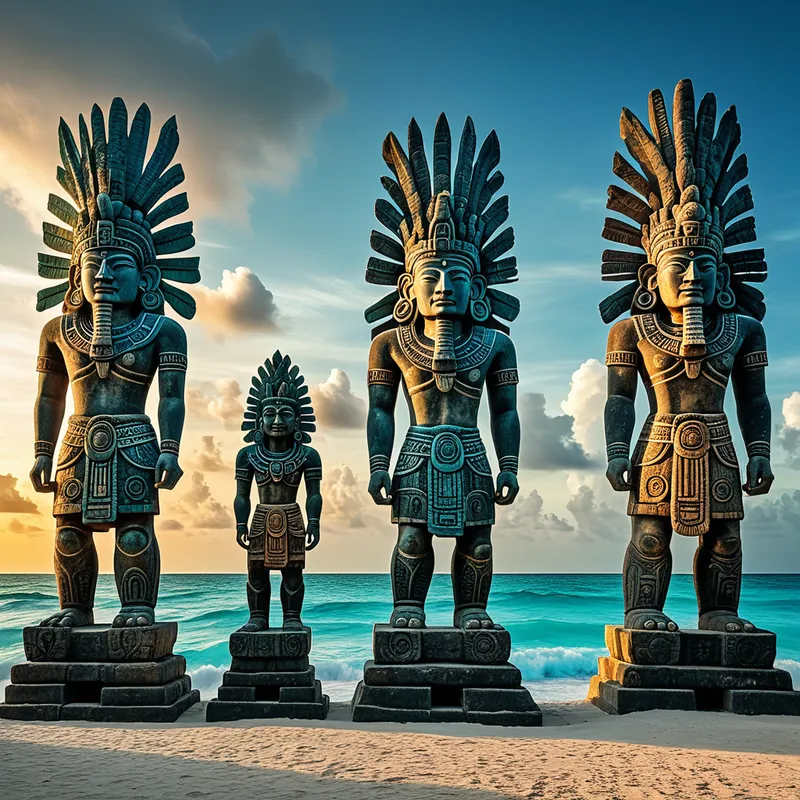
They turned their gaze to the featureless horizon and summoned forth the first of the Bacabs. From the place where light first bleeds into the world, they called the Red Lizard. He rose, a giant of crimson stone, and planted his feet in the abyss. He faced the dawn, and his breath was the warm, life-giving wind. The east was born.
Next, from the land of the noonday sun and the bleaching bones, they called the White Death-Bird. He unfolded skeletal wings of alabaster and took his place. He faced the north, the cold region of ancestors and wisdom hard-won. His silence was profound.
Then, from the realm of sunset and the sinking of all things, they called the Black Jaguar. His form swallowed the dying light, a silhouette of obsidian and power. He faced the west, and his growl was the echo of endings, of water flowing into the underworld.
Finally, from the place of lush growth and yellow corn, they called the Yellow Bee-Lord. He buzzed with fertile energy, his body the color of ripe maize. He faced the south, and his humming was the promise of abundance and continuation.
With a groan of stone and a sigh of wind, the four great bearers straightened their backs. Their shoulders met the descending vault of heaven and held it fast. The sea, now bounded, grew still. In the sacred space between them, at the very center, the first seed of the Ceiba tree took root. Its trunk pierced the new world, its roots plumbing the dark waters below, its branches cradling the stars above. The cosmos had its corners. The world had its directions. And in that ordered space, the story of life could finally begin.
Cultural Origins & Context
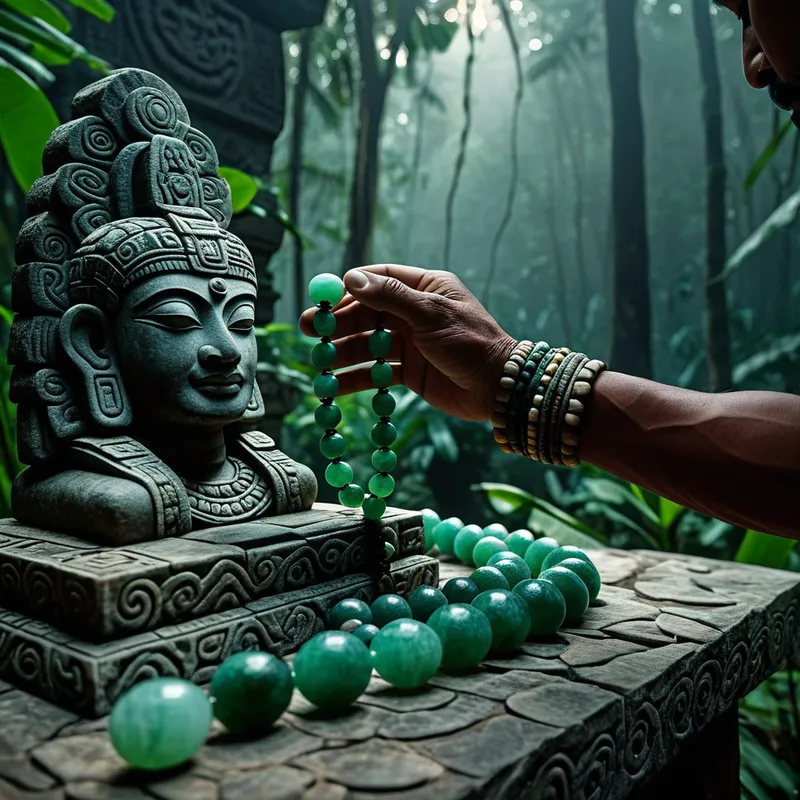
This cosmological framework is not a single, isolated story but the foundational architecture of the Mayan worldview, intricately recorded in texts like the Popol Vuh and etched into the stone of countless temples and stelae. For the Maya, space was not neutral; it was sacred, charged with specific qualities, deities, colors, and destinies. The myth of the Four Directions was the template upon which all of reality was built—from the layout of cities (often mirroring the cosmic order) to agricultural cycles, royal rituals, and divinatory practices.
It was knowledge held and enacted by the priesthood and the nobility, but its principles permeated daily life. Every community, every household, existed within this sacred cartography. The myth’s societal function was ultimate orientation: it told people not just where they were, but who they were in relation to the powers of creation, the cycles of time, and the journey of the soul after death. It was a living map, recited in ceremonies and made visible in art, ensuring the continued balance of the world against the ever-present threat of chaos.
Symbolic Architecture
The Four Directions represent the primal act of consciousness imposing order on the formless potential of the unconscious—the Tehom. Each direction is not just a place, but a psychological season, a mode of being, and a necessary aspect of a whole psyche.
The center is not a fifth direction, but the sacred point of integration where all four forces are held in dynamic tension, giving birth to the conscious Self.
The East (Red) is the archetype of dawn, beginnings, inspiration, and the illuminating spark of consciousness. Its deity is the Kinich Ahau. Psychologically, it is the moment of insight, the new idea, the birth of a project or a phase of life. The North (White) is the place of ancestors, wisdom, intellect, and cold, hard truth. It is associated with death, but a death that leads to wisdom—the stripping away of illusion. It represents the structuring, often critical, faculty of the mind.
The West (Black) is the domain of sunset, transformation, introspection, and the descent into the unconscious. Governed by the Lords of Xibalba, it is the necessary confrontation with shadow, endings, and the fertile decay that precedes rebirth. The South (Yellow) is the land of abundance, growth, vitality, and the full manifestation of life—represented by the ripe corn of the Maize God. It is the feeling function in full bloom, connection, nurturance, and the tangible fruits of one’s labors.
The Dreamer's Resonance
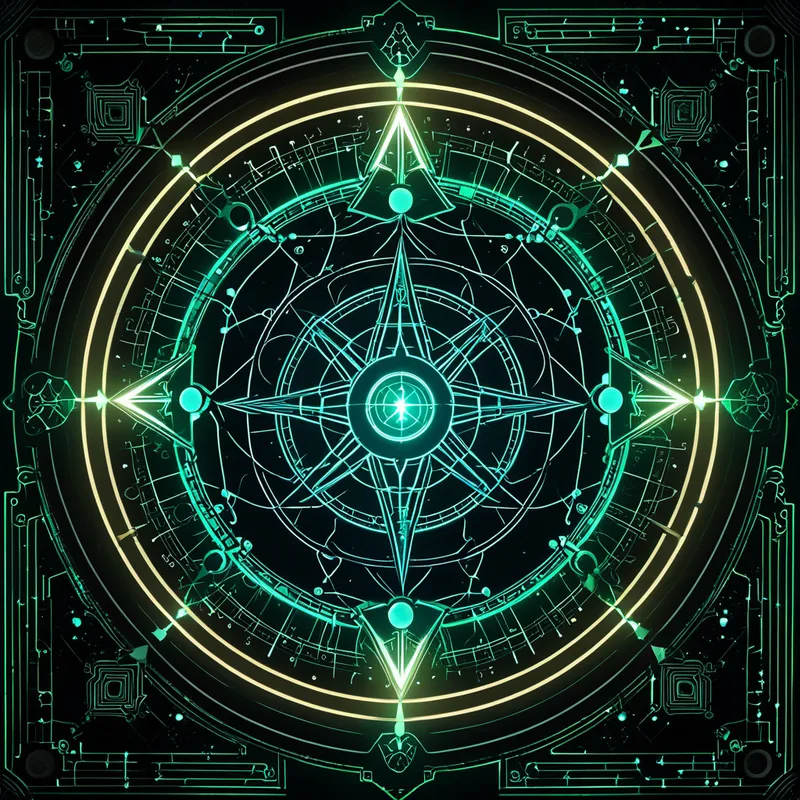
When this mythic pattern surfaces in modern dreams, it often manifests as a profound somatic experience of re-orientation. A dreamer may find themselves at a crossroads, in a room with four distinct doors, or observing a potent symbol like a mandala or compass rose. The somatic feeling can be one of anxiety (lost in chaos) or profound relief (finding true north).
Such dreams frequently occur during life transitions—career changes, relational shifts, spiritual awakenings, or after a period of dissolution (a "dark night of the soul"). The psyche is attempting to re-establish its internal coordinates. To dream of being pulled powerfully toward one specific colored direction suggests a call to integrate that quality: perhaps the fiery initiative of the East, or the deep, shadowy introspection of the West. The dream is the psyche’s innate ritual, performing the ancient work of the Bacabs within the individual: creating stable, sacred space for the next chapter of the dreamer’s life to unfold.
Alchemical Translation
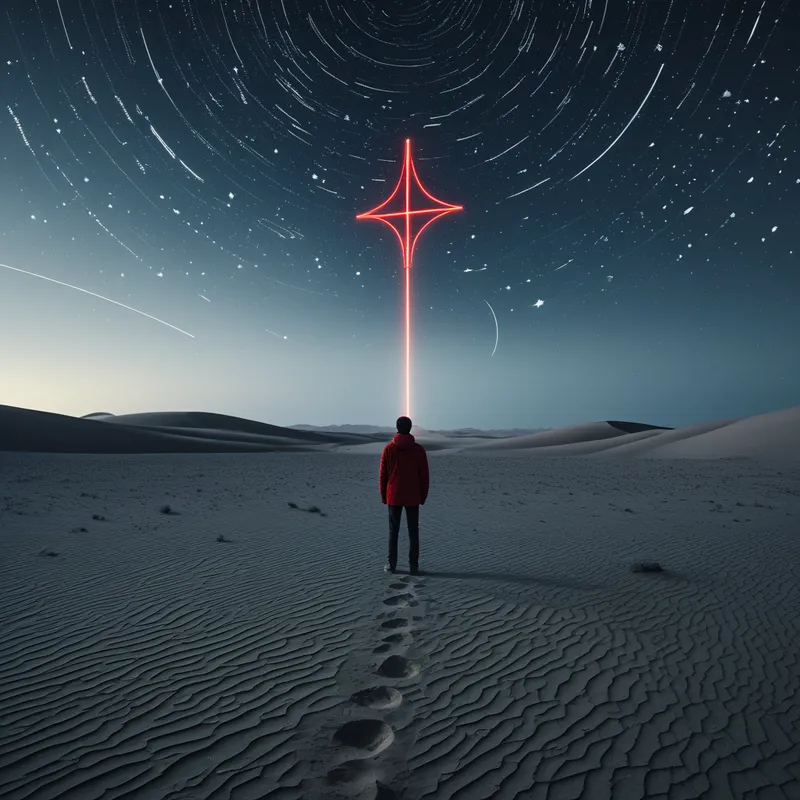
The myth models the complete process of psychic transmutation, or individuation. The initial state is the formless sea—the undifferentiated psyche, full of potential but also paralyzing chaos. The "call" from the Heart of Sky is the emerging urge toward consciousness and order, often felt as a crisis or a deep, inarticulate longing.
The alchemical work is not to choose one direction, but to become the living center where all four are acknowledged, honored, and brought into relationship.
The erection of the four pillars is the labor of building a stable ego-structure. We cultivate our Eastern inspiration (creativity), our Northern analysis (discernment), our Western capacity for introspection and dealing with shadow, and our Southern ability to connect and nurture. This is the "Great Work" of building a competent, grounded personality capable of holding the tension of opposites.
The ultimate goal, symbolized by the thriving Ceiba at the center, is the birth of the Self. This is the point where the individual is no longer identified with any single "direction" or complex but stands at the integrated center, connected to the depths (the roots in the underworld), grounded in reality (the trunk on earth), and open to the transcendent (the branches in the heavens). The individual becomes a microcosm of the ordered, sacred cosmos.
Associated Symbols
Explore related symbols from the CaleaDream lexicon:
- Tree — The Ceiba at the center of the four directions, representing the axis mundi, the Self, and the connection between all realms of existence.
- Direction — The core concept of the myth: the establishment of sacred orientation as the foundation for a coherent world and a coherent psyche.
- Sun — The primary deity of the East, Kinich Ahau, embodying consciousness, enlightenment, and the cyclical nature of time anchored by the directions.
- Earth — The stable plane created by the bounding of the directions, the realm of human life and manifestation that rests upon this sacred architecture.
- Stone — The substance of the Bacabs themselves, representing permanence, foundation, and the enduring structure of cosmic and psychological order.
- Circle — The implied sacred space contained within the four cardinal points, representing wholeness, completion, and the bounded cosmos.
- Temple — The human-built reflection of the cosmic order, often architecturally aligned with the four directions to serve as a portal to the sacred.
- Ritual — The enacted repetition of the myth, through ceremony and offering, to maintain the balance of the directions and the health of the world.
- Order — The supreme achievement of the myth: the transformation of primordial chaos into a structured, livable, and meaningful cosmos.
- Journey — The path of life, death, and rebirth, which can only be navigated with the understanding and blessing of the powers of the four directions.
- Seed — The potential for life, like the first seed of the world tree, which can only sprout and grow within the protected, oriented space created by the directions.
- Rebirth — The promise inherent in the structure; each sunset in the West leads to a dawn in the East, modeling the eternal cycle of transformation within a stable framework.