The Marriage of Gaia and Uranus Myth Meaning & Symbolism
The primal union of Earth and Sky, a fertile but tyrannical marriage, whose violent end births the Titans and reshapes the cosmos forever.
The Tale of The Marriage of Gaia and Uranus
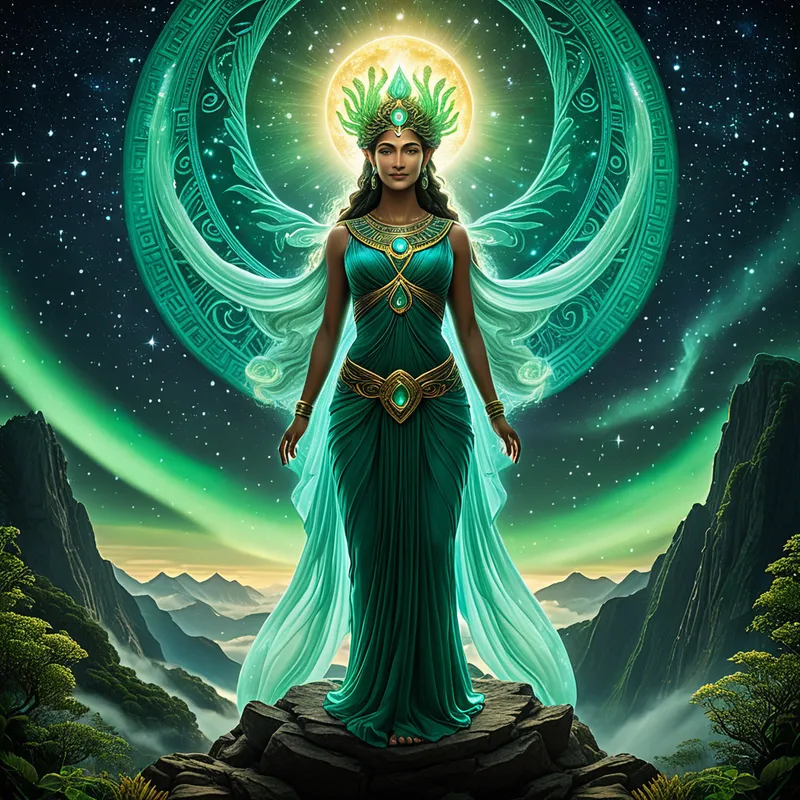
In the beginning, there was a gaping, yawning void—Chaos. And from that womb of nothingness, the first being arose: Gaia, the broad-breasted Earth. She was not soil, but the soul of the land itself—the thrust of mountains, the deep river valleys, the silent, fertile dark. From herself, without consort, she brought forth [Uranus](/myths/uranus “Myth from Greek culture.”/), the starry Sky, to cover her completely, a perfect, glittering dome. She bore the towering heights, the Ourea, and the restless, salt-embracing [Pontus](/myths/pontus “Myth from Greek culture.”/).
But her greatest creation was her union with Uranus himself. Sky descended upon Earth in a perpetual, fertile embrace. This was the first marriage, the Hieros Gamos. From this cosmic coupling, life teemed. First came the Titans, twelve mighty beings, six sons and six daughters, vast as continents. Then, the three Cyclopes, each with a single, blazing eye. Last, the three Hecatoncheires, each with a hundred arms and fifty heads, beings of raw, untamable force.
Yet, Uranus looked upon his children, not with love, but with fear. The Cyclopes with their forging hammers, the Hecatoncheires with their terrifying might—they were powers that could challenge his reign. A sickening dread filled the starry god. So, as each was born, he refused to let them see the light. He pushed them back, deep into the secret, suffocating hollows of their mother Gaia, into [Tartarus](/myths/tartarus “Myth from Greek culture.”/). [The Earth](/myths/the-earth “Myth from Hindu culture.”/) groaned under the weight of this imprisonment; her fertile plains cramped, her roots strained. The pain was ceaseless, a torment of unfulfilled potential.
Gaia, the all-mother, writhed in agony and fury. Her love for Uranus curdled into a deep, seismic wrath. From her very substance, she forged a weapon: a great sickle of grey, adamantine flint, its edge sharper than any sorrow. She called her Titan children forth from their hiding within her and laid her terrible plan before them. “Who among you will wield this? Who will end your father’s tyranny and free your siblings?”
A cold silence fell. Fear of [the sky](/myths/the-sky “Myth from Persian culture.”/)-father was absolute. Finally, the youngest Titan, Cronus, with ambition like a hidden seed, stepped forward. His voice was iron. “I will do it, Mother. I am not afraid.”
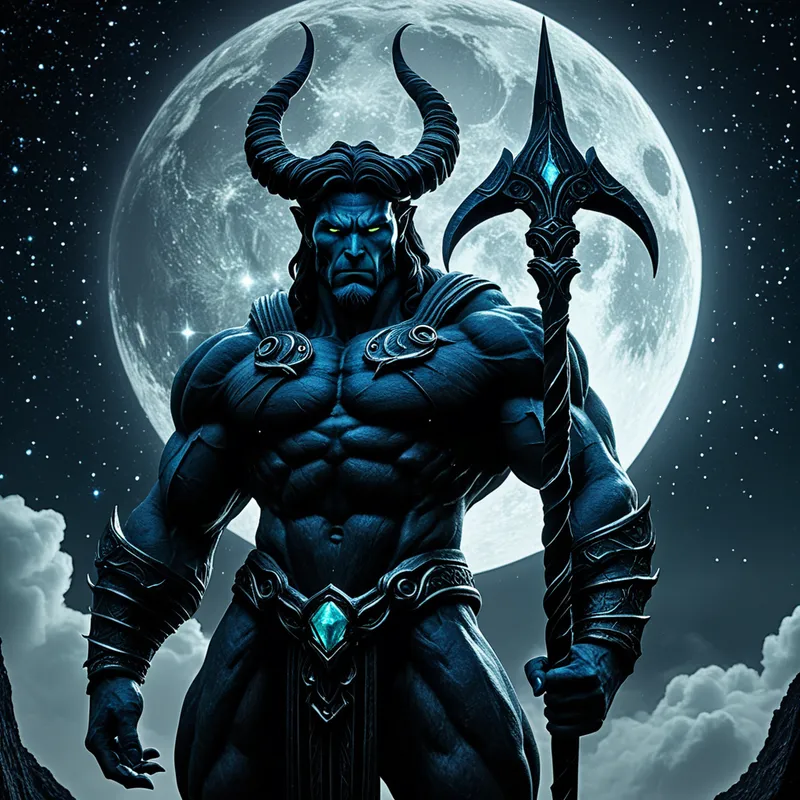
The stage was set. That night, as Uranus descended in longing to envelop Gaia, Cronus emerged from his ambush. With a single, brutal arc, he swung the grey sickle. The blade met its celestial target. Uranus recoiled with a roar that shook the pillars of the cosmos. His life-essence, his blood and seed, spilled upon the waiting Earth. From those bloody drops that soaked into Gaia’s soil sprang the Erinyes, the Giants, and the Melian [nymphs](/myths/nymphs “Myth from Greek culture.”/). Where his severed flesh fell into the rolling sea, foam gathered, and from that foam was born Aphrodite, rising radiant and new.
Wounded and deposed, Uranus was thrust forever away from Gaia’s embrace. He became the distant, cold sky, forever separated from the warm Earth by the breath of the air, Aether. The age of the Sky’s direct rule was over. The age of [the Titans](/myths/the-titans “Myth from Greek culture.”/) had begun.
Cultural Origins & Context
This foundational myth comes to us primarily from the Theogony of the poet Hesiod, composed around 700 BCE. It is not mere entertainment, but a sacred narrative explaining the origin and order of the cosmos. Hesiod presents it as received wisdom, a truth delivered by the Muses themselves. In an oral culture, such stories were the bedrock of understanding, recited at festivals and gatherings to reinforce a shared worldview.
The myth served multiple societal functions. It established a divine genealogy, making the current world order (ruled by Zeus, grandson of Uranus) legitimate through a narrative of succession. It explained natural phenomena: the permanent separation of earth and sky, the origin of vengeful spirits and certain deities. Most profoundly, it modeled a pattern of cosmic conflict where tyranny is inevitably challenged by the next generation, a theme that resonated in the Greek political imagination, moving from primal chaos to a more structured, if still fraught, divine monarchy.
Symbolic Architecture
This myth is the primordial [blueprint](/symbols/blueprint “Symbol: A blueprint represents the foundational plan or design for something, often symbolizing potential, structure, and the mapping of one’s inner self or future.”/) of creation through conflict. Gaia represents the unconscious, fecund ground of being—the [psyche](/myths/psyche “Myth from Greek culture.”/)’s raw potential, the [body](/symbols/body “Symbol: The body in dreams often symbolizes the dreamer’s self-identity, personal health, and the relationship they have with their physical existence.”/), the instinctual world. Uranus symbolizes the ordering principle, the conscious mind or [spirit](/symbols/spirit “Symbol: Spirit symbolizes the essence of life, vitality, and the spiritual journey of the individual.”/) that seeks to [structure](/symbols/structure “Symbol: Structure in dreams often symbolizes stability, organization, and the framework of one’s life, reflecting how one perceives their environment and personal life.”/) and define. Their initial union is the state of potential wholeness, where everything is possible.
The first separation in the cosmos is not between light and dark, but between the embrace and the prison.
Uranus’s act of pushing his children into Tartarus is the repression of the unconscious’s powerful, chaotic contents—the creative urges, the titanic emotions (the Titans), the brilliant but disruptive insights (the Cyclopes), and the overwhelming, unintegrated psychic forces (the Hecatoncheires). This repression causes profound suffering in the foundational self (Gaia’s [agony](/symbols/agony “Symbol: Intense physical or emotional suffering, often representing unresolved pain, internal conflict, or profound transformation.”/)).
The [sickle](/symbols/sickle “Symbol: The sickle symbolizes the cyclical nature of life, harvest, and the labor involved in reaping rewards from hard work.”/), crafted from Gaia’s own substance, is the [weapon](/symbols/weapon “Symbol: A weapon in dreams often symbolizes power, aggression, and the need for protection or defense.”/) of the repressed. It is not an external tool, but an archetypal will forged from deep, wounded instinct. Cronus, the agent of this will, represents the nascent ego that must perform the necessary, violent act of [differentiation](/symbols/differentiation “Symbol: The process of distinguishing or separating parts of the self, emotions, or identity from a whole, often marking a developmental or psychological milestone.”/)—severing the identification with the oppressive, [static](/symbols/static “Symbol: Static represents interference, disruption, and the breakdown of clear communication or signal, often evoking feelings of frustration and disconnection.”/) ruling principle (the [father](/symbols/father “Symbol: The father figure in dreams often symbolizes authority, protection, guidance, and the quest for approval or validation.”/) complex, the old [king](/symbols/king “Symbol: A symbol of ultimate authority, leadership, and societal order, often representing the dreamer’s inner power or external control figures.”/)) to allow for new psychic [life](/symbols/life “Symbol: The symbol of ‘Life’ represents a journey of growth, interconnectedness, and existential meaning, encompassing both the joys and challenges that define human experience.”/).
The Dreamer’s Resonance
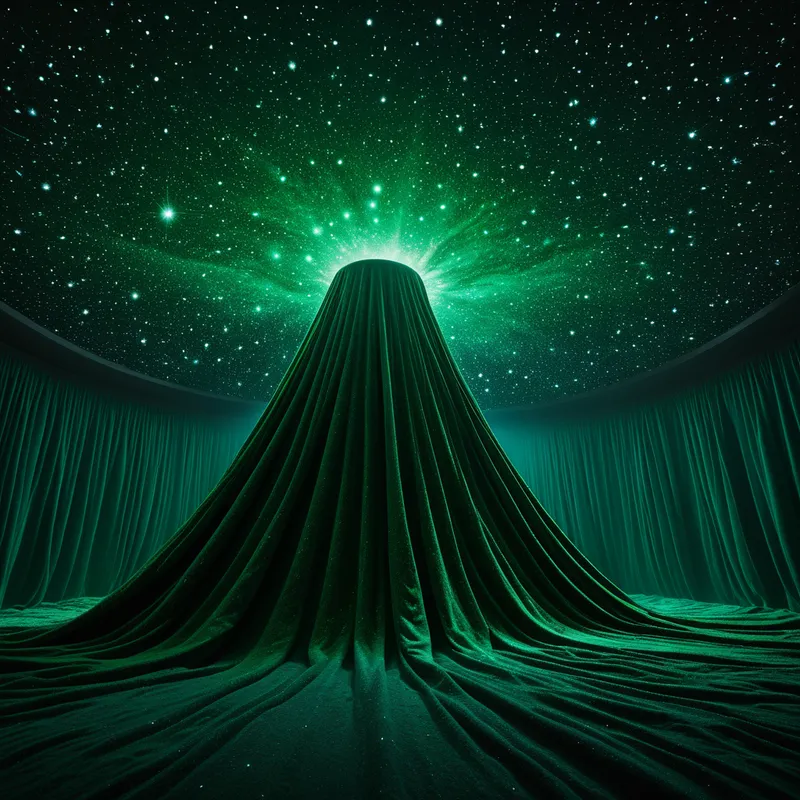
When this myth stirs in the modern dreamer, it often signals a profound somatic and psychological process of breaking a deep-seated pattern. One may dream of oppressive ceilings, domes, or skies; of being trapped in caves or under heavy blankets; or of fertile ground that is barren on the surface. There is a feeling of immense potential straining against a constrictive force.
The dreamer might experience this as chronic physical tension (Gaia’s cramping), a sense of creative or emotional suffocation, or a relationship dynamic where one’s natural expression is “pushed back” into a hidden, painful place. The emergence of a “sickle” in a dream—any sharp, curved tool used for cutting or harvesting—can symbolize the gathering of one’s own inner resources to make a decisive, liberating cut from an outdated structure, even if that structure was once part of a nourishing “marriage” or identity.
Alchemical Translation
The alchemical journey mirrored here is the [prima materia](/myths/prima-materia “Myth from Alchemical culture.”/) of the soul—the initial, undifferentiated state (the union)—being subjected to the [separatio](/myths/separatio “Myth from Alchemical culture.”/). This is not a gentle process, but a necessary violence that initiates the work of individuation.
One must become Cronus, wielding the sickle of conscious choice, to end the tyranny of a heaven that refuses to let life see the light.
The modern individual undergoes this when they confront a dominant, life-negating complex—perhaps an internalized critical voice (Uranus as the judgmental sky-father), a rigid belief system, or a familial pattern that stifles growth. The “cut” is the act of psychological differentiation: setting a boundary, speaking a long-silenced truth, or choosing a path that severs one from an old identity. The blood spilled is the pain of that separation, but from it are born new, vital forces: the fierce protectiveness of one’s values ([the Erinyes](/myths/the-erinyes “Myth from Greek culture.”/)), the giant strength to rebuild (the Giants), and, most beautifully, the capacity for self-love and creative beauty (Aphrodite) arising from what was once cast away.
The final state—the permanent separation of Earth and Sky by Aether—is the achieved psychic space. It is the conscious distance between one’s instinctual ground (Gaia) and one’s ordering principles (Uranus), with the breath of reflection and spirit (Aether) in between. The marriage is over, but a new, more conscious relationship is established, making [the world](/myths/the-world “Myth from Tarot culture.”/)—both inner and outer—a place where life can finally emerge into the light.
Associated Symbols
Explore related symbols from the CaleaDream lexicon: