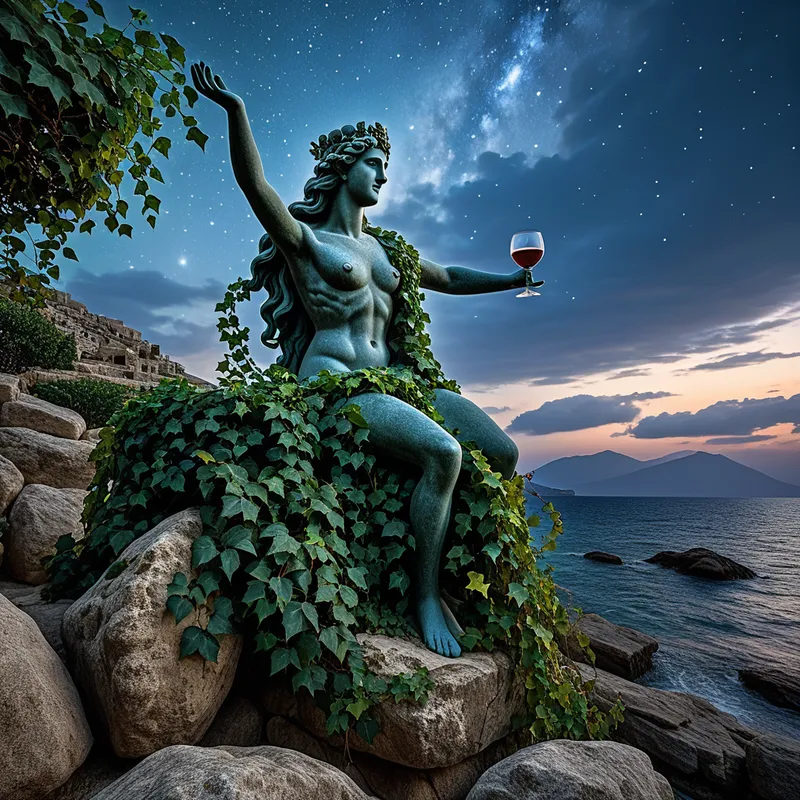
The Marriage of Dionysus and Ariadne Myth Meaning & Symbolism
The god of ecstasy finds the abandoned princess on a desolate shore, transforming her mortal grief into a constellation of immortal union.
The Tale of The Marriage of Dionysus and Ariadne
Hear now the tale not of a hero’s [triumph](/myths/triumph “Myth from Roman culture.”/), but of a god’s compassion, and the mortal thread that led him to it.
The air on the isle of Naxos was salt and sorrow. Ariadne, daughter of a king, savior of a hero, lay curled upon the cold shingle where [the sea](/myths/the-sea “Myth from Greek culture.”/) licked the land with a indifferent tongue. Hours before, she had slept a sleep of victory and love, her heart full of the Athenian prince, [Theseus](/myths/theseus “Myth from Greek culture.”/). She had given him the clew of thread, had guided him from [the labyrinth](/myths/the-labyrinth “Myth from Greek culture.”/)’s monstrous gut. For her, he had promised [the world](/myths/the-world “Myth from Tarot culture.”/). And with the dawn, he had taken it away, his ship a fading scar on [the horizon](/myths/the-horizon “Myth from Various culture.”/).
Her weeping was the only sound, a raw counterpoint to the gulls. She was a discarded tool, a used secret, a princess of Knossos turned driftwood on a foreign shore. The sun climbed, pitiless. The shadows shortened. Her world had contracted to the grit beneath her cheek and the vast, uncaring blue above.
Then, the air changed.
It grew thick with the scent of crushed ivy and fermenting grapes, of damp earth and wild honey. A sound approached—not the crash of waves, but the soft pad of great cats and the gentle creak of wheels. Light, dappled and green-gold, fell upon her closed eyelids. She stirred, and opening her eyes, beheld a vision.
Before her stood a chariot, drawn not by horses but by two leopards, their eyes ancient and knowing. And in [the chariot](/myths/the-chariot “Myth from Tarot culture.”/), a figure of impossible vitality. His hair was dark and lush, crowned with a wreath of vine and ivy. In his hand, a thyrsus pulsed with a faint, living light. His eyes held the madness of the forest and the depth of the night sky—this was Dionysus.
There was no fear in her, only a profound exhaustion. The god stepped down. He did not speak of kingdoms or labyrinths. He saw only the abandonment, the shattered trust. With a touch that was both fierce and tender, he lifted her from the stones. “Your mortal hero has given you to the sea and [the sky](/myths/the-sky “Myth from Persian culture.”/),” his voice seemed to say, not in words, but in the rustle of leaves. “But the sea and the sky are my domains. And they have given you to me.”
Where despair had hollowed her, a new, terrifying fullness began to bloom. He placed in her hand his thyrsus; its touch was like a root taking hold in her soul. He offered her a cup, not of [water](/myths/water “Myth from Chinese culture.”/), but of wine so dark it was like drinking the night itself—a night alive with stars. In that draught, her grief did not vanish; it was transformed, fermented into a profound and piercing joy. Her tears became [the dew](/myths/the-dew “Myth from Alchemical culture.”/) on his vines.
Their marriage was not in a palace hall. It was the island itself that bore witness. The [Maenads](/myths/maenads “Myth from Greek culture.”/) appeared from the groves, their torches flickering in the twilight. Satyrs piped wild, joyous tunes. The very rocks seemed to soften, sprouting flowers where her feet had trodden in sorrow. In this riot of life, Dionysus took Ariadne as his wife.
And as the final pledge, as the ultimate token that her abandonment was not an end but a translation, the god reached into the vault of heaven. He took [the crown](/myths/the-crown “Myth from Various culture.”/) of gold and jewels he had given her—a wedding gift—and cast it into the sky. There it hung, its gems cooling into points of eternal fire. The Corona Borealis shone down upon them, a celestial diadem for a mortal girl who was abandoned and was found, who was broken and was made whole, not by a hero’s promise, but by a god’s ecstatic, redeeming love.

Cultural Origins & Context
This myth, primarily preserved in the works of Hesiod, Plutarch, and in numerous vase paintings, is not a simple folktale. It is a theological and cultural cornerstone. Dionysus, the latecomer to the Olympian [pantheon](/myths/pantheon “Myth from Roman culture.”/), represents a force that both terrified and fascinated the Greek world: the uncontrollable, ecstatic, and transformative power of nature and the unconscious mind. His myths often involve the rescue and elevation of mortal women (like Ariadne or the mother of his son, Oenopion), integrating them into his divine retinue.
Ariadne’s story was told at symposia, depicted on drinking vessels, and performed in dithyrambs—choral hymns to Dionysus. It served a crucial societal function. In a culture deeply concerned with honor, betrayal, and the fickleness of human fortune ([tyche](/myths/tyche “Myth from Greek culture.”/)), the myth offered a potent narrative: that the ultimate betrayal by a human hero could be the necessary prelude to an encounter with the divine. It reframed abandonment not as a final social death, but as the raw material for a sacred initiation. The marriage symbolized the god’s claim over the islands of the Aegean and the mysterious, often painful, processes of psychological death and rebirth that were central to his cultic mysteries.
Symbolic Architecture
At its core, this is a myth of alchemical substitution. The [human](/symbols/human “Symbol: The symbol of a human represents individuality, complexity of emotions, and social relationships.”/), transactional [relationship](/symbols/relationship “Symbol: A representation of connections we have with others in our lives, often reflecting our emotional state.”/) (Ariadne-Theseus, based on utility and broken oaths) is dissolved so that the divine, transformative relationship (Ariadne-Dionysus, based on seeing and accepting the broken state) can be forged.
Ariadne represents the ego that has served a heroic, [logos](/myths/logos “Myth from Christian culture.”/)-driven principle (Theseus, the slayer of the [monster](/symbols/monster “Symbol: Monsters in dreams often symbolize fears, anxieties, or challenges that feel overwhelming.”/), the rational planner). She has used her cunning (the thread) to navigate the [labyrinth](/symbols/labyrinth “Symbol: The labyrinth represents a complex journey, symbolizing the intricate path toward self-discovery and understanding one’s life’s direction.”/) (the complex, monstrous unconscious). But the heroic principle, once it achieves its goal, discards the very [soul](/symbols/soul “Symbol: The soul represents the essence of a person, encompassing their spirit, identity, and connection to the universe.”/)-guide that made it possible. This is the [crisis](/symbols/crisis “Symbol: A crisis symbolizes turmoil, urgent challenges, and the need for immediate resolution or change.”/) of meaning after [achievement](/symbols/achievement “Symbol: Symbolizes success, mastery, or reaching a goal, often reflecting personal validation, social recognition, or overcoming challenges.”/), the profound depression of the “what now?” when the grand project is complete.
Dionysus does not come to fix the old story; he comes to intoxicate it into a new one.
Dionysus is the archetypal embodiment of the unconscious itself—not as a dark [labyrinth](/myths/labyrinth “Myth from Various culture.”/) to be escaped, but as a vital, creative, and ecstatic force to be wed. His [arrival](/symbols/arrival “Symbol: The act of reaching a destination, marking the end of a journey and the beginning of a new phase or state.”/) at the [moment](/symbols/moment “Symbol: The symbol of a ‘moment’ embodies the significance of transient experiences that encapsulate emotional depth or pivotal transformations in life.”/) of absolute [abandonment](/symbols/abandonment “Symbol: A dream symbol representing feelings of being left behind, isolated, or emotionally deserted, often tied to primal fears of separation and loss of support.”/) signifies that the [psyche](/myths/psyche “Myth from Greek culture.”/)’s deepest resources are often only accessible when [the ego](/myths/the-ego “Myth from Jungian culture.”/)’s plans have utterly failed. The [wine](/symbols/wine “Symbol: Wine often symbolizes celebration, indulgence, and the deepening of personal connections, but it can also represent excess and escape.”/) he offers is the intoxicating draft of a [reality](/symbols/reality “Symbol: Reality signifies the state of existence and perception, often reflecting one’s understanding of truth and life experiences.”/) beyond [the ego](/myths/the-ego “Myth from Jungian culture.”/)’s comprehension, a reality where [grief](/symbols/grief “Symbol: A profound emotional response to loss, often manifesting as deep sorrow, yearning, and a sense of emptiness.”/) and joy are not opposites but part of the same fermenting whole. The [crown](/symbols/crown “Symbol: A crown symbolizes authority, power, and achievement, often representing an individual’s aspirations, leadership, or societal role.”/) becoming a [constellation](/symbols/constellation “Symbol: Represents guidance, destiny, and the navigation through life, symbolizing the connections between experiences and paths.”/) is the ultimate [symbol](/symbols/symbol “Symbol: A symbol can represent an idea, concept, or belief, serving as a powerful tool for communication and understanding.”/): personal tragedy is eternally memorialized and transfigured into an impersonal, cosmic [pattern](/symbols/pattern “Symbol: A ‘Pattern’ in dreams often signifies the underlying structure of experiences and thoughts, representing both order and the repetitiveness of life’s situations.”/) of [beauty](/symbols/beauty “Symbol: This symbol embodies aesthetics, harmony, and the appreciation of life’s finer qualities.”/).
The Dreamer’s Resonance
When this myth stirs in the modern dreamer, it often manifests as a powerful somatic and emotional sequence. The dreamer may experience the Ariadne moment: dreams of being left behind on a shoreline, airport, or empty station; of a partner or ally turning away; of a contract or promise dissolving into nothing. The feeling is one of core betrayal and desolation.
If the psyche is ripe for the Dionysian response, the dreamscape then shifts. The empty location becomes lush and overgrown. Strange, benign yet wild animals appear (big cats, goats, serpents). There is the presence of a compelling, often androgynous or overpoweringly vital figure who is not “romantic” in a human sense, but who offers a profound, non-verbal communion—a dance, a shared drink, a crown of living plants. The dreamer may feel a terrifying yet liberating loss of ego-boundaries, a “drunkenness” on sheer existence.
This dream pattern signals the psyche undergoing a crucial alchemy: the conscious attitude (the Theseus complex of goal-oriented striving) has exhausted itself and betrayed the soul’s deeper needs. The unconscious (Dionysus) is now actively intervening to initiate a marriage—a permanent bonding—between the abandoned ego and the transformative, irrational, life-affirming powers of the deep psyche.
Alchemical Translation
The individuation process modeled here is the Coniunctio—[the sacred marriage](/myths/the-sacred-marriage “Myth from Various culture.”/)—but of a specific kind. It is not the balanced union of conscious and unconscious symbolized by a royal marriage in a sunlit castle. It is the Coniunctio that occurs in [the wilderness](/myths/the-wilderness “Myth from Biblical culture.”/), born from utter defeat.
The modern individual’s “labyrinth” may be a career, a rigid identity, or a perfect plan. The “thread” is one’s intellect or skill used to navigate it. The “Theseus” is the part of us that believes in purely logical, heroic solutions. When we achieve the goal and are left feeling empty and abandoned by our own success, we are on the shore of Naxos.
The alchemical work begins not in seeking a better hero, but in becoming receptive to the god in the wreckage.
The Dionysian force is the psyche’s capacity for radical acceptance and ecstatic re-framing. To “wed Dionysus” is to consent to let our deepest pain be fermented into a new vintage of being. It is to allow the wild, creative, and irrational parts of ourselves—our madness, our passions, our untamed grief and joy—to be recognized not as enemies to be slain in a labyrinth, but as consorts, as divine partners.
The final stage, the constellation, is the act of finding meaning. Our personal story of abandonment is not erased; it is placed in a transpersonal context. It becomes a part of the night sky of the soul—a fixed point of beauty and [reference](/myths/reference “Myth from Global/Universal culture.”/) that guides us and others. We are no longer the abandoned one, but the one in whom abandonment and rescue have married and given birth to a star. The process completes the alchemical cycle: Solve (the dissolution of the old bond on the shore) and Coagula (the coagulation into a new, eternal form in the heavens). The individual is no longer merely human or merely divine, but a unique point of intersection where both meet—a mortal crowned with immortal light.
Associated Symbols
Explore related symbols from the CaleaDream lexicon: