The marketplace of Athens Myth Meaning & Symbolism
A tale of the primal human agora, where the cacophony of the world meets the inner voice, forging identity from the raw materials of chaos and connection.
The Tale of The marketplace of Athens
Before the world was parsed into data, before the self was a concept to be curated, there was the noise. And the noise was the world.
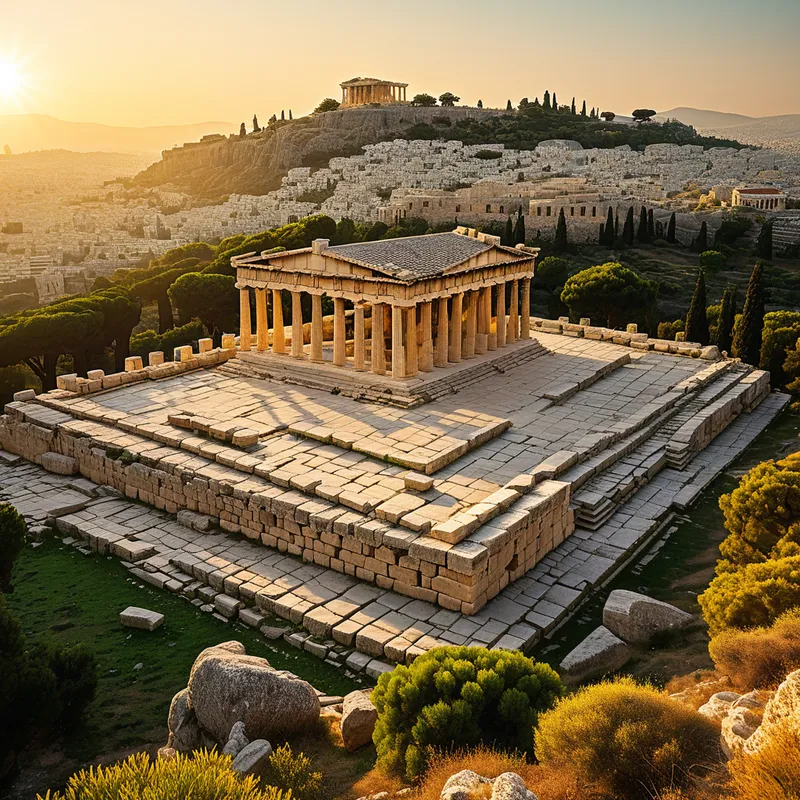
Come, listen. Not to the dry scrolls of historians, but to the breath of the place itself. It is dawn in Athens. The first light does not creep; it strikes the high shoulder of the Acropolis like a gong, and the sound is a signal. Below, in the bowl of the city, the Agora stirs.
It begins as a murmur—the scrape of a stone door, the clatter of a pot. Then, a flood. From every street, the people pour forth. Not a uniform mass, but a riot of being. Here comes the fishmonger, his voice a ragged cry over the silver shimmer of his catch. There, the potter arranges his wares, each vessel a captured echo of the wheel’s spin. A soldier leans on his spear, bronze gleaming dully, his eyes distant with memory of other fields. A woman from the hills spreads out woven cloth, the patterns speaking of a different rhythm, of looms and mountain springs.
And among them, moving like a different species of fish through the current, are the men in simple robes. They pause. They gather. One, with a beard like a storm cloud, plants his staff and begins to speak of Dike and the nature of the soul. A circle forms. Words become nets, cast to catch slippery truths. A young man objects, his logic a sharp knife. The debate rises, a structured tempest within the greater chaos.
This is the conflict. Not of clashing armies, but of a thousand wills, a thousand needs, a thousand voices—all vying for space, for attention, for a drachma, for a truth. The air thickens with the scent of baking bread, spilled wine, dust, sweat, and the faint, clean smell of ink from the scroll-seller’s stall. It is overwhelming. It is the world in its raw, unedited form: beautiful, brutal, demanding.
The rising action is the struggle of the individual soul within this cacophony. A young merchant from Corinth stands at his stall of fine oils. He is here to sell, to build a fortune. But the sounds wash over him—the philosopher’s question about “the good life,” the lament of a farmer over a poor harvest, the joyful shout of children chasing a dog. His purpose, so clear at dawn, begins to dissolve. He is not just a merchant. He is a node in this vast, vibrating web. The conflict is internal: to retreat into the singular identity of “merchant,” or to open to the terrifying, exhilarating reality of being part of the whole.
The resolution is not a victory, but a realization. It comes not with a decree, but in a moment of stillness. The merchant stops shouting his prices. He listens. He hears the philosopher speak of the Polis as a living being. He sees the farmer’s weathered hands and understands the olive oil he sells began in such soil. He feels the press of the crowd not as an annoyance, but as a current of shared life. He does not leave the marketplace. He re-enters it. Now, his cry of “Fine oil from Corinth!” is not an isolated demand, but a thread in the larger tapestry. He has found his place, not by silencing the noise, but by finding his own note within the symphony. The marketplace endures, forever chaotic, forever whole.
Cultural Origins & Context
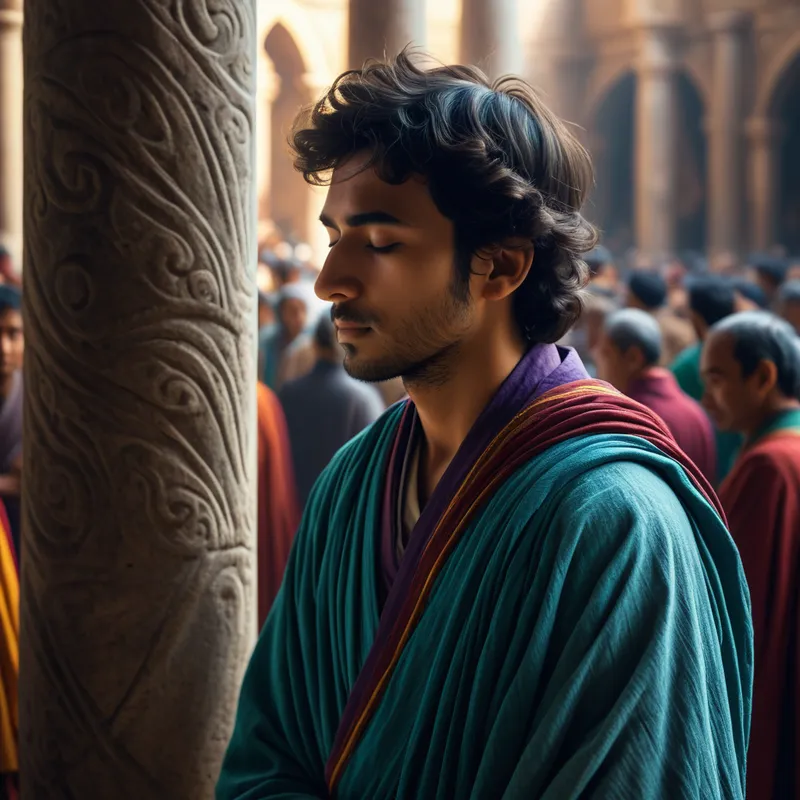
The Athenian Agora was not merely a setting for a myth; it was the living, breathing engine of the myth itself. This “story” is not a single narrative passed down by bards, but a composite cultural reality experienced daily by every citizen and metic (resident alien) of Athens from the 6th to the 4th centuries BCE. Its “authors” were the entire populace.
Its societal function was multifaceted and fundamental. Physically, it was the economic heart—the origin of the word “economics” (oikonomia, household management) played out on a civic scale. Politically, it was the space where democracy was performed, where citizens gathered to be selected for office by lot, to serve on juries, and to participate in the Ecclesia. Judicially, courts convened in its stoas. Philosophically, it was the birthplace of Western thought, where Socrates engaged in his dialectical elenchus, questioning all assumptions amidst the everyday bustle.
The myth of the marketplace was transmitted not through epic poetry, but through lived experience and the philosophical treatises that reflected upon it. Plato’s dialogues are saturated with its atmosphere. The function was pedagogical and existential: to teach the individual how to be a citizen, which, for the Greeks, was synonymous with learning how to be a fully realized human. The Agora was the training ground for navigating the tension between individual interest (idiotes, from which we get “idiot,” meaning a private person) and public duty (polites, citizen).
Symbolic Architecture
Psychologically, the Marketplace of Athens symbolizes the nascent field of consciousness itself. It represents the moment the emerging ego, the “I,” steps out of the private, undifferentiated world of the family (oikos) and into the dazzling, terrifying complexity of collective life.
The Agora is the psyche’s first encounter with the Other as a legitimate, demanding, and necessary reality. It is the birth of the social self.
Each element holds profound symbolic weight. The crowd is the swirling, often chaotic content of the unconscious and the external world, pressing in with its demands and possibilities. The individual stalls and merchants represent the various sub-personalities, talents, and potential identities within us—the inner artist, merchant, warrior, philosopher—all vying for resources and expression. The philosophers debating symbolize the inner dialogue, the cognitive function that seeks to impose logos (reason, order, meaning) upon the chaos. The goods exchanged are not merely objects, but psychic material: ideas, values, emotions, and projections traded in the commerce of relationship.
The central deity of this space is not Athena on her hilltop, but Hermes. As the god of the threshold, commerce, and communication, he presides over all exchange. He is the archetypal symbol of the connective function of consciousness, the psychic energy that facilitates the “trade” between inner and outer, between one complex and another. The struggle to find one’s voice in the din is the struggle to establish a conscious standpoint, a merchant’s stall of the soul, from which to engage with the whole.
The Dreamer’s Resonance
When this mythic pattern stirs in the modern dreamer, it often manifests as dreams of overwhelming crowds, bustling airports, infinite shopping malls, or chaotic city squares. The somatic experience is one of sensory overload, slight panic, and a profound search for orientation.
Psychologically, this dreamscape appears at critical junctures of identity formation or re-formation. It may surface when starting a new career, entering a new social group, or during any life transition that demands the integration of a new “role” into the self. The dreamer is the young Corinthian merchant, their old, simple identity (“I am a student,” “I am a single person,” “I am in that job”) no longer sufficient to navigate the new complexity of their inner and outer world.
The process is one of ego adaptation. The anxiety in the dream is the ego’s fear of dissolution in the face of too many possibilities and demands. The dream is not instructing the dreamer to flee the marketplace, but to do the difficult work the myth models: to pause, to listen to the cacophony, and to discern within it where their own authentic “stall” can be built. It is an invitation to move from being a passive, overwhelmed consumer of life’s noise to becoming an active, conscious participant in its exchange.
Alchemical Translation
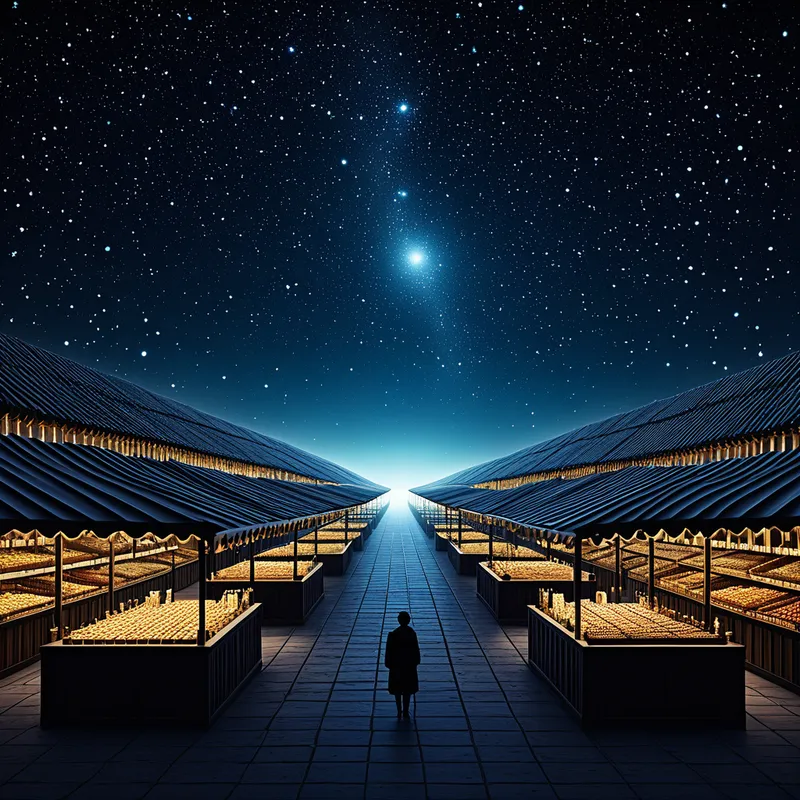
The alchemical process mirrored in the Agora is coagulatio—the making solid, the bringing of spirit into manifestation within the world. The prima materia is the raw, chaotic potential of the unformed self. The furnace is the heated, pressurized environment of social and psychological engagement.
Individuation is not a retreat from the marketplace, but a deeper, more conscious entry into its fray. The goal is not to become a solitary sage on a mountaintop, but to become a wise merchant in the square, one who knows the true value of what they offer and what they receive.
The modern individual’s “Athens” is their total life context: their relationships, career, digital spaces, and internal complexes. The “chaos” is the competing demands of these realms. The alchemical work is to perform the philosopher’s act amidst the noise: to engage in the inner dialogue that seeks the golden mean, the just price, the authentic word.
The triumph is the realization that the self is not a fixed statue to be defended, but a dynamic agora in miniature. It is a space where inner figures (the inner critic, the wounded child, the ambitious hero) can come to “trade,” to be heard and related to, under the governance of a conscious, Hermes-like ego that facilitates communication. To integrate the myth is to understand that one’s consciousness is the marketplace where the world is metabolized into meaning. The final product of this psychic alchemy is not a purified, isolated gold, but a resilient, connected, and participatory self, capable of adding its unique and necessary voice to the eternal, chaotic, and beautiful symphony of being.
Associated Symbols
Explore related symbols from the CaleaDream lexicon: