The Manna Myth Meaning & Symbolism
In the desert wilderness, a grumbling people receive a daily, mysterious sustenance from the sky, a gift demanding trust and tempering the soul.
The Tale of The Manna
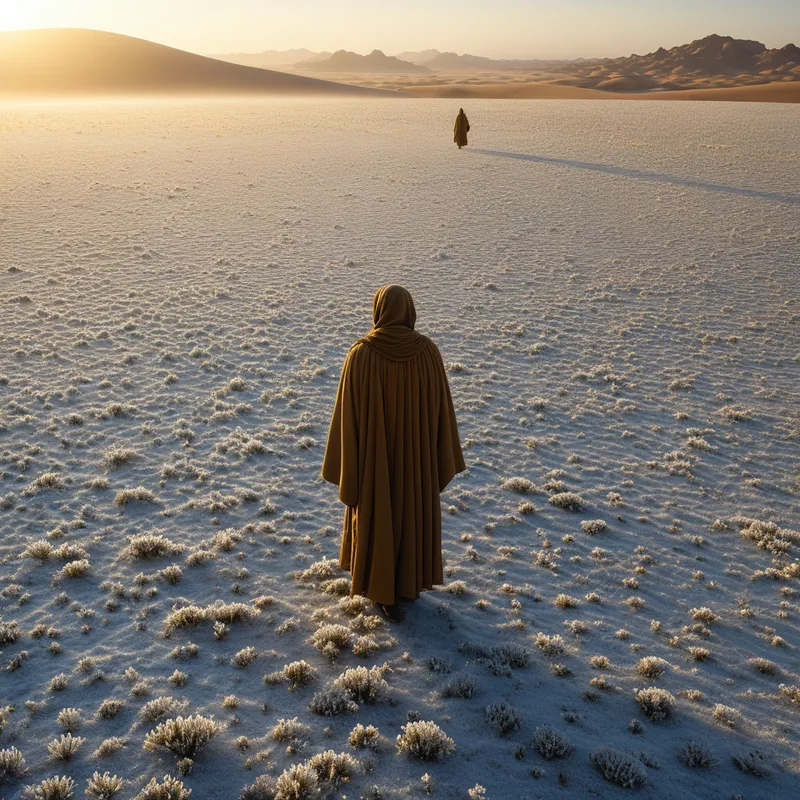
Listen. The story begins in the belly of a vast, sun-scorched silence. It is the silence of the desert, a place of bones and burning sky, where the wind writes forgotten names on the dunes. A people walk there, a nation born in the sudden, violent rupture of liberation. They are free, but freedom has brought them here, to this trackless waste between the memory of slavery and the promise of a land they have never seen.
Their feet are blistered, their throats are dust. The memory of Egypt’s flesh-pots—the leeks, the onions, the garlic—curls in their minds like a sweet, tormenting smoke. They turn on their leader, Moses, their voices a dry rasp of despair. “Was it because there were no graves in Egypt that you have taken us away to die in the wilderness? Would that we had died by the hand of YHWH in Egypt, when we sat by the pots of meat and ate bread to the full!”
Their lament rises like heat-haze to the heavens. And the heavens answer.
It comes with the dew. In the grey light before dawn, when the world holds its breath, a fine, flaky substance appears upon the face of the wilderness. It is delicate as hoarfrost on the desert stone. The people see it and murmur, “Man hu?” What is it? For they do not know what it is. Moses tells them, “It is the bread which YHWH has given you to eat.”
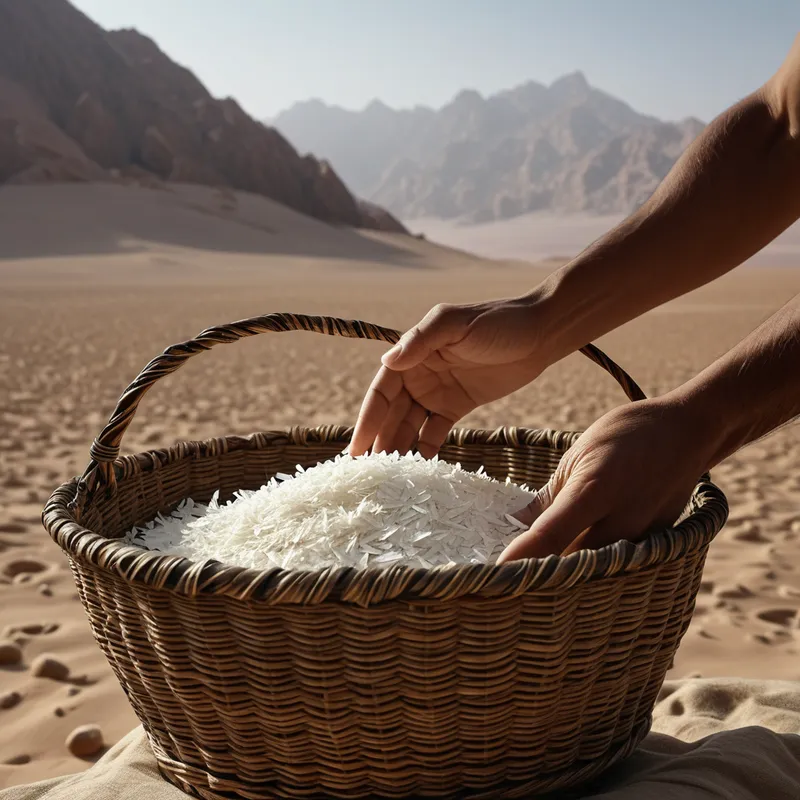
They gather it, this mysterious manna. It is white like coriander seed, and its taste is like wafers made with honey, or like the richness of fresh oil. A command is given with the gift: each is to gather only what they need for the day, an omer per person. No more. Those who are greedy, who hoard it against the terror of tomorrow, find their stored treasure writhing with worms and stinking by morning. It cannot be owned, only received.
But on the sixth day, a different instruction: gather a double portion, for the seventh day is a solemn rest, a Sabbath to YHWH. On that day, the ground will be bare. And so it is. The extra portion does not spoil. The people learn the rhythm of gift and rest, of trust inscribed in their very hunger.
For forty years, as they wander, the manna descends. It ceases only on the day they cross the Jordan, when they eat the produce of the land of Canaan. The bread of angels becomes a memory, a story told to wide-eyed children: of the time when heaven fed them, day by fragile day, in the great and terrible wilderness.
Cultural Origins & Context
This narrative is woven into the foundational epic of the Israelites, preserved in the books of Exodus and Numbers. It functioned as a central etiological myth, explaining not only a miraculous event but establishing the core socio-religious rhythms of the community. Passed down through priestly and wisdom traditions, it was a story told at festivals and during Sabbath observances, a tangible link to the wilderness generation.
Its societal function was multifaceted. It was a testament to divine providence, a proof-text for YHWH’s sustaining power. It also served as a critique of faithlessness and a pedagogical tool for teaching obedience and the sacred cadence of work and rest. The manna story helped forge a collective identity defined not by the static security of empire (Egypt), but by a dynamic, demanding relationship with a deity who provided, but on terms that required trust and adherence to a cosmic order.
Symbolic Architecture
At its heart, the manna is the archetypal symbol of grace—the unearned, daily sustenance that comes from a source beyond the ego’s control. It is not grown from the earth by human labor; it descends. This represents a fundamental psychological shift from an attitude of acquisition and hoarding (the ego’s fortress) to one of receptivity and trust (the soul’s openness).
The gift that cannot be stored is the only gift that teaches the soul to live in the present tense of grace.
The wilderness is the indispensable backdrop. It is the nekyia, the descent into the barren landscape of the psyche where old structures (the identity of a slave) have dissolved and new ones (the identity of a free people in covenant) are not yet formed. In this liminal space, the ego’s resources are utterly bankrupt. The manna symbolizes the nourishment that arises from the unconscious itself—insights, dreams, synchronicities—when the conscious mind has exhausted its plans.
The strict prohibition against hoarding is a profound psychological law. Hoarding manna represents the ego’s attempt to capture and control the numinous, to turn a living symbol into dead capital. The resulting putrefaction signifies the fate of any spiritual insight that is not integrated but merely collected as a trophy. The Sabbath double portion introduces the alchemy of rhythm: the unconscious provides the extra energy needed for the conscious mind to rest, to cease its frantic doing and simply be.
The Dreamer’s Resonance
When this myth stirs in the modern dreamer, it often manifests as a profound anxiety about scarcity amidst a surreal abundance. One may dream of searching frantically for food in a barren landscape, only to find it is made of a substance they cannot recognize or trust. Or they may dream of a mysterious, nourishing light or substance that appears at their door each morning, but vanishes if they try to show it to others or bank it for later.
Somatically, this can correlate with disorders of digestion and metabolism—the body’s literal system of intake, processing, and trust in daily nourishment. Psychologically, it signals a crisis of faith in the process of life itself. The dreamer is in a personal wilderness—perhaps after a job loss, the end of a relationship, or a creative drought. The old “Egyptian” sources of identity and security are gone. The dream of manna asks: Can you tolerate not knowing what the next day’s nourishment will look like? Can you receive what is given, without the guarantee of a stockpile? The process is one of surrendering the ego’s demand for a five-year plan and developing a trust in the daily, often mysterious, ministrations of the Self.

Alchemical Translation
The alchemical journey modeled by the manna myth is the transmutation of anxiety into trust, and of scarcity consciousness into a recognition of sufficiency. The base metal is the “slave psyche”—dependent on external, predictable systems (even oppressive ones) for sustenance. The fire of the wilderness burns this away, leaving the soul in a state of raw, terrified need.
The manna is the prima materia of the new consciousness. It is the first evidence that the universe (the Self) is not hostile to the soul’s journey. The alchemical operation is the daily gathering and consumption. This is the opus contra naturam—the work against the ego’s natural instinct to hoard. Each day, the ego must release its claim on tomorrow and fully ingest the present moment’s grace.
Individuation is not a project of accumulation, but a practice of daily, trusting reception. The Self provides, but only in the measure needed for today’s portion of the journey.
The ultimate goal is not the manna itself, but the development of the internal omer—the calibrated vessel of the soul that knows its true measure, its enough. When this vessel is formed, the psyche can cross its Jordan. The manna ceases because the external miracle has been internalized as a capacity for faith. The individual no longer eats the bread of angels from the sky; they have learned to cultivate the promised land within, where nourishment arises from a lived, embodied trust in the generative process of life itself. The wilderness is not left behind, but integrated; its lesson of daily grace becomes the fertile ground of a mature spirit.
Associated Symbols
Explore related symbols from the CaleaDream lexicon: