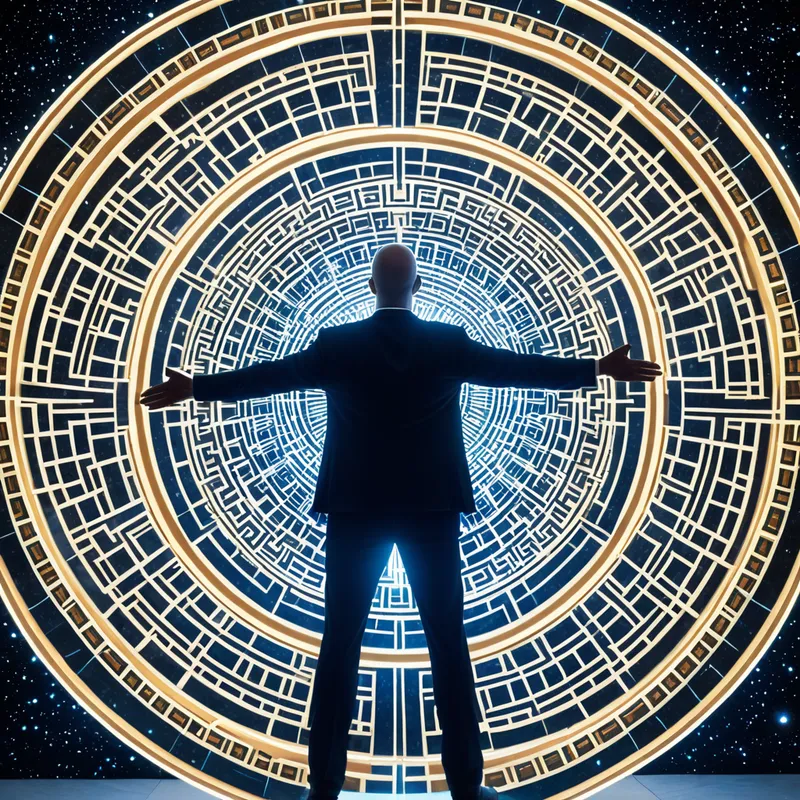
The Mandala Myth Meaning & Symbolism
The myth of the divine architect who, from primordial chaos, constructs a sacred geometric pattern, establishing the center, the circumference, and the order of all worlds.
The Tale of The Mandala
In the time before time, there was only the Primordial Murmur. It was not darkness, for there was no light to define it. It was not silence, for there was no ear to hear it. It was a swirling, churning ocean of potential, a soup of unspoken words and unformed shapes, yearning for a whisper of definition.
From within this murmuring expanse, a consciousness stirred. Not born, but awoken. This was the First Measurer. It opened its inner eye and saw not objects, but the desperate, formless longing for boundary. It felt not with hands, but with a profound will to make distinct.
And so, the First Measurer extended its essence—a point of absolute awareness into the chaos. This point did not push the Murmur away; it invited it. “Here,” the point declared without sound, “is a place to gather.” And the swirling potential began to slow, to cohere around this singular declaration of here. This was the birth of the Axis Mundi, the still point of the turning world.
But a center alone is a prison. From this still point, the Measurer drew a line. It was the first act of relationship, connecting the here to a there. The line was a breath of intention, a radius of influence. Then came another, at a perfect angle, creating a cross. The Murmur shivered, sensing the first bones of structure. From this cross, a circle bloomed—a perimeter, a container, a sacred vessel to hold the becoming. The chaos now had an inside and an outside.
The Measurer worked not with matter, but with the very grammar of existence. Squares emerged within circles, gates at the four cardinal directions. Triangles of aspiration pointed upward; triangles of foundation rooted downward. Each shape was a word in a silent language, a harmonic ratio sung into [the void](/myths/the-void “Myth from Buddhist culture.”/). Towers of concentric squares rose like stepped mountains. Moats of perfect circles flowed like rivers of solidified light. Pathways radiated from the center to the gates, and spiraled back again.
With each geometric utterance, a layer of [the world](/myths/the-world “Myth from Tarot culture.”/) snapped into being. The innermost square became the seat of pure spirit. The next ring, the realm of thought and archetype. Then the realm of formative energy, then the realm of nascent matter, and finally, the outermost wall, the boundary where the ordered cosmos met the endless, creative potential of the returning Murmur. The [Mandala](/myths/mandala “Myth from Buddhist culture.”/) was complete. It was not a [thing](/myths/thing “Myth from Norse culture.”/) built, but a verb made permanent: to order, to integrate, to make whole.
The First Measurer rested at the center, not as a ruler on a throne, but as the conscious heart of the pattern. The Primordial Murmur did not vanish; it now hummed through the gates and along the pathways, no longer a terrifying chaos, but the dynamic, creative breath of a living cosmos. The myth ends with the Measurer’s silent decree: “As above, so below. Let every soul contain this city. Let every mind find its center, draw its circle, and build its world.”

Cultural Origins & Context
The myth of The Mandala is the foundational narrative of the Architectural culture, a civilization that viewed cosmology, statecraft, and psychology through the lens of sacred geometry and intentional design. It was not merely a story but an operative cosmology, recited by Archon-Tellers during the laying of a city’s foundation stone, the coronation of a ruler, or the initiation of an apprentice into the mysteries.
The myth served a dual societal function. Exoterically, it justified and guided the physical construction of their cities, which were always laid out as gigantic, functional mandalas—with a central temple-palace, concentric ring roads, and four main gates aligning with solstice points. The ruler was seen as the human embodiment of the First Measurer, responsible for maintaining cosmic and social order from the civic center. Esoterically, it was a map for the structuring of the individual [psyche](/myths/psyche “Myth from Greek culture.”/), taught in mystery schools. The myth was passed down through precise oral recitation accompanied by ritual sand-tracing, ensuring the sacred proportions and sequences were encoded in both memory and muscle.
Symbolic Architecture
At its core, the [Mandala](/symbols/mandala “Symbol: A sacred geometric circle representing wholeness, the cosmos, and the journey toward spiritual integration.”/) myth is a profound [allegory](/symbols/allegory “Symbol: A narrative device where characters, events, or settings represent abstract ideas or moral qualities, conveying deeper meanings through symbolic storytelling.”/) for the [emergence](/symbols/emergence “Symbol: A process of coming into being, rising from obscurity, or breaking through a barrier, often representing birth, transformation, or revelation.”/) of [consciousness](/symbols/consciousness “Symbol: Consciousness represents the state of awareness and perception, encompassing thoughts, feelings, and experiences.”/) from the unconscious. The Primordial [Murmur](/symbols/murmur “Symbol: A low, continuous, often indistinct sound suggesting hidden communication, subconscious messages, or collective voices beneath surface awareness.”/) represents the undifferentiated, chaotic totality of the psyche—[the Self](/myths/the-self “Myth from Jungian culture.”/) in its raw, potential state. It is pure libido, [energy](/symbols/energy “Symbol: Energy symbolizes vitality, motivation, and the drive that fuels actions and ambitions.”/) without [direction](/symbols/direction “Symbol: Direction in dreams often relates to life choices, guidance, and the path one is following, emphasizing the importance of navigation in personal journeys.”/).
The center is not chosen; it is the inevitable point where consciousness awakens to its own existence amid the inner chaos.
The First Measurer symbolizes the archetypal force of [the ego](/myths/the-ego “Myth from Jungian culture.”/)-complex in its most creative, ordering [capacity](/symbols/capacity “Symbol: A measure of one’s potential, limits, or ability to contain, process, or achieve something, often reflecting self-assessment or external demands.”/). Its act of “measuring” is the fundamental psychic function of discrimination—making distinctions, setting boundaries, creating values and hierarchies. The geometric shapes are not arbitrary; they are the innate, pre-existing psychic structures of the [collective unconscious](/symbols/collective-unconscious “Symbol: The Collective Unconscious refers to the part of the unconscious mind shared among beings of the same species, embodying universal experiences and archetypes.”/)—the archetypes—which provide the foundational patterns for all [human](/symbols/human “Symbol: The symbol of a human represents individuality, complexity of emotions, and social relationships.”/) experience. [The square](/myths/the-square “Myth from Platonic culture.”/) embodies matter, [stability](/symbols/stability “Symbol: A state of firmness, balance, and resistance to change, often represented by solid objects, foundations, or steady tools.”/), and the [four functions of consciousness](/myths/four-functions-of-consciousness “Myth from Jungian culture.”/) (thinking, feeling, [sensation](/symbols/sensation “Symbol: Sensation in dreams often represents the emotional and physical feelings experienced in waking life, highlighting one’s intuition or awareness.”/), [intuition](/symbols/intuition “Symbol: The immediate, non-rational understanding of truth or insight, often described as a ‘gut feeling’ or inner knowing that bypasses conscious reasoning.”/)). The circle represents wholeness, the Self, and the [boundary](/symbols/boundary “Symbol: A conceptual or physical limit defining separation, protection, or identity between entities, spaces, or states of being.”/) of the individuated psyche. The gates are the points of [connection](/symbols/connection “Symbol: Connection symbolizes relationships, communication, and bonds among individuals.”/) and [transaction](/symbols/transaction “Symbol: An exchange of value, energy, or information between parties, representing balance, reciprocity, and the flow of resources in life.”/) between the inner ordered world and the outer world of experience.
The Dreamer’s Resonance
When a modern dreamer encounters mandala imagery—be it a intricate circular pattern, a labyrinthine city plan, or a geometric design that feels profoundly significant—it often signals a critical phase of psychic reorganization. This is not a peaceful process, but an active, sometimes arduous, inner construction project.
Somatically, one might dream of this during periods of intense stress or life transition, when the old “architecture” of the personality is proving inadequate. The dream-ego may be lost in chaotic, formless landscapes (the Murmur) or may be actively tracing lines, building walls, or searching for a center. These dreams point to the Self’s instinctual movement toward greater integration. The psyche is attempting to establish a new Axis Mundi—a revised core identity or value system—from which a new, more capacious personality structure can be built. The dream is the blueprint of this nascent wholeness.
Alchemical Translation
The myth models the entire process of Jungian individuation. The initial state is the [nigredo](/myths/nigredo “Myth from Alchemical culture.”/), the chaotic, confused state of the unexamined life. The awakening of the First Measurer is the spark of self-awareness, the beginning of the albedo, the whitening or clarifying work of analysis and differentiation.
Individuation is not becoming perfect, but becoming whole; it is the conscious construction of a container sacred enough to hold all one’s contradictions.
The drawing of the circle is the establishment of the ego-Self axis, the vital connection between personal consciousness and the transpersonal Self. The construction of the inner squares and gates represents the citrinitas, the “yellowing” or integration of the four functions and the confrontation with archetypal contents (met at the gates). The final, radiant Mandala is the [rubedo](/myths/rubedo “Myth from Alchemical culture.”/), the reddening or realization of the Self—a psychic structure that is both perfectly ordered and dynamically connected to the creative chaos of life (the Murmur). The modern individual’s “alchemical work” is to become [the architect](/myths/the-architect “Myth from Various culture.”/) of their own soul, to consciously participate in this eternal myth by finding their center, setting healthy boundaries, and integrating disparate parts into a functioning, sacred whole. The [triumph](/myths/triumph “Myth from Roman culture.”/) is not in eliminating chaos, but in building a life that can creatively channel it.
Associated Symbols
Explore related symbols from the CaleaDream lexicon: