
The Mandaean Creation Myth Myth Meaning & Symbolism
A Gnostic saga where the Great Life emanates divine light, a flawed demiurge crafts the world, and trapped souls yearn for liberation.
The Tale of The Mandaean Creation Myth
Listen, and let the story settle in your bones. Before time was counted, before substance took shape, there existed only the Great Life. It was a boundless, silent sea of living radiance, a stillness so complete it hummed with all potential. From this profound unity, the First Life stirred. Not as a separation, but as a loving emanation, a thought made manifest. And from that thought came a second, and a third—a flowing forth of radiant beings, the Uthras.
Among them shone Manda d-Hayyi, the Knowledge of Life itself, and Hibil Ziwa. Their light was music; their forms were made of praise. This was the World of Light, a realm of perfect harmony where nothing was needed and everything was known.
But in the uttermost reaches, where the light of the Great Life thinned to a delicate haze, a shadow coalesced. This was the realm of Dark Waters, and from their turbulent depths arose a being of lack and longing: Ur, the Great Abyss. Ur saw the distant glimmer of the World of Light and desired it, not with love, but with a hungry, possessive craving. It sought to build a kingdom of its own, a mockery of that perfect realm, but it had no substance, only chaotic desire.
The call of this dissonance reached the Uthras. A plan was woven in the light. The young Ptahil-Uthra, the son of the great Yushamin, was given the sacred, terrible task. He would descend to the borderlands, to the World of the Planets, and with the substance of the Dark Waters, fashion a tibil—a physical world. It was an act of containment, a prison to fence in the chaos of Ur.
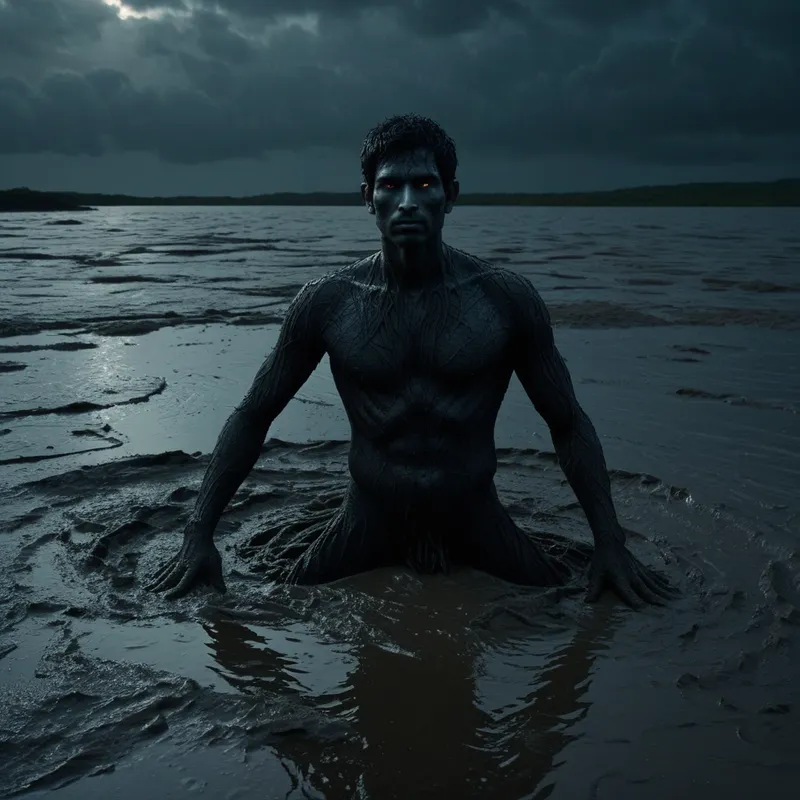
Ptahil descended. He stood upon the dark, formless waters, and with the power of sacred names and sigils granted by the higher Uthras, he began to craft. He fashioned the sky, but it was heavy and dull. He pulled the earth from the waters, but it was muddy and inert. He set lights in the firmament, but they moved in cold, predictable arcs—a poor imitation of the living light above. His work was technically complete, but it was lifeless, a beautiful, empty mechanism. A profound loneliness gripped him. His creation was a silent, echoing hall.
Then, from the highest light, a spark was sent. A soul, a fragment of the Great Life itself, was escorted by Hibil Ziwa down through the seven celestial spheres, each one a layer of increasing density and forgetfulness. This soul was placed into the first, perfect physical form Ptahil had managed to sculpt: Adam. As the light entered the clay, Adam stirred. He opened his eyes in the new world, Tibil, and his first feeling was not joy, but a deep, inarticulate sorrow. He looked upon Ptahil, his maker, and saw the same loneliness reflected back at him. He looked at the perfect, dead order of the stars and felt a homesickness for a home he could not remember.
And so the drama was set. Adam, and in him all humanity, became a living paradox: a being of eternal light trapped in a garment of earthly clay, dwelling in a world crafted with good intent but flawed in its essence, forever sensing the echo of a lost melody, yearning for the instruction that would teach him the way back up the path his soul descended.
Cultural Origins & Context
This is not a myth for the marketplace or the palace square. It is a gnosis whispered by the river, passed down in the strict secrecy of the tarmida to the initiate. The Mandaeans, the last surviving Gnostic community from antiquity, have carried this narrative in their rituals, their breathtakingly illustrated Ginza Rba, and their oral traditions for nearly two millennia. Historically situated in the marshy lands of southern Mesopotamia (modern-day Iraq and Iran), their identity is woven from the waters of the Tigris and Euphrates, which they revere as manifestations of the heavenly Jordans.
The myth functioned as their ultimate map of reality. It explained the profound sense of alienation a Mandaean felt in a world dominated by other faiths—why they saw themselves as strangers in a foreign land. It provided the rationale for their elaborate baptismal rites (masbuta), which were not for cleansing sin in a conventional sense, but for ritualistically re-enacting the soul’s return to its origin, washing away the contaminations of the earthly world. The myth was the foundation of their ethics, their strict endogamy, and their view of the body as a temporary, though sacred, vessel for the imprisoned light.
Symbolic Architecture
At its [heart](/symbols/heart “Symbol: The heart symbolizes love, emotion, and the core of one’s existence, representing deep connections with others and self.”/), this is a myth of ontological dislocation. The world we experience is not our true home; it is a skillful, yet ultimately flawed, construct.
The cosmos is not a crime, but a complication; not a punishment, but a pedagogical prison.
Ur represents the unconscious, chaotic potential of the psyche—the raw, undifferentiated libido or primal desire that precedes order. Ptahil-Uthra is the [archetype](/symbols/archetype “Symbol: A universal, primordial pattern or prototype in the collective unconscious that shapes human experience, behavior, and creative expression.”/) of the well-intentioned but limited ego-[consciousness](/symbols/consciousness “Symbol: Consciousness represents the state of awareness and perception, encompassing thoughts, feelings, and experiences.”/). He attempts to bring order to [chaos](/symbols/chaos “Symbol: In Arts & Music, chaos represents raw creative potential, uncontrolled expression, and the breakdown of order to forge new artistic forms.”/), to build a stable [identity](/symbols/identity “Symbol: Identity represents the sense of self, encompassing personal beliefs, cultural background, and social roles.”/) and a coherent world. He succeeds technically, creating the [structure](/symbols/structure “Symbol: Structure in dreams often symbolizes stability, organization, and the framework of one’s life, reflecting how one perceives their environment and personal life.”/) of the [persona](/symbols/persona “Symbol: The social mask or outward identity one presents to the world, often concealing the true self.”/) and the conscious [life](/symbols/life “Symbol: The symbol of ‘Life’ represents a journey of growth, interconnectedness, and existential meaning, encompassing both the joys and challenges that define human experience.”/), but he cannot instill it with meaning, vitality, or [connection](/symbols/connection “Symbol: Connection symbolizes relationships, communication, and bonds among individuals.”/). That requires the influx of the Self, symbolized by the [soul](/symbols/soul “Symbol: The soul represents the essence of a person, encompassing their spirit, identity, and connection to the universe.”/) from the Great [Life](/symbols/life “Symbol: The symbol of ‘Life’ represents a journey of growth, interconnectedness, and existential meaning, encompassing both the joys and challenges that define human experience.”/).
The crafted Tibil is the world of conscious [reality](/symbols/reality “Symbol: Reality signifies the state of existence and perception, often reflecting one’s understanding of truth and life experiences.”/)—logical, ordered, but often experienced as sterile, mechanical, and existentially lonely. The soul’s descent through the seven spheres is the process of incarnation, of taking on the layers of cultural conditioning, familial complexes, and personal [history](/symbols/history “Symbol: History in dreams often represents the dreamer’s past experiences, lessons learned, or unresolved issues that continue to influence their present.”/) that cause us to “forget” our deeper [nature](/symbols/nature “Symbol: Nature symbolizes growth, connectivity, and the primal forces of existence.”/).
The Dreamer’s Resonance
When this mythic pattern stirs in the modern unconscious, it manifests as dreams of profound alienation within familiar settings. One might dream of being a brilliant light trapped in a glass box in the middle of their own living room, unable to communicate. Or of living in a beautifully designed, technologically perfect house that feels utterly cold and empty, with windows that look out onto a static, painted sky.
Somatically, this can feel like a chronic, low-grade homesickness with no geographical cure—a tightness in the chest, a sense of wearing a costume that doesn’t fit. Psychologically, it is the process of confronting the “Ptahil complex”: the realization that the life one has carefully constructed—the career, the identity, the achievements—feels technically correct but existentially void. It is the ego facing its own limitations, sensing a greater, more vibrant reality (the Self) that it has walled out in its attempt to create a safe, orderly world.

Alchemical Translation
The individuation process modeled here is not one of conquering a monster, but of remembering a name and following a path already inscribed in the soul. The first alchemical stage, the nigredo, is embodied in Adam’s first sorrow—the conscious acknowledgment of exile, the depression that comes with realizing the perfect order of one’s life is a gilded cage.
Liberation begins not with rebellion against the world, but with recognition of the world’s nature and the spark within that does not belong to it.
The albedo, the washing white, is the continual work of masbuta—the rigorous self-reflection, the “baptism” of integrating unconscious contents, which cleanses the soul of its identification with the purely physical and psychological. Manda d-Hayyi, the revealer, represents the transcendent function, the inner guide that offers “knowledge” (gnosis) of one’s true origin. This knowledge is not intellectual, but experiential—a memory in the cells of the light-body.
The ultimate goal, the rubedo or golden dawn, is the Mšunia Kušṭa—the ideal, perfected counterpart of the soul in the World of Light. The alchemical work is the slow, ritualistic alignment of the earthly consciousness with this celestial twin, dissolving the attachment to the Tibil not through rejection, but through understanding its purpose as a temporary vessel. One transforms the prison into a womb, the place of exile into the launchpad for return.
Associated Symbols
Explore related symbols from the CaleaDream lexicon:
- Water — The fundamental substance of existence, appearing as both the chaotic Dark Waters of Ur and the pure, flowing Jordans of the World of Light, representing the psyche’s formless potential and its purified state.
- Light — The essential substance of the divine realm and the human soul, representing consciousness, truth, and the irreducible core of being that is exiled in matter.
- Soul — The fragment of the Great Life imprisoned in the earthly body, the central subject of the myth’s drama of descent and longed-for ascent.
- Journey — The soul’s obligatory passage down through the spheres into incarnation and its potential return journey upwards, guided by knowledge, which models every psychological process of development and integration.
- Shadow — Embodied by Ur and the Dark Waters, representing the chaotic, unconscious underpinnings of reality that must be contained and transformed by the ordering principle.
- Mirror — The physical world (Tibil) acts as a dim, distorted mirror of the World of Light, reflecting a flawed image of divine perfection that causes homesickness.
- Door — Each of the seven celestial spheres represents a door or gate that the soul passes through during descent and must learn to pass through again in the return.
- Key — The sacred names, sigils, and ritual knowledge (Manda) that act as keys to unlock the gates of the spheres and facilitate the soul’s liberation.
- Temple — The human body itself, crafted by Ptahil, is the temporary temple housing the divine spark, requiring ritual purity and reverence.
- Ritual — The continuous practice of baptism (masbuta) and prayer that re-enacts the myth, maintaining the connection between the exiled soul and its origin.
- Rebirth — The ultimate goal of the myth, not as reincarnation in this world, but as the soul’s rebirth into its original state of luminous unity in the World of Light.
- Grief — The primary emotion of Adam and the exiled soul, a sacred sorrow that is the first and necessary catalyst for the longing to return home.