The Magnum Opus Myth Meaning & Symbolism
The alchemist's sacred quest to transmute base matter into gold, mirroring the soul's journey from fragmentation to wholeness.
The Tale of The Magnum Opus
Listen, and I will tell you of the Work. Not the work of hands, but the Work of [the World](/myths/the-world “Myth from Tarot culture.”/)-Soul, the labor whispered in the veins of [the earth](/myths/the-earth “Myth from Hindu culture.”/) and the breath of the stars. It begins not with a hero, but with a seeker in a chamber of shadows and smoke.
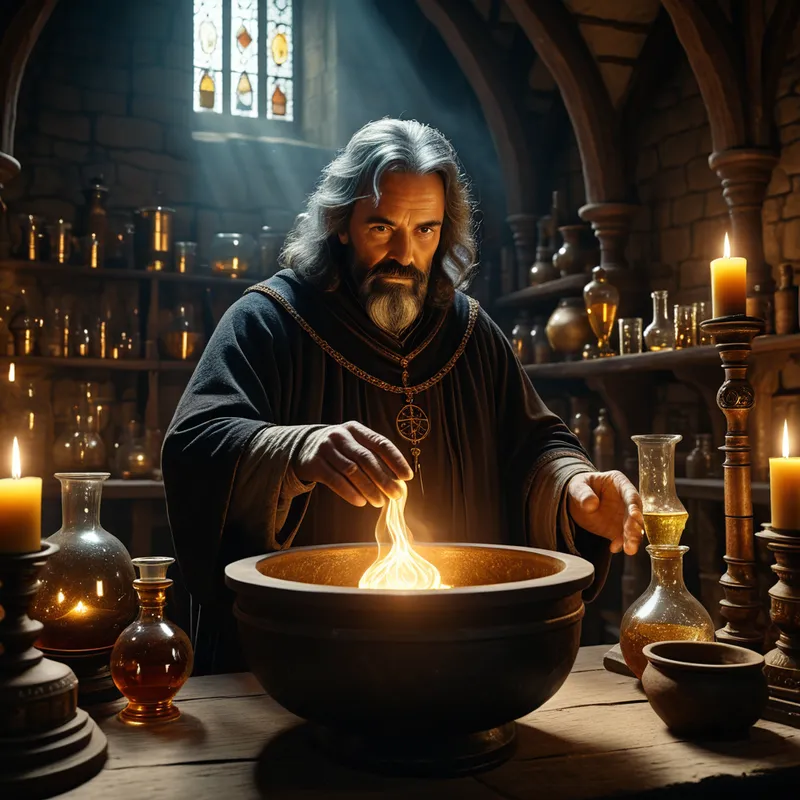
The air is thick with the scent of salt and [sulfur](/myths/sulfur “Myth from Alchemical culture.”/), of vinegar and longing. In the center of the chamber stands the athanor, its belly a low, persistent fire, the heart-beat of the endeavor. [The Alchemist](/myths/the-alchemist “Myth from Various culture.”/) is no king, no warrior; they are a figure of patience and ash-stained robes, their eyes reflecting the flickering flames. Before them lies the [Prima Materia](/myths/prima-materia “Myth from Alchemical culture.”/)—a lump of dark, despised earth, the very dregs of creation, heavy with all the weight of the world’s corruption and despair.
This is the First Sorrow: [Nigredo](/myths/nigredo “Myth from Alchemical culture.”/). The Alchemist commits the base matter to the flames. It does not resist, but seems to welcome its own undoing. It blackens, cracks, and putrefies. A foul vapor rises—the spirit fleeing the corpse. In this darkness, all forms dissolve. The Alchemist, too, feels this dissolution; their certainties rot, their identity smokes away into the gloom of the chamber. They must sit with the blackness, with the stench of failure, until even despair loses its name.
From the absolute black, a miracle of moisture: Albedo. As if weeping for its own death, the matter yields a pure, white vapor that condenses into a crystalline dew. This is the Lunar Queen, the silvered tears of [the moon](/myths/the-moon “Myth from Tarot culture.”/). The mass whitens, becoming like a bleached bone or a shard of [moonstone](/myths/moonstone “Myth from Various culture.”/). A cold, clarifying light fills the chamber. It is the light of reflection, of sorrow distilled into insight. The Alchemist washes the matter with this celestial [water](/myths/water “Myth from Chinese culture.”/), not with hands, but with unwavering attention, a baptism that cleanses not by scrubbing, but by revelation.
Then, the fire is stoked. The white matter reddens. This is the Great Fire, [the Passion](/myths/the-passion “Myth from Christian culture.”/): Citrinitas gives way to the roaring dawn of [Rubedo](/myths/rubedo “Myth from Alchemical culture.”/). The substance seethes, turning the color of blood and sunset. It is a dangerous, glorious riot of color and heat. Here, the opposites wrestle—the fixed and the volatile, the masculine Sulfur and the feminine [Mercury](/myths/mercury “Myth from Roman culture.”/). The Alchemist must now perform [the sacred marriage](/myths/the-sacred-marriage “Myth from Various culture.”/), the Coniunctio Oppositorum. It is not a gentle union, but a fiery coagulation, a battle that becomes a dance, a dance that becomes a new song.
And then, silence. The fire dies to a glow. In [the crucible](/myths/the-crucible “Myth from Alchemical culture.”/), where there was only base earth, now rests a small, heavy stone. It is not merely yellow, but possesses a light of its own—a soft, penetrating gold that seems liquid and solid all at once. This is the [Lapis Philosophorum](/myths/lapis-philosophorum “Myth from Alchemical culture.”/), [the Philosopher’s Stone](/myths/the-philosophers-stone “Myth from Alchemical culture.”/). To touch it is to feel the warmth of a sun held in the palm. A single grain of it, cast upon a plate of lead, causes the metal to shudder, blush, and shimmer into purest gold. But the greater miracle is not in [the vessel](/myths/the-vessel “Myth from Alchemical culture.”/); it is in the Alchemist, whose eyes now hold the same quiet, unassailable light. The Work is complete. The leaden soul has found its gold.
Cultural Origins & Context
The myth of the [Magnum Opus](/myths/magnum-opus “Myth from Alchemical culture.”/) is not a single story from a single time, but a living, breathing tradition that coalesced in the Hellenistic world, flourished in the Islamic [Golden Age](/myths/golden-age “Myth from Universal culture.”/), and reached its symbolic zenith in Medieval and Renaissance Europe. It was never a “public” mythology but an esoteric one, passed down through encrypted texts, cryptic illustrations, and oral instruction within guilds and secret societies. Figures like [Hermes Trismegistus](/myths/hermes-trismegistus “Myth from Greek culture.”/), Jabir ibn Hayyan, and later European adepts like Paracelsus were its prophets and scribes.
Its societal function was dual. On the exoteric level, it was a proto-science, a framework for understanding matter and pursuing practical ends like metallurgy and medicine. On the esoteric level—its true heart—it was a spiritual psychology. [The laboratory](/myths/the-laboratory “Myth from Alchemical culture.”/) was an oratory, [the alembic](/myths/the-alembic “Myth from Alchemical culture.”/) a model for the soul. The myth provided a coded map for personal transformation, a way to discuss the perilous journey of enlightenment under the protective guise of chemical recipes, safe from the scrutiny of orthodox religious authorities. It was a myth for those who sought God not only in scripture, but in the very fabric of creation.
Symbolic Architecture
The [Magnum](/symbols/magnum “Symbol: A powerful spiritual symbol representing divine authority, ultimate truth, and transformative force that transcends ordinary reality.”/) [Opus](/symbols/opus “Symbol: A spiritual or alchemical term for a great work of creation, often representing the culmination of a life’s purpose or a transformative process.”/) is the supreme [allegory](/symbols/allegory “Symbol: A narrative device where characters, events, or settings represent abstract ideas or moral qualities, conveying deeper meanings through symbolic storytelling.”/) for the process of individuation—the psychological [journey](/symbols/journey “Symbol: A journey in dreams typically signifies adventure, growth, or a significant life transition.”/) toward becoming an integrated, authentic Self. The Prima Materia represents the unformed, chaotic stuff of our [psyche](/myths/psyche “Myth from Greek culture.”/), our raw potential mixed with our [shadow](/symbols/shadow “Symbol: The ‘shadow’ embodies the unconscious, repressed aspects of the self and often represents fears or hidden emotions.”/), our complexes, and our unlived [life](/symbols/life “Symbol: The symbol of ‘Life’ represents a journey of growth, interconnectedness, and existential meaning, encompassing both the joys and challenges that define human experience.”/).
The first stage of the Work is the descent into one’s own darkness; to make gold, one must first acknowledge the lead.
The four cardinal stages—Nigredo, [Albedo](/symbols/albedo “Symbol: In alchemy, the whitening stage representing purification, spiritual ascension, and the emergence of consciousness from darkness.”/), Citrinitas, Rubedo—are not [linear](/symbols/linear “Symbol: Represents order, predictability, and a direct, step-by-step progression. It symbolizes a clear path from cause to effect.”/) steps but spiraling phases of [death](/symbols/death “Symbol: Symbolizes transformation, endings, and new beginnings; often associated with fear of the unknown.”/) and [rebirth](/symbols/rebirth “Symbol: A profound transformation where old aspects of self or life die, making way for new beginnings, growth, and renewal.”/). Nigredo is the confrontation with [the shadow](/myths/the-shadow “Myth from Jungian culture.”/), depression, and the “dark [night](/symbols/night “Symbol: Night often symbolizes the unconscious, mystery, and the unknown, representing the realm of dreams and intuition.”/) of the [soul](/symbols/soul “Symbol: The soul represents the essence of a person, encompassing their spirit, identity, and connection to the universe.”/).” [Albedo](/symbols/albedo “Symbol: In alchemy, the whitening stage representing purification, spiritual ascension, and the emergence of consciousness from darkness.”/) is the purification, the [emergence](/symbols/emergence “Symbol: A process of coming into being, rising from obscurity, or breaking through a barrier, often representing birth, transformation, or revelation.”/) of [consciousness](/symbols/consciousness “Symbol: Consciousness represents the state of awareness and perception, encompassing thoughts, feelings, and experiences.”/) (Luna) from the unconscious mire. Citrinitas is the dawning of spiritual [awareness](/symbols/awareness “Symbol: Conscious perception of self, surroundings, or internal states. Often signifies awakening, insight, or heightened sensitivity.”/) and the “solar” understanding, while Rubedo is the full [integration](/symbols/integration “Symbol: The process of unifying disparate parts of the self or experience into a cohesive whole, often representing psychological wholeness or resolution of internal conflict.”/), where the conscious ego and the unconscious Self are united in a living, embodied totality—symbolized by the sacred [marriage](/symbols/marriage “Symbol: Marriage symbolizes commitment, partnership, and the merging of two identities, often reflecting one’s feelings about relationships and social obligations.”/).
The [Philosopher’s Stone](/symbols/philosophers-stone “Symbol: The ‘Philosopher’s Stone’ represents the ultimate goal of transformation and enlightenment, symbolizing the quest for knowledge, wisdom, and the attainment of one’s true potential.”/) is the ultimate [symbol](/symbols/symbol “Symbol: A symbol can represent an idea, concept, or belief, serving as a powerful tool for communication and understanding.”/) of the achieved Self. It is not perfection, but wholeness. It represents the psychic center that can “transmute” experience—suffering, joy, conflict—into meaning. It is the inner [authority](/symbols/authority “Symbol: A symbol representing power structures, rules, and control, often reflecting one’s relationship with societal or personal governance.”/) that turns the base [metal](/symbols/metal “Symbol: Metal in dreams often signifies strength, transformation, and the qualities of resilience or coldness.”/) of reactive [emotion](/symbols/emotion “Symbol: Emotion symbolizes our inner feelings and responses to experiences, often guiding our actions and choices.”/) into the gold of conscious [response](/symbols/response “Symbol: Response in dreams symbolizes how one reacts to situations, often reflecting the subconscious mind’s processing of events.”/).
The Dreamer’s Resonance
When this myth stirs in the modern dreamer, it speaks of a profound somatic and psychological process underway. Dreams of dark, rotting basements or being buried in black earth resonate with Nigredo—the psyche initiating a necessary dissolution. The dream ego may feel lost, corrupted, or hopeless. This is the body-mind’s way of processing deep-seated grief, rage, or trauma that has been “fixed” like lead in the system.
Dreams of washing in clear, cold springs, of finding white stones or bones, or of a serene, silver light reflect the Albedo phase. Here, the psyche is in a state of cleansing and clarification after a crisis. It is a fragile, reflective time, often accompanied by feelings of vulnerability but also profound insight.
To dream of the furnace or the sacred marriage is to feel the psyche’s forge operating at full capacity; it is rarely peaceful, but vibrantly, terrifyingly alive.
Finally, dreams featuring a radiant red or gold object—a gem, a child, a sun held in the hand—signal the approach of Rubedo. This is not the end of the process, but a moment of crystallization, where the dreamer touches, however briefly, a sense of indestructible core identity and purpose. The dream often carries a numinous, awe-inspiring quality, a somatic sensation of warmth, density, and rightness.
Alchemical Translation
For the modern individual, the Magnum Opus models the non-negotiable ordeal of psychic transmutation. Our culture offers endless shortcuts—positive thinking, quick fixes, spiritual bypassing—but the alchemical myth insists on the value of the opus, the long, devoted labor.
The first translation is the embrace of the Nigredo. In a life obsessed with light, we must learn to honor our darkness—our depression, our anger, our “useless” suffering—not as failure, but as the essential Prima Materia of our growth. This is the stage of shadow-work.
The second is the practice of the Albedo: the cultivation of conscious reflection. This is the work of therapy, journaling, meditation, or art—the “washing” that separates insight from identification. It is learning to hold our experiences in the cool light of awareness, without judgment.
The Stone is not found; it is coagulated from the blood, sweat, and tears of a thousand small sacrifices of the ego.
The final translation is the courageous engagement with the Coniunctio. This is the lived application of wholeness. It is the ability to hold tension—between work and love, solitude and relationship, strength and vulnerability—without splitting or collapsing. It is the marriage of our inner masculine and feminine principles, not as gender, but as modes of being: our capacity for action (Sulfur) and our capacity for receptivity and flow (Mercury).
The resulting “Stone” is not a static trophy. It is a living, psychic function: the ability to be in the world with resilience, authenticity, and compassion. It is the realization that the gold we sought was never outside, but was the very nature of the consciousness that undertook the search, forged in the fire of its own experience. The Magnum Opus, therefore, is not a myth of an end, but a myth of a beginning—the beginning of a life lived from the center, where one is both the Alchemist and the Gold.
Associated Symbols
Explore related symbols from the CaleaDream lexicon: