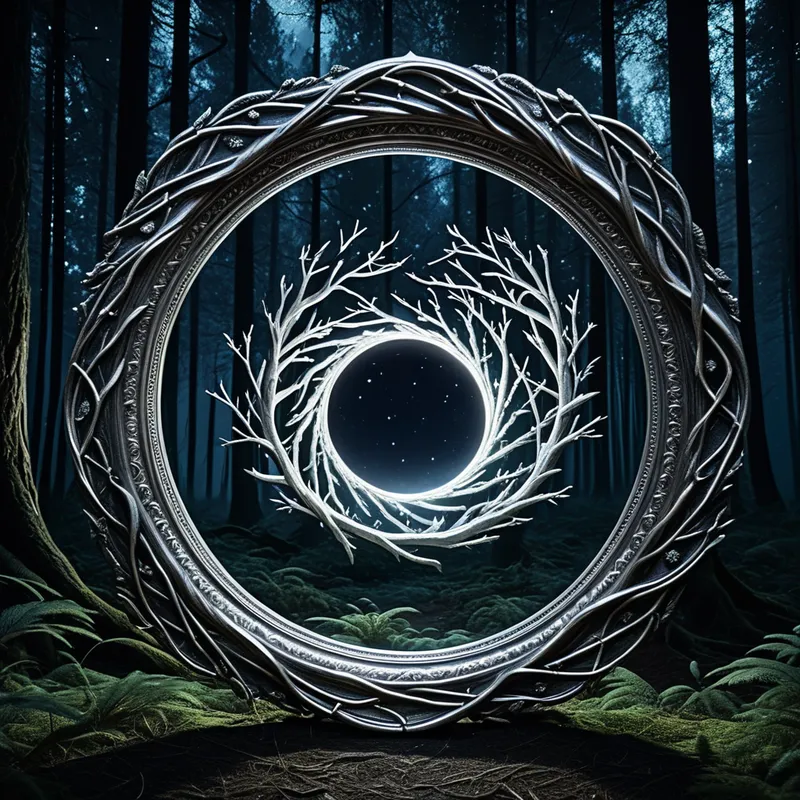
The Magic Mirror Myth Meaning & Symbolism
A queen's quest for validation from a magical mirror spirals into obsession, revealing the shadow self and the high price of confronting one's own reflection.
The Tale of The Magic Mirror
Listen, and I will tell you of the silver whisper in the dark, of the question that devours kingdoms. In a land where the woods were deep with secrets and the stones remembered the names of gods, there lived a queen of surpassing beauty. Her hair was the color of raven’s wings, her skin like winter’s first snow. But in the silent hours, when the castle slept, a chill would settle in her heart—a fear that the world’s admiration was a fleeting thing, a petal on the wind.
In the deepest vault of the castle, behind a door of black oak banded with iron, was her solace and her curse. It was not gold or jewels she kept there, but a thing of older, colder power: The Magic Mirror. Its frame was wrought of silver so pure it seemed liquid, twisted into the shapes of thorn and vine. Its surface was not glass, but a pool of quicksilver and shadow, ever-shifting.
Every night, by the light of a single candle, the queen would stand before it. The air would grow still, thick with the scent of ozone and cold earth. She would speak the words carved into the frame, words that tasted of iron and frost: “Mirror, mirror, on the wall, who is the fairest one of all?”
And the mirror would answer. Not with a voice of air, but with a resonance that vibrated in the bones, a sound that seemed to come from the earth itself. “You, my queen, are the fairest in the land.” For years, this was the ritual. The words were a balm, a spell that held her world intact. Her beauty was not just a fact; it was a decree from an oracle of silver and shadow.
But time, the sly thief, works even on queens. A child grew in the castle—a princess with laughter like sunlight and a kindness that warmed stones. The queen watched her, and the old chill in her heart became a gnawing frost. One night, the ritual repeated. The question hung in the vault’s cold air. The mirror’s surface swirled, not with comforting silver, but with tendrils of deep, smoke-like grey. The resonant voice spoke again, but the words were different. “You, my queen, are fair, it is true. But Snow White is a thousand times fairer than you.”
The words did not echo; they were absorbed by the stone, leaving a silence more terrible than any sound. The queen’s reflection in the mirror did not show a face twisted with rage, but a face hollowed by a truth she could not bear. The balm had become poison. The oracle had betrayed her. From that moment, the queen was no longer a ruler of a kingdom, but a servant to a single, burning question. The mirror had shown her not her rival, but her own ending—the fading of her light before a newer, brighter dawn. Her every action, every dark and desperate plot that followed, was not merely to destroy the girl, but to silence the truth in the glass. To make the world conform, once more, to the reflection she demanded to see.

Cultural Origins & Context
The myth of the Magic Mirror finds its roots not in royal courts, but in the hearthside and the spinning room. It is a warning tale, passed down by grandmothers and traveling storytellers in the oral traditions of Fairy Tale cultures. Its primary function was societal and psychological. It was told to young women, yes, but also to rulers and artisans—to anyone who might confuse their social role or fleeting attribute for their core self.
The mirror itself is a folkloric amplification of a universal human tool. In a culture where polished metal and still water were the only reflectors, the idea of a mirror that speaks transforms a simple object of vanity into an oracle of identity. The storyteller, often an older woman wise to the ways of time and change, used the tale to illustrate the peril of external validation. The queen’s kingdom represents not just a political state, but the psychic territory of the self. Her descent into obsession shows what happens when the governance of that territory is handed over to an external, unforgiving judge.
Symbolic Architecture
At its heart, the myth is not about beauty, but about truth—and our catastrophic relationship with truths we have not chosen. The Magic Mirror symbolizes the objective, impersonal voice of reality. It does not judge morally; it simply reflects what is. It is the unblinking eye of the cosmos, the fact of aging, the reality of another’s talent, the unvarnished feedback of the world.
The mirror does not create the shadow; it only has the courage to name the light that casts it.
The queen represents the ego in its most brittle, identified state. She has conflated her entire sense of worth and power with a single, perishable attribute: her celebrated beauty. The mirror’s shift in proclamation is the moment the psyche encounters an undeniable aspect of the shadow—here, the shadow of impermanence and the threat of being superseded. Snow White is not merely a person; she is the symbol of new life, innocent potential, and the future that inevitably displaces the present. The queen’s violent rejection of her is the ego’s futile war against the flow of time and the cycle of life itself.
The Dreamer’s Resonance
When this myth pattern activates in the modern dreamscape, the dreamer is often at a precipice of self-confrontation. To dream of a talking mirror, or a mirror that shows a shocking or unwanted reflection, signals a moment where a deeply held self-image is being challenged by the unconscious.
The somatic experience is often one of freezing or sinking dread—a cold realization in the pit of the stomach. Psychologically, the dreamer is undergoing a forced differentiation between the persona (the mask they show the world, like the queen’s “fairest” title) and a more complex, perhaps less flattering, self-knowledge. The figure in the mirror that is not you, or the voice that contradicts you, is an emergent truth from the psyche’s depths. The dream is the mind’s own Magic Mirror, delivering a verdict the dreamer has felt but refused to consciously acknowledge—perhaps about a fading skill, a relationship outgrown, or a self-deception that can no longer be sustained.

Alchemical Translation
The myth models the first, most brutal stage of psychic alchemy: the nigredo, or blackening. This is the necessary death of an old identity. The queen’s story is a cautionary tale of what happens when this stage is refused; she attempts to destroy the messenger (Snow White) and silence the oracle (the mirror’s truth), leading only to her own dissolution.
For the modern individual on the path of individuation, the alchemical work begins with the courage to ask the mirror’s question and to listen to the answer, however devastating. The transmutation occurs not in changing the reflection, but in changing one’s relationship to it.
The goal is not to be named the fairest, but to outgrow the need for the question.
The “magic” of the mirror is ultimately its function as a catalyst for disintegration. The proud, identified ego (the queen) must be humbled and broken apart by a truth it cannot control. From that ashes of that shattered self-image, a more conscious self can begin to form—one that does not seek its worth in a comparative oracle, but finds its substance in being, flawed and mortal, behind the glass. The mirror’s final lesson is that the true sovereign is not the one praised by the reflection, but the one who can stand before any reflection, in its perfect clarity or its terrifying truth, and still say, “I am.”
Associated Symbols
Explore related symbols from the CaleaDream lexicon: