The Magic Carpet Myth Meaning & Symbolism
A king's quest for a flying throne reveals the power of the mind to transcend the material world and rule the inner kingdom.
The Tale of The Magic Carpet
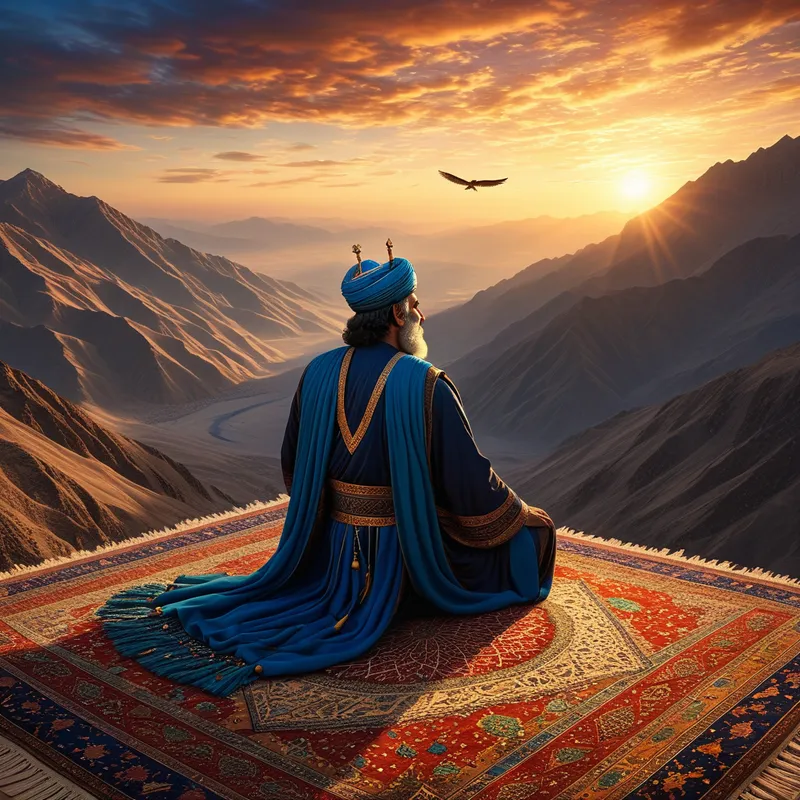
Listen, and let the winds of the Persian plateau carry you back. In the time when [the world](/myths/the-world “Myth from Tarot culture.”/) was woven from wisdom and wonder, there sat a king whose name was a whisper of the divine: Sulayman, [Solomon](/myths/solomon “Myth from Biblical culture.”/), son of David. His throne was [justice](/myths/justice “Myth from Tarot culture.”/), his ring commanded the jinn, and his heart understood the language of the ants. Yet, a profound restlessness stirred within him. To rule justly, he believed, one must see the entirety of one’s kingdom—not just its borders on a map, but the joy in its markets, the sorrow in its hidden valleys, the secret prayers rising from its rooftops at dawn.
He summoned his most cunning vizier. “I desire a throne that does not rest upon [the earth](/myths/the-earth “Myth from Hindu culture.”/),” the king declared, his voice echoing in the marble hall. “A throne that can carry me on the breath of [the wind](/myths/the-wind “Myth from Various culture.”/), so I may witness my domain as the falcon witnesses the field.”
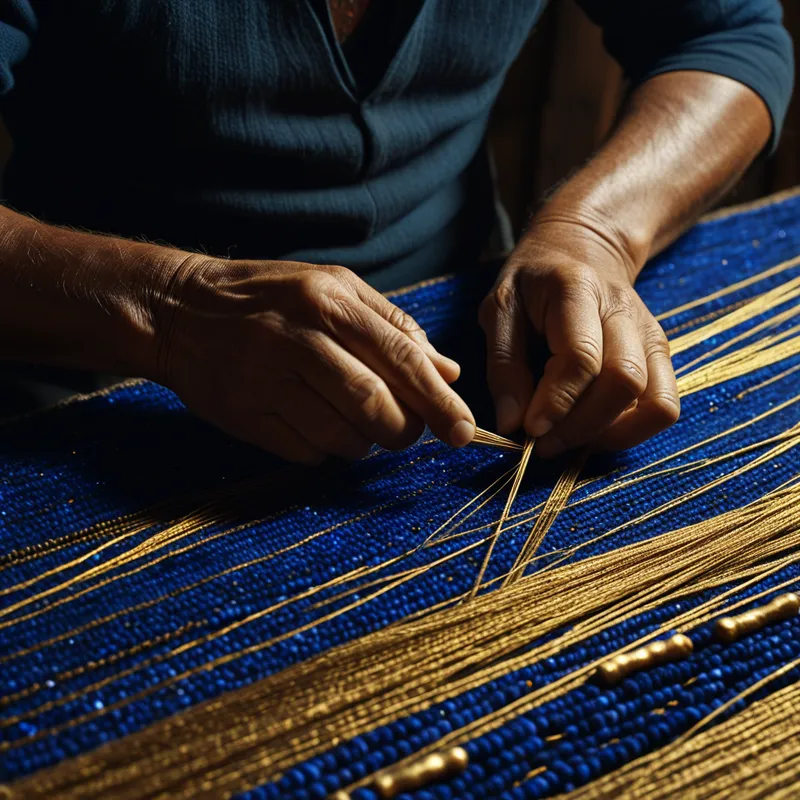
The vizier, a man whose mind was a [labyrinth](/myths/labyrinth “Myth from Various culture.”/) of arts, bowed low. He traveled to the farthest reaches, to the mountain weavers whose fingers were kissed by starlight. He bargained with merchants for silks dyed with the essence of twilight and dawn. And he commissioned the impossible: a carpet, vast as a courtyard square, woven not merely with thread, but with intention.
For forty days and forty nights, the greatest masters worked. They did not weave mere patterns of flowers and vines. They wove the very schematics of the cosmos—the orbits of planets, the migration paths of birds, the sacred geometry that underpins reality. They stitched spells of levitation into the warp and weft, whispers of ancient winds into the fringe. The final thread, a filament of pure, moon-touched silver, was set as the sun crested [the horizon](/myths/the-horizon “Myth from Various culture.”/).
The carpet was brought before Sulayman. It lay inert, a breathtaking tapestry of deep blues, golds, and crimsons. The king, his court, and a host of gathered jinn and humans held their breath. Sulayman stepped upon it. He raised his hand, not in command, but in invitation to the east wind.
And the carpet stirred. It rippled like [water](/myths/water “Myth from Chinese culture.”/), then lifted, smooth as a leaf caught in an updraft. A gasp swept the crowd. Sulayman sat upon his cushion, and the carpet ascended, carrying him, his throne, and all who stood upon it into [the sky](/myths/the-sky “Myth from Persian culture.”/). They sailed over minarets and mountains, over deserts that shimmered like gold and rivers that snaked like sapphire threads. He saw his kingdom not as a ruler from a palace, but as a guardian from the heavens. The people below looked up and saw not a tyrant in a chariot of fire, but a benevolent shadow that blessed them with shade as it passed. The journey was one of silent, awe-struck observation—a ruler becoming one with the ruled through the ultimate act of witness. And when he descended, the carpet settled as softly as a sigh, its magic now a quiet hum in the palace stones, a testament that the greatest power is not to command the earth, but to understand it from above.
Cultural Origins & Context
[The flying carpet](/myths/the-flying-carpet “Myth from Various culture.”/) is one of the most enduring and globally recognized motifs to emerge from the rich tapestry of Persian mythology and folklore. Its most famous literary anchor is in the One Thousand and One Nights, but its roots dig much deeper into the Persian [psyche](/myths/psyche “Myth from Greek culture.”/). It is a narrative device that transcends simple fantasy; it functioned as a metaphorical vehicle within oral storytelling traditions, shared by naqqāls and around caravan campfires.
In a culture renowned for its sublime carpet-weaving artistry—where a carpet was a microcosm, a garden of paradise, a map of the universe—the idea that such an object could contain latent, miraculous power is a natural symbolic leap. The myth served multiple societal functions: it celebrated Persian artistic genius, it explored the concept of righteous and omniscient kingship embodied by Sulayman, and it provided a narrative space to contemplate humanity’s ancient desire to overcome natural limits. It was not a story of escape, but one of enlightened engagement. The carpet allowed the sovereign to perform his duty more completely, framing transcendence as a tool for deeper responsibility, not irresponsibility.
Symbolic Architecture
At its core, the [magic carpet](/symbols/magic-carpet “Symbol: The magic carpet symbolizes freedom, adventure, and the ability to rise above challenges.”/) is an [emblem](/symbols/emblem “Symbol: A symbolic design representing identity, authority, or ideals, often used in heraldry, logos, or artistic expression.”/) of the liberated imagination and the sovereign Self. It represents the [human](/symbols/human “Symbol: The symbol of a human represents individuality, complexity of emotions, and social relationships.”/) [capacity](/symbols/capacity “Symbol: A measure of one’s potential, limits, or ability to contain, process, or achieve something, often reflecting self-assessment or external demands.”/) to rise above the literal, [material](/symbols/material “Symbol: Material signifies the tangible aspects of life, often representing physical resources, desires, and the physical world’s influence on our existence.”/) [plane](/symbols/plane “Symbol: Dreaming of a plane often symbolizes a desire for freedom, adventure, and new possibilities, as well as transitions in life.”/)—the “ground of being”—to gain a transcendent [perspective](/symbols/perspective “Symbol: Perspective in dreams reflects one’s viewpoints, attitudes, and how one interprets experiences.”/).
The carpet is the woven psyche itself; its flight is the moment consciousness realizes it is not bound by the loom.
The [hero](/symbols/hero “Symbol: A hero embodies strength, courage, and the ability to overcome significant challenges.”/), Sulayman, is the [archetype](/symbols/archetype “Symbol: A universal, primordial pattern or prototype in the collective unconscious that shapes human experience, behavior, and creative expression.”/) of the integrated ruler. His restlessness is not a flaw, but the call of [the Self](/myths/the-self “Myth from Jungian culture.”/) towards greater wholeness. He does not seek the [carpet](/symbols/carpet “Symbol: Represents the foundation upon which life experiences are built.”/) for conquest or pleasure, but for [vision](/symbols/vision “Symbol: Vision reflects perception, insight, and clarity — often signifying the ability to foresee or understand deeper truths.”/). [The jinn](/myths/the-jinn “Myth from Pre-Islamic Arabian / Islamic culture.”/) and weavers he commands symbolize the harnessing of unconscious, elemental forces (the jinn) and disciplined, conscious skill (the weavers) in service of this psychic evolution. The [carpet](/symbols/carpet “Symbol: Represents the foundation upon which life experiences are built.”/)’s [flight](/symbols/flight “Symbol: Flight symbolizes freedom, escape, and the pursuit of one’s aspirations, reflecting a desire to transcend limitations.”/), therefore, is not mere travel, but the act of achieving a [meta](/symbols/meta “Symbol: A self-referential concept or layer about the nature of reality, systems, or the self. In gaming, it refers to the optimal strategies and knowledge above the game’s basic rules.”/)-position. From this [height](/symbols/height “Symbol: Height often symbolizes ambition, perspective, and the elevation of one’s self-awareness.”/), one sees patterns invisible from the ground: the interconnectedness of all parts of the [kingdom](/symbols/kingdom “Symbol: A kingdom symbolizes authority, belonging, and a sense of identity within a larger context or community.”/), the [relationship](/symbols/relationship “Symbol: A representation of connections we have with others in our lives, often reflecting our emotional state.”/) between [shadow](/symbols/shadow “Symbol: The ‘shadow’ embodies the unconscious, repressed aspects of the self and often represents fears or hidden emotions.”/) and light, the true scale of one’s domain. It is the [psychology](/symbols/psychology “Symbol: Psychology in dreams often represents the exploration of the self, the subconscious mind, and emotional conflicts.”/) of the overview effect applied to the [soul](/symbols/soul “Symbol: The soul represents the essence of a person, encompassing their spirit, identity, and connection to the universe.”/).
The Dreamer’s Resonance
When the motif of the flying carpet appears in a modern dream, it rarely manifests as a literal, ornate rug. More often, it is the sensation: a sudden, effortless levitation of the dream-ego, perhaps on a blanket, a piece of furniture, or simply through intention. This is a dream of profound somatic release.
Psychologically, the dreamer is likely in a process of dis-identification. They are experiencing a shift where a part of the psyche—often the burdened, problem-solving ego—is being lifted out of a tangled, ground-level conflict. The feeling is one of relief, expansion, and agency. It signals that the dreamer is accessing a resource (the “magic” of the carpet) that allows them to see their life situation from a detached, broader perspective. The conflict hasn’t vanished, but they are no longer mired in it. It can also indicate a creative breakthrough, where disparate ideas (the woven threads) suddenly coalesce into a functioning whole that “lifts” the project or understanding to a new level. The somatic signature is lightness in the chest and a clearing of psychic pressure.

Alchemical Translation
The myth models the alchemical process of sublimatio—the spiritualization of matter, the raising of the heavy into the light. The “base material” is the mundane, earth-bound perspective, limited by sensory data and personal bias. The king’s conscious desire for greater vision is the first fire of [the alchemist](/myths/the-alchemist “Myth from Various culture.”/).
Individuation requires building a vehicle—a vas—capable of carrying the ego to meet the Self. The magic carpet is that vessel, woven from the threads of experience, insight, and disciplined practice.
The weaving process is the careful, often tedious work of analysis, reflection, and integration that must precede any transcendent experience. One cannot simply jump into the air; one must construct the vehicle. Each insight, each conquered complex, each moment of patience is a thread in the loom. The final command to the wind is the surrender, the allowing of a force greater than the will (the unconscious, the spirit) to fill [the vessel](/myths/the-vessel “Myth from Alchemical culture.”/) and activate it.
The triumphant flight is the experience of psychic transformation itself. The ruler, now truly sovereign, surveys his inner kingdom—the complexes, the talents, [the shadow](/myths/the-shadow “Myth from Jungian culture.”/) lands—from a position of non-attached compassion. He is in it, but not of it. This is the goal of individuation: not to flee the human condition, but to rule it with wisdom gained from having seen its entirety. The return to earth is crucial; the transformation is meaningless if it does not inform one’s grounded life. The magic, now integrated, becomes a quiet hum in the foundation of the personality, a permanent new perspective from which to engage the world.
Associated Symbols
Explore related symbols from the CaleaDream lexicon: