The Maenads Myth Meaning & Symbolism
The myth of the Maenads, the ecstatic female followers of Dionysus, reveals the primal, transformative power of nature and the psyche that civilization seeks to contain.
The Tale of The Maenads
Hear now the sound that breaks the silence of the ordered world. It is not a song, but a cry—a ululation that rises from the mountain passes, carried on [the wind](/myths/the-wind “Myth from Various culture.”/) that smells of crushed ivy, damp earth, and spilled wine. It is the cry of the [Maenads](/myths/maenads “Myth from Greek culture.”/).
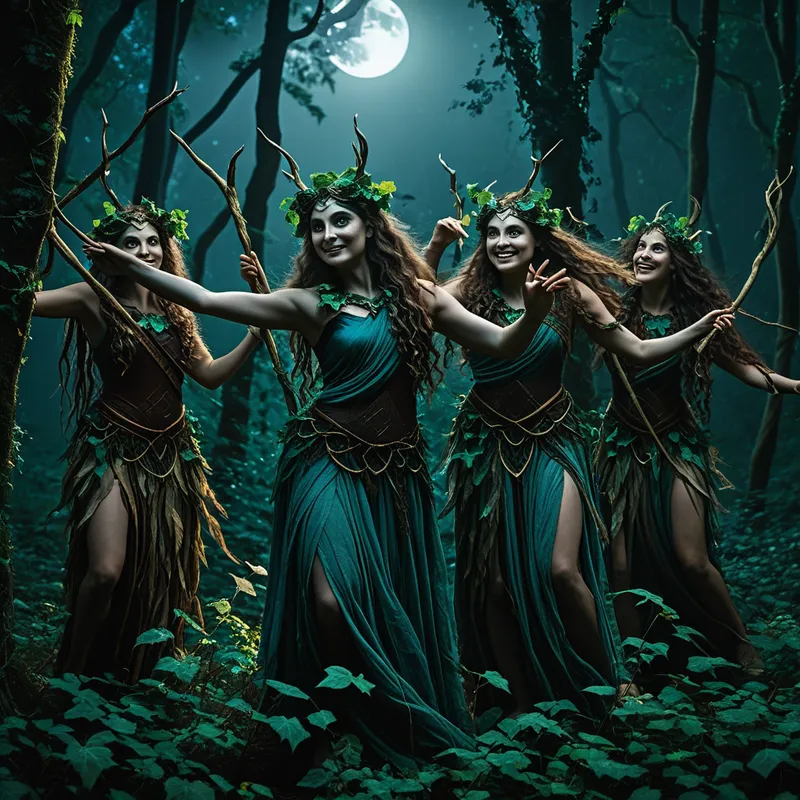
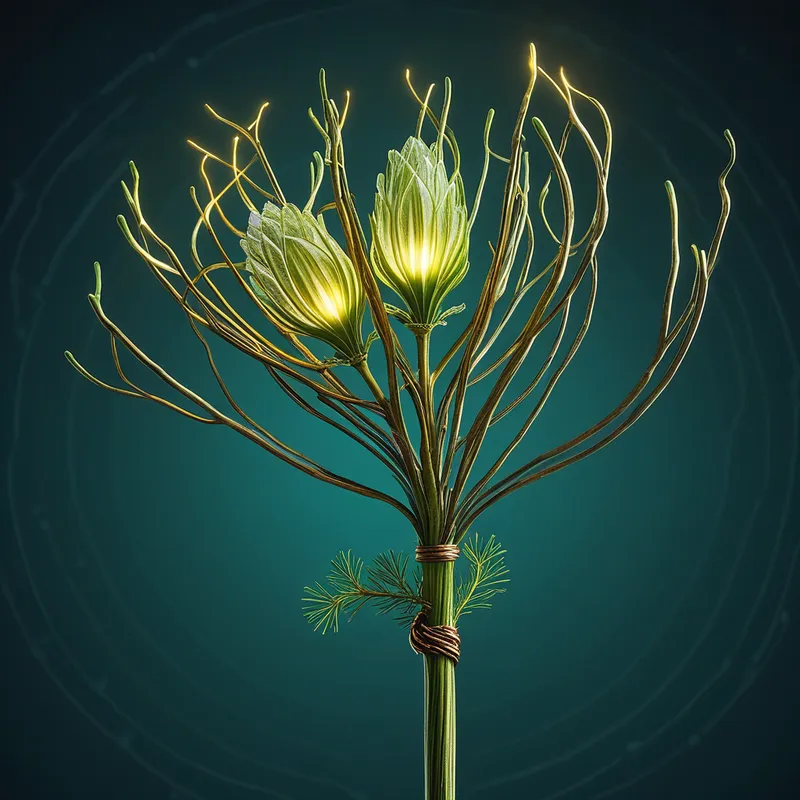
They come when the sun dies and [the moon](/myths/the-moon “Myth from Tarot culture.”/), a silver sliver, claims [the sky](/myths/the-sky “Myth from Persian culture.”/). They are the women of Thebes, of Corinth, of every city whose walls are built too high. By day, they are mothers, weavers, keepers of [the hearth](/myths/the-hearth “Myth from Norse culture.”/). But when the god’s call shivers through the air, they cast off their peploi like dead skin. They wrap themselves in the spotted hides of fawns, crown their unbound hair with writhing snakes of ivy and bryony. In their hands, they take up the thyrsus—a fennel stalk that is both weapon and sacred scepter.
Their lord is Dionysus, [the Stranger](/myths/the-stranger “Myth from Biblical culture.”/)-God. He who was born twice: once from the mortal Semele, consumed by the glory of Zeus, and again from the thigh of the king of gods. He walks among mortals not with the distant thunder of his father, but with the intoxicating scent of the vineyard and the unsettling smile of one who knows a secret that unravels all order.
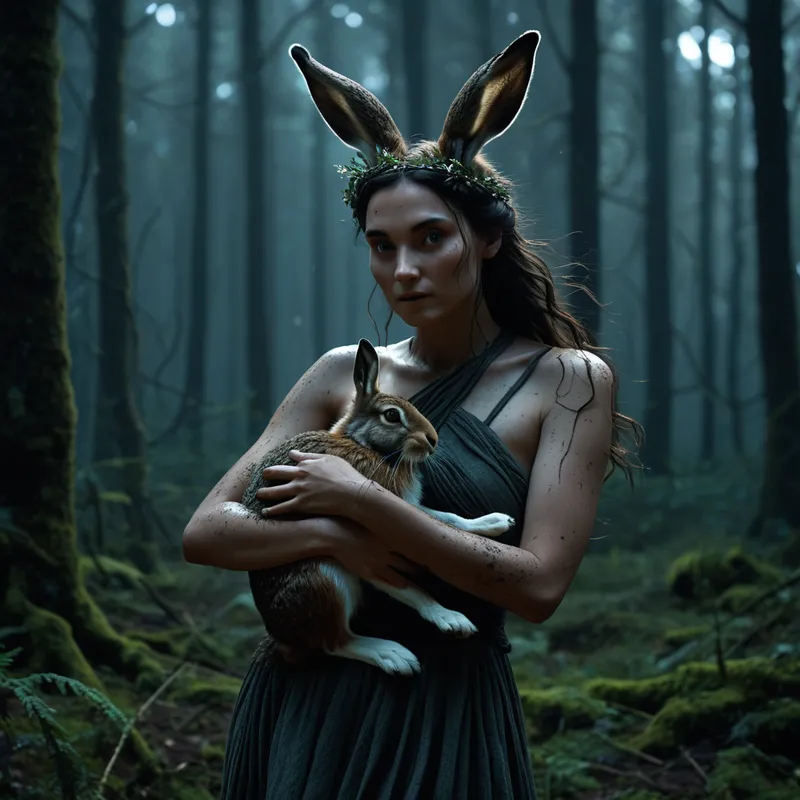
On the slopes of [Mount Cithaeron](/myths/mount-cithaeron “Myth from Greek culture.”/), they gather. The god’s presence is a drumbeat in their blood. They begin to move, not a dance taught by any mortal, but a spasm of [the earth](/myths/the-earth “Myth from Hindu culture.”/) itself. Their heads toss back, eyes rolling white to the moon. They become entheoi—the god within. With their bare hands, they tear at the soil, and milk and honey spring forth from the rock. They snatch up serpents, feeling only the god’s cool power. They seize the young of mountain beasts—fawns, wolf cubs—and with a tenderness that is itself a kind of madness, nurse them at their breasts.
But the god’s blessing is a double-edged thyrsus. When the frenzy peaks, it seeks a culmination. The gentle nurturers become the divine hunters. A roar echoes—not of the god, but of a beast that refuses to be tamed. It is Pentheus, the ruler who spies on the sacred rites from a high pine tree, clad in a woman’s dress, believing himself hidden, believing he can control what he does not understand.
The Maenads see. Or rather, the god within them sees. To their dilated eyes, he is no king, but a mountain lion, a monstrous beast sent to defile their mystery. With a shriek that splits the night, they surge. They uproot the tree. They descend. There is no sword, no spear. Only hands—the same hands that called milk from stone—now rend and tear. Agave, Pentheus’s own mother, leads the rite, her face alight with holy [triumph](/myths/triumph “Myth from Roman culture.”/). She raises the prize aloft, believing it to be the head of a glorious lion, only to see, as the god’s presence ebbs, the staring eyes of her son.
The cry that follows is not of ecstasy, but of a wound deeper than [the world](/myths/the-world “Myth from Tarot culture.”/). The mountain falls silent. The Maenads, spent, human again, are left in the terrible dawn with the consequences of the divine. The god has passed. He has proven his power, not through creation, but through the most intimate and devastating destruction. The wild has spoken, and its grammar is ecstasy and blood.
Cultural Origins & Context
The myth of the Maenads, primarily channeled to us through the tragic lens of Euripides’s Bacchae, was not mere entertainment. It was a cultural nerve, touching the deepest anxieties and recognitions of the Greek polis. The rites of Dionysus, including the oreibasia (mountain dancing) of his female followers, were historical realities, practiced in various forms across the Greek world. These were often state-sanctioned, seasonal rituals—a pressure valve for the women who lived highly circumscribed lives within the city’s walls.
The myth served as a container for profound societal questions. It asked: What is the price of civilization? What forces do we exclude to build our walls, our laws, our hierarchies? The Maenads represented everything the logical, Apollonian male citizen feared: uncontrolled female sexuality, the loss of individual reason to collective frenzy, and the terrifying fertility of nature that could not be legislated. The storytellers, often male poets in a patriarchal society, were both documenting a religious phenomenon and wrestling with [the shadow](/myths/the-shadow “Myth from Jungian culture.”/) of their own cultural order. The myth functioned as a warning against impiety (like Pentheus’s) and as a terrifying acknowledgment that the forces the city repressed were not just real, but divine.
Symbolic Architecture
Psychologically, the Maenads are not monsters, but archetypal personifications of the untamed libido—not merely sexual, but the raw, creative, and destructive [life](/symbols/life “Symbol: The symbol of ‘Life’ represents a journey of growth, interconnectedness, and existential meaning, encompassing both the joys and challenges that define human experience.”/) force itself that exists prior to and beneath the structures of [the ego](/myths/the-ego “Myth from Jungian culture.”/).
The civilized mind builds a city; the wild soul remembers the mountain.
Dionysus represents this force in its totality—the intoxicating inspiration and the annihilating madness. The Maenads are that force made manifest in the [human](/symbols/human “Symbol: The symbol of a human represents individuality, complexity of emotions, and social relationships.”/) [psyche](/myths/psyche “Myth from Greek culture.”/), specifically in what a patriarchal [framework](/symbols/framework “Symbol: Represents the underlying structure of one’s identity, emotions, or life. It signifies the mental or emotional scaffolding that supports or confines the self.”/) would label the “feminine” principle: the intuitive, the embodied, the cyclical, the emotionally overwhelming. Pentheus is the archetypal rigid ego: the [king](/symbols/king “Symbol: A symbol of ultimate authority, leadership, and societal order, often representing the dreamer’s inner power or external control figures.”/), the rationalist, the one who seeks to spy on, categorize, and control the unconscious from a position of detached superiority. His dressing as a woman to do so symbolizes the ego’s clumsy, arrogant attempt to co-opt the power of the unconscious without surrendering to it.
The sparagmos (the rending) is the ultimate symbolic act. It is not meaningless violence, but a brutal deconstruction. It represents the necessary [dissolution](/symbols/dissolution “Symbol: The process of breaking down, dispersing, or losing form, often representing transformation, release, or the end of a state of being.”/) of the old, rigid [identity](/symbols/identity “Symbol: Identity represents the sense of self, encompassing personal beliefs, cultural background, and social roles.”/) (the tyrannical king/ego) that refuses to adapt or acknowledge deeper realities. The fact that it is performed by the [mother](/symbols/mother “Symbol: The symbol of ‘Mother’ represents nurturing, protection, and the foundational aspect of one’s emotional being, often associated with comfort and unconditional love.”/) figure, Agave, deepens the [symbolism](/symbols/symbolism “Symbol: The use of symbols to represent ideas or qualities, often conveying deeper meanings beyond literal interpretation. In dreams, it’s the language of the unconscious.”/): it is the primal, nurturing [source](/symbols/source “Symbol: The origin point of something, often representing beginnings, nourishment, or the fundamental cause behind phenomena.”/) of life itself that, when denied and repressed, becomes the agent of the ego’s destruction.
The Dreamer’s Resonance
When the energy of the Maenads erupts in a modern dream, it rarely appears as ancient Greek women. Instead, one might dream of:
- A wild, unstoppable party in a corporate office where furniture is broken and papers fly.
- Being chased or embraced by a feral version of oneself or one’s mother.
- A gathering of women (or a powerful feminine figure) performing an incomprehensible, compelling ritual in a forest or urban ruin.
- The sudden, uncontrollable growth of vines or wild plants shattering the walls of one’s home.
Somatically, this dream pattern correlates with a profound psychological process: the uprising of the instinctual body against the tyranny of over-civilization. The dreamer may be experiencing a life that feels sterile, overly controlled, or disconnected from passion and authenticity. The Maenad-dream is the psyche’s rebellion. It signals that the libido—the vital energy—is dammed up and is now breaking through, often with chaotic and frightening force. It is an invitation, or a demand, to reconnect with the wild, embodied, and non-rational aspects of [the self](/myths/the-self “Myth from Jungian culture.”/) that have been exiled.

Alchemical Translation
The individuation process modeled here is not one of gentle integration, but of catastrophic, ecstatic confrontation. The alchemical stage is [nigredo](/myths/nigredo “Myth from Alchemical culture.”/)—the blackening, the dissolution, the descent into chaos.
The gold of the authentic self is not found by polishing the persona, but in the crucible where the persona is torn apart.
The modern individual’s “Pentheus” is the constructed self: the successful professional, the perfect parent, the identity built solely on social approval and rational achievement. This structure becomes a prison. The “Dionysian call” is the inner crisis: the burnout, the depression, the inexplicable rage or longing that will not be silenced by more order.
To undergo the alchemy, one must, in a sense, become the Maenad. This does not mean literal frenzy, but the courageous surrender to the process. It means allowing the “civilized” self to be deconstructed by the upwelling of authentic feeling, forgotten creativity, and buried instinct. It is a terrifying, often painful, rite of passage where what was once held sacred (one’s reputation, control, old self-image) is torn apart.
The triumph, the albedo or whitening that follows, is not a return to the old order. Agave does not go back to being the unthinking queen. She awakens to a horrific, but real, truth. For the modern individual, the resolution is the birth of a consciousness that has faced its own wildness and survived. It is an ego that is no longer a tyrannical king spying from a tree, but a participant in the larger, mysterious ecology of the Self—humbled, broader, and capable of holding both ecstasy and grief. The integrated self learns to carry the thyrsus: to channel the wild, creative force with awareness, rather than being obliterated by it or spending a lifetime building walls against it.
Associated Symbols
Explore related symbols from the CaleaDream lexicon: