The Love Story of Qays and Layla
A legendary Arabian love story where Qays's obsessive passion for Layla leads to madness, becoming an enduring symbol of unattainable desire and poetic inspiration.
The Tale of The Love Story of Qays and Layla
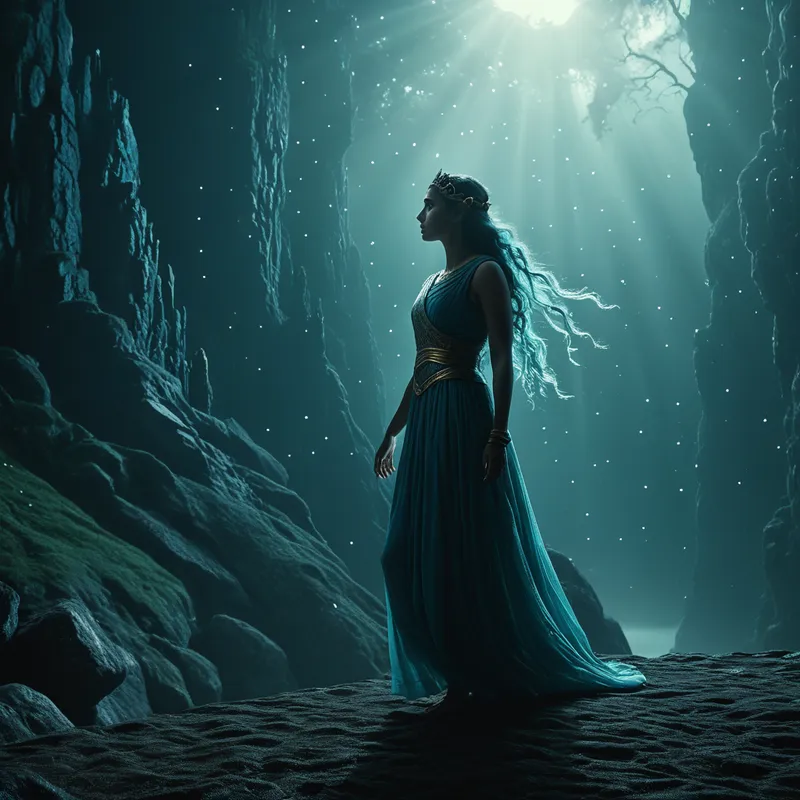
In the vast, sun-scorched deserts of the Najd, where [the horizon](/myths/the-horizon “Myth from Various culture.”/) shimmers like a promise, two souls were kindled in the same flame. Qays ibn al-Mulawwah and Layla bint Mahdi grew as children of the same tribe, their hearts blooming in the innocent soil of shared days. They herded sheep under the same immense sky, their laughter a secret language against [the wind](/myths/the-wind “Myth from Various culture.”/). But as the years turned, that childhood affection deepened into a current of passion so profound it could find no ordinary outlet. Qays, the poet, saw in Layla not merely a woman, but the very essence of beauty and meaning. He began to compose verses, pouring his soul into odes that sang of her eyes, her grace, her name. He sang them openly, recklessly, branding his love upon the ears of [the world](/myths/the-world “Myth from Tarot culture.”/). He became Majnun Layla—“The Madman of Layla.”
His public, poetic obsession became his undoing. In the rigid honor-code of the Bedouin society, such explicit declaration was a scandal, a stain upon Layla’s family. Her father, bound by custom and social preservation, forbade the union. Layla was given in marriage to another man, a wealthy merchant named Ward al-Thaqafi. The news did not extinguish Qays’s love; it atomized his sanity. The world of tents, trade, and tribal law became a meaningless phantom. He fled into [the wilderness](/myths/the-wilderness “Myth from Biblical culture.”/), the vast, indifferent embrace of [the desert](/myths/the-desert “Myth from Biblical culture.”/) becoming his only sanctuary.
There, in the company of wild beasts who recognized his raw, unfiltered soul more than men ever could, Majnun lived. He composed his poetry on the rocks, sang to the scorpions and gazelles, and spoke only of Layla. His love transcended the physical; it became a spiritual fixation, a religion of absence. Layla, imprisoned in her gilded marital home, heard echoes of his verses carried by travelers. Her heart remained his, a silent chamber of parallel suffering. They met, in rare, stolen moments—not as lovers reunited, but as two ghosts haunting the edges of their own tragedy. It is said that when they finally stood face to face, separated by an uncrossable chasm of circumstance, they could not speak. The reality could never match the sublime, tortured ideal nurtured in separation.
Majnun’s madness was not a diminishment but a transformation. He ceased to recognize the human Layla, for his Layla had become an internal archetype, a celestial beloved. When the real Layla died—some say of a broken heart, a quiet fading—the news was brought to Majnun in the desert. He went to her grave, wept his final verses, and there, embracing [the earth](/myths/the-earth “Myth from Hindu culture.”/) that held her, his own spirit departed. They were united only in [death](/myths/death “Myth from Tarot culture.”/), their story finding its consummation not in marriage, but in the eternal fusion of myth.
Cultural Origins & Context
The story of Qays and Layla is rooted in the oral traditions of 7th-[century](/myths/century “Myth from Biblical culture.”/) Arabia, a time when the desert peninsula was a tapestry of warring tribes governed by strict codes of honor (‘ird), hospitality, and poetic prowess. Poetry was not mere art; it was a social weapon, a record of history, and the highest form of intellectual currency. A poet’s words could elevate a tribe to glory or doom it to ridicule. In this context, Qays’s poetry was a catastrophic social transgression. By publicly declaring his love, he exposed Layla to gossip, damaging her family’s honor and making her an impossible bride for him. His act was one of supreme artistic sincerity but profound cultural indiscretion.
The tale evolved through centuries, most notably crystallizing in the 12th-century Persian poet Nizami Ganjavi’s narrative poem [Layla and Majnun](/myths/layla-and-majnun “Myth from Persian culture.”/). Nizami, and later poets like Jami, transplanted the Bedouin story into a Persian Sufi mystical framework, interpreting Majnun’s worldly love as an allegory for the soul’s (nafs) passionate, maddening yearning for God (al-Haqq). This layered the original Arabian tragedy with a profound spiritual dimension, ensuring its resonance across the Islamic world and beyond. The story exists in a liminal space between probable history and definitive myth, its power derived from its embodiment of a central, painful tension: the clash between individual passionate truth and the collective social order.
Symbolic Architecture
At its core, the myth is a profound map of the [psychology](/symbols/psychology “Symbol: Psychology in dreams often represents the exploration of the self, the subconscious mind, and emotional conflicts.”/) of idealization. Layla ceases to be a person and becomes a [symbol](/symbols/symbol “Symbol: A symbol can represent an idea, concept, or belief, serving as a powerful tool for communication and understanding.”/) of the unattainable—the perfect object of desire that can only exist in the imagination. Majnun’s madness is the logical [conclusion](/symbols/conclusion “Symbol: A conclusion can symbolize resolution, closure, and the finality of experiences or decisions.”/) of a love that refuses compromise with [reality](/symbols/reality “Symbol: Reality signifies the state of existence and perception, often reflecting one’s understanding of truth and life experiences.”/).
Majnun does not go mad from loss; he goes mad into a higher, more terrible clarity. The desert is not an escape, but the externalization of his inner landscape—barren of all but the single, burning obsession.
The social prohibition is not merely a [plot](/symbols/plot “Symbol: A plot symbolizes the unfolding of a story, representing personal narratives and life direction.”/) [device](/symbols/device “Symbol: A device in dreams often symbolizes the tools or mechanisms that we use to navigate our inner or outer worlds.”/); it is the necessary catalyst for this [alchemy](/symbols/alchemy “Symbol: A transformative process of purification and creation, often symbolizing personal or spiritual evolution through difficult stages.”/). Without the [barrier](/symbols/barrier “Symbol: A barrier symbolizes obstacles, limitations, and boundaries that prevent progression in various aspects of life.”/), love remains in the [realm](/symbols/realm “Symbol: The symbol of ‘Realm’ often signifies the boundaries of one’s consciousness, experiences, or emotional states, suggesting aspects of reality that are either explored or ignored.”/) of the personal and the possible. The barrier transforms it into the absolute and the impossible, fueling the poetic fire. Their love is perfected by its failure to be realized in the mundane world. In this, the [story](/symbols/story “Symbol: The symbol of ‘Story’ represents the narrative woven through our lives, embodying experiences, lessons, and emotions that shape our identities.”/) explores the dark [symbiosis](/symbols/symbiosis “Symbol: A dream of mutual dependence and interconnected growth, often representing harmonious relationships or integrated aspects of the self.”/) between creativity and suffering, suggesting that the most potent art is often born from a wound that will not heal.
The Dreamer’s Resonance
For the modern [psyche](/myths/psyche “Myth from Greek culture.”/), Qays and Layla speak to the part of us that idealizes, that falls in love not with a person but with an archetype—the anima or animus projected onto another. It is a myth for anyone who has loved the idea of someone more than their reality, or who has felt their deepest passions be pathologized by society as “madness.” Majnun represents the ultimate rejection of the pragmatic ego in favor of the obsessive, imaginative self. His journey is a terrifying yet compelling invitation: what if we followed our one true song to its absolute end, regardless of consequence?
The myth also resonates with the experience of creative individuals for whom their art becomes a possessive, all-consuming force. The “madness” of the artist, channeling a passion that isolates them from conventional life, is mirrored in Majnun’s desert exile. His story asks us to consider the cost of absolute fidelity to an inner vision. Furthermore, in an age where social media creates a curated “Layla” for every “Majnun,” the myth warns of the loneliness inherent in loving a silhouette.
Alchemical Translation
The alchemical process here is one of solificatio—a burning into solar obsession, followed by a mortificatio—a death of the social self. Majnun’s ego, his place in the tribe, is utterly dissolved in the acid of his love. What remains is not a healed, integrated individual, but a purified, fragmented essence: the poet as vessel for a single, overwhelming emotion.
The marriage that society forbids in life is enacted in the soul. Layla, the anima, is internalized. Majnun’s wandering is the psyche’s attempt to reconcile the inner beloved with an outer world that denies her existence. Their physical deaths are merely the final ritual confirming a union that had already taken place in the symbolic realm.
This is not an alchemy of lead to gold in a worldly sense, but of ordinary affection into absolute, destructive, and creative archetypal force. The [prima materia](/myths/prima-materia “Myth from Alchemical culture.”/) is youthful love; the [nigredo](/myths/nigredo “Myth from Alchemical culture.”/) is social shame and separation; the [rubedo](/myths/rubedo “Myth from Alchemical culture.”/) is the crimson fire of poetic utterance and mad devotion. The final product is not a philosopher’s stone, but the story itself—an eternal, crystalline artifact of suffering and beauty.
Associated Symbols
Explore related symbols from the CaleaDream lexicon:
- Lover — The archetypal figure consumed by passion, for whom love becomes the central, defining, and often destructive axis of existence.
- Mad — A state of consciousness shattered by overwhelming emotion or insight, existing outside the bounds of rational order and social acceptance.
- Desert — A landscape of austerity, trial, and purification, representing both exile and the vast, empty space where the soul confronts its deepest obsessions alone.
- Poetry — The transformative art born from deep feeling, capable of encoding unbearable experience into enduring, rhythmic beauty.
- Wall — The symbol of prohibition, separation, and the social or psychological barriers that make desire impossible, thereby intensifying it.
- Heart — The seat of passion and suffering, representing the vulnerable core that is both the source of love and the site of its most profound wounds.
- Wild Beast — The untamed, instinctual nature that recognizes and accepts raw, unfiltered emotion when civilized society rejects it.
- Grave — The final place of union in death, representing the only resolution possible for a love that could not be fulfilled in life.
- Name — The spoken word that binds identity to obsession; to sing the beloved’s name is to conjure and imprison her essence in the world.
- Shadow — The rejected, “mad” aspect of [the self](/myths/the-self “Myth from Jungian culture.”/) that is forced into exile, yet holds the key to a potent, if destructive, authenticity.
- Journey — The endless, aimless wandering that is not towards a destination, but is itself the only possible expression of a fractured life.
- Unwritten Story — The potential life of domestic happiness and social integration that was forever foreclosed, haunting the edges of the tale that was actually lived.