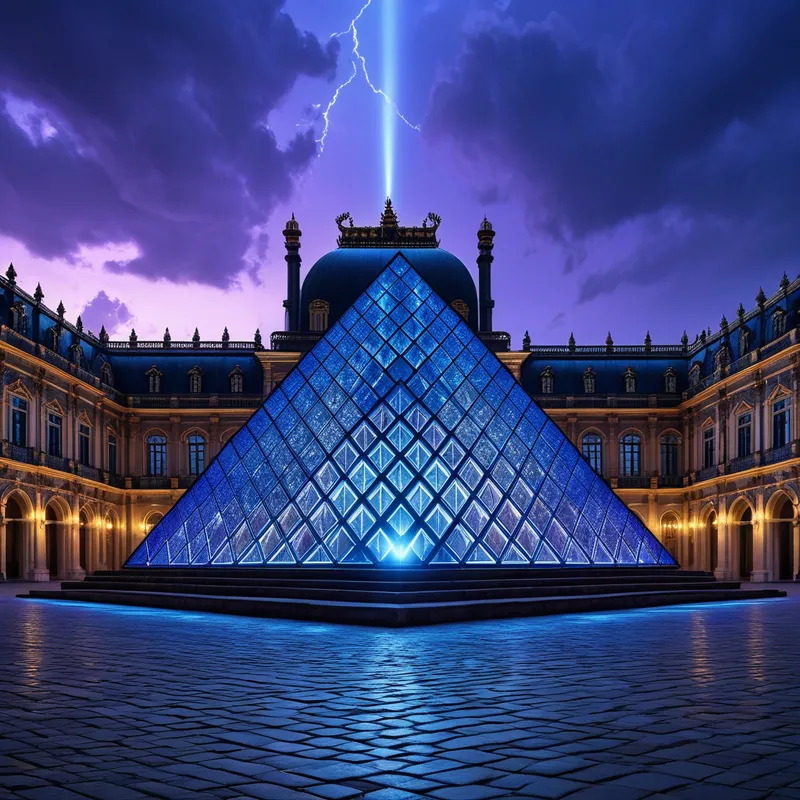
The Louvre Pyramid Myth Meaning & Symbolism
A crystal of future thought is plunged into the heart of a stone memory, sparking a war of shadows and a revelation of unified light.
The Tale of The Louvre Pyramid
Listen. There is a palace of memory, a [labyrinth](/myths/labyrinth “Myth from Various culture.”/) of stone built by the hands of kings and the dreams of artists. For centuries it slept, a slumbering beast of marble and myth, its halls choked with the whispers of gods and the dust of forgotten battles. It was a tomb of glory, a beautiful, heavy sleep.
Then came the Architect. He did not come with hammer and chisel, but with line and light. He saw not a sleeping beast, but a heart waiting for a new kind of beat. From the realm of pure thought and sharp angles, he drew forth a seed—a seed of crystal and clarity, of geometry so pure it seemed sung into existence by the stars themselves. This was the Crystal Seed.
With a reverence that felt like defiance, he brought it to the very heart of the stone labyrinth, the Court of Kings. [The earth](/myths/the-earth “Myth from Hindu culture.”/) trembled not with violence, but with a deep, resonant sigh as he plunged the Seed into the ancient cobbles. It did not settle; it unfolded. Glass and steel erupted from the ground, not as a growth, but as a revelation—a perfect, luminous pyramid, a mountain of light in a valley of shadow.
And the shadows awoke.
They were the Guardians of the Old Sleep. They poured from the ornate windows, slithered from the mouths of stone gargoyles, coalesced from the very dust of the galleries. Their voices were the rustle of parchment, the groan of settling stone, the outraged cries of a thousand connoisseurs. “Sacrilege!” they hissed. “A shard of cold future in the warm body of the past! It is a wound, a scar, an alien eye!”
The Pyramid said nothing. It merely gathered the weak sun, the grey rain, the first hesitant stars, and held them within its facets, transforming them into a cool, internal radiance. This was its only speech: a silent, persistent luminescence. The battle was not of swords, but of sight. The shadows threw themselves against its transparent flanks, seeking to smother, to obscure, to prove it a mere obstruction.
But the light did not fight. It admitted. One by one, the shadows, in their frantic assault, saw their own forms reflected—and then seen through. They saw the ornate wing of the palace framed and magnified by a crystal edge. They saw the cloudy sky given order by a geometric lattice. They saw their own formless rage given a shape, contained, and made part of a larger pattern.
A great stillness fell. [The Architect](/myths/the-architect “Myth from Various culture.”/) stood at [the threshold](/myths/the-threshold “Myth from Folklore culture.”/), between the crystal light and the stone dark. He did not enter the Pyramid. Instead, he turned and placed his hand upon the old, cold wall of the palace. And where his hand touched, a faint, answering glow began to pulse within the stone, as if remembering it, too, was once a living idea. The Pyramid’s light, reaching out, did not erase the palace; it illuminated its truth. It became not a door into the future, but a lens focusing the eternal present. [The labyrinth](/myths/the-labyrinth “Myth from Greek culture.”/) was not replaced; it was finally seen. The heart of the sleeping beast was now a heart of light, and its first new beat echoed through time, a single, clear note of synthesis.
Cultural Origins & Context
This is a myth born in the late 20th century, in [the crucible](/myths/the-crucible “Myth from Alchemical culture.”/) of public controversy and architectural audacity. Its bards are not poets around a fire, but journalists, critics, politicians, and citizens of Paris and [the world](/myths/the-world “Myth from Tarot culture.”/). The myth was passed down through headlines of fury (“[Pharaoh](/myths/pharaoh “Myth from Egyptian culture.”/) Francois Mitterrand!”), televised debates, and the visceral, public experience of witnessing a familiar psychic landscape irrevocably altered.
Its societal function was profound. It served as a ritual narrative for a culture undergoing a seismic shift from the industrial to the information age. The Old Palace represented the tangible, weighty authority of history, art, and national identity—a knowledge kept in vaults. The Pyramid represented the emerging ethos of transparency, accessibility, and global connection—a knowledge meant to be channeled and disseminated. The myth gave a grand, archetypal language to the very real tensions between preservation and innovation, between national treasure and world heritage, between the sacred silence of the museum and the noisy democracy of the crowd. It was a story told to process the shock of the new, and ultimately, to find a new coherence.
Symbolic Architecture
At its core, the [Pyramid](/symbols/pyramid “Symbol: The pyramid symbolizes stability, strength, and the journey toward enlightenment, reflecting the connection between the earthly and the divine.”/) is a [symbol](/symbols/symbol “Symbol: A symbol can represent an idea, concept, or belief, serving as a powerful tool for communication and understanding.”/) of the directed conscious mind being inserted into the vast, unconscious [palace](/symbols/palace “Symbol: A palace symbolizes grandeur, authority, and the pursuit of one’s ambitions or dreams, often embodying a desire for stability and wealth.”/) of the past. It is not an invasion, but an act of precise, courageous orientation.
The crystal does not judge the stone; it reveals the light already trapped within it.
The geometric perfection symbolizes the [human](/symbols/human “Symbol: The symbol of a human represents individuality, complexity of emotions, and social relationships.”/) longing for order, [clarity](/symbols/clarity “Symbol: A state of mental transparency and sharp focus, often representing resolution of confusion or attainment of insight.”/), and rational understanding confronting the beautiful, chaotic, and often overwhelming richness of inherited culture, personal [history](/symbols/history “Symbol: History in dreams often represents the dreamer’s past experiences, lessons learned, or unresolved issues that continue to influence their present.”/), and instinct. The [transparency](/symbols/transparency “Symbol: A state of clarity, openness, and unobstructed visibility where truth, intentions, or processes are fully revealed without deception or hidden elements.”/) is critical—it represents a [consciousness](/symbols/consciousness “Symbol: Consciousness represents the state of awareness and perception, encompassing thoughts, feelings, and experiences.”/) that seeks to observe without [distortion](/symbols/distortion “Symbol: The alteration of form, sound, or perception from its original state, often creating unsettling or creative effects.”/), to integrate without assimilating. The War of Shadows is the inevitable psychic backlash, the [resistance](/symbols/resistance “Symbol: An object or tool representing opposition, struggle, or the act of pushing back against external forces or internal changes.”/) of entrenched complexes, habitual identities, and the fear that [clarity](/symbols/clarity “Symbol: A state of mental transparency and sharp focus, often representing resolution of confusion or attainment of insight.”/) will annihilate [mystery](/symbols/mystery “Symbol: An enigmatic, unresolved element that invites curiosity and exploration, often representing the unknown or hidden aspects of existence.”/).
The myth’s [resolution](/symbols/resolution “Symbol: In arts and music, resolution refers to the movement from dissonance to consonance, creating a sense of completion, release, or finality in a composition.”/)—the [illumination](/symbols/illumination “Symbol: A sudden clarity or revelation, often representing spiritual awakening, intellectual breakthrough, or the dispelling of ignorance.”/), not the destruction, of the old—offers a master symbol for [synthesis](/symbols/synthesis “Symbol: The process of combining separate elements into a unified whole, representing integration, resolution, and the completion of a personal journey.”/). The Pyramid becomes a [psychopomp](/myths/psychopomp “Myth from Greek culture.”/), a guiding [structure](/symbols/structure “Symbol: Structure in dreams often symbolizes stability, organization, and the framework of one’s life, reflecting how one perceives their environment and personal life.”/) that allows the contents of the deep past (the art, the memories, the shadows) to be seen in a new light and related to a conscious standpoint. It is the [axis](/symbols/axis “Symbol: A central line or principle around which things revolve, representing stability, orientation, and the fundamental structure of reality or consciousness.”/) mundi of modern culture, connecting the chthonic [depths](/symbols/depths “Symbol: Represents the subconscious, hidden emotions, or foundational aspects of the self, often linked to primal fears or profound truths.”/) of history with the celestial aspiration of future thought.

The Dreamer’s Resonance
To dream of the Louvre Pyramid is to dream of a moment of profound psychic reorganization. The dreamer is likely at a point where a new, clear, and perhaps rigid principle of understanding (a career path, a philosophical insight, a therapeutic breakthrough) has been introduced into the tangled, beautiful, and shadowy labyrinth of their personal history and emotional life.
Somatically, this may feel like a sharp, clean pressure in the chest or mind—a “geometric” feeling amidst emotional fog. The conflict in the dream mirrors the inner resistance: parts of [the self](/myths/the-self “Myth from Jungian culture.”/) (the Guardians) rise up in protest, fearing this new structure will make them obsolete, will expose them, or will sterilize the rich, messy complexity of their inner world. The dream may sit in the tension of this standoff.
The resolution, if it comes, is not a battle won, but a perception shifted. The dreamer may find themselves inside the pyramid, looking out at their own life with startling clarity, every memory and emotion held and framed in a new context. Or they may see the light from the pyramid gently falling on a forgotten or shameful part of their internal “palace,” not to burn it, but to reveal its true form and its right to exist within the whole. The dream is an alchemical vessel for the integration of personal history.
Alchemical Translation
The myth models the individuation process with stark modernity. The [prima materia](/myths/prima-materia “Myth from Alchemical culture.”/) is the chaotic, weighty totality of the personal and collective past (the Palace). The conscious ego, in its evolved form as the Magician-Architect, introduces the lapis, [the philosopher’s stone](/myths/the-philosophers-stone “Myth from Alchemical culture.”/), symbolized by the perfect, transformative geometry of the Pyramid.
The work is not to build the new on the ruins of the old, but to use the new to decipher the eternal scripture of the old.
The “War of Shadows” is the essential [nigredo](/myths/nigredo “Myth from Alchemical culture.”/), the blackening, the confrontation with [the shadow](/myths/the-shadow “Myth from Jungian culture.”/). The outrage, the doubt, the feeling of desecration are all necessary phases where the old conscious attitude dissolves in the face of the unconscious’s reaction. The Pyramid’s steadfast, silent luminescence is the albedo, the whitening—the emergence of a transcendent function that does not take sides, but simply holds the tension.
The final revelation is the [rubedo](/myths/rubedo “Myth from Alchemical culture.”/), the reddening, the production of the gold. This gold is the achieved synthesis: a consciousness that is both clear (pyramidal) and deeply connected to its roots (palatial). The individual no longer has to choose between being a custodian of their past and an architect of their future. They become the living courtyard where the two meet, where memory is illuminated by awareness, and where awareness is deepened by memory. The light within the crystal is the symbol of the Self, the unified totality of the [psyche](/myths/psyche “Myth from Greek culture.”/), finally providing a coherent, illuminating center to the once-labyrinthine existence.
Associated Symbols
Explore related symbols from the CaleaDream lexicon: