The Lotus Sutra Myth Meaning & Symbolism
A cosmic assembly where the Buddha reveals that all beings possess the seed of perfect enlightenment, transcending all provisional teachings.
The Tale of The Lotus Sutra
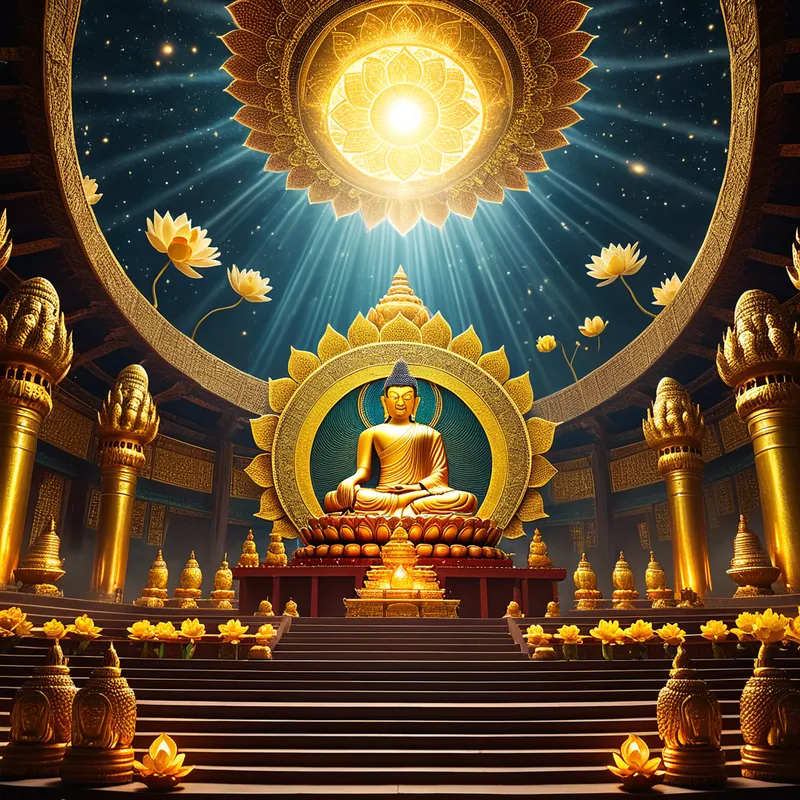
Gather close, and let the mind’s eye see. The air on Vulture Peak is still, thick with the scent of sandalwood and the silent anticipation of worlds. The sky itself seems to hold its breath. Upon a lion throne carved from the mountain’s heart sits Shakyamuni Buddha, but not as the mendicant monk known to the villages below. His body is a mountain of light, his presence a calm so deep it draws the cosmos near.
From the ten directions they come. Bodhisattvas with names like Avalokiteshvara and Manjushri, their forms adorned with jewels that are condensed vows. Gods and dragons, spirits of the wind and trees, kings and arhats who believed their journey was done—all find seats upon the earth, which softens to receive them. The assembly is vast, a living tapestry of every state of being.
The Buddha begins to speak, but his words are not the familiar teachings on suffering and its end. A white curl of light emerges from his brow, illuminating countless Buddha-lands in distant realms, revealing Buddhas teaching in every grain of sand. The ground trembles. A stupendous, jeweled stupa rises from the earth, hanging in the air. From within it comes the voice of a Buddha from an incalculable past, Prabhutaratna, who has crossed aeons to witness this moment. He makes space on his throne, and Shakyamuni enters the stupa, the two Buddhas sitting side-by-side, a vision of timeless truth.
Then, the revelation unfolds, shattering all previous understanding. The Buddha declares that the paths he taught before—the striving for personal liberation, the arduous disciplines—were but skillful means, provisional rafts to cross a river. The true, singular vehicle, the one great purpose, is now unveiled: Anuttara-samyak-sambodhi. He proclaims that even his own lifespan is immeasurable, that he has been teaching since time without beginning, and that he will continue for eons to come.
He tells parables: of a father luring his children from a burning house with promises of toy carriages, only to give them each a magnificent real carriage; of a poor man unaware of a priceless jewel sewn into his garment. The meaning is thunderous. There is no inferior disciple, no being excluded. The Buddha-nature is universal, inherent, waiting only for this moment of recognition. He predicts the future Buddhahood of even those who had merely offered a single flower in faith. The cosmos itself rejoices; flowers rain from the heavens, the earth shakes in six ways, and every being in the assembly sees, for a fleeting, eternal instant, the boundless potential within their own heart.
Cultural Origins & Context
The Lotus Sutra emerged in India between the 1st century BCE and the 2nd century CE, a pivotal text of the <abbr title=“The “Great Vehicle” branch of Buddhism emphasizing universal liberation”>Mahayana movement. It was not presented as a historical record of a single sermon, but as the ultimate, transcendent teaching of the Buddha, preserved and transmitted by cosmic Bodhisattvas until the world was ready to hear it.
Its transmission to East Asia, particularly via the scholar-monk Saicho and the profound influence on schools like Nichiren Buddhism and Tiantai, transformed it from a text into a living cultural force. Recitation of its title or chapters became a central devotional practice, believed to harmonize the individual with the fundamental law of the universe. Its societal function was revolutionary: it democratized enlightenment, offering the ultimate goal not just to monastics, but to laypeople, women, and even those considered spiritually barren. It provided a theological foundation for the compassionate activity of the Bodhisattva, who vows to work for the liberation of all beings.
Symbolic Architecture
The myth’s core is an alchemy of symbols dismantling limited perception. The Vulture Peak is not merely a location but the axis mundi, the point where conventional reality intersects with ultimate truth. The Buddha’s emission of light signifies the illumination of the unconscious, revealing the interconnected totality of existence hidden from ordinary view.
The provisional teachings are the scaffolding of the psyche; the Lotus Sutra is the revelation that the scaffolding was made of gold all along, and is the palace itself.
The jeweled stupa and the Buddha Prabhutaratna symbolize the eternal, unchanging Dharma that exists outside of time, validating the present revelation. The central symbol, the lotus flower, is the master key. It grows from the mud of suffering and ignorance (samsara), yet blooms pristine and beautiful above the water, representing the awakening (nirvana) that is not apart from the world but transforms one’s relationship to it. The “One Vehicle” (Ekayana) annihilates the hierarchy of spiritual paths, asserting a profound psychological non-duality: the seeker and the goal, the afflicted mind and the enlightened mind, are not two.
The Dreamer’s Resonance
When this myth stirs in the modern dreamer, it often manifests not as a literal reading of sutras, but as a profound shift in self-perception. One might dream of discovering a hidden, magnificent room in a familiar, cramped house—symbolizing the discovery of vast, latent potential within a limited self-concept. Another may dream of a revered teacher or parent finally revealing a long-withheld secret of one’s true origin or destiny, mirroring the Buddha’s disclosure of his immeasurable lifespan and the disciples’ inherent Buddhahood.
Somatically, this can feel like a deep, central unlocking—a release of a held breath the dreamer didn’t know they were holding. Psychologically, it is the process of the ego confronting its own provisional nature. The “burning house” of the parable is the dreamer’s own neurotic life-structure, built on anxiety, ambition, or a sense of lack. The dream signals the beginning of the end of identifying solely with that small, burning self, and the terrifying, exhilarating glimpse of an identity that is cosmic, timeless, and fundamentally whole.

Alchemical Translation
The individuation process modeled here is the ultimate integration: the assimilation of the Self archetype into conscious life. The myth’s narrative is a map for psychic transmutation. First, one must attend the “assembly”—withdraw projections, gather the disparate parts of the psyche (the inner gods, demons, and disciples), and prepare for a revelation that will destabilize the old order.
The “skillful means” are the necessary, earlier stages of development: building a competent ego, developing ethical structures, and engaging in spiritual practice. These are the “provisional vehicles.” The alchemical crisis occurs when these structures become prisons, when the ego realizes its tools are insufficient for the soul’s deepest longing.
The triumph is not in attaining something new, but in the catastrophic and gracious realization that what you sought, you already are. The work is not acquisition, but recognition.
The “opening of the jeweled stupa” is the moment when the timeless, core Self (Prabhutaratna) validates the seeking ego (Shakyamuni), and they sit together. This is the conjunction, the hieros gamos of the personal and the transpersonal. The prediction of Buddhahood for all is the internal commitment to live from this recognized wholeness, to see that same potential in every other fragment of existence, and to act accordingly. The lotus does not flee the mud; it roots in it, transforms it, and blossoms. So too, the individuated Self does not reject the world but engages it with boundless compassion, having seen that nirvana is samsara rightly perceived.
Associated Symbols
Explore related symbols from the CaleaDream lexicon: