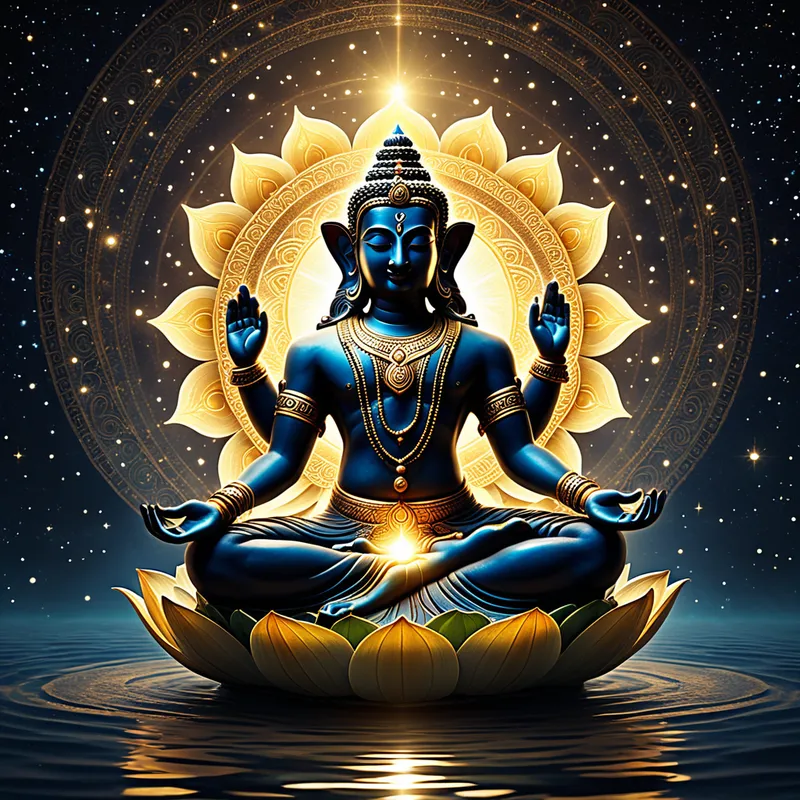
The Lotus Myth Meaning & Symbolism
From the cosmic waters, a single lotus blooms, bearing the creator god Brahma. It is the universe's first breath, a symbol of divine emergence from primordial chaos.
The Tale of The Lotus
In the beginning, there was neither existence nor non-existence. There was only the One, Brahman, resting in infinite, dreamless sleep. And then, a vibration—a soundless hum that was the first thought of being. This thought stirred the boundless, dark, and silent waters. These were not waters of any ocean you know, but the waters of potential, the Narayana, upon which the Mahavishnu reclined.
From the navel of this sleeping divinity, a stem of light emerged. It grew, not upward or downward, for such directions did not yet exist, but outward into the possibility of space. This stem was the axis of all that would be. And at its end, swelling with the breath of that first cosmic thought, a bud formed. It was a lotus bud, tightly closed, holding within it all the laws of time, the blueprints of mountains and rivers, the echoes of future laughter and tears.
The waters themselves held their breath. In that timeless moment between the unmanifest and the manifest, the bud began to unfurl. One petal, then another, each a new dimension, a new layer of reality peeling back from the heart of mystery. The light that was trapped within now spilled forth, not as a harsh glare, but as a soft, golden, dawn-like radiance. It was the first light, and it illuminated the lotus throne now fully bloomed.
And seated upon the luminous heart of this celestial flower was Brahma. He opened his eyes—all four of them—and beheld the emptiness. He saw the infinite petals of his throne, each a potential universe, and the stem that connected him to the source of all. His first act was not to speak, but to listen. He heard the residual hum of creation, the Om, resonating through the stem and into his very being. From that sound, from the light of the lotus, and from the waters below, his mind began to weave. He began the great work of naming and forming, populating the void with the diversity of existence, all while seated upon the flower that was his source, his vessel, and his proof that life emerges most beautifully from the deepest, darkest mud.
Cultural Origins & Context
The myth of the cosmic lotus is not a single story from one text, but a foundational image woven throughout the tapestry of Hindu thought. Its earliest seeds are found in the Vedas, where the lotus is associated with fertility and the dawn. It fully blossoms in the later Puranas, particularly the Vishnu Purana and Brahma Purana, where the narrative of Brahma’s birth from the Nabhi-Kamala is detailed.
This was not merely a priestly abstraction. The myth was passed down through temple sculptures, vibrant paintings, and the oral recitations of storytellers and gurus. It served a profound societal function: it was a cosmological map. It answered the human need to understand origins, not with a scientific chronology, but with a symbolic, meaningful narrative. It placed the act of creation on a throne of beauty and purity emerging from a formless base, offering a model for how order, culture (dharma), and consciousness itself arise from the chaotic potential of the unformed. It taught that the source of creation is both transcendent (the divine navel) and immanent (the muddy waters), and that to create is a sacred, divine act.
Symbolic Architecture
The lotus is perhaps the most densely layered symbol in Eastern spirituality. Its architecture is a perfect map of a profound psychological and cosmic truth.
The lotus does not grow on a mountaintop; it roots in the mud. Its lesson is not of escape, but of transformative relationship with the very substance that seems to oppose it.
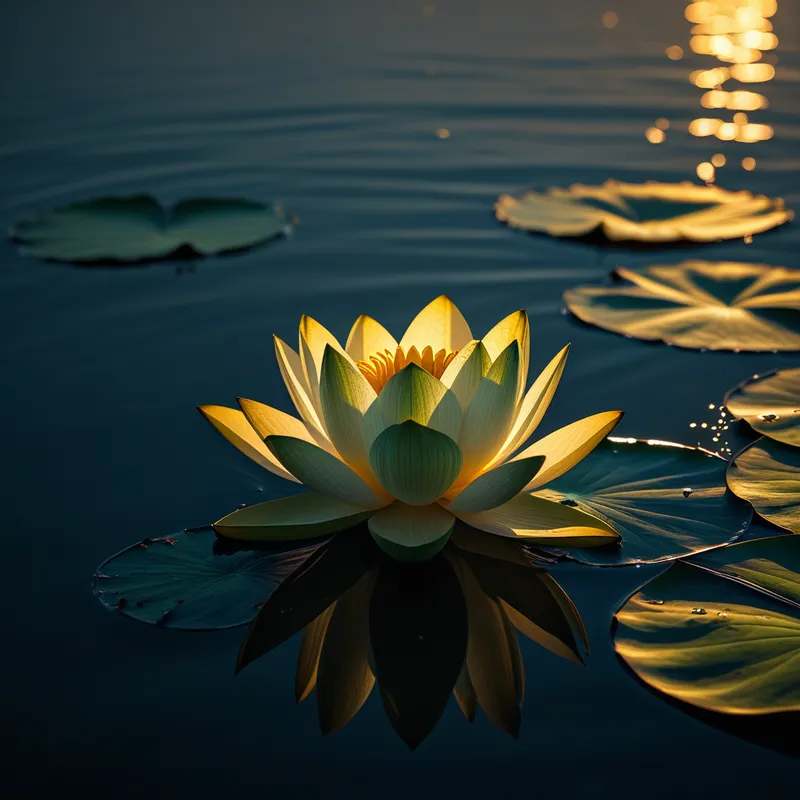
First, it is a symbol of non-attachment and purity. The flower is immaculately clean and radiant, despite rising from murky waters. This represents the ideal of being in the world but not stained by it—a consciousness that engages with life’s complexities (the mud of desire, conflict, materiality) but is not defined by them. The water droplets that bead on its petals, refusing to soak in, symbolize this graceful detachment.
Second, it represents spiritual awakening and enlightenment. The closed bud is the sleeping soul, the unawakened mind. Its blooming under the sun is the dawning of wisdom (jnana), the unfolding of consciousness petal by petal, until the full radiance at the heart—the seat of the divine—is revealed. This is why deities are so often depicted seated or standing on lotus flowers; they represent realized consciousness.
Third, it is an emblem of cosmic harmony and creation. Its stem is the world-axis, the axis mundi connecting the underworld (roots in mud/water), the earthly realm (stem through water), and the heavenly realm (the flower in air and light). The opening petals mirror the expanding universe. It is a living mandala, illustrating the emergence of exquisite, ordered form from undifferentiated chaos.
The Dreamer’s Resonance
When the lotus blooms in a modern dream, it is rarely a casual image. It signals a profound process stirring in the dreamer’s psyche. Somatically, one might feel a sense of expansion in the chest, a lightness, or a deep, peaceful warmth—the feeling of something long submerged finally breaking the surface.
Psychologically, this dream marks a moment of emergence. The dark waters of the dream are the personal or collective unconscious—the mud of repressed memories, unresolved emotions, inherited traumas, or simply the unformed potential of the Self. The lotus is the new psychic structure, the nascent consciousness, or a moment of pristine insight pushing its way up from this depth. It speaks of a process of purification happening at a level deeper than the ego’s efforts. The dreamer is not building this flower through willpower; they are witnessing its organic growth from the fertile ground of their own inner darkness. It is the psyche’s announcement that a period of confusion or emotional turmoil is giving birth to a new clarity, a new level of integrity, or a creative vision that is inherently pure in its origin.

Alchemical Translation
The myth of the lotus provides the ultimate alchemical recipe for individuation—the process of becoming a whole, integrated Self. The alchemical prima materia, the worthless base matter, is the muddy water: our messy, chaotic, instinctual, and often shame-laden personal history.
The alchemical gold is not found by rejecting the leaden mud of our experience, but by submitting to the transformative pressure it exerts, until our deepest nature flowers in response.
The first stage, nigredo (the blackening), is immersion in this mud. It is the necessary descent into one’s shadows, conflicts, and pains. This is not failure, but the essential rooting. The stem growing through the water is the albedo (the whitening), the stage of purification and rising awareness, where one begins to distinguish between the reactive ego (the churning water) and the growing stem of conscious connection to a deeper source. The blooming of the flower under the sun is the rubedo (the reddening) and citrinitas (the yellowing), the culmination: the revelation of the Self in its radiant, golden-hued completeness, fully expressed in the world.
For the modern individual, this translates to a path of profound self-acceptance. Our trauma, our “flaws,” our chaotic past—this is not waste to be discarded, but the very nutrient-rich medium from which our most authentic and beautiful character can grow. The goal is not to become a disembodied spirit floating above life, but to become like the lotus: grounded in the full reality of our experience, yet capable of producing something of transcendent beauty and stability from it. We are invited to stop fighting our mud and instead, from that exact spot, send down roots and push upward toward the light, trusting the innate intelligence of the psyche to form the flower that is uniquely ours.
Associated Symbols
Explore related symbols from the CaleaDream lexicon: