The Lote Tree of the Utmost Boundary Myth Meaning & Symbolism
A luminous tree at the edge of creation, marking the ultimate limit of human knowledge and the threshold of divine presence.
The Tale of The Lote Tree of the Utmost Boundary
Listen, and let your heart ascend.
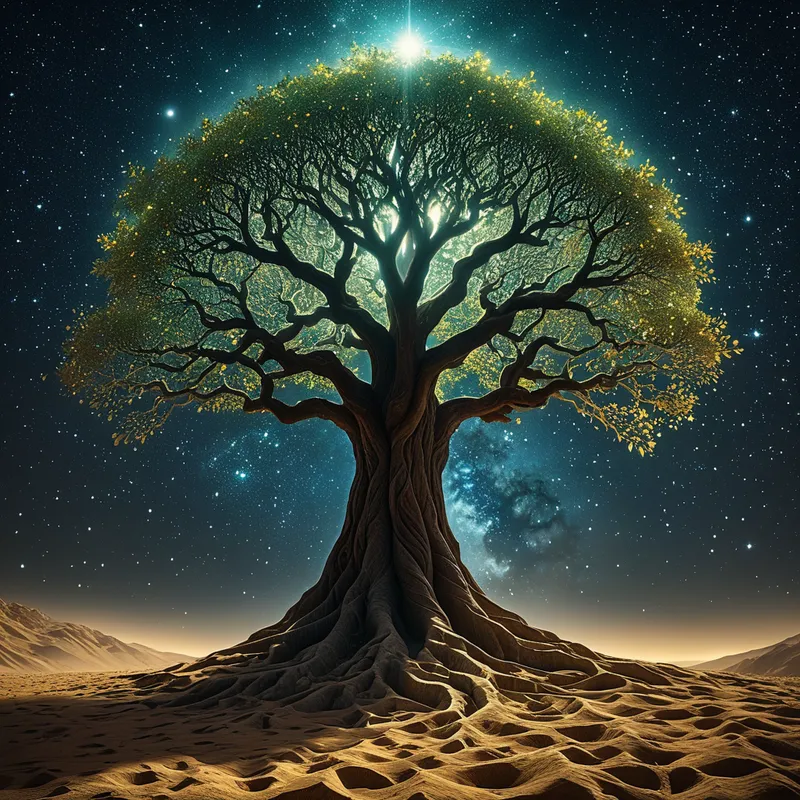
In the fathomless night beyond the seven heavens, where the music of the spheres falls silent and the paths of angels end, there stands a tree. It is not a tree of earth, drinking from muddy streams. This is the Sidrat al-Muntaha, rooted in a soil of pure light, at the very rim of all that is known, all that is created.
Its grandeur drowns the mind. Imagine a canopy so vast it could shade worlds, leaves not of green but of numinous light, each one a vessel containing knowledge beyond language. Its fruits are not for mortal hands; they swell like moons, holding the secret sweetness of divine proximity. And around it, a ceaseless flutter—not of birds, but of angels, their wings beating in rhythms of worship, their forms cloaked in veils of radiance. They swarm the tree, a living, humming halo, but they do not pass it. For the tree is the boundary. Beyond its luminous veil lies the Unseen, the realm of Allah, where no creature may tread.
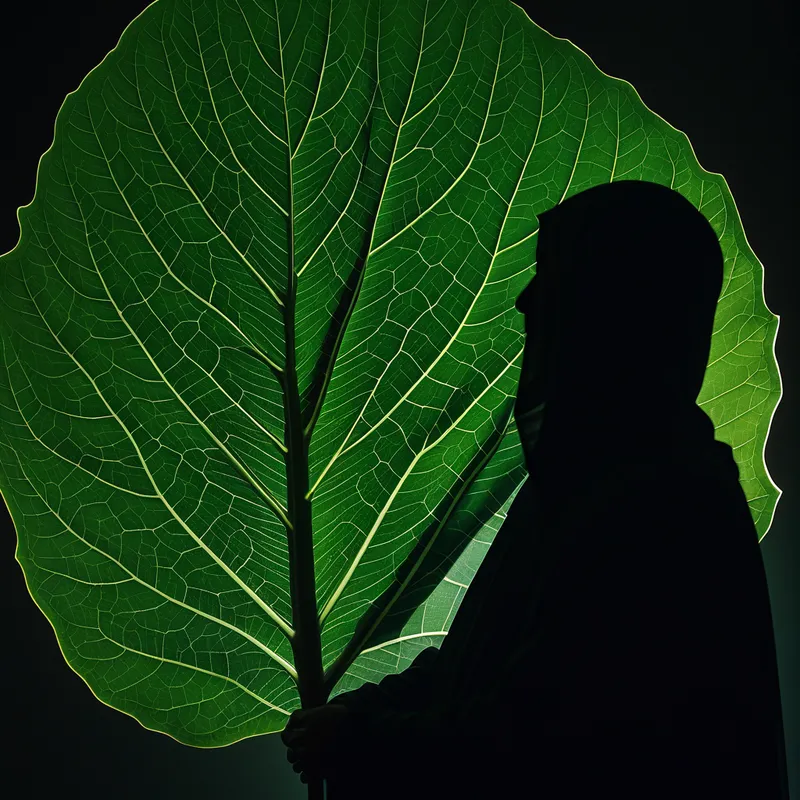
Into this sublime desolation came a traveler. Not on foot, but borne upon a creature of light, the Buraq. He was Muhammad, the chosen one, guided by the archangel Jibril. They had pierced the veils of the heavens, one by one, meeting prophets of old in chambers of crystalline light. But here, at the Sidrah, Jibril halted. His brilliance, which had illuminated their path through creation, seemed to dim before the tree’s overwhelming presence.
“I can go no further,” Jibril said, his voice a symphony of resignation and awe. “If I take one step closer, I will be consumed.”
And so, the final steps were taken alone. The traveler dismounted and approached the tree. As he drew near, a profound transformation overcame it. The tree was enveloped by the command of Allah, swathed in a majesty and light so intense that description fails. It was covered, drowned in a splendor that defied color and form. In that moment, the tree was not merely seen but known as the ultimate signpost, the final marker of the created order. The traveler’s gaze lifted, past the shimmering leaves, past the swarming angels, to what lay in the boundless intimacy beyond. There, in that direct communion at the edge of existence, the final revelations were bestowed, the ultimate prayers ordained. He had reached the source where all rivers of knowledge begin, and where all journeys of creation end.
Cultural Origins & Context
The myth of the Sidrat al-Muntaha is inextricably woven into the narrative of the Isra and Mi’raj, the Night Journey and Ascension of the Prophet Muhammad. This event is mentioned briefly in the Quran and elaborated upon in the vast collections of Hadith. It was not a story told for mere entertainment, but a foundational pillar of Islamic cosmology and spirituality, passed down by scholars and mystics to map the unseen realms and define the limits of human spiritual aspiration.
Its societal function was multifaceted. For the early Muslim community, it served as a divine validation of the Prophet’s status, placing his experience at the apex of all prophetic journeys. For theologians, it provided a metaphysical cartography, establishing a clear hierarchy between creation and the Creator. For mystics, particularly in the Sufi tradition, the Lote Tree became the central symbol of the soul’s ultimate destination—the point where individual consciousness dissolves into divine presence, where the lover meets the Beloved. It was a story that defined a boundary not to imprison, but to orient the entire spiritual endeavor of a civilization.
Symbolic Architecture
The Sidrah is the ultimate [symbol](/symbols/symbol “Symbol: A symbol can represent an idea, concept, or belief, serving as a powerful tool for communication and understanding.”/) of the limen. It is not a [wall](/symbols/wall “Symbol: Walls in dreams often symbolize boundaries, protection, or obstacles in one’s life, reflecting the dreamer’s feelings of confinement or security.”/), but a marker. It represents the absolute limit of [human](/symbols/human “Symbol: The symbol of a human represents individuality, complexity of emotions, and social relationships.”/) intellect, imagination, and even angelic [perception](/symbols/perception “Symbol: The process of becoming aware of something through the senses. In dreams, it often represents how one interprets reality or internal states.”/).
The tree does not forbid; it defines. It is the point where knowing must surrender to being.
Psychologically, it represents the [boundary](/symbols/boundary “Symbol: A conceptual or physical limit defining separation, protection, or identity between entities, spaces, or states of being.”/) of the conscious ego. Its roots are in the known world—the accumulated [knowledge](/symbols/knowledge “Symbol: Knowledge symbolizes learning, understanding, and wisdom, embodying the acquisition of information and enlightenment.”/), tradition, and rational understanding (the seven heavens). Its branches and leaves reach into the [collective unconscious](/symbols/collective-unconscious “Symbol: The Collective Unconscious refers to the part of the unconscious mind shared among beings of the same species, embodying universal experiences and archetypes.”/), teeming with archetypal forms (the angels). But its true [nature](/symbols/nature “Symbol: Nature symbolizes growth, connectivity, and the primal forces of existence.”/) is revealed only at its [zenith](/symbols/zenith “Symbol: The highest point in the sky or life’s peak moment, representing spiritual culmination, achievement, and divine connection.”/), which points to the transcendent Self, the irreducible core of being that is both the [source](/symbols/source “Symbol: The origin point of something, often representing beginnings, nourishment, or the fundamental cause behind phenomena.”/) and the [destination](/symbols/destination “Symbol: Signifies goals, aspirations, and the journey one is on in life.”/). The [Prophet](/symbols/prophet “Symbol: A messenger or seer who receives divine revelations, often warning of future events or guiding moral direction.”/)’s [journey](/symbols/journey “Symbol: A journey in dreams typically signifies adventure, growth, or a significant life transition.”/) models the ego’s (Muhammad) guided voyage through the layers of the personal and collective psyche (the heavens), aided by [intuition](/symbols/intuition “Symbol: The immediate, non-rational understanding of truth or insight, often described as a ‘gut feeling’ or inner knowing that bypasses conscious reasoning.”/) and [revelation](/symbols/revelation “Symbol: A sudden, profound disclosure of truth or insight, often through artistic or musical means, that transforms understanding.”/) (Jibril), only to be left at the threshold of the Self, which must be approached in ultimate solitude and naked [consciousness](/symbols/consciousness “Symbol: Consciousness represents the state of awareness and perception, encompassing thoughts, feelings, and experiences.”/).
The Dreamer’s Resonance
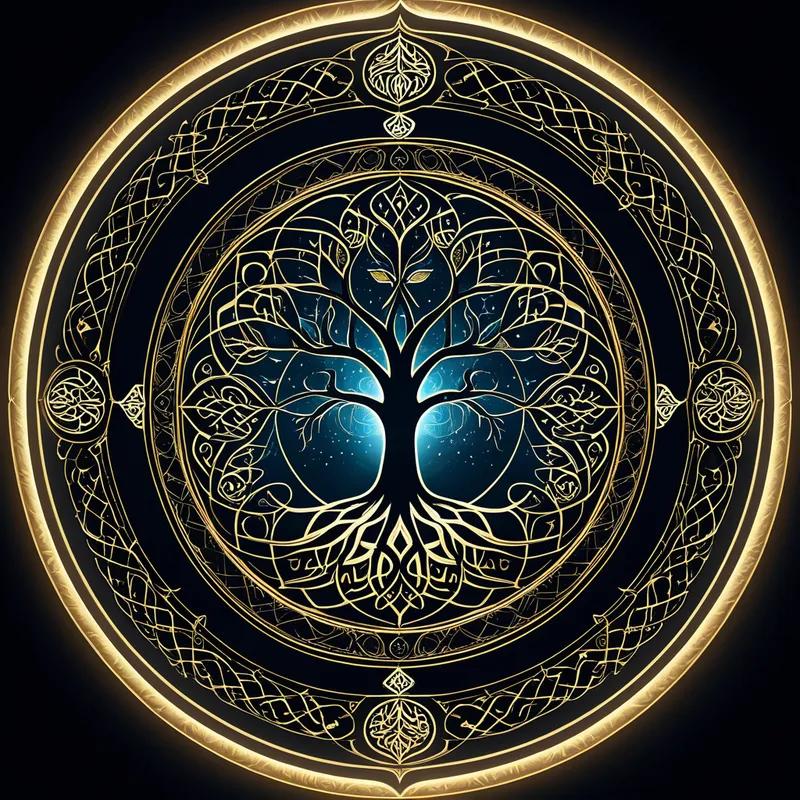
When this myth stirs in the modern dreamer, it often manifests as dreams of encountering a vast, significant tree at the edge of a familiar landscape—a forest, a garden, a city. The dreamer feels compelled to approach it. The somatic experience is one of profound awe, a tightening in the chest, a feeling of being both incredibly small and paradoxically central. There may be a sense of beings (shadows, lights, figures) surrounding the tree but not interfering.
This is the psyche signaling a confrontation with a personal “utmost boundary.” It could be the limit of one’s current identity, the edge of a long-held belief system, or the threshold of a transformative insight. The “angels” around the tree may represent helpful insights or guiding principles that have brought the dreamer this far, but which cannot cross over. The dream presents the necessity of a solitary, fearless step into a new psychic territory where old maps no longer apply. The intense light covering the tree in the myth translates in dreams as a blinding revelation, a beautiful but terrifying truth that demands a complete reorientation of the self.
Alchemical Translation
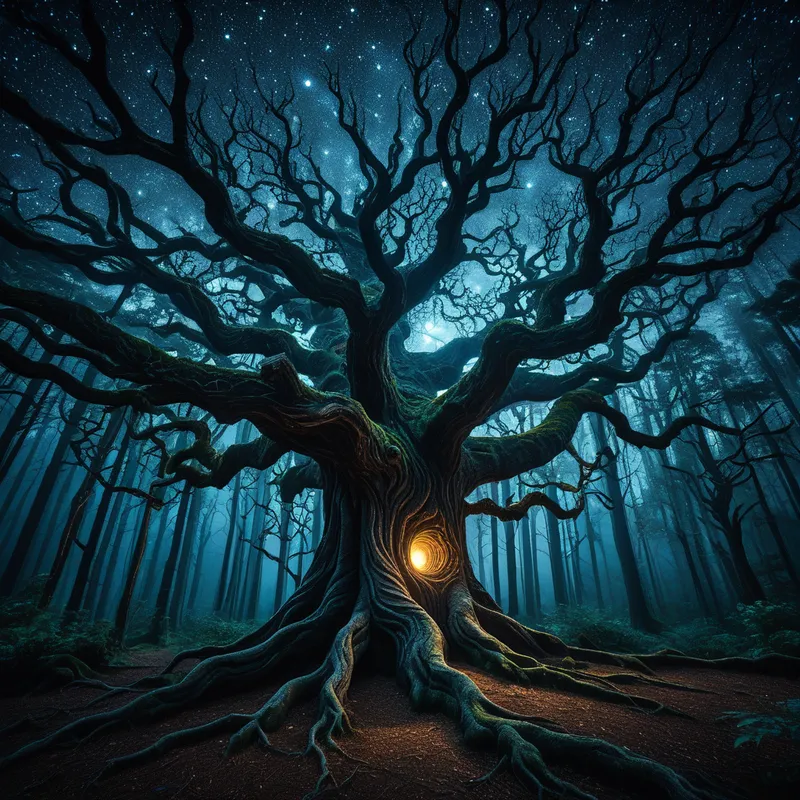
The alchemy here is one of definition and surrender. The journey to the Sidrah is the process of individuation in its ultimate phase. First, one must traverse and integrate the contents of the personal unconscious (the lower heavens). Then, one must navigate the archetypal realm (the higher heavens, meeting ancestral figures). The guide (Jibril), representing the transcendent function that bridges conscious and unconscious, is essential but has a defined limit: it can lead you to the boundary of the Self, but not into it.
The final transmutation occurs not in doing, but in being witnessed; not in seeking, but in having been found.
Reaching the tree is the moment of supreme self-awareness, where the ego fully perceives the archetype of wholeness. The “covering” of the tree is the critical act of psychic transmutation. It symbolizes the ego’s realization that the Self is ultimately ineffable, beyond its full comprehension or possession. The ego does not conquer the Self; it is enveloped and transformed by it. For the modern individual, this translates as the hard-won understanding that our deepest identity is not something we construct, but something we discover—and that discovery requires the humility to stop at the boundary of mystery, to let the ultimate truth remain veiled in its own light, while allowing its transformative power to reshape us from within.
Associated Symbols
Explore related symbols from the CaleaDream lexicon:
- Tree of Life — The universal archetype of the world axis, connecting all realms of existence, of which the Sidrat al-Muntaha is a specific, ultimate Islamic manifestation.
- Boundary — The core function of the Lote Tree, representing the necessary and sacred limit that defines creation and makes spiritual aspiration meaningful.
- Light — The essential substance of the Tree and the divine presence beyond it, symbolizing pure consciousness, revelation, and the ineffable nature of truth.
- Journey — The foundational narrative structure of the Isra and Mi’raj, modeling the soul’s arduous ascent through layers of being to its source.
- Veil — Represented by the Tree itself and the divine covering that envelops it, symbolizing the mystery that both conceals and reveals the ultimate reality.
- Angel — The celestial beings surrounding the Tree, representing intermediary forces, guided intuition, and the limits of archetypal knowledge.
- Threshold — The spatial metaphor for the Sidrah’s location, the critical point of transition between the known self and the unknowable Self.
- Root — The hidden foundation of the Tree in divine command, symbolizing the deep, unseen connection between the limit of creation and its origin.
- Star — Evoking the celestial, navigational nature of the Tree as the ultimate guiding post in the cosmos of the soul.
- Temple — The Sidrah as the final sanctuary of creation, the most remote and holy place where direct communion becomes possible.
- Vision — The mode of perception granted at the Boundary, surpassing ordinary sight for a transformative witnessing of divine majesty.
- Door — The Tree as the ultimate portal, marking the end of one state of being and the (inaccessible) entrance to another.