
The Lord's Prayer Myth Meaning & Symbolism
A sacred formula given by a divine teacher, mapping the soul's journey from heavenly origin through earthly trial to ultimate liberation.
The Tale of The Lord’s Prayer
The air on the mountainside was thick with dust and longing. They had come from the fishing boats and the tax booths, from sickbeds and from the shadows of their own failures, drawn by a rumor of a different kingdom. The sun beat down, but they did not feel its burn, for their attention was fixed on the one who sat before them.
He was not seated on a throne of cedar or ivory, but on the humble, sun-warmed stone of the hill. His voice did not boom like thunder, but carried on the dry breeze with the quiet authority of a deep, underground spring. The crowd pressed in, a tapestry of frayed cloaks and hopeful eyes. They had asked for the secret, the map, the words that could bridge the chasm they felt between the grind of their days and the whisper of the holy.
He looked at them, seeing not just the faces before him, but the generations of hunger behind them—the hunger for bread, for justice, for a name that was not “subject” or “sinner.” He began to speak, and his words were not new laws carved in stone, but a breath to be inhaled, a pattern to be woven into the very fabric of their being.
“Our Father…” he said, and the word hung in the air, a radical intimacy. It was an invocation, not to a distant star-god, but to a source, a hearth-keeper of the cosmos. “Who art in heaven…” he continued, locating that source not here, in the dust, but in a dimension of perfected potential, the blueprint from which all this fractured beauty fell.
“Hallowed be thy name.” This was the first act: the sanctification of the origin. To speak the true name of the source with reverence was to align the axis of one’s soul. “Thy kingdom come, thy will be done, on earth as it is in heaven.” Here was the great alchemical operation—the desperate, glorious wish for the above and the below to marry, for the divine pattern to imprint itself upon the mud and marrow of the world, through them.
Then, the descent into human need. “Give us this day our daily bread…” A plea for the literal crust that staves off death, yes, but also for the substance of meaning, the morsel of insight needed for just this day’s journey. “And forgive us our debts, as we forgive our debtors…” He spoke of a currency of the soul, a ledger of trespasses that could choke the spirit. Release was demanded, a terrifying reciprocity. To be forgiven was to be bound to forgive.
“And lead us not into temptation, but deliver us from evil.” A final, stark acknowledgment of the terrain. The path was through a field of snares, a landscape haunted by the Adversary. The prayer was for guidance away from the inner precipice, for rescue from the consuming void.
He fell silent. The words lingered, not as a spell to control the divine, but as a vessel to be filled by the human condition. He had given them not a sword, but a tuning fork. Its pitch was the resonance between the hearth of heaven and the hungry heart.

Cultural Origins & Context
This mythic utterance emerges from a specific crossroads of history and hope. It is set within the Second Temple Judaism of the 1st century, a culture laboring under Roman occupation and yearning for the fulfillment of ancient prophetic promises. The teacher, Jesus of Nazareth, was a rabbi operating within this milieu, yet his teachings often subverted expectations of a militant kingdom.
The prayer was transmitted orally within tight-knit, often persecuted, communities. It was not initially a private devotion but a communal identifier, a counter-cultural creed. To call God “Father” (Abba) in a world of imperial “Lords” and distant temple hierarchies was a political and theological act. Its societal function was multifaceted: it was a catechism for converts, a binding ritual for the community, and a portable sanctuary for individuals far from temple or synagogue. It distilled the essence of the Kingdom message into a repeatable, memorizable form, ensuring its survival and propagation.
Symbolic Architecture
The prayer is a masterful map of the psyche’s journey from alienation to wholeness. Its structure is a symbolic descent and return.
“Our Father in heaven” represents the Self, the transcendent, organizing center of the psyche from which consciousness emanates. It is the archetypal origin.
“Hallowed be thy name” symbolizes the ego’s first and necessary task: the recognition and reverence of this greater center. It is the beginning of alignment, where the personal “I” acknowledges its source.
The kingdom is not a place to be conquered, but a pattern to be recognized within.
“Thy kingdom come…” is the central, alchemical invocation for the integration of the unconscious (heaven) with consciousness (earth). It is the longing for individuation—for the inner divine pattern to manifest in one’s actual life.
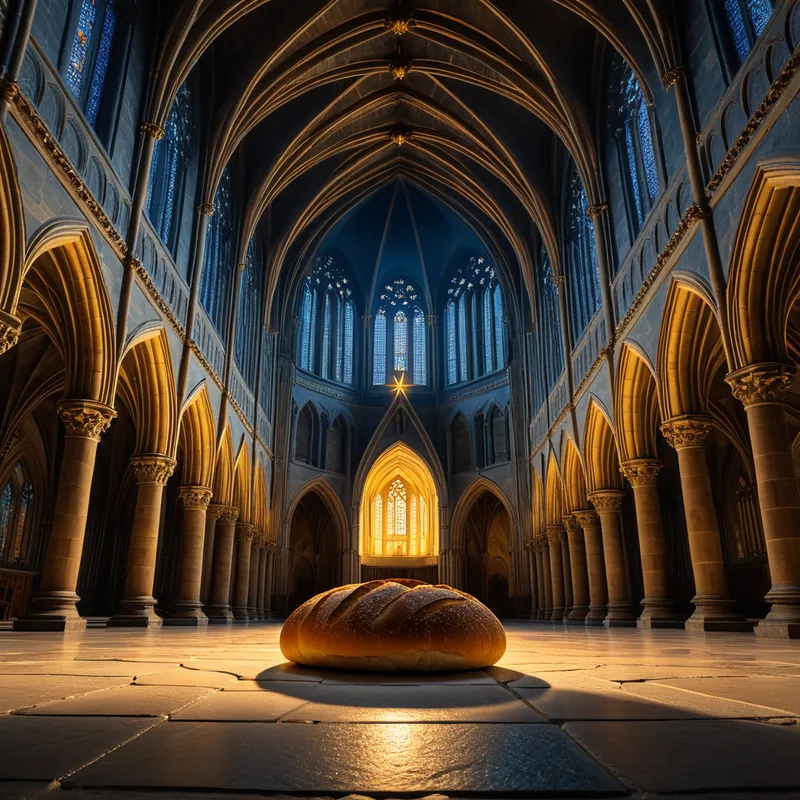
“Daily bread” is the symbol of the nourishment of the Self, provided in manageable, daily doses. It is the mana, the insight, the synchronicity that sustains the journey.
The “debts” and “debtors” articulate the psychology of the Shadow. The debt is the unresolved guilt, the unintegrated fault. Forgiveness is the psychic act of releasing the hold of the Shadow, both the one we project onto others and the one we bury in ourselves. The conditionality—“as we forgive”—makes it the prayer’s most dangerous and transformative clause, binding inner peace to the release of outer blame.
“Temptation” and “evil” represent the perils of the journey: the lure of inflation (identifying with the Self), the seduction of the Anima or Animus in their negative aspects, and the dissolution of the ego in the face of the chaotic, undifferentiated unconscious.

The Dreamer’s Resonance
When this mythic pattern stirs in the modern dreamer, it signals a profound process of recentering and negotiation with transpersonal forces. To dream of reciting the prayer, or of its phrases appearing in the landscape, suggests the ego is actively seeking alignment with the Self. The dreamer may be in a life transition, seeking purpose, or grappling with a moral or relational debt that weighs on the soul.
A dream of receiving “daily bread”—perhaps as a mysterious, glowing object or food offered by a guide—points to the psyche providing the specific nourishment needed for the current stage of development. Conversely, dreaming of being unable to say the words, or of them being twisted, may reflect a feeling of spiritual alienation, a blocked connection to the inner source, or a deep struggle with the obligation to forgive. The somatic sensation is often one of either profound relief and grounding (a weight lifted, a warmth in the chest) or of constriction and anxiety (a tight throat, a sense of being bound), mirroring the state of the dreamer’s inner negotiations.
Alchemical Translation
The Lord’s Prayer is a manual for psychic transmutation, a formula for the Great Work of becoming an individual. It models the stages of individuation.
The operation begins with invocation (“Our Father”), turning the mind’s eye toward the transcendent center. This is followed by sanctification, the conscious decision to value this connection above all else. The core of the work is the coniunctio, the sacred marriage prayed for in “on earth as it is in heaven”—the laborious, daily effort to bring unconscious contents (instincts, dreams, shadow aspects) into conscious relationship.
To ask for daily bread is to consent to the mystery of sufficient grace, to be fed but never sated, forever on the journey.
The provision (“daily bread”) represents the insights that bubble up from the unconscious—dream symbols, creative impulses, moments of clarity—that fuel the process. The most critical and difficult phase is solutio and coagulatio—the dissolution and re-formation found in “forgive us our debts.” Here, the hardened complexes (the “debts”) must be dissolved in the waters of honest self-examination and compassion (forgiveness), so that the personality can re-coagulate in a more flexible, integrated form.
Finally, “deliver us from evil” is the protective invocation for the final stage. As the ego becomes more aligned with the Self, the risk of inflation—of believing I am the Creator—becomes acute. This plea is for humility, for protection from the ultimate temptation of spiritual pride, ensuring the completed “stone” of the individual is grounded, humble, and whole. Thus, the prayer charts the soul’s journey from primal unity, through the necessary fragmentation of earthly experience, back to a conscious, earned wholeness.
Associated Symbols
Explore related symbols from the CaleaDream lexicon: