The Loom of the Fates Myth Meaning & Symbolism
Three primordial sisters spin, measure, and cut the thread of every mortal life, embodying the inescapable and sacred pattern of destiny.
The Tale of The Loom of the Fates
Listen. Before the gods of Olympus drew their first breath, there was the hum. A deep, resonant vibration in the marrow of the cosmos, older than time, quieter than thought. It came from a place beyond places, a cave behind [the cave](/myths/the-cave “Myth from Platonic culture.”/) of [the world](/myths/the-world “Myth from Tarot culture.”/), where [three sisters](/myths/three-sisters “Myth from Native American culture.”/) sat in a triangle of perfect, silent understanding.
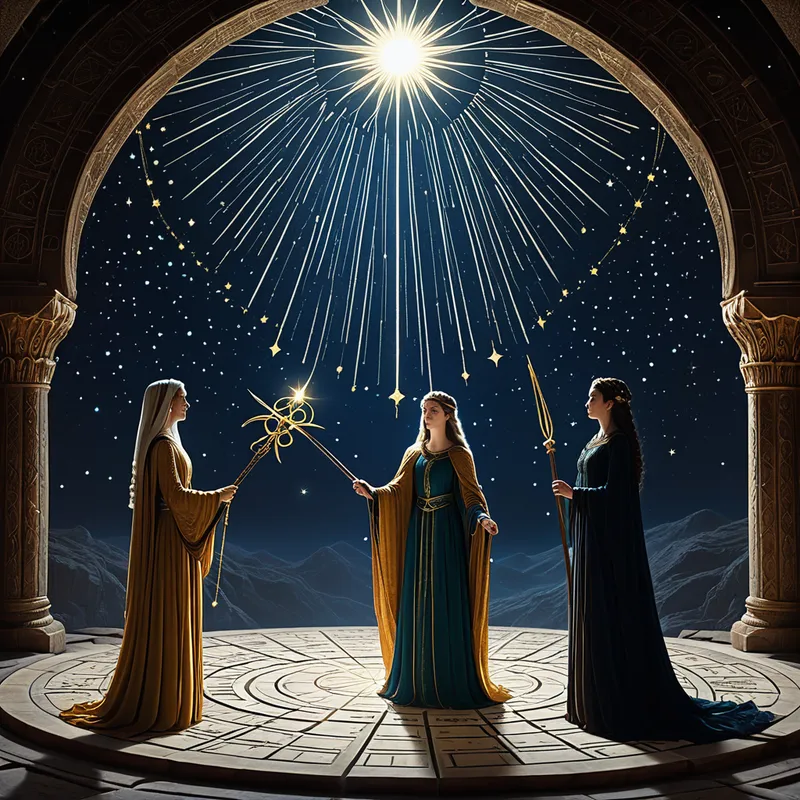
They were the [Moirai](/myths/moirai “Myth from Greek culture.”/). Their skin was the color of old parchment, their eyes like wells that held the light of dead stars. The eldest, Clotho, sat with a distaff of polished ivory, her fingers moving with a rhythm that was the heartbeat of creation itself. From nothing—from the breath of chaos and the dust of potential—she drew forth a single, shimmering filament. It glowed with a soft, internal light, humming with the promise of a life yet unlived. The thread was warm to the touch, vibrating with a unique song.
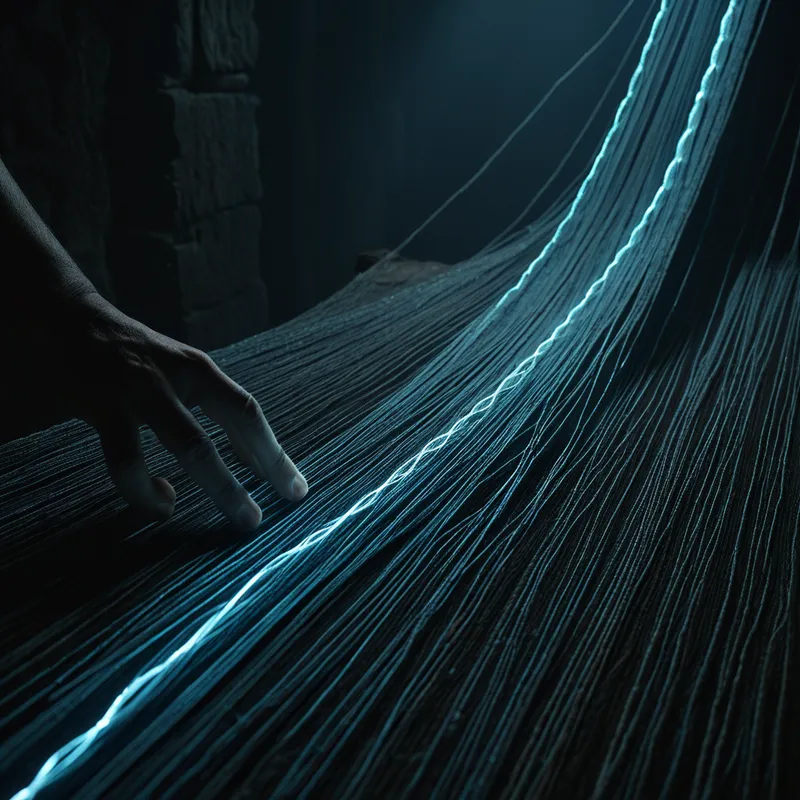
She passed it to the middle sister, Lachesis. Lachesis received the thread with the solemnity of a priestess. Before her lay no simple tool, but the Loom of [the Fates](/myths/the-fates “Myth from Greek culture.”/)—a frame of ancient, dark wood that seemed to stretch into infinity. With hands that knew the weight of galaxies, she took the thread and began to weave. She did not choose the pattern arbitrarily. She measured the thread against the tapestry of the cosmos itself, consulting a scroll that was not written in ink but in the swirling patterns of nebulae and the orbits of planets. She decided its length, its strength, and the intricate knots of joy, sorrow, love, and loss that would adorn its span. The loom’s shuttle clicked and clacked, a sound like the ticking of the first clock.
Finally, the woven length passed to the youngest sister, Atropos. Do not be fooled by her title of “youngest”; her gaze was the oldest, holding the absolute peace of the inevitable. In her lap rested a pair of shears, their blades forged from the absence of light, cold and final. She watched the tapestry, her expression one of profound, detached compassion. She waited. She waited for the precise moment when the song of the thread reached its natural crescendo, when the pattern woven by Lachesis was complete. There was no malice in her action, only the flawless execution of an eternal law. When the moment came, her hand would move—a swift, clean, irrevocable snip. The hum would cease. The light in the thread would fade, and its unique song would become a silent note in the symphony of completed lives. And without a pause, Clotho’s fingers would already be moving, drawing forth a new thread from [the void](/myths/the-void “Myth from Buddhist culture.”/), as the great, humming loom of existence continued its endless, beautiful, terrifying work.
Cultural Origins & Context
The myth of [the Moirai](/myths/the-moirai “Myth from Greek culture.”/) is not a story told around a single hearth; it is a foundational stratum of the Greek worldview, emerging from the deepest, pre-Olympian layers of belief. They are older and more fundamental than Zeus himself, and even the King of the Gods was said to fear their decrees. Their origins are shadowy, linked to the primordial goddess Ananke (Necessity), suggesting they personified an impersonal cosmic order rather than capricious divine whim.
This myth was not merely entertainment. It was a psychological and societal anchor. In a world of plague, war, and sudden death, the Fates provided a framework for understanding life’s most painful arbitrariness. A child’s death, a hero’s fall at the height of glory—these were not random tragedies but part of a woven pattern too vast for mortal eyes to see. The myth offered a grim but potent comfort: your suffering has a place. Your thread is part of the whole. This belief was enacted in ritual, from the prayers of mothers for the “good measuring” of their children’s threads to the philosophical acceptance espoused by Stoics, who saw wisdom in aligning one’s will with the unchangeable pattern of the Loom.
Symbolic Architecture
The Loom is one of humanity’s most potent symbols for the [nature](/symbols/nature “Symbol: Nature symbolizes growth, connectivity, and the primal forces of existence.”/) of existence. It represents the interconnectedness of all [life](/symbols/life “Symbol: The symbol of ‘Life’ represents a journey of growth, interconnectedness, and existential meaning, encompassing both the joys and challenges that define human experience.”/), the interweaving of cause and effect, and the predetermined [structure](/symbols/structure “Symbol: Structure in dreams often symbolizes stability, organization, and the framework of one’s life, reflecting how one perceives their environment and personal life.”/) of [reality](/symbols/reality “Symbol: Reality signifies the state of existence and perception, often reflecting one’s understanding of truth and life experiences.”/)—what Carl Jung might call the archetypal [pattern](/symbols/pattern “Symbol: A ‘Pattern’ in dreams often signifies the underlying structure of experiences and thoughts, representing both order and the repetitiveness of life’s situations.”/) of the Self.
The thread is not your life; it is the raw potential of your life. The weaving is not your destiny; it is the encounter between your potential and the world.
Clotho, the Spinner, symbolizes the spark of inception, the initial creative [impulse](/symbols/impulse “Symbol: A sudden, powerful urge or drive that arises without conscious deliberation, often linked to primal instincts or emotional surges.”/)—the [moment](/symbols/moment “Symbol: The symbol of a ‘moment’ embodies the significance of transient experiences that encapsulate emotional depth or pivotal transformations in life.”/) of [birth](/symbols/birth “Symbol: Birth symbolizes new beginnings, transformation, and the potential for growth and development.”/), the genesis of an [idea](/symbols/idea “Symbol: An ‘Idea’ represents a spark of creativity, innovation, or realization, often emerging as a solution to a problem or a new outlook on life.”/), the first cause. Lachesis, the Measurer, embodies the unfolding of life in time. She represents the environmental, genetic, and karmic factors that shape the thread: culture, [family](/symbols/family “Symbol: The symbol of ‘family’ represents foundational relationships and emotional connections that shape an individual’s identity and personal development.”/), historical [moment](/symbols/moment “Symbol: The symbol of a ‘moment’ embodies the significance of transient experiences that encapsulate emotional depth or pivotal transformations in life.”/), and the countless choices (both yours and others’) that give the thread its specific [texture](/symbols/texture “Symbol: Texture in dreams represents sensory engagement, material interaction, and the tangible quality of experiences, often reflecting how one processes reality through touch and feel.”/) and [direction](/symbols/direction “Symbol: Direction in dreams often relates to life choices, guidance, and the path one is following, emphasizing the importance of navigation in personal journeys.”/). Atropos, the Cutter, is the [symbol](/symbols/symbol “Symbol: A symbol can represent an idea, concept, or belief, serving as a powerful tool for communication and understanding.”/) of limit itself. She is [mortality](/symbols/mortality “Symbol: The awareness of life’s finitude, often representing transitions, impermanence, or existential reflection in dreams.”/), the ending that gives shape and meaning to the [story](/symbols/story “Symbol: The symbol of ‘Story’ represents the narrative woven through our lives, embodying experiences, lessons, and emotions that shape our identities.”/). She is not [death](/symbols/death “Symbol: Symbolizes transformation, endings, and new beginnings; often associated with fear of the unknown.”/) as a [monster](/symbols/monster “Symbol: Monsters in dreams often symbolize fears, anxieties, or challenges that feel overwhelming.”/), but [death](/symbols/death “Symbol: Symbolizes transformation, endings, and new beginnings; often associated with fear of the unknown.”/) as the necessary frame around the [picture](/symbols/picture “Symbol: A picture in a dream often symbolizes one’s perceptions, memories, or the desire to capture and preserve moments in time.”/) of life.
Psychologically, the trio represents the complete cycle of any psychic process: its [emergence](/symbols/emergence “Symbol: A process of coming into being, rising from obscurity, or breaking through a barrier, often representing birth, transformation, or revelation.”/) from the unconscious (Clotho), its development and complexification through conscious engagement with reality (Lachesis), and its necessary [conclusion](/symbols/conclusion “Symbol: A conclusion can symbolize resolution, closure, and the finality of experiences or decisions.”/) or transformation to make way for new content (Atropos). To resist Atropos is to cling to outworn attitudes, preventing renewal.
The Dreamer’s Resonance
To dream of the Loom is to have the unconscious directly present the architecture of the [psyche](/myths/psyche “Myth from Greek culture.”/). You may dream of tangled threads, of trying to re-weave a pattern, of a silent woman with shears, or of your own hands becoming the weaver.
Such dreams often surface during life transitions: the end of a relationship, a career change, the death of a loved one, or a profound identity crisis. The somatic sensation is one of being fated or guided—a deep, often unsettling pull from within. The dream of the Loom is the psyche’s way of illustrating that a particular psychic thread—a long-held identity, a compulsive behavior, a foundational belief—has reached the end of its measured length. Atropos is active within. The dreamer is undergoing a necessary psychic death, a cutting away of what has been, so that Clotho may, in time, spin anew. The anxiety in the dream is [the ego](/myths/the-ego “Myth from Jungian culture.”/)’s protest against this impersonal, inner necessity.
Alchemical Translation
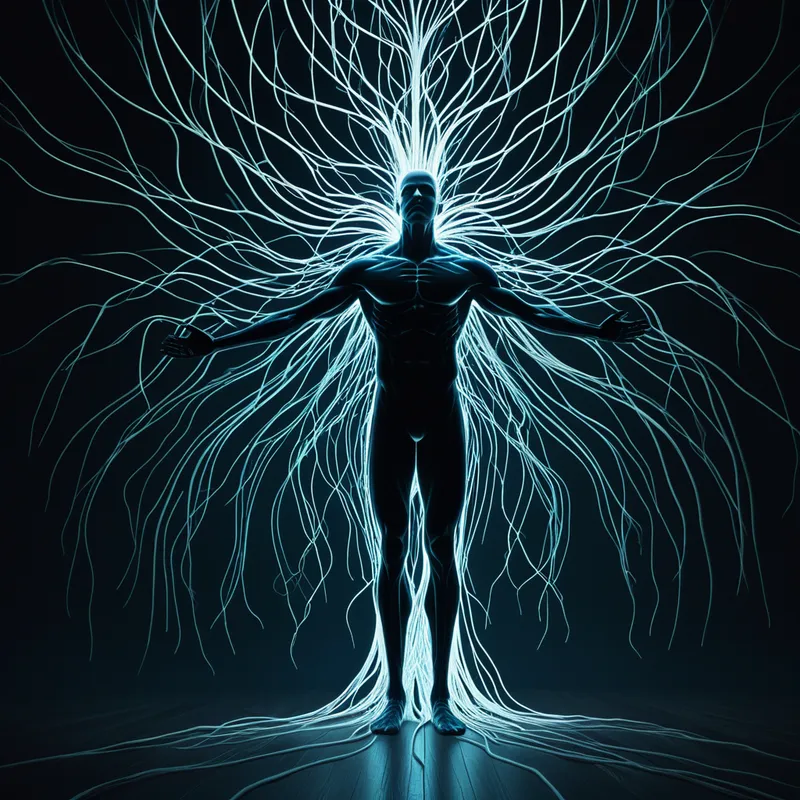
The individuation process is the heroic journey of moving from being a passive thread on the Loom to becoming, in part, a conscious weaver at your own loom. The myth does not promise you can escape the great Loom of the Moirai; rather, it invites you to understand its principles and integrate them.
The first alchemical stage is Awareness ([Nigredo](/myths/nigredo “Myth from Alchemical culture.”/)). You must confront the Atropos within—your own mortality, your limits, the aspects of your fate you cannot change (your birth, your body, your past). This is the darkening, the “cutting” of illusion. The second stage is Engagement (Albedo). You take up the role of Lachesis. With conscious reflection, you “measure” your thread. You examine the patterns you’ve woven: your habits, relationships, and beliefs. You begin to discern which patterns serve your wholeness and which are mere repetition. The final stage is Co-Creation ([Rubedo](/myths/rubedo “Myth from Alchemical culture.”/)). Here, you align with Clotho. You accept the raw material of your being and your fate, and from that acceptance, you spin new intention. You cannot choose the initial thread, but you can, with consciousness, influence the tension, the color, and the beauty of the weave within the measured length you are given.
The ultimate alchemy is not cheating the shears, but learning to hear the music of your own thread so clearly that when the cut comes, it feels not like an amputation, but like the final, resolving note of a song you chose to sing with all your heart.
Thus, the Loom transforms from a symbol of external tyranny to one of inner order. To live your fate consciously is the highest freedom. You become a localized expression of the very principle that weaves the cosmos, participating in [the great work](/myths/the-great-work “Myth from Alchemical culture.”/) not as a slave to the pattern, but as a awakened knot within the infinite tapestry.
Associated Symbols
Explore related symbols from the CaleaDream lexicon: