The Long Count Calendar Myth Myth Meaning & Symbolism
A myth of cosmic cycles where time is a sacred burden, measured by divine sacrifice, demanding renewal through ritual to birth new worlds from the old.
The Tale of The Long Count Calendar Myth
Listen. The world is not a line, but a great, turning wheel. Its axle is the Wakah-Chan, the Ceiba tree that pierces the heart of the sky and roots deep in the black waters of Xibalba. And upon this wheel, time is not a river, but a sacred burden. A weight carried by the gods.
In the First Dawn, the gods gathered in the primordial sea. They spoke the Word, and the mountains rose from the waters. They breathed the Spirit, and the forests clothed the stone. But the world was silent. It had no praise, no memory, no story. It needed witnesses. So, from maize dough and the blood of the gods, they fashioned the First People. Their hearts were made to count the days, to mark the passage of the sun, to remember the names of the gods who bore the weight of the cosmos on their backs.
The burden was the Long Count. It was a vast road of days, measured in winal, tun, k’atun, and mighty b’ak’tun. To carry it, the gods took turns as the Year Bearers. They staggered under its immensity. The sun-god K’inich Ajaw blazed with the effort, his journey across the sky a daily act of supreme endurance. The Maize God was cut down at the end of each growing season, his body buried in the dark earth so that the count of seasons could continue. The rain-giving Chaak wept torrents, his tears the price for the turning of the seasonal wheel.
But the burden was too great. The count grew heavy, and the gods grew weary. The world grew old. The people forgot the rituals. The temples fell silent. The countdown to the end of a Great Cycle was not a prophecy of doom, but the groaning of the cosmic axle. The sky would darken. The stars would tremble in their courses. The Wakah-Chan would shudder, its roots loosening in the underworld. This was the myth: not an end, but a moment of supreme tension, when the burden must be transferred, when the old carriers must lay down their load so new ones may lift it.
And in that moment of darkness, between the last day of the old count and the first day of the new, a sacrifice was needed. A divine offering to grease the axle of the world. Sometimes it was the blood of kings, mirroring the gods’ own sacrifice. Sometimes it was the Maize God himself, descending into Xibalba to be reborn. The sacrifice was the key that turned the lock, that allowed the great stone gears of the cosmos to click forward one more notch, from 13.0.0.0.0 to 0.0.0.0.1. A return to zero. A completion. A new burden shouldered. A new sun would rise, a new Maize God would sprout, and the Long Count would begin again, its weight both curse and sacred duty, the very engine of existence.
Cultural Origins & Context
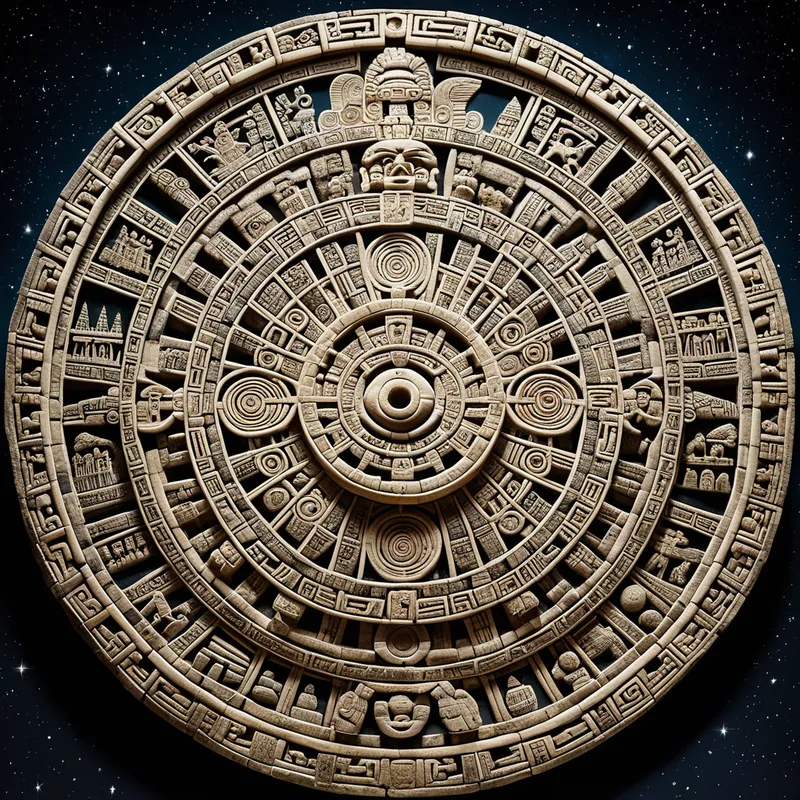
This myth is not a single story inscribed in one codex, but the profound narrative logic embedded in the very structure of Mesoamerican timekeeping. The Long Count calendar was a precise, linear count of days from a mythic starting point (often correlated with August 11, 3114 BCE), used for historical record-keeping by Maya scribes and kings. The myth described above is the theological and cosmological framework that gave this mathematical system its soul.
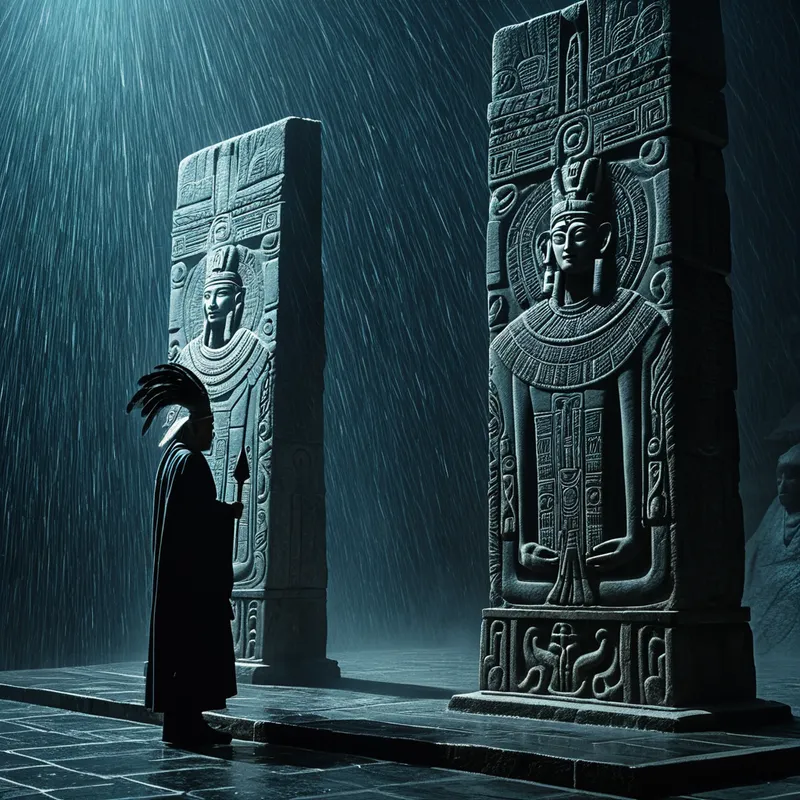
It was passed down and enacted by the priestly class and the royal court. Kings were not just rulers; they were the living anchors of cosmic time. Their accession rituals, their bloodletting ceremonies, and even their wars were performances of this myth, acts meant to “hold up the sky” and ensure the smooth transfer of the temporal burden at the end of a k’atun or a Great Cycle. Monuments like stelae were stone embodiments of this myth, freezing a moment in the Long Count and linking it to the divine action of the king, thus placing human history within the grand, repetitive narrative of divine burden-bearing and renewal.
Symbolic Architecture
At its core, the Long Count myth symbolizes the psyche’s confrontation with the absolute [reality](/symbols/reality “Symbol: Reality signifies the state of existence and perception, often reflecting one’s understanding of truth and life experiences.”/) of cycles, endings, and the terrifying necessity of the void that precedes [rebirth](/symbols/rebirth “Symbol: A profound transformation where old aspects of self or life die, making way for new beginnings, growth, and renewal.”/). Time is not neutral; it is a [weight](/symbols/weight “Symbol: Weight symbolizes burdens, responsibilities, and emotional loads one carries in life.”/) of [consciousness](/symbols/consciousness “Symbol: Consciousness represents the state of awareness and perception, encompassing thoughts, feelings, and experiences.”/), a [responsibility](/symbols/responsibility “Symbol: Responsibility in dreams often signifies the weight of duties and the expectations placed upon the dreamer.”/) to witness, remember, and participate in the cosmic order.
The completion of a cycle is not an annihilation, but a return to the sacred zero—the pregnant void from which all counting, and thus all manifested existence, begins anew.
The [Year](/symbols/year “Symbol: A unit of time measuring cycles, growth, and passage. Represents life stages, progress, and mortality.”/) Bearer gods represent the archetypal forces that [structure](/symbols/structure “Symbol: Structure in dreams often symbolizes stability, organization, and the framework of one’s life, reflecting how one perceives their environment and personal life.”/) our inner and outer reality—the drive for growth (Maize God), the light of consciousness (K’inich Ajaw), the fluidity of [emotion](/symbols/emotion “Symbol: Emotion symbolizes our inner feelings and responses to experiences, often guiding our actions and choices.”/) (Chaak). Their weariness is the exhaustion we feel when identified with only one mode of being for too long. The end of a b’ak’tun is that profound psychological [moment](/symbols/moment “Symbol: The symbol of a ‘moment’ embodies the significance of transient experiences that encapsulate emotional depth or pivotal transformations in life.”/) when an old [identity](/symbols/identity “Symbol: Identity represents the sense of self, encompassing personal beliefs, cultural background, and social roles.”/), a long-held belief [system](/symbols/system “Symbol: A system represents structure, organization, and interrelated components functioning together, often reflecting personal or social order.”/), or a [life](/symbols/life “Symbol: The symbol of ‘Life’ represents a journey of growth, interconnectedness, and existential meaning, encompassing both the joys and challenges that define human experience.”/) [structure](/symbols/structure “Symbol: Structure in dreams often symbolizes stability, organization, and the framework of one’s life, reflecting how one perceives their environment and personal life.”/) has run its complete [course](/symbols/course “Symbol: A course represents direction, journey, or progression in life, often choosing paths to follow.”/). It can no longer bear the weight of our evolving experience.
The Dreamer’s Resonance
When this myth stirs in the modern dreamer, it often manifests as dreams of immense, intricate machines grinding to a halt; of watching a colossal clock face where the hands spin backwards to midnight; or of standing before a vast, stone door marked with unknown glyphs that must be opened as a world-age ends. Somatic sensations include a heavy pressure on the chest or shoulders—the literal feeling of carrying a burden—or a dizzying, disorienting sensation of temporal collapse, where past and future lose meaning.
Psychologically, this indicates a process of de-structuring. The conscious ego’s familiar timeline—its plans, its narrative of self, its sense of progression—is being dissolved by the unconscious. The dreamer is at the “end of a count,” experiencing the death of a psychological epoch. The anxiety is not about literal doom, but about the dissolution of the known world and the terrifying, open potential of the zero point that follows.
Alchemical Translation
The alchemical work modeled by this myth is the opus contra naturum—the work against the ego’s nature, which is to cling to continuity. The individual is called to become both the sacrificing king and the reborn god. First, one must consciously “carry the burden”—to fully live out and take responsibility for a cycle of life, whether it be a career, a relationship, or a phase of development. Then, at its appointed end, one must offer a sacrifice to the turning wheel.
This sacrifice is the voluntary relinquishment of the identity that carried you through that cycle. It is the offering of your old “count” to the void.
The descent into the metaphorical Xibalba is the liminal period of depression, confusion, or “dark night of the soul” that follows a major ending. Here, in the dark, the psychic materials are broken down. The alchemical goal is not to rebuild the same self, but to allow a new one to be reconstituted from the essence, just as the Maize God is reborn from his own bones. To emerge bearing a new count, a new beginning (0.0.0.0.1), is the achievement of a higher-order consciousness that has integrated the reality of cyclical death and rebirth into its very fabric. One becomes a conscious participant in the timing of the soul, a sage who understands that every ending holds within it the seed of a new world.
Associated Symbols
Explore related symbols from the CaleaDream lexicon:
- Calendar — The central artifact of the myth, representing the imposed, sacred order on the chaos of time, and the measurable journey of a consciousness through a defined cycle.
- Sacrifice — The essential act that enables the transfer of the cosmic burden; the voluntary offering of something precious (an old identity, a comfort) to fuel the transition between world ages.
- Zero — The most profound symbol, represented by a shell in Maya numerology; it is not nothingness, but completion, the fertile void, and the point of reset from which all new counts begin.
- Cycle — The fundamental shape of existence in the myth, challenging linear perception and insisting that all journeys are returns, and all ends are preludes.
- Burden — The weight of time and consciousness itself, a sacred duty that defines the purpose of gods and humans, symbolizing the responsibility of awareness.
- Rebirth — The inevitable promise following the sacrificial end; the emergence of the Maize God from the underworld, modeling the psyche’s capacity for renewal from its own essence.
- Stone — The medium of the myth’s record (stelae, altars), representing permanence within the cycle, the attempt to anchor a moment of the count in enduring form.
- Order — The divine principle the calendar upholds; the myth is a story about the perpetual, costly maintenance of cosmic and psychic structure against entropy.
- Darkness — The necessary, fertile space between cycles—the underworld of Xibalba—where dissolution occurs and the materials for the new world are gathered.
- Blood — The ritual currency of sacrifice, mirroring the primordial sacrifice of the gods; it symbolizes the vital life-force that must be surrendered to animate a new cycle.
- Tree — The Wakah-Chan, the axis mundi; the stable center around which the cyclical drama unfolds, connecting all phases of the cycle from heavens to underworld.
- Journey — The path of the sun god, the descent of the Maize God, and the linear progression of the Long Count itself—all are sacred journeys within the greater circle.