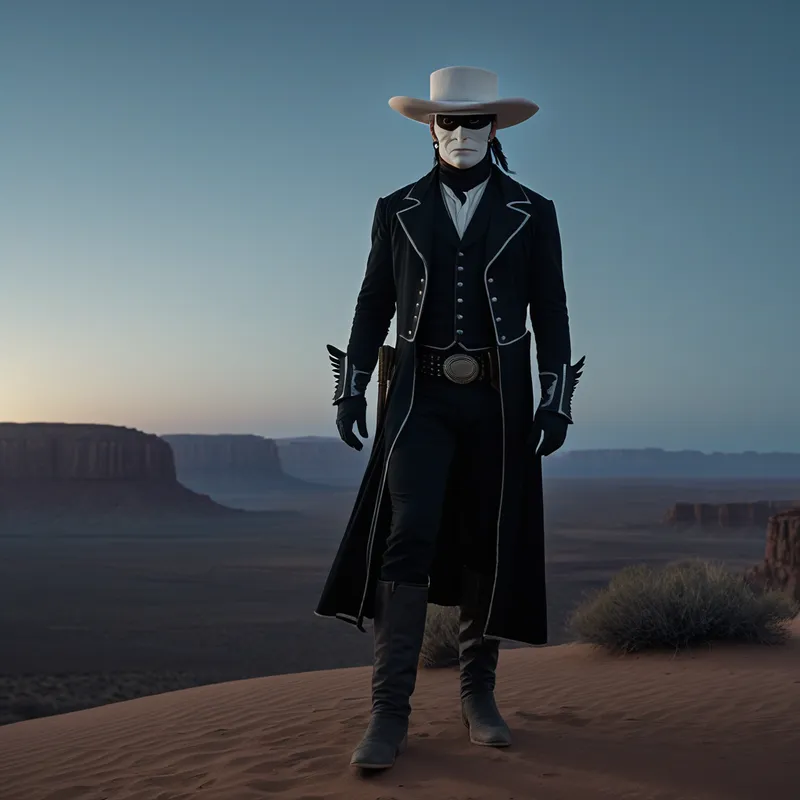
The Lone Ranger Myth Meaning & Symbolism
A masked lawman and his companion, born from tragedy, ride as agents of incorruptible justice in a world of moral ambiguity.
The Tale of The Lone Ranger
Listen. The wind carries the memory of gunpowder and sage across the high desert. In a time when the law was a whisper and justice a rumor, there was a man.
He was not born a legend. He was born a man of the law, one of six Texas Rangers riding into a canyon of ambush. The air, once still, shattered into a storm of lead and betrayal. Five good men fell, their blood soaking into the thirsty earth. The sixth was left for dead, a broken body beneath a merciless sun.
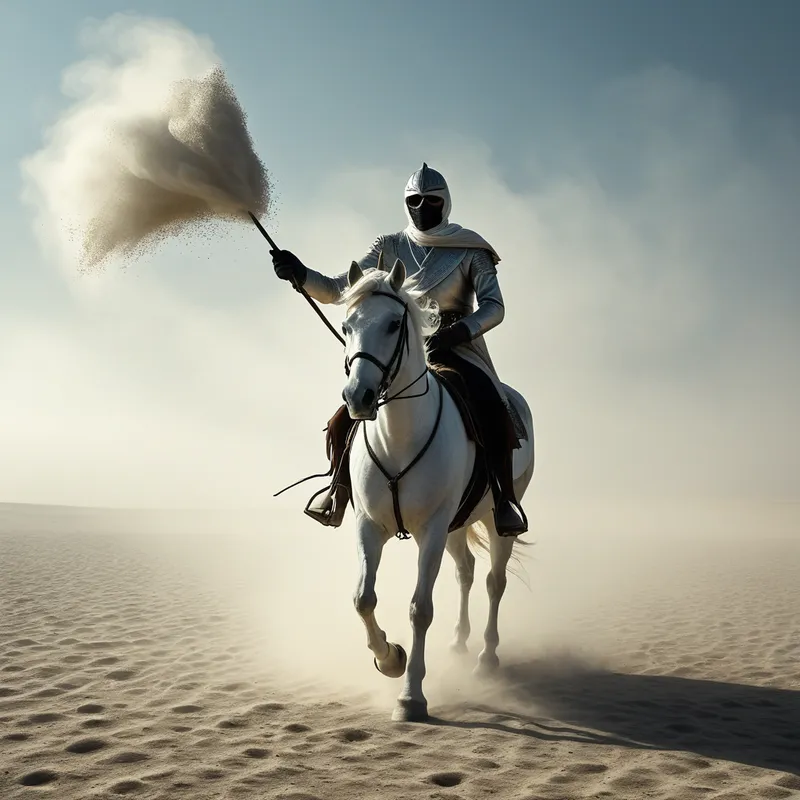
But the sun did not claim him. A spirit walked the wild places then, a great stallion the color of bleached bone and morning mist. It came to the fallen man, its breath warm against his cold skin. And a voice, older than the mountains, spoke not in words but in a knowing: Rise. Your work is not done.
He rose. A Tonto found him, a man who walked between worlds, who saw the truth of things. Together, they buried the dead Ranger and forged a new man from the ashes of the old. From the ore of the earth, they smelted silver, crafting bullets that would not kill but would mark, a currency of pure justice. He took a mask, not to hide, but to become. He was no longer John Reid. He was a question. He was a principle. He was the Lone Ranger.
With his faithful companion and his great white stallion, Silver, he rode. He did not seek the sheriff’s star, for the star could be tarnished. He sought the balance. He appeared where the greedy rancher drove settlers from their land, where the corrupt banker stole the life’s work of widows, where the cruel outlaw thought himself king of an empty realm. He spoke little. His actions were his language: the crack of a silver bullet disarming a villain, the swift application of frontier law, the helping hand to the oppressed. He was the storm that cleansed, then vanished, leaving behind only the echo of a hearty “Hi-yo, Silver!” and the glint of a silver bullet as his calling card—a reminder that justice, though often solitary, was always watching.
Cultural Origins & Context
The myth of the Lone Ranger is a uniquely 20th-century folktale, born not around campfires but from the crackling static of radio waves. Created by Fran Striker and George W. Trendle in 1933, it was a conscious fabrication that tapped into a deep, pre-existing American psychic need. It emerged in the nadir of the Great Depression, a time when institutional authority had crumbled, and the individual felt powerless against vast, impersonal forces of economic and social collapse.
The myth was passed down not by elders, but by a new priesthood: radio dramatists, and later, television producers, comic book writers, and filmmakers. Its societal function was profound. It offered a narrative antidote to despair—a fantasy where one incorruptible individual, operating outside a broken system yet adhering to a strict, self-imposed moral code, could set things right. He was the idealized frontier spirit, repurposed for the modern age. The Western setting was not mere backdrop; it was the symbolic Outlaw Territory of the human soul where good and evil were starkly defined, a moral clarity desperately longed for in a complex, grey world.
Symbolic Architecture
The Lone Ranger is not a person but an archetypal constellation. The mask is the core symbol. It does not conceal identity; it annihilates the personal ego to birth a transpersonal function. John Reid must die for the Ranger to live.
The mask is the crucible where the personal self is sacrificed to become an instrument of a higher principle.
The silver is alchemical. It represents purity, reflection, and value that cannot be corrupted. His bullets are not meant for murder but for precise, surgical justice—disarming, never destroying. Tonto is the essential other, the guide from the marginalized, instinctual world. He represents the wisdom of nature, tracking, healing, and a moral code based on loyalty and reciprocity, not written law. Their partnership is the psychic union of conscious principle (Ranger) and unconscious wisdom (Tonto), necessary for any true quest. Silver is the elevated, purified instinct—the wild force of nature now in conscious service to the hero’s cause.

The Dreamer’s Resonance
When this myth stirs in the modern dreamer, it often manifests as a profound sense of ethical isolation. You may dream of being the only person in an office, a family, or a social group who sees a glaring wrong that others ignore. You are tasked with addressing it, but you feel you must do so alone, perhaps disguised or anonymously.
Somatically, this can feel like a tightness in the jaw (holding one’s tongue) or a burning in the chest (the fire of righteous conviction). Psychologically, this is the emergence of the Righteous Indignation complex. The dream is not necessarily advising solitary vigilante action. It is highlighting a part of the psyche that feels compelled to enact justice where the outer world’s systems have failed. The dream asks: What principle within you is so important that you would wear a mask, forsake personal recognition, and act solely for its sake? The loneliness is not a pathology, but the initial, necessary condition for differentiating your own moral authority from the collective.
Alchemical Translation
The Lone Ranger’s journey is a precise map for psychic transmutation, or individuation. The ambush at Bryant’s Gap is the traumatic shattering of the naive ego (John Reid, the man of the official law). This death is necessary.
The old identity must be annihilated by betrayal or crisis to make space for the Self to emerge.
The long healing with Tonto is the descent into the unconscious—nursing wounds, learning new languages (of instinct, of symbol), and forging a new covenant between the conscious mind and the soul’s deep wisdom. Crafting the silver bullets is the opus, the careful, disciplined work of refining one’s raw talents and energies into a precise, potent tool for the world. Donning the mask is the ultimate act of psychological liberation: you are no longer acting from personal history, grievance, or desire for reward. You become a vessel for an archetypal function—the Restorer of Balance.
For the modern individual, this myth models the move from being a victim of circumstance (“Why did this happen to me?”) to becoming a purposeful, anonymous agent of your deepest values. Your “frontier” is your own life, community, or inner world. Your “silver bullets” are your unique skills, purified of ego and aimed with precision. Your “Tonto” is the often-ignored intuitive voice, the body’s wisdom, the marginalized perspective you must integrate. You ride not to be hailed as a hero, but because the ride itself, in faithful service to what is right, is the only identity that now remains, and the only one that truly matters.
Associated Symbols
Explore related symbols from the CaleaDream lexicon: