The Loadstone of Magnesia Myth Meaning & Symbolism
A myth of a shepherd whose iron-shod staff was seized by the magnetic stone, revealing the primal force of attraction that binds the world.
The Tale of The Loadstone of Magnesia
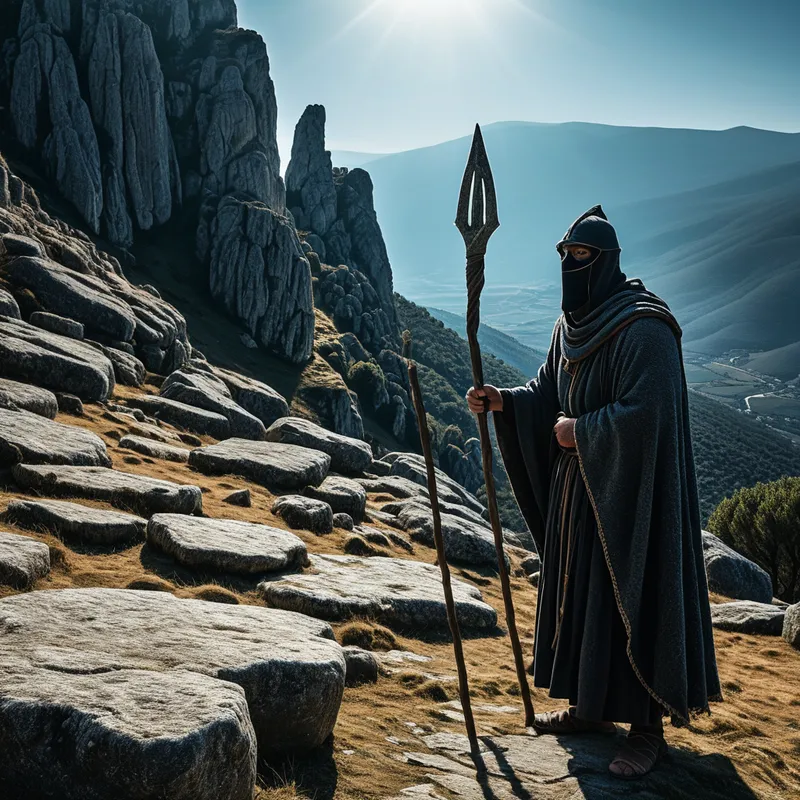
Hear now a tale not of gods clashing on Olympus, nor of heroes sailing for golden fleeces, but of [the earth](/myths/the-earth “Myth from Hindu culture.”/) itself speaking in a silent, irresistible tongue. It begins on the sun-baked slopes of Mount Pelia, in the land of Magnesia, where the air smells of [thyme](/myths/thyme “Myth from Greek culture.”/) and dry stone.
A shepherd, whose name is lost to [the wind](/myths/the-wind “Myth from Various culture.”/) that carves the cliffs, tended his flock. His world was one of known rhythms: the climb at dawn, the search for sparse grass, the descent at dusk. His sole companion was his staff, a stout limb of oak, shod at its foot with a cap of dark iron to steady his step on the scree. One day, driven by a thirst not for [water](/myths/water “Myth from Chinese culture.”/) but for solitude, he guided his sheep higher than ever before, into a barren ravine where even the goats were scarce.
The silence here was different—a dense, listening quiet. The ground was littered with peculiar black stones, heavy for their size, cool to the touch even in the fierce sun. Leaning on his staff, he paused to catch his breath. And then, [the world](/myths/the-world “Myth from Tarot culture.”/) shifted.
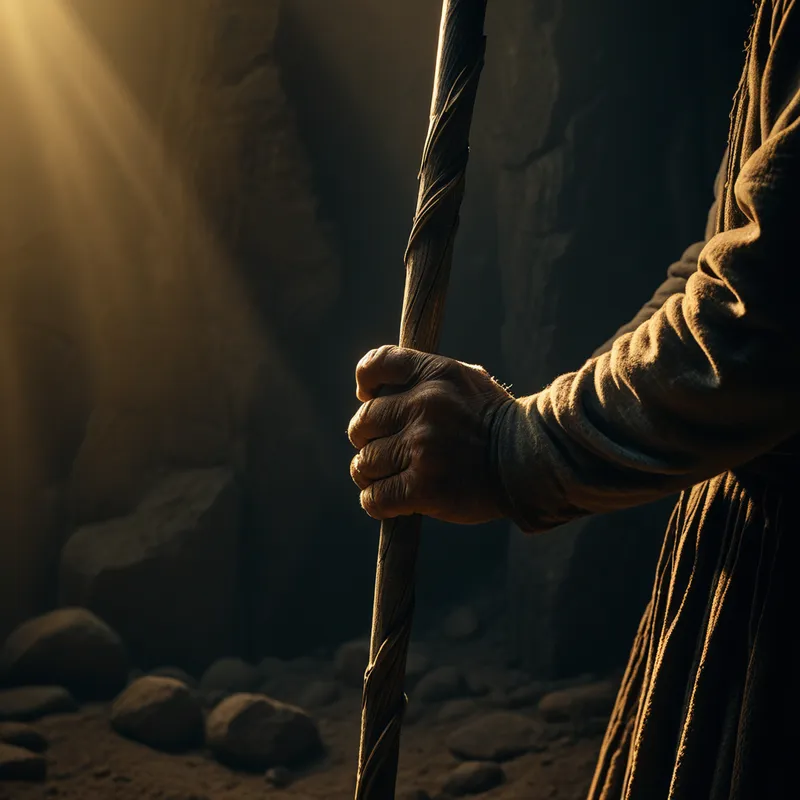
A force, silent and immense, seized the iron tip of his staff. It was not a wind; it was a will. The oak wood trembled in his hands, straining forward. He planted his feet, muscles corded, a grunt of effort escaping his lips. But the pull was absolute. The iron shoe clanged against one of the dark stones with a sound that was both a kiss and a lock snapping shut. He pulled, heaving with all his strength, but the bond was unbreakable. Fear, cold and sharp, pierced his awe. Was this the grip of a Naiad or a Satyr hiding in the stone?
He abandoned his staff, stumbling back down the mountain, his heart a wild drum against his ribs. He returned with villagers, men of sceptical minds and strong arms. They witnessed the miracle: iron nails leaping from belts, rings twisting on fingers, all drawn to the hungry black rock. The stone did not consume; it held. It was not a monster, but a presence. They named it the Loadstone, the lithos magnētis. The shepherd’s world of simple cause and effect was gone, replaced by a cosmos threaded with invisible lines of desire, where the earth itself could reach out and claim what was its own.
Cultural Origins & Context
This is not a myth of the epic cycle, sanctified by [Homer](/myths/homer “Myth from Greek culture.”/) or elaborated by the tragedians. Its origins are humbler, rooted in the pre-Socratic world of inquiry and wonder. The tale is attributed to the first natural philosopher, Thales of Miletus, who reportedly used it to explain the mysterious property of attraction. It was a “just-so story” from the dawn of science, a mythological framework to house a baffling physical observation.
Passed down not by bards in royal halls but by naturalists and travelers, its function was epistemological. For the ancient Greeks, the boundary between the mythical and the physical was porous. A phenomenon like magnetism demanded a narrative; it was an action, and every action implied an actor, an intention. The myth gave a face—or rather, a stony body—to this intention. It situated human technology (the iron-shod staff) within a natural world that was alive, responsive, and possessed of its own hidden agency. It served as a foundational parable for the Ionian philosophers: the cosmos is full of unseen forces (dynameis) that actively shape reality.
Symbolic Architecture
At its core, the myth symbolizes the [moment](/symbols/moment “Symbol: The symbol of a ‘moment’ embodies the significance of transient experiences that encapsulate emotional depth or pivotal transformations in life.”/) when the unconscious [psyche](/myths/psyche “Myth from Greek culture.”/) actively reaches into conscious [life](/symbols/life “Symbol: The symbol of ‘Life’ represents a journey of growth, interconnectedness, and existential meaning, encompassing both the joys and challenges that define human experience.”/) and claims something. The [shepherd](/symbols/shepherd “Symbol: A shepherd symbolizes guidance, protection, and the nurturing aspects of leadership, often reflecting the dreamer’s desire for direction or support.”/) represents the everyday ego, going about its [business](/symbols/business “Symbol: Dreaming of ‘business’ often symbolizes the dreamer’s ambitions, desires for success, and management of resources in their waking life.”/), reliant on its tools (the staff of [consciousness](/symbols/consciousness “Symbol: Consciousness represents the state of awareness and perception, encompassing thoughts, feelings, and experiences.”/) and directed will). The Loadstone is the unconscious itself—specifically, what Carl Jung would call a numinous [archetype](/symbols/archetype “Symbol: A universal, primordial pattern or prototype in the collective unconscious that shapes human experience, behavior, and creative expression.”/), an autonomous psychic content possessing tremendous gravitational pull.
The first law of the soul is attraction. Before integration comes capture; before understanding, awe.
The iron is the crucial intermediary. It symbolizes that [aspect](/symbols/aspect “Symbol: A distinct feature, quality, or perspective of something, often representing a partial view of a larger whole.”/) of the conscious [personality](/symbols/personality “Symbol: Personality in dreams often symbolizes the traits and characteristics of the dreamer, reflecting how they perceive themselves and how they believe they are perceived by others.”/) which is susceptible to the unconscious—a complex, a wound, a latent talent, a deep [memory](/symbols/memory “Symbol: Memory symbolizes the past, lessons learned, and the narratives we construct about our identities.”/). It is the “ferrous” quality in us, the part that can be magnetized. The dramatic, physical [seizure](/symbols/seizure “Symbol: A sudden, uncontrolled physical or emotional disruption, often symbolizing loss of control, overwhelming forces, or a system malfunction.”/) represents the often disruptive, fateful intrusion of [the Self](/myths/the-self “Myth from Jungian culture.”/) (the total, archetypal psyche) into the narrower [realm](/symbols/realm “Symbol: The symbol of ‘Realm’ often signifies the boundaries of one’s consciousness, experiences, or emotional states, suggesting aspects of reality that are either explored or ignored.”/) of [the ego](/myths/the-ego “Myth from Jungian culture.”/). The shepherd is not seeking this encounter; he is chosen by it. His initial fear is the ego’s [terror](/symbols/terror “Symbol: An overwhelming, primal fear that paralyzes and signals extreme threat, often linked to survival instincts or deep psychological trauma.”/) of being dissolved or controlled by something greater and unknown. The myth maps the primal [human](/symbols/human “Symbol: The symbol of a human represents individuality, complexity of emotions, and social relationships.”/) experience of being gripped by a [destiny](/symbols/destiny “Symbol: A predetermined course of events or ultimate purpose, often linked to spiritual forces or cosmic order, representing life’s inherent direction.”/), a calling, or a love that feels authored not by personal [choice](/symbols/choice “Symbol: The concept of choice often embodies decision-making, freedom, and the multitude of paths available in life.”/), but by a law of [nature](/symbols/nature “Symbol: Nature symbolizes growth, connectivity, and the primal forces of existence.”/).
The Dreamer’s Resonance
When this mythic pattern stirs in the modern dream-ego, it manifests as dreams of powerful, irrational attraction or immobilizing fixation. One might dream of a metal object stuck fast to a strange surface, of being pulled helplessly toward a door, a vortex, or a dark stone in a landscape. The somatic sensation is key: a feeling of being in the grip of something. There is often profound ambivalence—a mix of terror and fascination.
This dream signals that an archetypal content has achieved critical mass in the unconscious and is now exerting its magnetic pull on the conscious mind. The psychological process is one of numinous invasion. The ego is being confronted with a piece of its own destiny that it did not consciously choose. The “work” here is not to break free immediately, but first to stay with the experience, to feel the full force of the pull without fleeing into rationalization or denial. It is the beginning of a process where a latent, powerful part of the psyche is announcing its presence and its claim on the dreamer’s life energy.
Alchemical Translation
In the alchemical opus, [the first stage](/myths/the-first-stage “Myth from Alchemical culture.”/) is often [nigredo](/myths/nigredo “Myth from Alchemical culture.”/)—blackening, confusion, and the experience of being gripped by the [prima materia](/myths/prima-materia “Myth from Alchemical culture.”/), the chaotic base stuff of the soul. The Loadstone myth is a perfect allegory for this initial, crucial phase of individuation.
The shepherd’s journey to the barren ravine is the necessary withdrawal from collective life into a more solitary, introspective state. The discovery of the Loadstone is the confrontation with the Self in its raw, “stony,” impersonal form. The iron staff is the conscious attitude, the [persona](/myths/persona “Myth from Greek culture.”/), the adapted self that is suddenly revealed to have a hidden vulnerability—a hook into the depths.
The stone does not seek to destroy the iron, but to marry it. The goal is not freedom from the pull, but conscious relationship with it.
The alchemical translation is this: the ego must consent to be “held.” The initial terror must give way to a stance of observation and dialogue. What in me is “iron”? What complex, what pattern, is susceptible to this archetypal pull? The process of psychic transmutation begins when we stop trying to yank our staff free and instead ask, “What does this stone want with my iron?” This leads to the coniunctio, [the sacred marriage](/myths/the-sacred-marriage “Myth from Various culture.”/), where the conscious mind (iron) and the guiding archetypal force (the magnet) enter into a dynamic alignment. The individual is no longer just a shepherd with a staff, but a witness to, and eventually a conscious participant in, the magnetic mysteries that bind the soul to its own deepest purposes.
Associated Symbols
Explore related symbols from the CaleaDream lexicon: