
The Listening Jewels Myth Meaning & Symbolism
A tale of a queen who traded her voice for jewels that hold the world's unspoken truths, teaching that true wisdom is found in sacred silence.
The Tale of The Listening Jewels
Listen, and let the wind carry you back to when the world was younger, and the forests of Eldergreen whispered secrets to the stones. In that time, there ruled a queen named Elara, whose voice was said to be so clear it could calm storms and make the rivers pause in their courses to hear her song. Her kingdom was prosperous, yet a deep unease grew in the marrow of the land. The people spoke, but did not hear. They argued, but did not understand. A cacophony of fear and falsehood began to poison the roots of the great Weeping Oak.
One twilight, as the first star pierced the violet sky, the ancient spirit of the forest, known only as the Rooted Watcher, manifested before Elara. It was a form of shifting bark and patient moss, its eyes like deep pools in forgotten wells. “Your people drown in the noise of their own making,” it intoned, a sound like continents grinding. “They have forgotten the language beneath language. The truth is not in the speaking, but in the hearing.”
The Watcher led her to the heart of the forest, to a clearing where a single, crystalline tree stood. It bore no leaves, only luminescent fruits that were, in truth, perfect jewels: Sapphires of Sorrow, Emeralds of Unspoken Joy, and Ambers of Ancient Memory. “These are The Listening Jewels,” whispered the Watcher. “They drink the unvoiced truths of the world—the pain held in a clenched jaw, the love hidden behind averted eyes, the wisdom buried under fear. But to wield them, to truly hear, a great price is required. You must offer the instrument of your own speech. You must trade your sovereign voice for silent sovereignty.”
A terrible choice lay before Elara. To keep her voice was to remain a ruler of surface things, of decrees and songs that would soon be lost in the growing din. To surrender it was to step into a profound and terrifying solitude. She thought of her people, fragmenting in their misunderstanding. With a resolve that shook the stars, she opened her mouth and let her voice flow out—not as sound, but as a shimmering, silver mist that was absorbed into the roots of the crystalline tree.
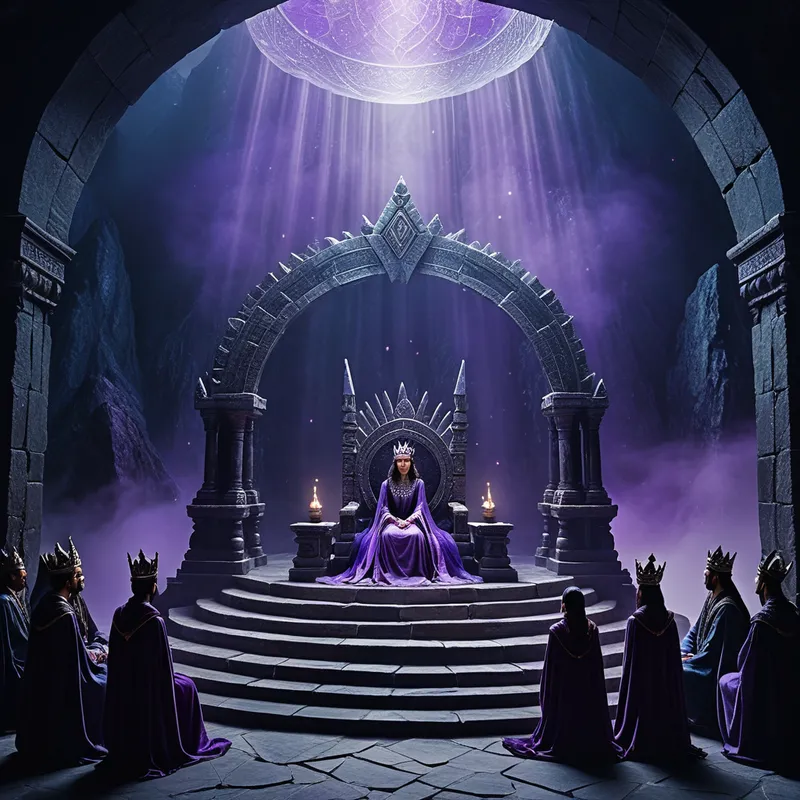
In return, the jewels detached and floated to her, settling into her crown, her necklace, her bracelets. Instantly, the world transformed. The silence was not empty, but overwhelmingly full. She heard the grief of the stone beneath the castle, the secret hopes of the shyest scullery maid, the true counsel hidden within a courtier’s flattery, and the land’s own slow song of growth and decay. She returned to her court, silent. At first, there was panic. But as she listened—truly listened—her responses, written on tablets or conveyed through gestures guided by her profound hearing, carried an uncanny wisdom. She resolved conflicts with insight into their hidden roots, fostered alliances by acknowledging unspoken loyalties, and healed wounds people had not even dared to name. Her silence became a sacred vessel into which her people could pour their truths, and from which she distilled a governance of profound understanding. The kingdom did not just prosper; it deepened, finding a harmony unheard of in the ages of loud kings.
Cultural Origins & Context
The myth of The Listening Jewels is a cornerstone of the oral tradition belonging to the forest-dwelling cultures collectively referred to in anthologies as Folklore. It was not a tale for festivals, but for the quiet hours—told by hearth-keepers and elder guides during the long nights of winter, or whispered to adolescents undergoing rites of passage. Its primary custodians were often the Thread-Singers, individuals who occupied a role between storyteller, therapist, and community arbitrator.
Societally, the myth functioned as a foundational narrative for a culture that placed immense value on ecological attunement and social cohesion. In a practical sense, it encoded the principles of restorative justice and deep diplomacy. Disputes were brought before councils that would first practice a ritual of “laying down the noise,” emulating Elara’s sacrifice, before any speaking began. The story legitimized the authority of quiet contemplation and positioned true leadership not as charismatic oration, but as receptive, empathetic discernment. It was a myth that taught a people how to listen to the land, to each other, and to the silent currents of their own hearts.
Symbolic Architecture
At its core, the myth is a masterful map of a profound psychological transition: the journey from the tyranny of the ego’s voice to the sovereignty of the Self’s listening.
The first sacrifice of wisdom is the illusion that speaking is power. True power begins in the receptive void that hears the world into being.
Queen Elara’s Voice represents our conscious identity, our persona, and our desire to assert, control, and define the world through our own narrative. It is necessary, yet limited. The Rooted Watcher is the archetypal symbol of the Self—the ancient, total psyche that exists beyond the ego. Its challenge is the call to individuation.
The Listening Jewels themselves are multifaceted symbols. They are the organs of perception of the unconscious. To “wear” them is to develop the capacity for introspection, active imagination, and empathy. They process the “unvoiced truths”: the complex of the shadow (Sapphires of Sorrow), the latent potential of the anima/animus (Emeralds of Unspoken Joy), and the guiding patterns of the ancestral psyche (Ambers of Ancient Memory). The act of trading voice for jewels is the ultimate symbolic act of enantiodromia—a reversal into the opposite. The conscious faculty (speech) is surrendered to activate and integrate unconscious faculties (deep listening).

The Dreamer’s Resonance
When this myth stirs in the modern dreamer, it often signals a critical juncture in psychological development. To dream of losing one’s voice, or of willingly having it taken, points to a somatic recognition that the ego’s current strategies of “speaking its way through” life are failing. There is a fatigue of self-assertion.
Dreams may present as finding strange, glowing stones; having ears that become extraordinarily sensitive; or being in a crowd where everyone is shouting, but you can only hear the faint, true whisper beneath it all. The body may register this as a tightness in the throat chakra giving way to a peculiar pressure or openness in the ears and the center of the chest. Psychologically, the dreamer is navigating the dissolution of an old identity built on performance and external validation, and the terrifying, fertile birth of a new capacity for inner knowing. It is the psyche’s initiation into the value of silence, not as emptiness, but as the womb of authentic insight.

Alchemical Translation
The alchemical process mirrored in Elara’s journey is the Nigredo followed by the Albedo. The sacrifice of the voice is the Nigredo—the descent, the putrefaction of the old, loud, controlling ego. It feels like a death, a profound loss of a cherished power. This is the necessary first step in the Individuation process.
The crucible of the soul is forged in silence. There, the base metal of reactive opinion is transmuted into the gold of compassionate understanding.
The integration of the jewels represents the Albedo. The purified ego, now in service to the larger Self, is illuminated from within by the previously unconscious contents. The “governance” Elara returns to exercise is the modern individual’s task of self-governance. The insights gleaned from listening to the inner shadows, joys, and memories must be applied to manage one’s internal kingdom—the complexes, impulses, and relationships.
The myth does not end with Elara speaking again. Her power remains in her cultivated receptivity. Thus, the alchemical translation for us is not about eventually reclaiming the old, noisy ego, but about permanently shifting the center of gravity from “I speak, therefore I am” to “I listen, therefore I understand.” The final gold, the Rubedo, is not a loud triumph, but a deep, resonant, and enduring wisdom that comes from having made the unconscious conscious, and having chosen the sacred silence of the Sage over the clamorous certainty of the Hero.
Associated Symbols
Explore related symbols from the CaleaDream lexicon: