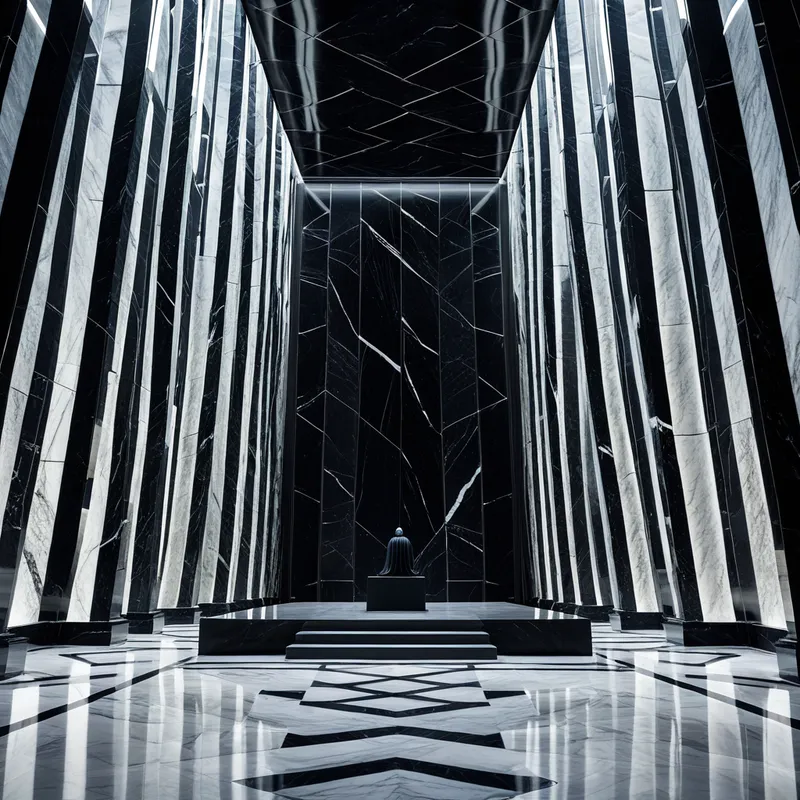
The Liminal Halls of Hades in Myth Meaning & Symbolism
A soul's journey through the silent, judgmental halls of the underworld, facing the echoes of a life to find the truth that lies beyond memory.
The Tale of The Liminal Halls of Hades in
Listen. Beyond the final sigh, past [the river](/myths/the-river “Myth from Buddhist culture.”/) where coins glint in a boatman’s palm, lies a place of echoes. This is not the realm of fiery torment or Elysian fields, not yet. It is the anteroom of eternity, the liminal halls.
Here, the air is still and cool, smelling of ancient stone and damp earth. The light has no source; it simply is, a grey, even illumination that casts no shadow, yet reveals everything. The halls themselves are a paradox—they feel infinitely vast, a palace of polished obsidian and veined marble, yet oppressively close, the ceiling just beyond reach, the walls a breath away on either side. Your footsteps, if you had feet that could make sound, would not echo. Silence is the first judge.
You are led, not by force but by a quiet, inevitable pull, down the central corridor. To either side are alcoves, niches, and grand archways leading into chambers of pure memory. In one, a banquet hall frozen in time, laughter etched on spectral faces, the taste of wine and regret thick on the tongue. In another, a childhood bedroom, the specific pattern of sunlight through a long-vanished window falling on a forgotten toy. The halls are not empty. They are populated by the shadows of your days—not people, but the emotional impressions left behind: the warmth of a loyal friend, the cold cut of a betrayal, the heavy weight of a promise unkept. They watch, silent and waiting.
At the heart of the halls, the corridor opens into a wide, circular chamber. Here sits the Weigher of Souls. It is not a god of wrath or mercy, but a presence of profound neutrality. It may appear as a tall figure shrouded in simple grey, its face a smooth oval, featureless. Or perhaps as a vast, still pool of [water](/myths/water “Myth from Chinese culture.”/). Before it, upon the flawless floor, your life does not play out like a scroll. Instead, from your essence, certain moments detach themselves. They rise like bubbles—the time you showed cowardice, glowing with a sickly yellow light; the time you offered kindness without thought of reward, shining a clear blue. They float in the space between you and the Weigher.
There is no spoken accusation. No defense is possible. The Weigher simply observes. And in that observation, you feel the totality of your own judgment. You see not what you did, but why. You feel the impact of your actions on [the web of life](/myths/the-web-of-life “Myth from Various culture.”/), the ripples you caused. The silence of the hall becomes the voice of your own conscience, amplified to a deafening roar. This is the ordeal: to stand utterly known, stripped of every story you told yourself, every excuse, every proud identity. You are only the raw truth of your choices.
Then, a shift. The Weigher’s gaze—if it had eyes—softens from assessment to acknowledgment. The judged moments, both light and dark, do not vanish. They begin to orbit one another, the yellow and blue and every other color swirling, merging. They are not weighed against each other, but integrated. From this silent alchemy, a single, new quality emerges from your core: a understanding, a bittersweet acceptance. It is not forgiveness, not from an external source. It is reconciliation. With this, the Weigher gestures, not with a hand, but with a subtle change in the atmosphere. A new archway, previously unseen, manifests in the wall of the chamber. Beyond it is not an end, but a beginning—the true journey into the depths of [Hades](/myths/hades “Myth from Greek culture.”/) proper, or perhaps a return, can now commence. You have passed through the liminal. You have met yourself.

Cultural Origins & Context
The motif of a judging or reviewing anteroom in the afterlife is a truly global, universal archetype, appearing in countless cultural garments. It is not the property of a single mythos, but a psychic structure common to humanity. We see it in the ancient Egyptian [Weighing of the Heart](/myths/weighing-of-the-heart “Myth from Egyptian culture.”/) ceremony before [Osiris](/myths/osiris “Myth from Global/Universal culture.”/) and the Forty-Two Assessors in the Hall of Two Truths. We hear echoes in the Zoroastrian Chinvat Bridge, and in the Buddhist Bardo states described in the Tibetan Book of the Dead, where the consciousness encounters peaceful and wrathful deities—projections of its own [karma](/myths/karma “Myth from Hindu culture.”/).
This myth was never the property of bards alone, though they carried its narrative form. It was held by priests, shamans, and philosophers as the crucial map for the soul’s most critical transition. Its societal function was profound: it served as the ultimate ethical engine. By externalizing the internal process of conscience and consequence into a cosmic drama, it provided a powerful narrative framework for [justice](/myths/justice “Myth from Tarot culture.”/), accountability, and the examined life. It taught that the final audit is not of wealth or power, but of essence and intent. It was passed down not merely as a story of what happens after, but as an instruction for how to live now.
Symbolic Architecture
Psychologically, the Liminal Halls represent the individuation process’s most daunting phase: the confrontation with the Self through the [assembly](/symbols/assembly “Symbol: Assembly symbolizes collaboration, unity, and the coming together of individuals or ideas in pursuit of a common goal.”/) of the [shadow](/symbols/shadow “Symbol: The ‘shadow’ embodies the unconscious, repressed aspects of the self and often represents fears or hidden emotions.”/). The halls are the [architecture](/symbols/architecture “Symbol: Architecture in dreams often signifies structure, stability, and the framing of personal identity or life’s journey.”/) of [the personal unconscious](/myths/the-personal-unconscious “Myth from Jungian Psychology culture.”/)—a vast, orderly, yet deeply personal [museum](/symbols/museum “Symbol: A museum symbolizes the preservation of memories, culture, and knowledge; a place for reflection and learning.”/) of everything we have experienced and repressed.
The judgment is not a sentence passed by an other, but the soul’s inevitable shudder of self-recognition when all its scattered fragments are gathered in one silent room.
The featureless Weigher is the [archetype](/symbols/archetype “Symbol: A universal, primordial pattern or prototype in the collective unconscious that shapes human experience, behavior, and creative expression.”/) of objective [consciousness](/symbols/consciousness “Symbol: Consciousness represents the state of awareness and perception, encompassing thoughts, feelings, and experiences.”/), the inner [observer](/symbols/observer “Symbol: An observer represents contemplation, self-awareness, and the act of witnessing one’s experiences.”/) stripped of [persona](/symbols/persona “Symbol: The social mask or outward identity one presents to the world, often concealing the true self.”/) and ego. It is not “God” judging, but [the Self](/myths/the-self “Myth from Jungian culture.”/) perceiving [the ego](/myths/the-ego “Myth from Jungian culture.”/)’s [life](/symbols/life “Symbol: The symbol of ‘Life’ represents a journey of growth, interconnectedness, and existential meaning, encompassing both the joys and challenges that define human experience.”/) in totality. The floating [memory](/symbols/memory “Symbol: Memory symbolizes the past, lessons learned, and the narratives we construct about our identities.”/)-bubbles are complexes—packages of thought, [emotion](/symbols/emotion “Symbol: Emotion symbolizes our inner feelings and responses to experiences, often guiding our actions and choices.”/), and [memory](/symbols/memory “Symbol: Memory symbolizes the past, lessons learned, and the narratives we construct about our identities.”/) that possess autonomous [energy](/symbols/energy “Symbol: Energy symbolizes vitality, motivation, and the drive that fuels actions and ambitions.”/) within the [psyche](/myths/psyche “Myth from Greek culture.”/). The [alchemy](/symbols/alchemy “Symbol: A transformative process of purification and creation, often symbolizing personal or spiritual evolution through difficult stages.”/) of their merging is the core of healing; it is the [dissolution](/symbols/dissolution “Symbol: The process of breaking down, dispersing, or losing form, often representing transformation, release, or the end of a state of being.”/) of inner conflict through [awareness](/symbols/awareness “Symbol: Conscious perception of self, surroundings, or internal states. Often signifies awakening, insight, or heightened sensitivity.”/), where we stop fighting our own darkness and begin to understand its [role](/symbols/role “Symbol: The concept of ‘role’ in dreams often reflects one’s identity or how individuals perceive their place within various social structures.”/) in our composition.

The Dreamer’s Resonance
When this myth stirs in modern dreams, it rarely appears as an ancient marble hall. It manifests as the endless, fluorescent-lit corporate corridor after hours, the deserted shopping mall, the repeating sequence of identical hotel rooms. The somatic feeling is one of profound isolation, quiet anxiety, and suspended animation—the very essence of the liminal. The “judge” may be a silent authority figure, a mirror that reflects a distorted image, or even a cold, automated voice over a loudspeaker.
Dreaming of this pattern signals that the psyche is in a state of life review or existential audit. The dreamer is likely at a crossroads, having ended a chapter (a relationship, career, identity) but not yet begun the next. The psychological process is one of subconscious stock-taking. The ego is being gently, or not so gently, confronted with aspects of the self it has disowned—unexpressed grief, unacknowledged pride, hidden shames. The dream is the hall. The process of waking and integrating those feelings is the audience with the Weigher.

Alchemical Translation
For the modern individual, the journey through the Liminal Halls models the essential, non-negotiable stage of psychic transmutation: the [nigredo](/myths/nigredo “Myth from Alchemical culture.”/), or [the dark night of the soul](/myths/the-dark-night-of-the-soul “Myth from Christian Mysticism culture.”/). Our culture prizes ascent, light, and positivity, fleeing from descent, shadow, and honest appraisal. This myth insists that wholeness is only forged in the descent.
To bypass the halls is to remain a ghost, haunted by the unlived life. To walk them is to reclaim your substance.
The alchemical operation is [solutio](/myths/solutio “Myth from Alchemical culture.”/) (dissolution) followed by coagulatio (coagulation). In the halls, the hardened narratives of our [persona](/myths/persona “Myth from Greek culture.”/) (“I am the victim,” “I am the hero”) are dissolved in the silent, objective light of truth. We are reduced to our essential components—our raw actions and intentions. Then, in the presence of the Weigher, a new coagulation occurs. The disparate elements are not discarded; the cowardice and the courage, the generosity and the greed, are seen as part of a single spectrum of being. They are reintegrated into a more conscious, more responsible whole.
The [triumph](/myths/triumph “Myth from Roman culture.”/) of the myth is not a verdict of “innocent.” It is the achievement of awareness. One leaves the Liminal Halls not lighter, but heavier—burdened with the full weight of one’s truth, which is the only foundation solid enough upon which to build an authentic life or take the next step into the unknown. It is the archetypal orphan finding not a parent in [the underworld](/myths/the-underworld “Myth from Greek culture.”/), but their own sovereign soul.
Associated Symbols
Explore related symbols from the CaleaDream lexicon: