The Library of Babel Myth Meaning & Symbolism
An infinite library contains every possible book, a universe of total information where the search for a single, coherent truth becomes a divine and maddening obsession.
The Tale of The Library of Babel
In the beginning, there was [the Word](/myths/the-word “Myth from Biblical culture.”/). And the Word was not one, but all. It was the universe itself, and its name was the Library of Babel.
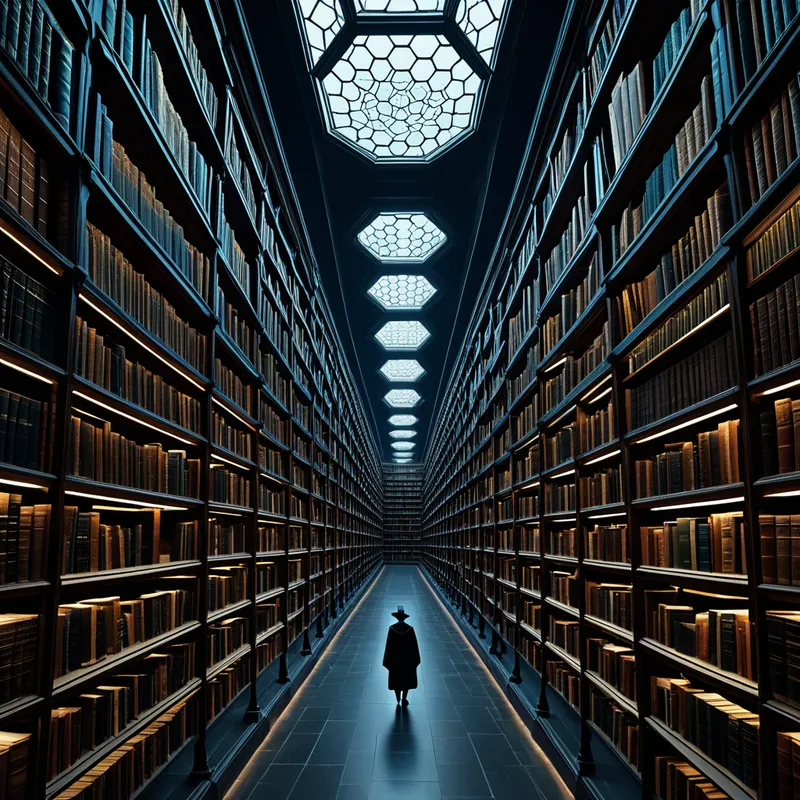
Imagine a cosmos not of stars and void, but of galleries. Endless, repeating hexagons, four walls of books, two of bare necessity. In each, a sleeping chamber, a latrine, a spiral staircase plunging up and down into further hexagons, forever. The air is the smell of ancient paper and dust, and the light comes from great, dim, spherical lamps whose light never fails. This is [the world](/myths/the-world “Myth from Tarot culture.”/). There is no outside. The Library is all that is, was, or ever could be.
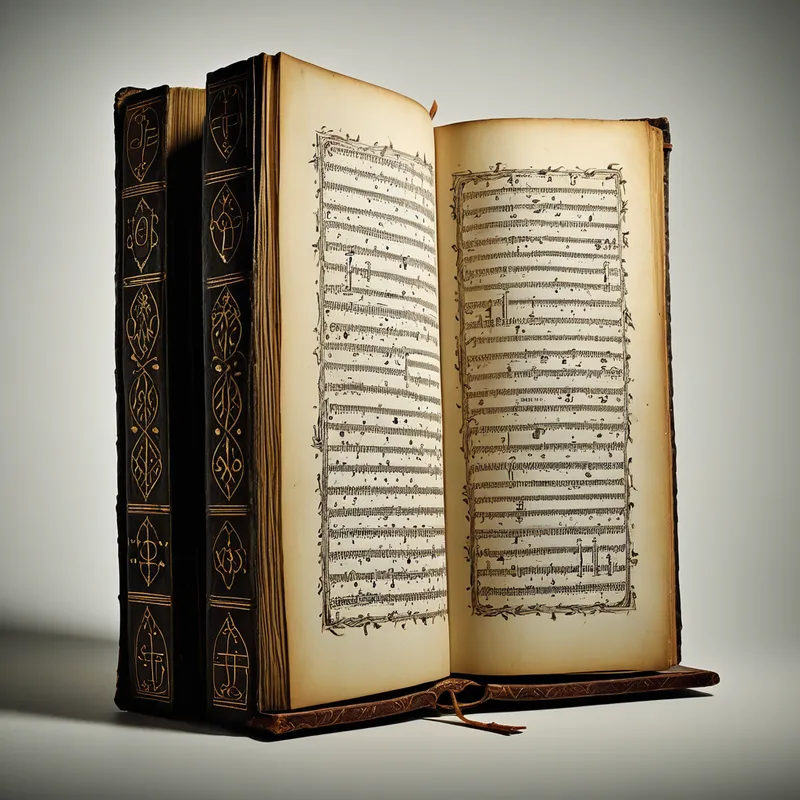
For the books are not merely many; they are total. Each volume contains four hundred and ten pages; each page, forty lines; each line, eighty characters. The orthographic symbols are twenty-five in number. From this finite set, every possible combination has been set into type. Here, on some shelf, in some hexagon, is the perfect, verbatim account of your birth, your death, and every moment between. Here is the lost gospel of a forgotten god. Here is the book that proves, with crystalline logic, the meaning of existence. And here, on the next shelf, is the same book with a single letter changed, rendering it nonsense. For every coherent text, there are galaxies of gibberish, of beautiful but meaningless strings, of tantalizing fragments that dissolve into chaos.
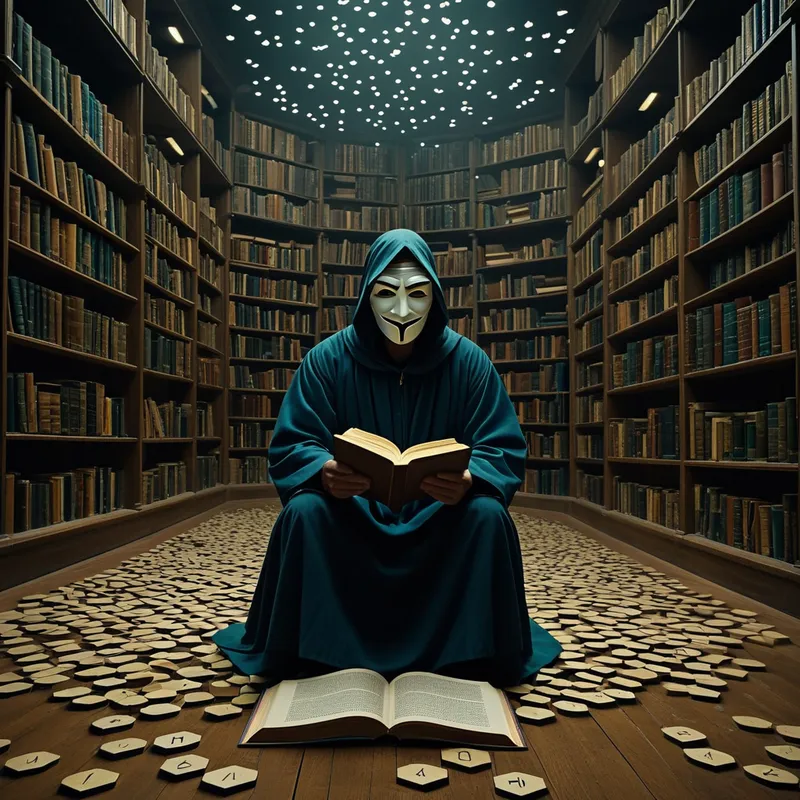
The people of the Library—the librarians—are born into this totality. For generations, a sacred order prevailed: the belief in the Catalogue of Catalogues. They believed that somewhere, a book existed that was the index to all others, the key to [the labyrinth](/myths/the-labyrinth “Myth from Greek culture.”/). Men dedicated their lives to the Search. They wandered the hexagons, driven by a holy fervor, following clues in coherent texts, forming sects around different methodologies. Some argued one must read every book in a single gallery; others that one must follow a specific pattern through the staircases.
But as centuries passed, and no key was found, a great despair took root. The sheer scale of the search revealed its absurdity. The discovery of a single meaningful page in a sea of nonsense became a torment, not a [triumph](/myths/triumph “Myth from Roman culture.”/). A heresy arose: the belief that the meaningful books were infinitely outnumbered by the meaningless, that all order was a fleeting accident in an ocean of chaos. Factions formed. The “Purifiers” began destroying books they deemed nonsensical, an act of blasphemous futility. Others, the “Infinities,” retreated into silence, believing any speech was merely quoting from some unknown book elsewhere, that they had no true selves.
The myth does not end with a hero finding the key. It ends with the quiet, terrible realization. The Library is infinite and periodic. If one traveled far enough, one would find the same hexagons, the same books, repeated. The total knowledge, the ultimate truth, is there. But it is drowned, absolutely and forever, in its own infinite repetition. The searcher is left with a choice: to embrace the maddening quest as a form of worship, or to sit in his hexagon, and in the perfect, silent totality, go quietly, cosmically, insane.
Cultural Origins & Context
This is a foundational myth of the Science Fiction culture, originating not from oral tradition but from the written word of its prophet, Jorge Luis Borges. Written in 1941, it emerged in a world on the brink of informational explosion, where the dream of total knowledge—through encyclopedias, libraries, and later, digital networks—was beginning to show its terrifying shadow. Borges, a librarian himself, codified a deep, ancient anxiety into a modern cosmological parable.
It was passed down not by bards, but by readers, academics, and later, digital communities who saw in it a perfect description of their own reality: the internet. Its societal function is that of a cautionary meta-narrative. It serves as a psychic tool for a culture drowning in data. It asks: What happens when you have access to everything, and therefore, effectively, to nothing? It is a myth for the age of the search engine, a story that inoculates against the madness of infinite choice and the despair of infinite noise. It is told in university seminars, referenced in tech conferences, and whispered in the quiet moments of anyone who has ever felt lost in the vastness of available knowledge.
Symbolic Architecture
The Library of Babel is the [psyche](/myths/psyche “Myth from Greek culture.”/) itself, conceived as a cosmic archive. It represents the totality of the [collective unconscious](/symbols/collective-unconscious “Symbol: The Collective Unconscious refers to the part of the unconscious mind shared among beings of the same species, embodying universal experiences and archetypes.”/), where every thought, every [story](/symbols/story “Symbol: The symbol of ‘Story’ represents the narrative woven through our lives, embodying experiences, lessons, and emotions that shape our identities.”/), every possible [combination](/symbols/combination “Symbol: A combination in dreams often signifies the blending of various aspects of oneself or different life situations.”/) of psychic [material](/symbols/material “Symbol: Material signifies the tangible aspects of life, often representing physical resources, desires, and the physical world’s influence on our existence.”/) exists in potential form.
The Library is the mind of God, but a God who has written down every possible thought, including all the false ones, and then forgotten the index.
The books are psychic contents. The coherent volumes are the moments of [insight](/symbols/insight “Symbol: A sudden, deep understanding of a complex situation or truth, often arriving unexpectedly and illuminating hidden connections.”/), the integrated memories, the meaningful narratives we construct about our lives. The overwhelming majority—the gibberish—represent the chaotic, unprocessed, and fragmented material of the unconscious: traumas, repressed desires, and random neural [noise](/symbols/noise “Symbol: Noise in dreams signifies distraction, confusion, and the need for clarity amidst chaos.”/). The search for the Catalogue of Catalogues is [the ego](/myths/the-ego “Myth from Jungian culture.”/)‘s [quest](/symbols/quest “Symbol: A quest symbolizes a journey or search for purpose, fulfillment, or knowledge, often representing life’s challenges and adventures.”/) for a single, unifying theory of self, a master narrative that will make sense of all our contradictions and experiences. The [despair](/symbols/despair “Symbol: A profound emotional state of hopelessness and loss, often signaling a need for transformation or surrender to deeper truths.”/) of the librarians symbolizes the [crisis](/symbols/crisis “Symbol: A crisis symbolizes turmoil, urgent challenges, and the need for immediate resolution or change.”/) of meaning that occurs when [the ego](/myths/the-ego “Myth from Jungian culture.”/) confronts the sheer, unmanageable vastness of the inner world.
The hexagonal [structure](/symbols/structure “Symbol: Structure in dreams often symbolizes stability, organization, and the framework of one’s life, reflecting how one perceives their environment and personal life.”/) is crucial. It is a repeating, rational, ordered [cell](/symbols/cell “Symbol: The symbol of a ‘cell’ represents confinement, structure, and the essence of individuality within a larger system, often reflecting themes of restriction or protection in the dreamer’s life.”/)—a [symbol](/symbols/symbol “Symbol: A symbol can represent an idea, concept, or belief, serving as a powerful tool for communication and understanding.”/) of the mind’s attempt to impose structure on [chaos](/symbols/chaos “Symbol: In Arts & Music, chaos represents raw creative potential, uncontrolled expression, and the breakdown of order to forge new artistic forms.”/). Yet this very structure creates the [prison](/symbols/prison “Symbol: Prison in dreams typically represents feelings of restriction, confinement, or a lack of freedom in one’s life or mind.”/). The infinite repetition of the Library is the ultimate [symbol](/symbols/symbol “Symbol: A symbol can represent an idea, concept, or belief, serving as a powerful tool for communication and understanding.”/) of psychic enantiodromia, where the quest for meaning, pushed to its extreme, flips into its opposite: the realization of eternal, meaningless return.
The Dreamer’s Resonance
To dream of the Library of Babel is to experience a somatic state of overwhelming cognitive overload. The dreamer often finds themselves in a vast, institutional space—endless corridors, data centers, or indeed, libraries—where they are tasked with an impossible search. The book, file, or room they need is just out of reach, or when found, its contents are blurred, in the wrong language, or dissolve upon reading.
This dream pattern manifests during life transitions where the demand for a “correct” path or a single answer is high, but the data points are contradictory and infinite: choosing a career, deciphering a relationship, or seeking a personal philosophy. The body may feel heavy, sluggish, or paralyzed in the dream—a somatic expression of psychic stagnation. The dream is the unconscious presenting the ego with the reality of its situation: you are trying to find a simple narrative in a system of infinite complexity. The psychological process is one of confrontation with [the shadow](/myths/the-shadow “Myth from Jungian culture.”/) of knowledge—the realization that more information does not equal more wisdom, and that the search for an absolute answer can be a defense against the harder task of creating a meaningful, if subjective, one.

Alchemical Translation
The alchemical process modeled here is not the creation of gold, but the transmutation of infinite data into finite wisdom. [The prima materia](/myths/the-prima-materia “Myth from Alchemical culture.”/) is the chaotic totality of the Library—all the raw, unintegrated experiences, inherited complexes, and cultural noise of a life. The old, doomed librarians represent the ego’s initial, naive operation: the [nigredo](/myths/nigredo “Myth from Alchemical culture.”/) of endless, despairing search in the blackness of undifferentiated information.
The alchemist’s furnace is not for burning away impurity, but for accepting that the impurity—the nonsense, the chaos—is the majority of the substance. The work is to stop searching for the one pure book, and to learn to read the library itself.
The turning point, the albedo, is the abandonment of the quest for the absolute Catalogue. It is the moment of surrender, where the seeker stops trying to find meaning in the universe and begins the task of imposing a coherent, personal meaning upon a small, curated section of it. This is the creation of the “personal hexagon.”
The individuated modern self does not master the Library. It accepts its citizenship within it. It learns to navigate not by a master map, but by a personally-drawn, always-revisable one. It understands that the true “[philosopher’s stone](/myths/philosophers-stone “Myth from Alchemical culture.”/)” is not the answer, but the capacity to tolerate the question—to hold the tension between the known coherent page and the surrounding chaos of glyphs. The final stage, the [rubedo](/myths/rubedo “Myth from Alchemical culture.”/), is the realization that one’s own life is the only book one can truly author, even if its letters are drawn from the infinite, shared shelves of existence. The triumph is not in finding the key to the [labyrinth](/myths/labyrinth “Myth from Various culture.”/), but in discovering that the act of conscious, humble searching within your own limited gallery is the meaning.
Associated Symbols
Explore related symbols from the CaleaDream lexicon: