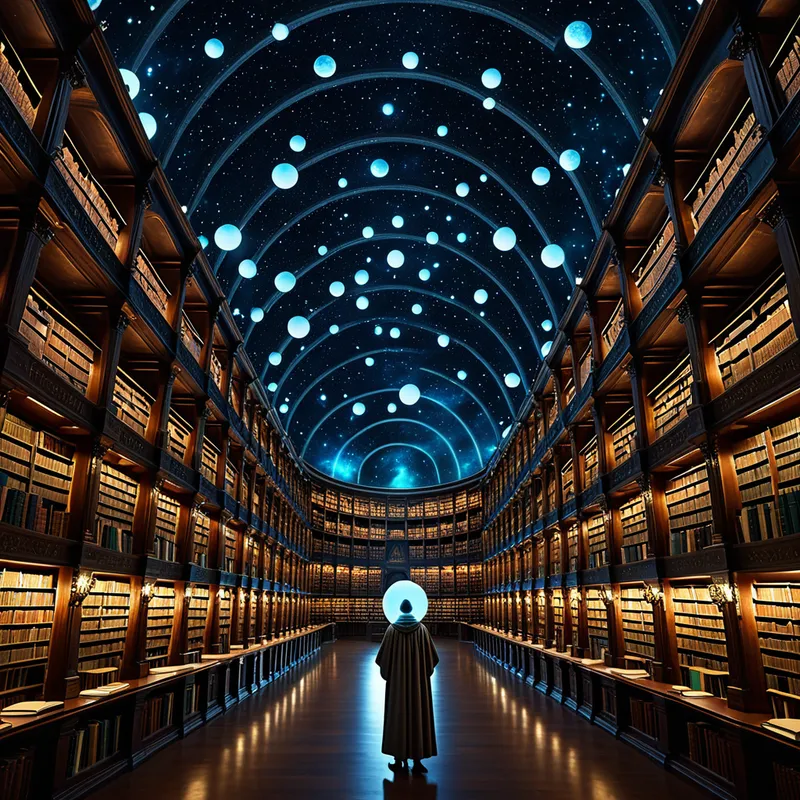
The Library of Alexandria as a Myth Meaning & Symbolism
The story of a universal archive of all human knowledge, its catastrophic loss, and the enduring quest to rebuild the library of the soul.
The Tale of The Library of Alexandria as a
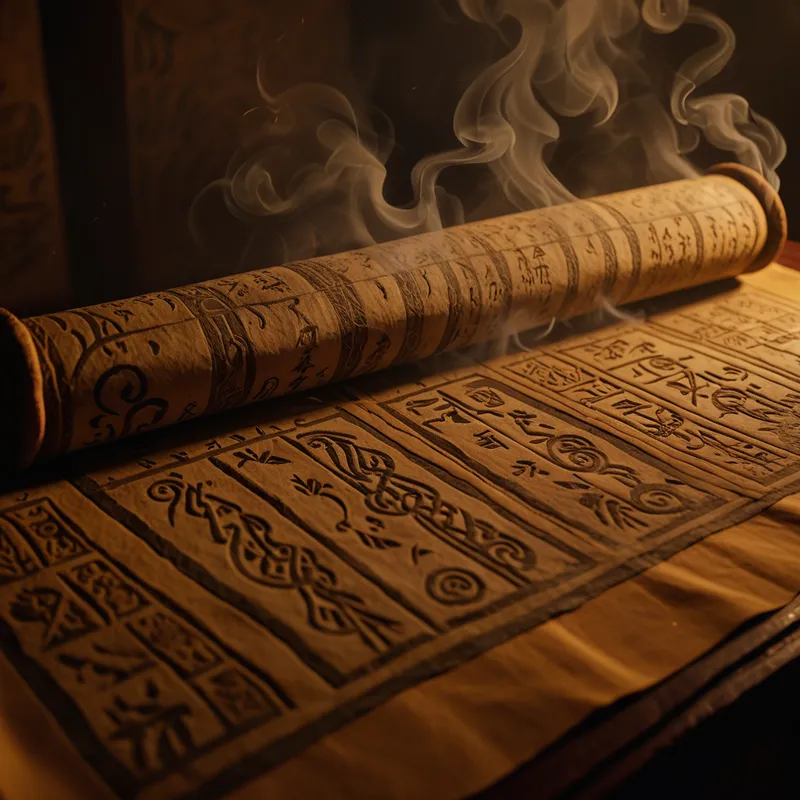
In the dreaming heart of the world, where memory becomes stone and thought takes the shape of a city, there stood a beacon. It was not a tower of fire, but a sanctuary of silence and whispered wisdom. The Library of Alexandria was born from a hunger so vast it could only be divine: the hunger to know everything. Kings and philosophers, sailors and astronomers, all brought their treasures—clay tablets etched with the laws of forgotten kings, papyrus scrolls singing of love and war, star charts mapping the paths of wandering gods, and herbals containing the secrets of life and death. It was said that every ship that docked was searched not for gold, but for books; every scroll was copied by scribes whose hands moved like the wind over reeds, so that the knowledge might be doubled, secured, eternal.
The Library was not merely a building. It was a living organism, a second Memory of Mankind. Its halls were cool and shadowed, lit by the soft, dusty gold of sun through high windows. The air smelled of papyrus, cedar oil, and the faint, metallic scent of ink. You could hear the soft shuffle of sandals, the rustle of a page, the murmur of a scholar arguing with a ghost across centuries. Here, the geometry of Euclid lived beside the epic voyages of heroes, the medical insights of the East conversed with the philosophies of the West. It was the world’s mind, gathered under one roof, breathing in unison.
But every mind has its shadow. The story whispers of a fire—not one, but many. Some say it was an accident of war, a careless torch in a naval battle that leaped ashore like a vengeful spirit. Others murmur of a deliberate purge, a willful turning away from the complexity and contradiction that such a complete collection represented. The flames did not discriminate. They consumed the elegant arguments and the foolish fables with equal appetite. The scrolls did not scream; they sighed as they curled into black ash, releasing their captured words back into the chaotic air. The great hall, once a cathedral of quiet thought, became a furnace of light and loss. The smoke that rose over Alexandria was the ghost of a hundred thousand conversations, a million ideas, dissolving into the indifferent sky.
And when the last ember died, a profound silence fell, deeper than before. The shelves stood half-empty, like a jawbone missing teeth. The scholars wandered the scorched halls, their hands empty. The universal memory had been wounded, fragmented. Yet, from that day to this, a new figure entered the myth: the Gatherer. Not the king who built it, but the countless unnamed souls who, hearing of the loss, began the work again. A fragment saved here, a copy discovered there, an oral tale written down before the last elder died. The Library, as a complete entity, was gone. But as a seed, as a mandate, as a ghost—it remained, and its rebuilding became the quiet, endless task of every generation.
Cultural Origins & Context
The myth of the Library of Alexandria is unique. It is a modern myth born from historical fragments, a story we have collectively woven from the threads of loss. Its origin is not in a single sacred text or oral tradition, but in the historical records of classical antiquity—the writings of Strabo, Seneca, and others—which themselves are incomplete. The actual library, part of the Mouseion in Hellenistic Egypt, suffered a long, ambiguous decline across centuries, through multiple fires and conflicts.
This very ambiguity is what allowed it to be mythologized on a global scale. The historical event was too vague to pin down, so the human imagination filled the void. It ceased to be merely a Ptolemaic institution and became a universal symbol. The story is passed down not by bards, but by historians, novelists, scientists, and librarians—the modern priests of knowledge. Its societal function is profound: it serves as a cautionary tale about the fragility of civilization, a lament for lost potential, and a foundational narrative for the mission of all libraries, museums, and digital archives. It is our culture’s story about the peril and necessity of remembering.
Symbolic Architecture
Psychologically, the Library represents the Self in its idealized, complete form—the integrated psyche that contains all potentials, all memories, all aspects of knowledge, both light and shadow. It is the aspiration for wholeness.
The Library is the psyche’s map of itself, a cartography so complete it becomes the territory.
The act of gathering every book symbolizes the ego’s heroic, perhaps hubristic, attempt to bring the entire unconscious into the light of consciousness. It is the individuation project as an architectural feat. The fire, then, is not merely an external catastrophe. It is the inevitable eruption of the unconscious—the repressed, the chaotic, the unintegrated shadow that cannot be so neatly shelved and catalogued. The fire is the trauma that shatters naive wholeness, the necessary crisis that proves total conscious control is an illusion.
The fragments that remain are the core complexes, the handful of guiding narratives and memories that survive our personal catastrophes. The endless work of the Gatherer symbolizes the lifelong psychological work of recollection, integration, and making meaning from what is left, and from what can be rediscovered or newly created.

The Dreamer’s Resonance
To dream of the Library—especially of wandering its lost halls, seeing its burning shelves, or desperately trying to save a single text—is to dream from the edge of a profound psychological process. Somatically, one may feel a sense of breathless awe coupled with deep anxiety, a pressure in the chest, or a feeling of racing against time.
This dream pattern often emerges during periods of intellectual or spiritual crisis, when one’s foundational “knowledge” or worldview feels threatened or incomplete. It can surface after a significant loss (a death, the end of an era) that feels like the burning of one’s personal archive. The dreamer is confronting the Archetype of the Destroyer within their own psychic structure. The process is one of de-integration—the terrifying but necessary dissolution of a once-stable inner system (the old library) to make way for something new. The dream is the psyche’s dramatic enactment of the truth that wisdom is not merely accumulated, but often forged in the fires of loss.

Alchemical Translation
The alchemical journey mirrored in this myth is not the classic Nigredo to Albedo, but a more profound and cyclical one: from Unio Mentalis (the intellectual union) through Mortificatio (the burning), to the eternal Opus Circumrotatum (the revolving work).
The initial building of the collection is the Unio Mentalis—the proud, conscious effort to create order and totality. The fire is the essential Mortificatio. In alchemy, the substance must be reduced to its blackened, primal state before transformation can begin. So too must the psyche’s pretensions of total knowledge be humbled and broken down.
The true treasure is not the collection that was lost, but the humility and purpose forged in the act of gathering anew.
The final stage is not a golden, static completion (Rubedo), but the recognition that the work itself is the goal. The modern individual’s alchemical task is to internalize the Gatherer. It is to accept that one’s inner library will never be complete, that fires (crises, failures, forgetting) are part of the process, and that the sacred duty is to faithfully, patiently, and passionately engage in the endless opus of seeking, integrating, and creating meaning from the fragments. We do not rebuild the Library to own knowledge, but to participate in the eternal conversation it represents. In this participation, we find our wholeness.
Associated Symbols
Explore related symbols from the CaleaDream lexicon: