The Library of Alexandria Myth Meaning & Symbolism
A myth of a universal repository of all human knowledge, its creation, its fiery destruction, and the eternal quest to reassemble its scattered fragments.
The Tale of The Library of Alexandria
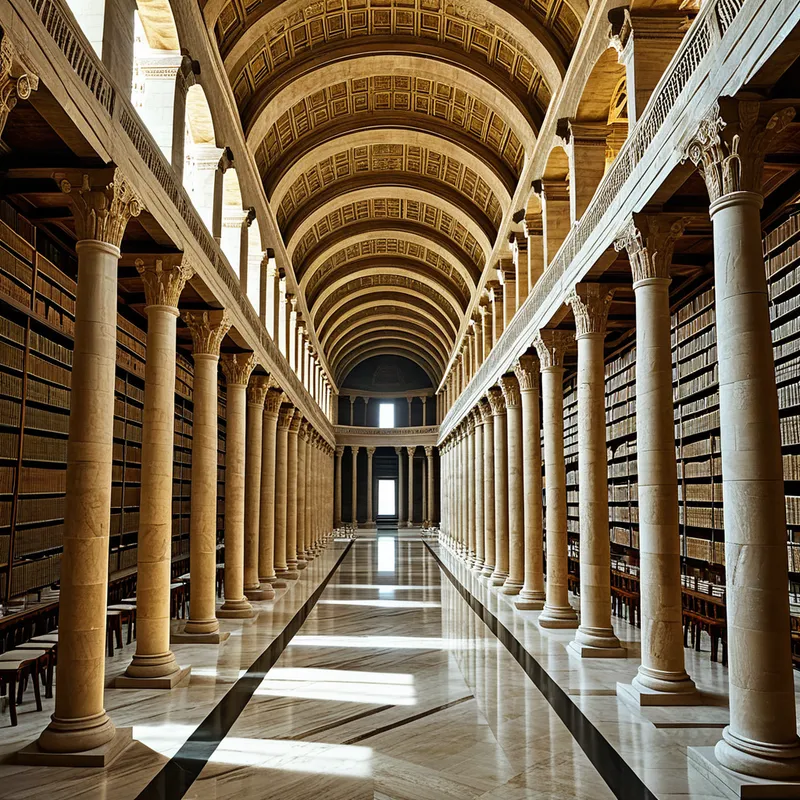
Listen, and let the scent of papyrus and cedar oil fill your mind. In the city where the sun god Helios kissed the waves of the Middle Sea, there arose a dream not of stone and empire, but of memory itself. It was the dream of the Ptolemies, those philosopher-kings who ruled from a throne of scrolls. They decreed that every ship in the harbor of Alexandria be boarded, not for gold or spice, but for books. Every manuscript, every poem, every star-chart and medical treatise was to be borrowed, copied in elegant script by an army of scribes, and placed within the sacred walls.
The Library grew. It was not a building, but a living organism, a second heart for the world. Its corridors, cool and shadowed, hummed with the whispered arguments of Stoics and Hierophants, the rustle of Babylonian astronomical clay tablets, the vivid illustrations of Indian surgical texts. Here, the circumference of the Earth was first measured with stunning accuracy. Here, the plays of Aeschylus rested beside the love poetry of the Nile. It was the memory of the species, gathered in one place, a testament to the human hunger to know.
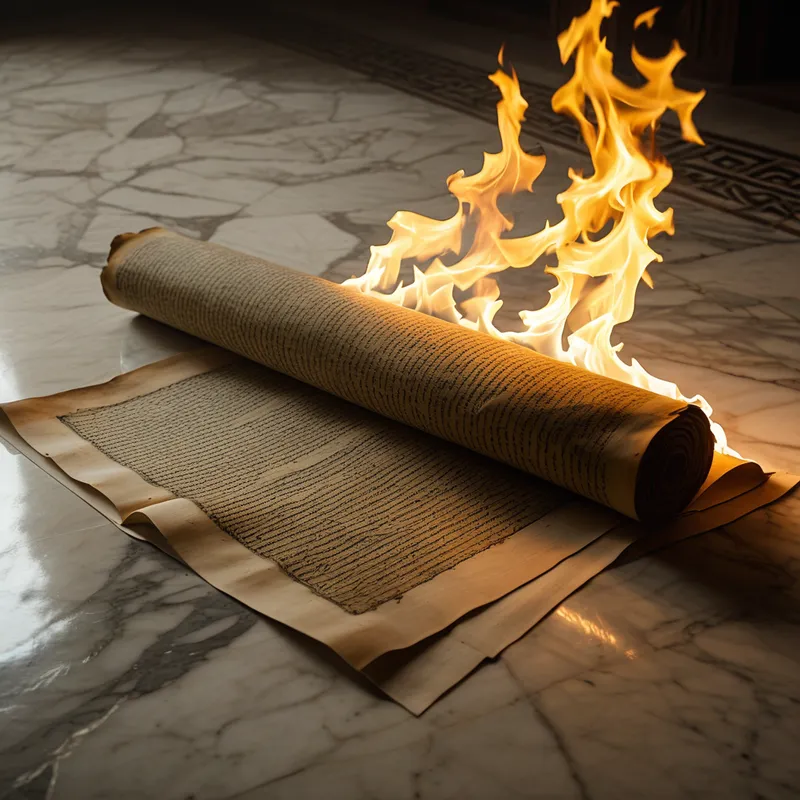
Then came the fire. Not once, but many times, as if fate itself were jealous of such concentrated light. The most haunting tale whispers of a conflict, a siege. A flame, born of war’s chaos, leapt from the docks. The wind, that same breeze that once carried scholarly debates, turned traitor. It drove the fire through the city, toward the marble colonnades. The scholars, those guardians of memory, became a frantic swarm, their arms laden with scrolls, their voices raw with despair. They watched as centuries of thought—the only copy of a play, a unique history of a vanished people, a map of forgotten stars—curled into black ash and ascended on the heat, becoming one with the indifferent smoke of battle. The great memory was shattered, its fragments scattered to the winds of time.
Cultural Origins & Context
The myth of the Library of Alexandria is unique; it is a modern myth born from historical tragedy. Its origins are not in an oral epic tradition but in the fragmented accounts of historians like Seneca, Strabo, and later, Ammianus Marcellinus. It was passed down not by bards, but by scholars mourning a loss they themselves could scarcely comprehend. The “Global/Universal” aspect is paramount: the Library was conceived as an archive of all human knowledge, actively seeking texts from every culture known to the Hellenistic world—Greek, Egyptian, Mesopotamian, Persian, Indian.
Its societal function was dual. For the Ptolemies, it was an instrument of soft power, a claim to cultural supremacy. For the world, however, it became a symbol of a collective, transcendent aspiration. Its destruction, whether gradual through neglect or catastrophic in fire, transformed it from an institution into a metaphor. It ceased to be a mere building in Egypt and became a psychic landmark in the human story, representing the fragility of civilization and the perpetual threat of amnesia. The myth is told today by scientists, librarians, historians, and artists—anyone who feels the weight of our shared, vulnerable heritage.
Symbolic Architecture
Psychologically, the Library represents the Self in its potential wholeness—the organized, accessible totality of the psyche’s contents. It is the inner sanctum where all experiences, memories, insights, and cultural inheritances are cataloged and integrated.
The Library is not merely a storehouse of facts, but the living structure of consciousness itself, where every thought ever thunk finds its shelf.
The act of collecting every book symbolizes the ego’s heroic, impossible task of bringing all unconscious material into the light of awareness. The scribes copying texts are the functions of perception and integration, laboring to make the foreign (the unknown) familiar (the known). The fire, then, is the inevitable eruption of the shadow and of uncontrollable affect—rage, envy, chaos—that periodically sweeps through the psyche, destroying hard-won synthesis. The lost scrolls are those complexes, memories, and potentials that become repressed, forgotten, or tragically inaccessible, creating gaps in our self-understanding.
The Dreamer’s Resonance
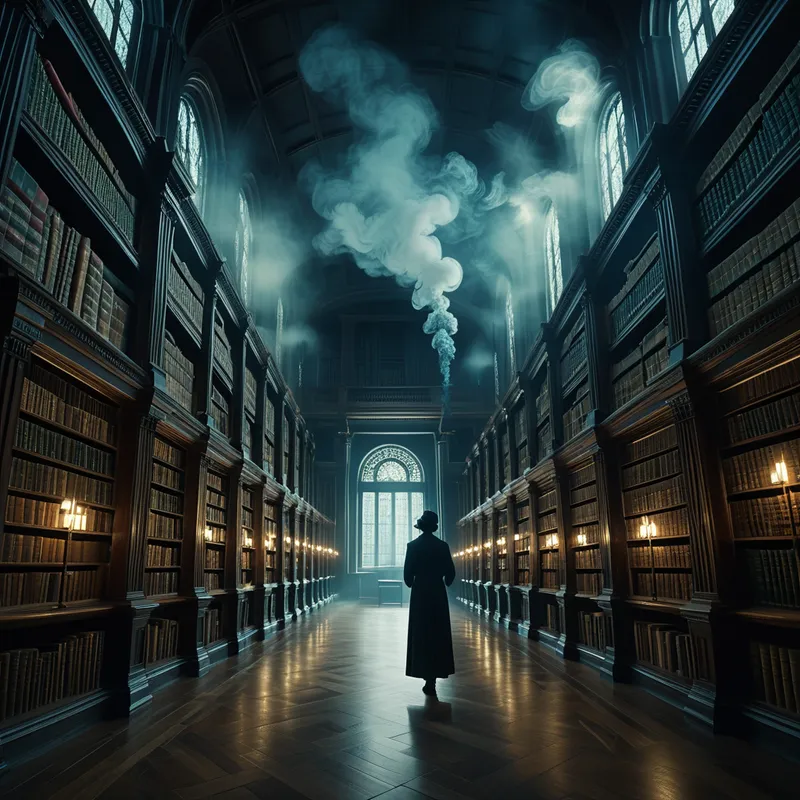
To dream of the Library of Alexandria is to dream of one’s own vast, internal archive in a state of crisis or potential. Common motifs include: wandering endless, labyrinthine stacks; finding a crucial book that turns to dust upon touch; or frantically trying to save specific scrolls from an approaching flame.
Somatically, this can feel like a tightening in the chest (the weight of lost potential), a racing heart (the anxiety of impending loss), or a profound, quiet awe (in the presence of inner vastness). Psychologically, the dreamer is confronting the reality of their own psychic fragmentation. They are facing the parts of their history—personal and ancestral—that have been “burned,” through trauma, neglect, or cultural dislocation. The dream is an expression of the psyche’s grief for its own wholeness and its relentless drive to reassemble the scattered self. It is the pain of knowing you contain a universe, but cannot read its maps.
Alchemical Translation
The alchemical process modeled here is not the creation of gold, but the re-creation of the vas after a shattering. The myth charts the path from unio mentalis (the intellectual gathering of knowledge) through mortificatio (the destruction by fire) to a higher, more resilient integration.
The initial collection—the “Ptolemaic” phase—is the conscious work of analysis, therapy, and study, gathering the contents of the unconscious. The fiery destruction is the necessary nigredo, the dark night of the soul, where these intellectual understandings are tested by raw, unmediated experience and emotion. They do not survive intact. They are purified, reduced to essential ash.
The triumph is not in preventing the fire, but in becoming the scribe who survives it, gathering the ashes that are now impregnated with the essence of all that was lost.
The individuation task, then, is to become the eternal scholar-scribe in the ruins. It is to accept that the total Library can never be physically rebuilt, but its essence—the prisca sapientia or ancient wisdom—can be distilled from the fragments. We integrate not by possessing perfect knowledge, but by embodying the quest for it. We become the living scroll, inscribed with the lessons of loss and the humble, persistent act of remembering. Our wholeness lies not in a flawless archive, but in the sacred, ongoing labor of reconstruction, knowing some chambers will forever remain dark, their contents hinted at only by the echo in the corridor.
Associated Symbols
Explore related symbols from the CaleaDream lexicon: