
The Lever Principle in Taoist Alchemy Myth Meaning & Symbolism
An ancient alchemist discovers the fulcrum of existence, learning that the smallest inner adjustment can transmute the heaviest psychic lead into spiritual gold.
The Tale of The Lever Principle in Taoist Alchemy
In the mist-wrapped peaks of the Kunlun Mountains, where clouds drink from stone and silence has its own voice, there lived an alchemist named Yun Ju. For sixty years, he had sought the Elixir of Life, his fingers stained with cinnabar, his eyes weary from scanning ancient bamboo slips. His cave was a forest of crucibles and alembics, yet the great transmutation—turning base lead into radiant gold, coarse mortality into refined immortality—eluded him. The weight of his failure was a stone in his belly, heavier with each passing season.
One evening, as the last copper light of day bled into the violet of twilight, Yun Ju sat in utter despair. The fire in his furnace had died to embers, mirroring the light within him. He gazed not at his elaborate tools, but at a simple, forgotten well in the corner of his cave, its bucket raised by a crude wooden lever. He watched a single dewdrop fall from the mossy stone lip onto the lever’s arm. Nothing happened. Yet the action, so small and complete, echoed in his hollowed spirit.
That night, he dreamed not of elixirs, but of balance. He saw the great Tai Chi turning, not by force, but by the precise pivot of its central axis. He saw the mountains themselves resting on a point no larger than a mustard seed. He awoke not with a start, but with a profound, unsettling stillness. The cacophony of his striving had ceased. In that silence, he heard a new instruction, not from a scroll, but from the arrangement of his own bones as he sat.
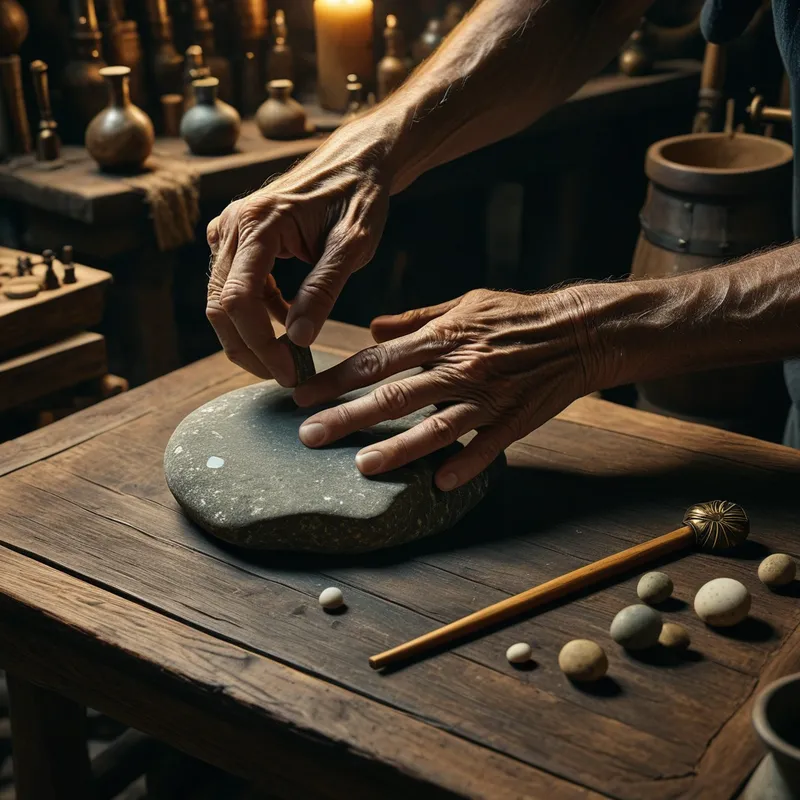
He dismantled his largest furnace. From its stones, he took a single, immense block of unworked lead—the very symbol of his dense, unresolved life. With calm certainty, he began to carve not an instrument, but a principle. He fashioned a lever of aged oak, its surface worn smooth by his contemplation. He shaped a fulcrum from a piece of jade, cool and unyielding. He did not seek to heat the lead, to beat it, or to dissolve it in potent acids. Instead, with immense care, he placed the great block upon one end of the lever.
Then, Yun Ju sat at the other end. He did not push. He did not strain. He simply adjusted his seat, minutely, feeling for the point of perfect equilibrium. He breathed with the rhythm of the earth below. Time lost its meaning. It was no longer about adding force, but about finding the exact place where force becomes unnecessary. And then, he saw it—the alignment. It was not in the wood or the stone, but in the relationship between them, a relationship that passed through the unshakable point of the jade.
He reached into his robe and took not a rare mineral, but the smooth river stone he kept for comfort. With a breath as soft as a butterfly’s landing, he placed it onto his end of the lever.
The great block of lead trembled. Then, with a sigh that seemed to come from the mountain’s heart, it rose. It did not shatter or melt. It was moved. And as it was lifted from the earth, a strange light—not of fire, but of clarified moonlight—seemed to weep from its pores. The dense, dull metal began to gleam with an inner luminescence, not becoming gold, but becoming something truer to its own essence, weightless in its perfect balance. Yun Ju wept. The lever had not moved the world; it had revealed the pivot upon which the world already turns.
Cultural Origins & Context
The principle of the lever, or gang gan, is not a single, codified myth from a classic text like the Dao De Jing or the I Ching. Instead, it is a pervasive allegorical teaching that permeates the oral and practical traditions of Neidan (Internal Alchemy). It is the kind of story a master would impart not at the beginning of training, but at its crisis point, when the disciple’s efforts have become their own obstacle.
This teaching finds its roots in the ancient Chinese observation of natural mechanics and their application to statecraft, warfare, and finally, the inner landscape. Philosophers like Zhuangzi spoke of using the “weight of the infinite” without being burdened by it. The myth crystallized within Taoist monastic communities, particularly those of the Quanzhen tradition, where the laboratory of the body replaced the external furnace. Its function was societal in an introverted sense: it provided a model for resolving internal conflict and achieving Wu Wei, thereby creating individuals of profound stability and insight who could benefit the community through their harmonious presence, not forceful intervention.
Symbolic Architecture
The myth’s power lies in its stark, elegant symbolism of psychic transformation. The Lead is the unrefined self—the burdens of habit, trauma, fixed identity, and the heavy Zhi Ren. It is psychological inertia. The Furnace of striving represents the ego’s desperate, forceful attempts at change, which often only reinforce the patterns they seek to break.
The lever does not oppose weight; it re-contextualizes it through the principle of relationship.
The Lever is the mind of Guan—the observing consciousness that can create a space between stimulus and reaction. The Fulcrum of jade is the unwavering point of stillness within, the Hun Dun, or the center of the Dantian. It is not an object to be found, but a truth to be realized: the immutable center of one’s being. Yun Ju’s River Stone is the subtle, almost negligible shift in attention, intention, or understanding—the release of a single identification. This is the alchemical agent. The resulting Light is not an external reward, but the inherent luminosity (Shen Ming) of the psyche when it is freed from the compression of misaligned effort.
The Dreamer’s Resonance
When this myth stirs in the modern unconscious, it often manifests in dreams of impossible physics or elegant solutions. One might dream of moving a colossal boulder with a feather, or of a complex, locked mechanism opening with the gentle turn of a tiny, previously overlooked key. Somaticly, the dreamer may experience a sensation of profound relief in the body—a sudden release of chronic tension in the shoulders or jaw, symbolizing the放下 (fang xia), the “letting down” of a burden they did not know they were still carrying.
Psychologically, these dreams surface during periods of “striving fatigue,” when conscious efforts to solve a life problem—be it relational, professional, or creative—have hit a wall. The dream presents the Lever Principle as an invitation from the deeper self to cease pushing against the symptom and to instead seek the fulcrum—the core belief, the unprocessed emotion, the hidden assumption—that gives the problem its oppressive weight. It is the psyche’s way of modeling a paradigm shift from doing to being in right relationship.

Alchemical Translation
The individuation process modeled here is one of sublime economy. The modern seeker, like Yun Ju, often begins by amassing tools—therapies, philosophies, practices—to attack their “lead.” The Lever Principle translates this struggle into a process of inner triangulation.
First, one must Identify the True Weight. This is not the surface complaint, but the core complex: the fundamental fear of abandonment, the ingrained sense of unworthiness, the tyrannical inner critic. Second, one must Establish the Fulcrum. This is the disciplined cultivation of a witness consciousness through meditation, mindfulness, or active imagination—a stable inner ground that does not get entangled in the drama. Third, and most crucially, comes The Subtle Adjustment. This is the alchemical work: the conscious reframing of a memory, the compassionate acceptance of a shadow aspect, the decision to forgive, or simply the choice to stop believing a painful story about oneself.
The great work is not in moving the mountain, but in discovering you are the space in which the mountain rests.
This tiny, internal shift, applied at the precise point of leverage (the insight into the weight’s true nature), generates a transformative force far exceeding any conscious effort. The complex is not destroyed; its energy is redeemed. The heaviness of depression can become the groundedness of presence. The heat of anger can become the catalytic energy for right action. The lead of the old self is not discarded but transmuted, lifted into the light of awareness where it reveals its essential, and heretofore hidden, value. One becomes, in the Taoist sense, a Zhen Ren—a person of authenticity, whose power lies not in exertion, but in perfect, poised alignment with the pivot of the Dao.
Associated Symbols
Explore related symbols from the CaleaDream lexicon: