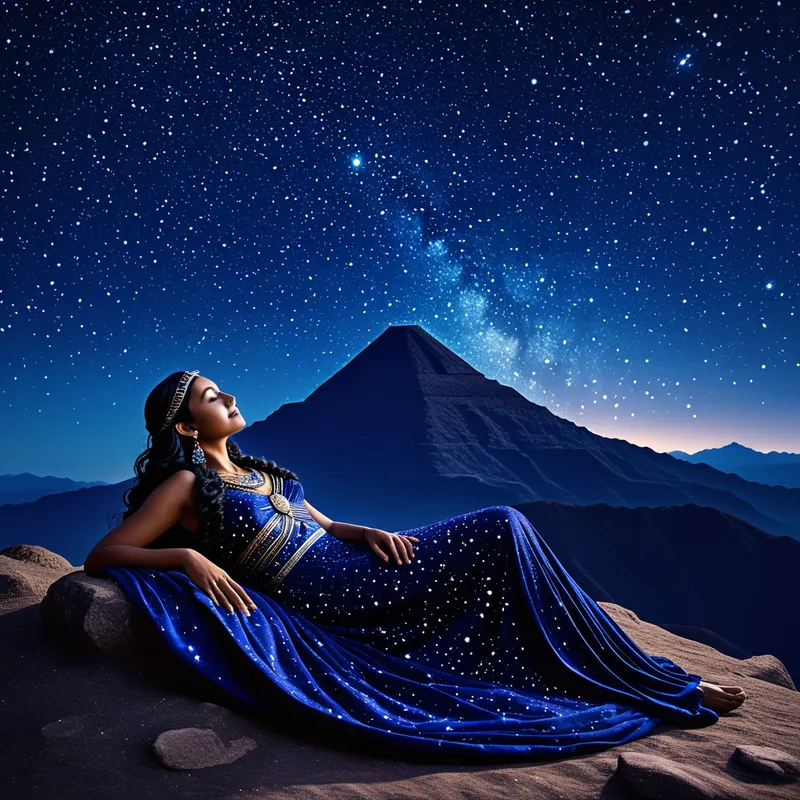
The Legend of the Sleeping Woman Myth Meaning & Symbolism
A volcanic goddess sleeps in eternal grief for her slain warrior lover, her sorrow shaping the land, embodying the sacred wound that births creation.
The Tale of The Legend of the Sleeping Woman
Listen. Before the Fifth Sun found its strength, when the world was painted in the hues of twilight and memory, there was a love that shook the foundations of the earth. It was not a gentle love, but a love as fierce as Huitzilopochtli's spear and as deep as the caverns of Coatlicue.
In the high valleys, where the air was thin and the eagles circled, there lived a princess of unparalleled beauty and spirit, Iztaccíhuatl. Her skin was the pale light of the moon on fresh snow, and her eyes held the stillness of mountain lakes. Her heart belonged to Popocatépetl, the mightiest warrior of her father’s kingdom, whose strength was rivaled only by his devotion. Their love was a secret flame, nurtured in stolen glances and whispered promises beneath the watchful gaze of the Tianquiztli.
But war, the ever-hungry jaguar, came calling. Popocatépetl was summoned to lead his people against a formidable enemy in distant, bloody lands. Before he departed, he knelt before the princess and her father, the king. “Grant me your daughter’s hand,” he vowed, his voice like grinding stone, “and I shall return covered in glory, or not at all.” The king, desperate for victory, agreed. Iztaccíhuatl’s heart soared with hope, a fragile bird in a gathering storm.
The battles were long. Seasons turned. A rival, consumed by jealous desire for the princess, brought false tidings to the court. He proclaimed that the noble Popocatépetl had fallen in combat. When Iztaccíhuatl heard this lie, her world shattered. The light in her moon-pale eyes extinguished. Grief, a cold and heavy cloak, settled upon her. She did not weep; she turned to stone from the inside out. She laid herself upon her bed, and her breath grew shallow, and then it ceased. She did not die as mortals die—she entered a sleep of pure sorrow, a stillness so profound it echoed in the bones of the valley.
Yet, the warrior lived. He returned, laden with the honors of war, his heart already beating with the rhythm of her name. He entered the silent city, and the truth struck him with the force of a tecpatl to the chest. He found his love, asleep in death’s embrace. The cry that tore from him had no human sound; it was the cracking of continents.
He would not let the earth claim her. With infinite tenderness, he carried her lifeless form far from the city, into the embrace of the great mountains. He laid her upon a bed of fragrant oyametl and wildflowers. Then, taking a smoking torch, he knelt at her side, a eternal sentinel. The gods, witnessing this devotion that defied even Mictlantecuhtli, were moved. They transformed the princess into a great mountain, her silhouette forever that of a sleeping woman, draped in a perpetual blanket of snow. And Popocatépetl, they turned into a mighty volcano beside her, his torch becoming the eternal fire within his peak, his vigil an endless plume of smoke guarding his beloved. There they rest, Iztaccíhuatl and Popocatépetl, holding the valley between them, a monument to a love that shaped the very land.

Cultural Origins & Context
This legend is deeply rooted in the Nahua worldviews of Central Mexico, most famously associated with the twin volcanoes visible from the Basin of Mexico, Iztaccíhuatl and Popocatépetl. While often termed an “Aztec” myth, its origins likely predate the Mexica empire, woven from the fabric of earlier cultures like the Toltecs. It was an etiological myth, explaining the majestic and terrifying geography that surrounded the altepetl of Tenochtitlan.
The story was not merely entertainment; it was a pedagogical and cosmological tool. Told by huehuetque and cuicapicque, it reinforced core societal values: the warrior’s duty and honor (yolcuitl), the profound consequences of deceit, and the sacred nature of a pledge (tlahtolli). More subtly, it modeled a cosmology where human emotion—especially love and grief—was so potent it could interact with and alter the divine landscape. The sleeping woman was not just a princess; she was a geographic fact, a constant reminder that the earth itself is born from and remembers profound feeling.
Symbolic Architecture
At its heart, this is a myth of the sacred wound that becomes the world. Iztaccíhuatl’s sleep is not a passive death, but an active state of suspended animation caused by a psychic trauma—the believed loss of the beloved. It represents the moment when a soul-rending grief is too vast to process consciously, and so the psyche retreats into a protective, dormant state.
The mountain is not a tomb, but a chrysalis. The sleep is not an end, but a gestation of unimaginable scale.
Popocatépetl’s transformation is equally significant. He is the active principle of devotion that refuses to let the beloved be forgotten to the underworld of oblivion. His eternal fire is the vigil of consciousness itself, the part of the psyche that holds the memory of the connection, the love, and the pain, ensuring it is not dissolved. Together, they symbolize a psychic dyad: the unconscious, frozen aspect of a trauma (the Sleeping Woman) and the conscious, enduring witness to that trauma (the Smoking Mountain). The valley between them is the lived reality shaped by this dynamic tension.
The false messenger is the archetypal Trickster shadow, representing not just an individual liar, but the corrosive power of misinformation, jealousy, and the fragile nature of communication upon which fate hinges.

The Dreamer's Resonance
When this myth pattern arises in modern dreams, it often signals a profound encounter with what depth psychology calls a complex—an emotionally charged cluster of ideas in the unconscious that has “fallen asleep.” The dreamer may encounter a sleeping figure of great beauty or importance, a frozen landscape, or feel themselves becoming immobile, heavy, turning to stone.
Somatically, this can feel like a leaden depression, a creative paralysis, or a relationship dynamic that has gone cold and static. Psychologically, it is the process of a core emotional injury—a betrayal, a profound loss, a heartbreak—that was so overwhelming the ego-consciousness could not integrate it. The psyche, in its wisdom, “put it to sleep” to ensure survival. To dream of this myth is to sense that this sleeping content is now seeking to be awoken, not necessarily to resume its old life, but to be transformed into a new, enduring part of the inner landscape. The dream asks: What beloved aspect of your own soul have you believed dead? What grief have you turned to stone?

Alchemical Translation
The individuation process modeled here is not one of heroic conquest, but of sacred witnessing and geological transformation. The “work” is not to storm the mountain and wake the sleeper with a kiss—that would be a fantasy of bypassing the depth of the wound. The alchemy is in becoming Popocatépetl.
First, one must carry the sleeping form: consciously acknowledge and hold the frozen, traumatized part of the self with respect, moving it from the forgotten crypt of repression to a place of honor in the inner wilderness.
Second, one must keep the vigil: maintain a constant, compassionate awareness (the smoking torch) beside this sleeping pain. This is the discipline of feeling the grief without being drowned by it, of remembering the love without clinging to its lost form.
The fire of the vigil does not melt the snow; it transmutes the entire system from a story of tragedy into a testament of enduring presence.
Finally, one allows the divine transmutation: trusting that from this sustained, conscious relationship between the waking self and the sleeping soul, a new psychic structure will form. The personal grief becomes impersonal landscape. The private agony becomes a source of strength, stability, and even beauty—a mountain in the soul’s terrain. The lover archetype is fulfilled not in union, but in the eternal, creative tension of remembrance, which itself becomes the foundation for a new world.
Associated Symbols
Explore related symbols from the CaleaDream lexicon:
- Mountain — The solidified, eternal form of profound emotion and the enduring structure of the psyche born from a sacred wound.
- Sleep — The protective, dormant state of a trauma or a soul-quality too overwhelming for conscious integration, requiring time and witness.
- Grief — The transformative sorrow that, when fully honored and held, has the power to reshape the internal and external landscape.
- Fire — The eternal vigil of consciousness, the active remembrance and devotion that prevents a sacred memory from being lost to oblivion.
- Love — The primordial force that motivates both the descent into sleep (from perceived loss) and the eternal vigil of transformation.
- Warrior — The aspect of the psyche that commits to a duty of protection and witness, transforming brute strength into enduring, conscious devotion.
- Death — Not as an end, but as the necessary transition into a different state of being, a sleep that precedes a geological rebirth.
- Earth — The receptive, transformative element that accepts the sleeping form and alchemizes personal tragedy into enduring, sacred geography.
- Heart — The central organ of feeling that is metaphorically turned to stone by grief, requiring the slow, patient fire of remembrance to be transmuted.
- Stone — The frozen, permanent record of a moment of supreme emotional impact, representing both the burden and the monument of deep feeling.