The Legend of the Pohutukawa Myth Meaning & Symbolism
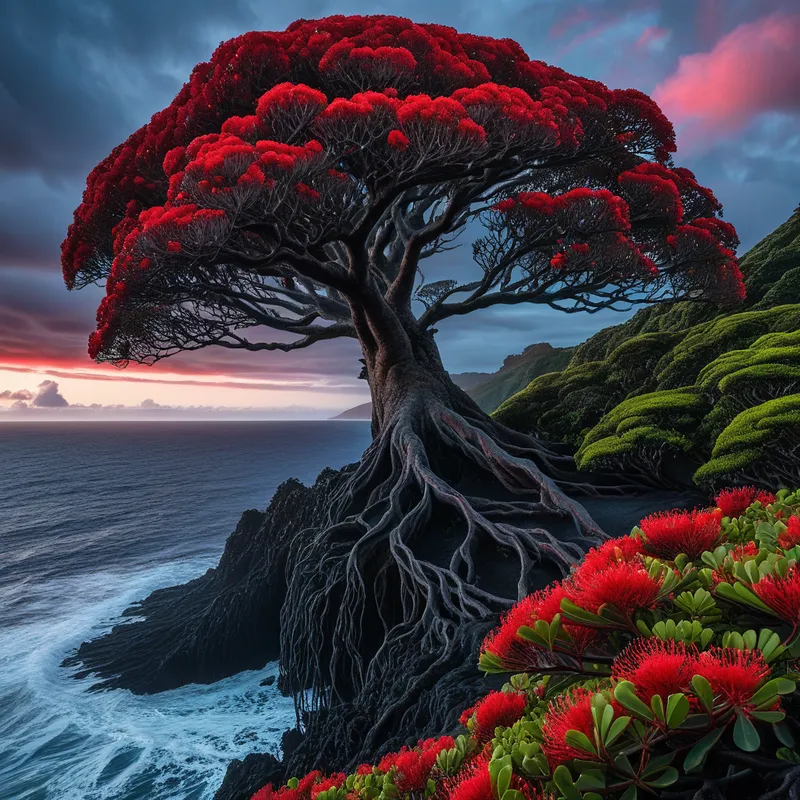
A young warrior's love defies death, his spirit transforming into the crimson-flowered Pohutukawa, guardian of the shoreline between worlds.
The Tale of The Legend of the Pohutukawa
Listen. The wind that sighs through the crimson canopy carries a memory older than the cliffs it clings to. It is the memory of a love that would not die.
In the time when the world was raw and the veil between Te Ao Mārama and Rarohenga was thin as sea mist, there lived a young warrior named Tawhaki. He was not just strong of arm, but profound of heart. His love was a woman whose laughter was the sound of freshwater streams, and whose spirit shone with the gentle light of the summer moon. But the wairua of sickness, jealous of such pure joy, stole her breath and carried her spirit down the hidden paths to Rarohenga, the realm of the dead.
A desolation colder than the southern ocean settled upon Tawhaki. The world lost its color, its taste. The songs of the birds were empty noise. Driven by a love that was now a burning ache in his chest, he made a decision that shook his whānau to its core. He would not let the final separation stand. He would descend to Rarohenga and bring her back.
Guided by the whispers of his ancestors and the desperate navigation of his own heart, Tawhaki found one of the few places where the worlds touched—a sheer, black cliff face that plunged into the roaring sea. It was said that at this place, the roots of reality grew thin. With no canoe, no rope, only the image of his beloved’s face as his compass, he leaped. He did not fall into water, but into the chilling twilight of the spirit realm.
Rarohenga was a land of echoes and shadows. The light was grey, the air still and heavy with memory. He wandered through forests of silent trees and across plains where forgotten names blew like dust. The spirits watched him, curious and somber. After a journey that felt like lifetimes, he found her. Her form was faint, like sunlight seen through deep water, but her eyes held the same light. Their reunion was a torrent of sorrow and joy, a moment that briefly warmed the grey land.
But the laws of tika are immutable. A living heart cannot remain in the land of the dead, nor can a spirit truly return to the world of flesh. The guardians of the threshold, ancient and implacable, barred their way back. Tawhaki pleaded, argued, offered his own life in exchange. The answer was a silent, firm negation.
Seeing the ultimate despair in his lover’s eyes as they faced eternal separation, Tawhaki made his final choice. If he could not guide her back to life, he would not leave her to eternity in twilight. And he would not return to a world empty of her. He took her hand and turned not towards the world of the living, but deeper into the essence of the boundary itself.
There, at the very edge where the sea of life crashes against the cliffs of death, he planted his feet. He wrapped his arms around his beloved, and he called upon every ounce of his love, his grief, his unwavering spirit. He did not fight the law; he became it. His body stilled, his skin hardened into bark, his arms stretched out as mighty branches. His spirit, mingled with hers, burst forth not as flesh, but as a profusion of vibrant, crimson flowers—each one a droplet of his life’s blood, each one a testament to his love. He became the first Pohutukawa, the sentinel tree. His roots grip the cliffs, holding fast the boundary. His flowers blaze red every summer, a beacon of a love so potent it transformed the landscape of life and death itself.

Cultural Origins & Context
This poignant narrative is woven into the oral traditions of the Māori, the indigenous people of Aotearoa (New Zealand). It belongs to the body of pūrākau, which are far more than mere stories; they are vessels of history, ethics, cosmology, and identity. The legend of the Pohutukawa would have been told by tohunga and elders, not as simple entertainment, but as a profound teaching during times of mourning, or to explain the sacred nature of the coastline and its distinctive guardian tree.
Its societal function is multifaceted. It provides a mythological etiology for the striking Pohutukawa tree, explaining why it grows on precarious coastal cliffs and blooms with such a vivid red hue. More deeply, it offers a cultural framework for understanding loss, love, and the transition to the afterlife. It reinforces the concept of mana and tapu associated with the threshold between worlds. The tree becomes a living taonga, a sacred treasure that embodies the ultimate sacrifice and serves as a constant, natural memorial. It teaches that true strength is found not only in battle, but in the courage to face the ultimate transition with love as one’s guiding star.
Symbolic Architecture
At its [heart](/symbols/heart “Symbol: The heart symbolizes love, emotion, and the core of one’s existence, representing deep connections with others and self.”/), this myth is an alchemical map of the psyche facing its most profound [rupture](/symbols/rupture “Symbol: A sudden break or tear in continuity, often representing abrupt change, separation, or the shattering of established patterns.”/): the [loss](/symbols/loss “Symbol: Loss often symbolizes change, grief, and transformation in dreams, representing the emotional or psychological detachment from something or someone significant.”/) of the beloved Other, which is also a loss of a part of the Self. Tawhaki represents the conscious ego that is shattered by [grief](/symbols/grief “Symbol: A profound emotional response to loss, often manifesting as deep sorrow, yearning, and a sense of emptiness.”/). His [journey](/symbols/journey “Symbol: A journey in dreams typically signifies adventure, growth, or a significant life transition.”/) to Rarohenga is the necessary descent into the unconscious—the land of shadows, memories, and lost connections—that profound [grief](/symbols/grief “Symbol: A profound emotional response to loss, often manifesting as deep sorrow, yearning, and a sense of emptiness.”/) demands.
The greatest love does not seek to possess, but to transform the very ground of separation into a new plane of connection.
The beloved is the [anima](/symbols/anima “Symbol: The feminine archetype within the male unconscious, representing soul, creativity, and connection to the inner world.”/), the inner feminine principle of relatedness, [emotion](/symbols/emotion “Symbol: Emotion symbolizes our inner feelings and responses to experiences, often guiding our actions and choices.”/), and [soul](/symbols/soul “Symbol: The soul represents the essence of a person, encompassing their spirit, identity, and connection to the universe.”/)-[connection](/symbols/connection “Symbol: Connection symbolizes relationships, communication, and bonds among individuals.”/). Her [death](/symbols/death “Symbol: Symbolizes transformation, endings, and new beginnings; often associated with fear of the unknown.”/) signifies a catastrophic withdrawal of this [life](/symbols/life “Symbol: The symbol of ‘Life’ represents a journey of growth, interconnectedness, and existential meaning, encompassing both the joys and challenges that define human experience.”/)-giving [energy](/symbols/energy “Symbol: Energy symbolizes vitality, motivation, and the drive that fuels actions and ambitions.”/) from the conscious world, plunging the psyche into [sterility](/symbols/sterility “Symbol: Represents inability to create, grow, or produce, often linked to emotional barrenness, creative blocks, or existential emptiness.”/) and [despair](/symbols/despair “Symbol: A profound emotional state of hopelessness and loss, often signaling a need for transformation or surrender to deeper truths.”/). The guardians of the threshold are the immutable laws of psychic [reality](/symbols/reality “Symbol: Reality signifies the state of existence and perception, often reflecting one’s understanding of truth and life experiences.”/): what has been integrated into the unconscious (repressed, lost, or transformed) cannot simply be retrieved in its original form.
The myth’s genius is in its [resolution](/symbols/resolution “Symbol: In arts and music, resolution refers to the movement from dissonance to consonance, creating a sense of completion, release, or finality in a composition.”/). Tawhaki’s transformation into the Pohutukawa is the archetypal [symbol](/symbols/symbol “Symbol: A symbol can represent an idea, concept, or belief, serving as a powerful tool for communication and understanding.”/) of psychic [fixation](/symbols/fixation “Symbol: An obsessive focus on a single idea, object, or person, often representing a spiritual blockage or an unresolved archetypal pattern.”/) at the point of [trauma](/symbols/trauma “Symbol: A deeply distressing or disturbing experience that overwhelms the psyche, often manifesting in dreams as unresolved emotional wounds or psychological injury.”/), which becomes a [source](/symbols/source “Symbol: The origin point of something, often representing beginnings, nourishment, or the fundamental cause behind phenomena.”/) of eternal meaning. He does not “get over” his loss; he metabolizes it. He becomes the [boundary](/symbols/boundary “Symbol: A conceptual or physical limit defining separation, protection, or identity between entities, spaces, or states of being.”/) itself. The [tree](/symbols/tree “Symbol: In dreams, the tree often symbolizes growth, stability, and the interconnectedness of life.”/) is a [symbol](/symbols/symbol “Symbol: A symbol can represent an idea, concept, or belief, serving as a powerful tool for communication and understanding.”/) of the transcendent function—a living, growing [symbol](/symbols/symbol “Symbol: A symbol can represent an idea, concept, or belief, serving as a powerful tool for communication and understanding.”/) that bridges the conscious and unconscious, life and death, [memory](/symbols/memory “Symbol: Memory symbolizes the past, lessons learned, and the narratives we construct about our identities.”/) and [presence](/symbols/presence “Symbol: Presence in dreams often signifies awareness or acknowledgment of something significant in one’s life.”/). The crimson flowers are the affect, the life-[blood](/symbols/blood “Symbol: Blood often symbolizes life force, vitality, and deep emotional connections, but it can also evoke themes of sacrifice, trauma, and mortality.”/) of feeling, now eternally expressed in a beautiful, generative form.
The Dreamer’s Resonance
When this myth stirs in the modern dreamer, it signals a profound somatic and psychological process of grieving a foundational attachment. To dream of clinging to a cliffside tree over an abyss, of searching a grey, silent landscape for a faded loved one, or of one’s own body turning to wood or flowering unexpectedly—these are manifestations of the Pohutukawa process.
The psyche is undertaking the heroic, quiet work of the lover archetype: not to conquer the loss, but to marry it. The somatic sensation is often one of deep, heavy anchoring—a feeling of being rooted in pain, yet simultaneously of something beautiful and vital struggling to bloom from that very anchor point. It is the process of moving grief from a passive state of suffering to an active state of witnessing and creation. The dreamer is not moving on, but growing around the absence, transforming the internal cliff-edge of their loss into a place of breathtaking, if sorrowful, beauty. The process asks: Can you love what is lost so deeply that you become a sanctuary for that love, rather than its ghost?
Alchemical Translation
The individuation journey modeled here is the transmutation of attachment into sacred witness. The initial state is nigredo: the black despair of loss, the world devoid of meaning. The descent to Rarohenga is the mortificatio, a necessary dissolution and confrontation with the shadowy contents of the personal and collective unconscious.
The spirit does not cross the threshold; it becomes the gate. In that becoming, the dichotomy of here and there, then and now, is dissolved in the eternal present of the symbol.
The critical alchemical stage is the coniunctio, not as a happy reunion, but as the sacred marriage of the conscious ego (Tawhaki) with its lost soul-image (the beloved) within the realm of the impossible—the boundary itself. This union does not produce a child, but a new function: the transcendent Pohutukawa.
For the modern individual, this translates to the arduous work of finding a “third thing.” When faced with an irreconcilable loss—of a person, a relationship, a dream, an identity—the path forward is not to choose between holding on (and dying inwardly) or letting go (and feeling annihilated). The alchemical translation is to find or create the symbolic equivalent of the Pohutukawa: a creative act, a committed practice, a way of life, or an internal stance that does not replace the loss, but grows from its very soil and forever bears its color. It is to root one’s identity not in having, but in being a bridge. One becomes, in a sense, a living legend—not famous, but meaning-full—whose very existence speaks of the love that shaped it, forever in bloom on the cliff-edge between what was and what is.
Associated Symbols
Explore related symbols from the CaleaDream lexicon:
- Tree — The central symbol of the myth, representing the living bridge between worlds, the fixation of spirit in form, and eternal, rooted witnessing.
- Sacrifice — Tawhaki’s ultimate offering of his human form and future, not in defeat, but as a conscious act of love to create a new, eternal reality.
- Love — The driving force of the narrative, depicted not as a fleeting emotion but as a cosmic power capable of altering the landscape of life and death.
- Death — Not an end, but a transition to another state of being (Rarohenga), and the necessary catalyst for the myth’s ultimate transformation.
- Spirit — The wairua that survives physical death and becomes the essential ingredient in the tree’s creation, mingling human love with natural form.
- Cliff — The literal and psychological precipice, the razor’s edge between known and unknown, conscious and unconscious, where transformation is forced.
- Flower — The beautiful, ephemeral yet recurring manifestation of inner life and emotion (blood, love) made visible and generative upon the stable structure of the tree.
- Journey — The heroic descent into the underworld (katabasis), a classic mythological motif representing the ego’s necessary confrontation with the depths of the unconscious.
- Ocean — The turbulent, unconscious realm bordering the cliff, symbolizing the unknown, emotion, and the source of life and transition.
- Heart — The symbolic seat of Tawhaki’s courage and love, which is literally transmuted into the tree’s vital sap and the red hue of its flowers.
- Rebirth — The core promise of the myth; not a return to old life, but the birth of an entirely new form of existence born from the ashes of loss.
- Threshold — The metaphysical boundary between Te Ao Mārama and Rarohenga, which the Pohutukawa eternally embodies and guards.