The Leap of Faith from Norse m Myth Meaning & Symbolism
A mythic tale of a hero who must abandon all knowledge and control, leaping into the abyss to be remade by a truth beyond understanding.
The Tale of The Leap of Faith from Norse m
Hear now a tale not carved on stone, but whispered on the wind that cuts between the worlds. It is a story of the space between heartbeats, of the silence that follows a final, shattered oath.
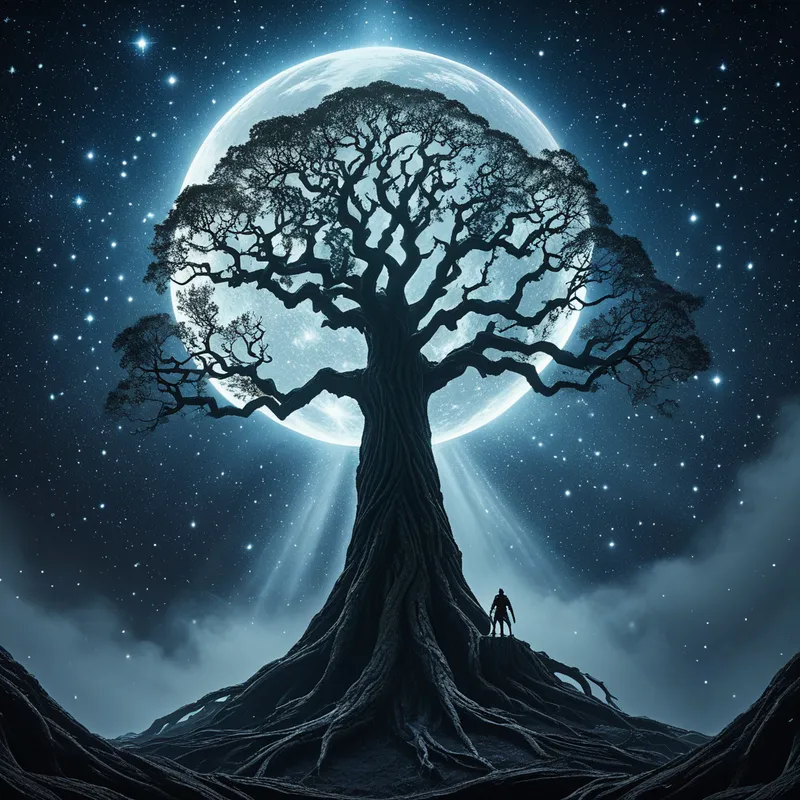
In the age when the Yggdrasil’s roots drank from wells of memory and mist, there stood a figure known only as the Seeker. He was no god, but a mortal of immense renown, a warrior-poet who had drunk from Mímisbrunnr and wrestled secrets from the Norns themselves. His mind was a fortress, his will a tempered blade. He knew the names of all things, the patterns of stars and the songs of rivers. Yet, a hollow wind howled in the chamber of his spirit. For all his knowing, he did not understand.
His journey brought him to the Gaping Maw, a fissure in reality at the deepest root of the World Tree. It was not a place of fire or ice, but of absolute, singing void. From it breathed not air, but the scent of ozone before a storm and the cold of unformed potential. Here, the voice of the universe—or perhaps the tree itself—spoke without sound. To gain the truth that heals, you must lose the truth you clutch. The bridge is gone. The path is behind you. There is only the fall.
The Seeker looked upon his hands, scarred from gripping sword and scroll. He looked at his mind, a labyrinth of perfect, useless maps. The conflict was not against a monster, but against the very architecture of his being. To leap was insanity. To stay was a living death. The rising action was the slow, agonizing unbinding: the unclenching of fists, the silencing of internal arguments, the letting go of every name he had for himself—warrior, sage, man.
With a cry that was neither of fear nor triumph, but of utter release, he stepped backwards into the nothing. He did not dive with purpose; he surrendered to the pull. The fall was not through space, but through the layers of his own accumulated self. He felt the scream of his ego, the shattering of his prized knowledge like glass. Sensation dissolved. Time bent. He was not falling, but being unmade.
And in that unmaking, in the core of the void where all his certainties had burned away, he was caught. Not by arms, but by a presence—vast, silent, and whole. It was not a rescue, but a recognition. The abyss was not empty; it was the womb of the real. He did not find an answer. He became the space where the question and the answer were the same. The resolution was not a return, but a re-emergence. He stepped from the mist at another root of the tree, whole, silent, with eyes that held the quiet darkness of the cosmos itself. He carried no trophy, only the indelible mark of the fall upon his soul.
Cultural Origins & Context
The “Leap of Faith from Norse m” is a fascinating meta-myth, a story that seems to echo from the edges of recorded Norse tradition rather than sit at its documented center. It belongs to what scholars of comparative mythology term the “Global/Universal” culture—not as a specific, attested Eddic poem, but as a profound archetypal pattern that uses the potent symbols, textures, and existential bleakness of the Norse cosmological landscape as its stage. It is the kind of tale a skald might have told in the deep winter, not of gods and giants clashing, but of the human spirit facing the ultimate interior frontier.
Its societal function was likely initiatory and philosophical. In a culture that revered wisdom won through ordeal (like Odin’s sacrifice on Yggdrasil), this story represents the logical, terrifying extreme: the wisdom that can only be gained when all tools, even the tool of the seeking mind, are abandoned. It was passed down not to glorify a hero’s deeds, but to map the territory of a psychic crisis every deep thinker or spiritual seeker might eventually face. It served as a narrative container for the experience of radical doubt, the “dark night of the soul,” using the familiar mythic lexicon of the abyss, the World Tree, and the journey to the roots to give form to a fundamentally internal, ineffable process.
Symbolic Architecture
The myth’s power lies in its stark symbolic architecture. The Yggdrasil represents the ordered cosmos, the known world of consciousness and law. The Gaping Maw at its root is the interface with the unconscious, the psychic underworld, where logic and identity dissolve. The Seeker is the conscious ego, the “I” that is constructed from knowledge, achievement, and control.
The Leap is not an act of bravery, but the final, necessary failure of the will. It is the ego’s consent to its own death.
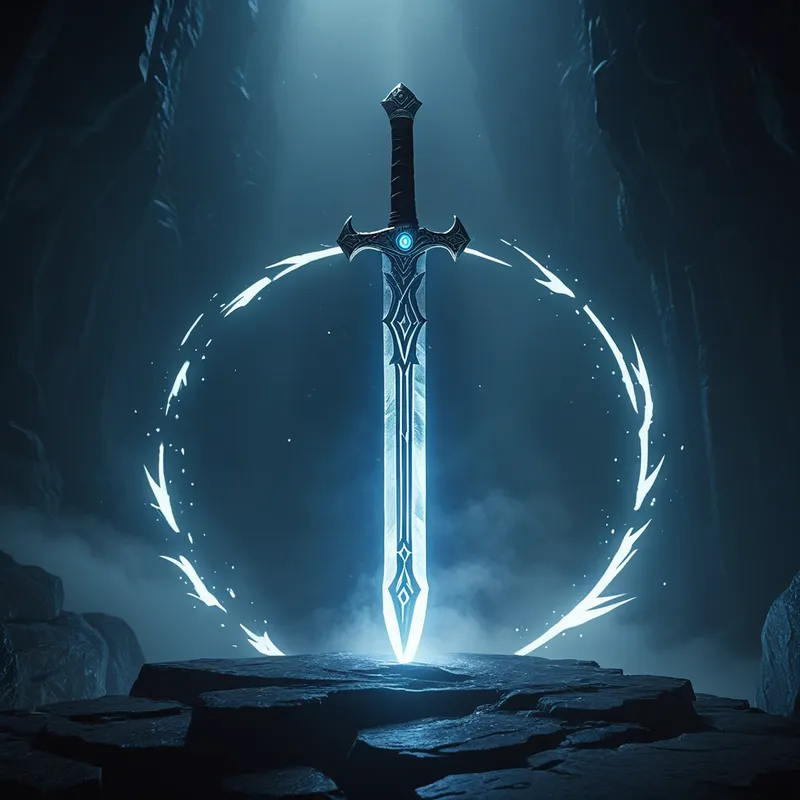
The sword or scroll he releases symbolizes the tools of discrimination and knowledge—the very apparatus we use to navigate and defend the self. Their loss is not an accident but a prerequisite. The fall itself is the descent into the unconscious, a nekyia. Crucially, he falls backwards—a surrender of forward-looking purpose, a relinquishment of the heroic quest narrative itself. Being “caught” by the presence in the void symbolizes the emergence of the Self, the central, organizing principle of the total psyche, which can only be encountered when the ego’s dominance ends. The re-emergence is not as the same man, but as one integrated with a reality beyond his former comprehension.
The Dreamer’s Resonance
When this myth stirs in the modern dreamer, it announces a profound psychological turning point. To dream of standing at a great height or edge, feeling a terrifying yet compelling urge to fall or jump, is to feel the call of this archetype. The somatic experience is often one of vertigo—a literal shaking of the foundational “ground” of one’s personality.
This dream pattern manifests when the individual’s adapted self—their career identity, their long-held beliefs, their strategies for safety and esteem—has become a prison. The conscious mind may be in crisis, feeling trapped and desperate. The dream presents the unconscious solution: dissolution. The dreamer is not contemplating physical death, but the death of a outworn psychic structure. The fear is the ego’s terror of annihilation; the compulsion is the deeper Self’s pull toward wholeness. The dream is a rehearsal, a symbolic enactment of the surrender the waking psyche must eventually make to move beyond a state of existential paralysis or chronic suffering.

Alchemical Translation
The alchemical process mirrored here is the nigredo, the blackening, the descent into the massa confusa where all elements are broken down. For the modern individual, this is the experience of profound depression, loss of meaning, or the collapse of a life narrative. The conscious mind views this as pure disaster. The myth reframes it as the necessary first step in individuation.
The alchemical vessel is not the crucible, but the void itself. The heat is not fire, but the absolute cold of letting go.
The individual’s “leap” is the conscious decision to stop trying to fix the broken state with old tools (more willpower, new plans, fresh positivity). It is to allow the collapse, to surrender the identity that is failing. This is the psychic transmutation: the lead of the ego’s despair becomes the gold of authentic being only by passing through the formless state. One does not “solve” the nigredo; one endures it until a new organizing principle, the psychic equivalent of the “presence in the void,” crystallizes from within. The triumph at the end of the myth is not achievement, but authenticity. The reborn Seeker carries no proof, because the transformation is internal. His authority no longer comes from what he knows, but from what he has become—a being capable of holding the tension between knowing and not-knowing, between the structured world of the Tree and the formless potential of the Abyss.
Associated Symbols
Explore related symbols from the CaleaDream lexicon: