The Law Myth Meaning & Symbolism
A covenant etched in stone, a boundary transgressed, and a long exile that forges a soul capable of holding both justice and mercy within.
The Tale of The Law
In the beginning of this tale, there was a Voice. It was not a voice of wind or water, but a sound that carved canyons in the soul, a Word that spoke worlds into being. This Voice called a people from the furnace of bondage, through a sea cleft in two, and into the vast, whispering silence of the desert. They were a people shaped by the lash, their spirits bowed, their memories a litany of bricks without straw.
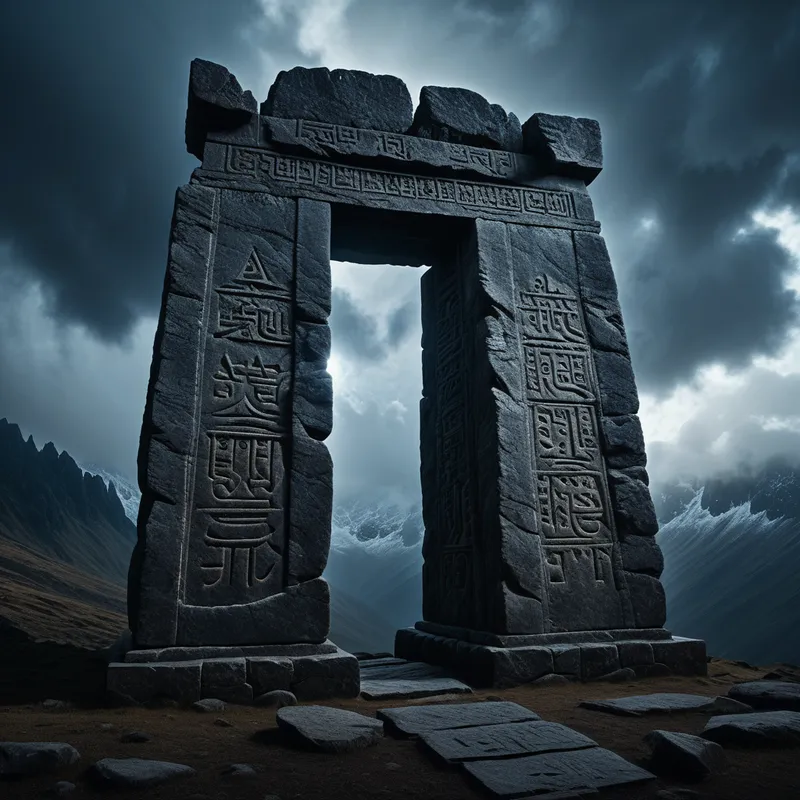
They came to a mountain, a bare and terrible pinnacle of rock whose peak was lost in a brooding darkness. Thunder that was not thunder rolled from its heart. Lightning that was not lightning—a fire that did not consume—danced upon its cliffs. The air grew thick and heavy, pressing upon the chest, smelling of ozone and ancient stone. The Voice spoke again, and the people trembled at the foot of the mountain, for the boundary between the human and the holy was drawn in fire. “Do not come up,” was the command. The mountain was alive with the terrible presence of the Tetragrammaton.
One man, Moshe, ascended into the cloud. For forty days and forty nights, he dwelt in the heart of the thunder. There, the Voice did not just speak; it inscribed. With a finger of pure will, it carved words into tablets of sapphire stone—not suggestions, not philosophies, but fundamental ordinances of existence. You shall have no other. You shall not murder. You shall not steal. These were the bones of a cosmos, the architecture for a society that was to be a kingdom of priests, a holy nation. It was a covenant, a marriage contract between the Divine and the delivered.
But below, in the camp of dust and doubt, the people grew restless. The silence of the mountain was more terrifying than the thunder. Where was their mediator? Had the consuming fire devoured him? Fear, that old companion from Egypt, whispered of abandonment. “Make us gods who will go before us,” they cried to Aharon. From their golden earrings, the spoils of their liberation, they forged a calf. They danced around it, proclaiming, “These are your gods, O Israel, who brought you up from the land of Egypt!” The covenant was not yet cooled from the divine engraving when it was shattered.
Moshe descended, the twin tablets heavy in his arms, their light a reflection of the world-as-it-should-be. He saw the revelry, the golden idol, the people returned to a bondage of their own making. In a fury of holy despair, he cast the tablets from his hands, and they shattered at the mountain’s base, the sacred letters scattering like lost stars. The story of the Law begins not with its giving, but with its breaking.

Cultural Origins & Context
This is not a single myth, but the foundational narrative thread of the Torah. It emerged from the crucible of tribal confederacy in the highlands of Canaan, a people defining themselves against the imperial, idolatrous cultures of Egypt and Mesopotamia. The story of the Law was their constitutional epic, recited at festivals, taught to children, and embedded in ritual. It was preserved and transmitted by priestly and prophetic lineages, most notably the Levitical caste, who were its custodians and interpreters.
Its societal function was multifaceted. It provided a concrete legal and ethical code—the 613 mitzvot—that regulated everything from diet to justice. More profoundly, it answered the existential question of identity: Who are we? The answer: We are the people who stood at Sinai. We are the people bound by this covenant. The Law (Halakha, “the way”) was not merely rules, but a path—a structured reality that separated the community from chaos and defined its sacred purpose in the world.
Symbolic Architecture
The Law, in its mythic presentation, is far more than a legal code. It is a profound symbol of structure itself—the necessary container for consciousness.
The mountain represents the axis mundi, the point of contact between the human and the transcendent. The tablets of stone symbolize the eternal, objective order—principles as hard and enduring as reality itself. The act of inscription signifies the imprinting of divine pattern onto the malleable substance of human life.
The Law is the psyche’s first attempt to name the unnameable, to give form to the formless terror and grace of the numinous.
The shattering of the tablets is the myth’s most critical psychological moment. It represents the inevitable failure of the ego to fully contain or live up to the perfect, archetypal pattern. The golden calf is the shadow of the Law—the regression to a simpler, instinctual, undifferentiated state (Egypt) when the burden of consciousness (the covenant) becomes too great. The idol is made from the very gold of their liberation, showing how our greatest gifts can be perverted into prisons when we fear the demands of growth.
The Dreamer’s Resonance
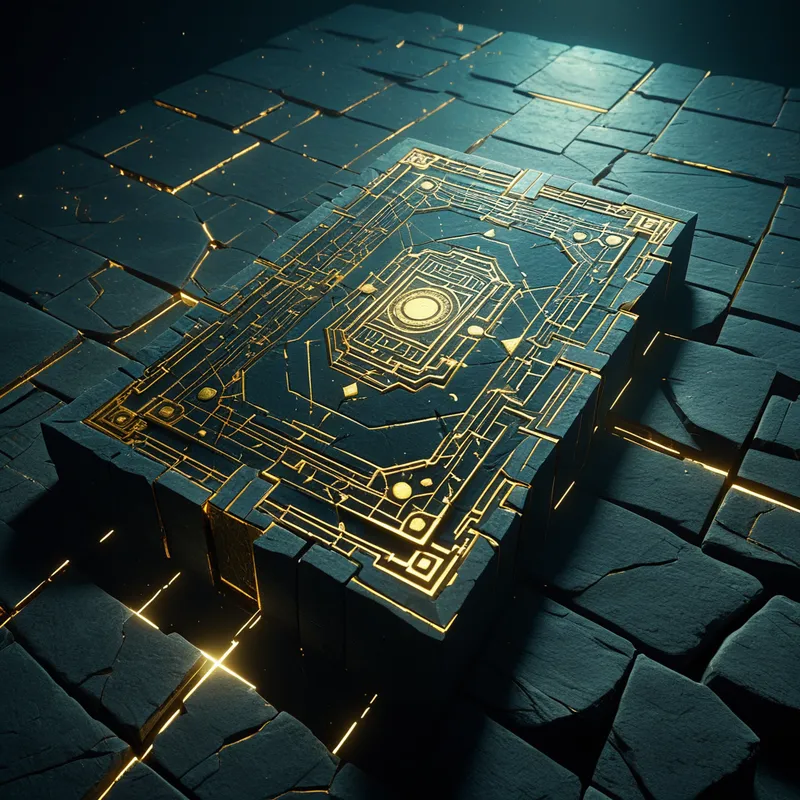
When this myth stirs in the modern soul, it often manifests in dreams of stark confrontation with rules, judgments, or immutable structures. One may dream of being on trial before a faceless tribunal, of trying to read a book with laws that keep changing, or of being crushed by the weight of a massive, perfect geometric stone.
Somatically, this can feel like a constriction in the chest or throat—the “weight of the law.” Psychologically, the dreamer is navigating a confrontation between their personal desires or instincts (the “golden calf” of immediate gratification, addiction, or old patterns) and an internalized, often tyrannical, moral authority (the “stone tablets” of the super-ego). The dream signals a crisis of integrity, where one’s actions have fallen out of alignment with one’s own deepest values or sense of purpose, resulting in a feeling of exile from one’s self.
Alchemical Translation
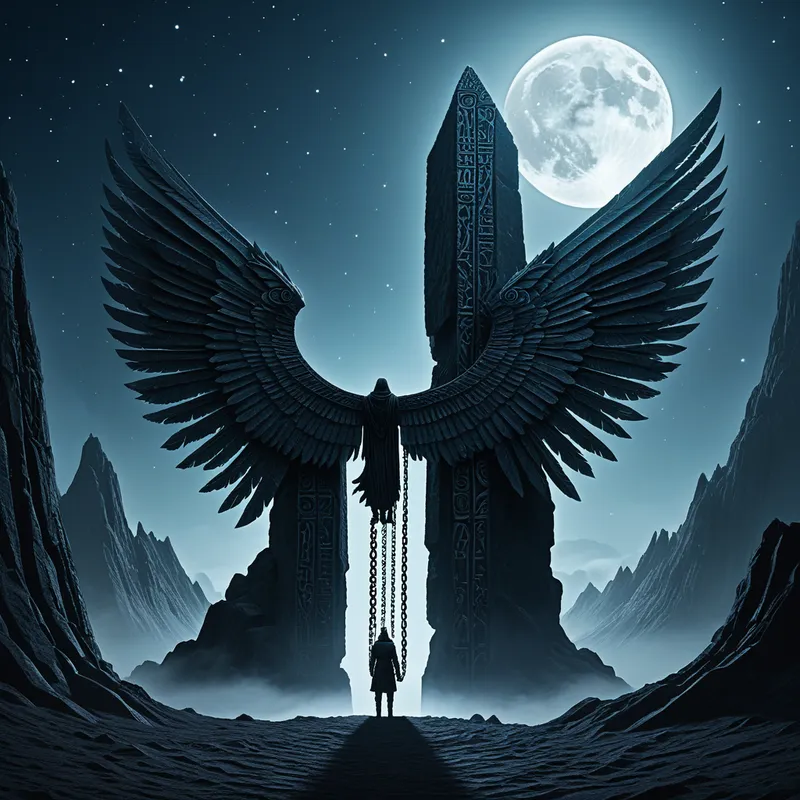
The alchemical journey modeled here is the transformation of the Law from an external, crushing imposition into an internal, liberating structure—the shift from literalism to wisdom.
The first stage is Reception (ascent to the mountain): The individual encounters a profound, ordering principle—a calling, a vocation, a moral truth that structures their chaotic inner world. The second is Shattering (the broken tablets): The conscious ego inevitably fails to perfectly embody this ideal. This failure is not the end, but the necessary humiliation that cracks open the rigid, literal interpretation. The third is the Remaking: Later in the myth, Moshe ascends again, and new tablets are carved, but this time, the writing is on both sides, and Moshe is involved in their preparation. This symbolizes the internalization of the law. It is no longer just divine fiat, but a co-creation. The Law becomes the Torah she’b’al peh, the oral law—the living, interpretive, human engagement with the eternal pattern.
Individuation is not the abolition of the Law, but the achievement of a soul spacious enough to hold both the tablet’s justice and the mercy that follows the shattering.
The ultimate alchemical product is not a perfect follower of rules, but a ruler—an individual who has metabolized the law into character. They do not just obey boundaries; they understand their sacred necessity and can, from a place of integrated authority, apply them with discernment and compassion. The journey from Sinai’s thunder to the prophet’s plea (“Forgive them!”) is the journey of the Law from stone to heart, from bondage to the paradoxical freedom found within a sacred structure.
Associated Symbols
Explore related symbols from the CaleaDream lexicon: